

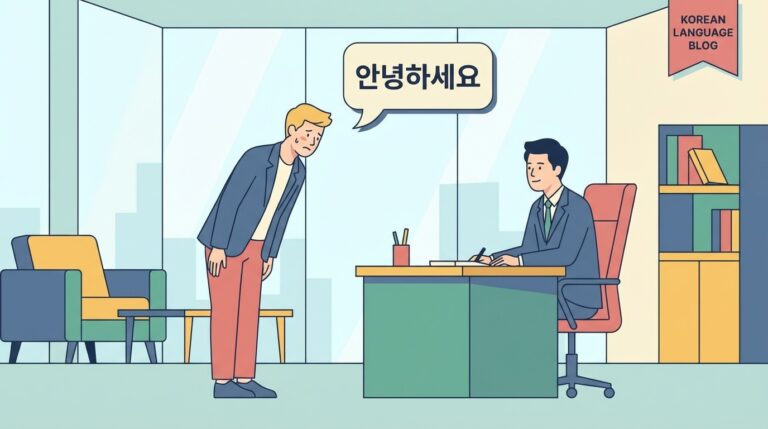
Phase 1: Empathy (Entering the Scene)
Hello! I’m the Senior Editor of Daily Hangul.
Picture this: You are standing in front of a sleek office building in Seoul, or maybe a trendy cafe in Hongdae where you’re applying for a part-time job. Your palms are sweating. You’ve practiced this scene a hundred times in your head. It’s the classic K-Drama underdog moment—the protagonist takes a deep breath, opens the door, and faces a row of intimidating interviewers.
In the drama subtitles, they just say, “Hello, I’m [Name].” But if you listen closely, the tone, the posture, and the specific words they use carry so much more weight than a simple greeting.
Introducing yourself in a Korean interview (면접 – myeonjeop) isn’t just about translating “Hi, my name is…” It’s about showing respect, cultural awareness, and that golden Korean trait: 열정 (Passion). If you don’t know the right nuances, you might sound too casual, like you’re greeting a buddy at a pub. But master these expressions, and you’ll instantly look like an “Insider” who truly understands Korean corporate or workplace culture.
This guide is built on real questions from my A2 beginner students who landed their first jobs in Korea. Let’s get you ready for that big moment!
Phase 2: Core Expressions Deep Dive
Let’s break down the three most crucial expressions you need to survive and ace a Korean interview.
1. 안녕하십니까, 지원자 OOO입니다.
- Pronunciation: [An-nyeong-ha-sim-ni-kka, ji-won-ja OOO-im-ni-da]
(Sound-alike: ‘sim’ sounds like a phone SIM card. ‘kka’ sounds like a sharp ‘kah’.)- Meaning: Hello, I am applicant OOO.
- K-Culture Moment: You’ve seen this in every Korean office drama like Misaeng. The new recruit stands up straight, hands perfectly at their sides, and booms this greeting across the room. It instantly changes the air from casual to professional.
- Editor’s Insight: Forget “안녕하세요 (Annyeonghaseyo)” for a moment. While it’s polite, “안녕하십니까 (Annyeonghasimnikka)” is the ultra-formal, professional version. Adding “지원자 (Applicant)” before your name shows you are serious and ready for business.
- Situation Spectrum:
- Friends (Casual): 🚫 (They will think you are acting like a robot)
- Coworkers (Semi-formal): ⚠️ (A bit too stiff for daily use)
- Interviewers/Bosses (Formal): ✅ (Absolutely perfect)
- 🤔 Think About It: Why does Korean have a completely different greeting for formal business settings? What does this tell us about the boundaries between personal and professional life in Korea?
2. 제 장점은 ~입니다.
- Pronunciation: [Je jang-jeom-eun ~im-ni-da]
(Sound-alike: ‘je’ sounds like the ‘je’ in jelly. ‘jang’ sounds like ‘Jang’ in Django.)- Meaning: My strength is ~.
- K-Culture Moment: During K-Pop survival shows, trainees always have a “PR time” where they point to the camera and confidently state their charms. This is your PR time!
- Editor’s Insight: At the A2 level, you don’t need complex sentences. Keep it simple and impactful. Fill in the blank with simple nouns like 책임감 (responsibility) or 친화력 (sociability).
- Situation Spectrum:
- Friends (Casual): ⚠️ (Sounds like you’re bragging weirdly)
- Coworkers (Semi-formal): ✅
- Interviewers/Bosses (Formal): ✅
- 🤔 Think About It: In some cultures, bragging about your strengths is discouraged. In a Korean interview, however, humbly but clearly stating your “jang-jeom” is expected. How do you talk about your strengths in your home country?
3. 열심히 하겠습니다!
- Pronunciation: [Yeol-sim-hi ha-get-seum-ni-da!]
(Sound-alike: ‘yeol’ rhymes with ‘Seoul’ but with a Y. ‘get’ sounds like getting something.)- Meaning: Literal: I will do it diligently. / Real nuance: I will give it my absolute all! I will work hard!
- K-Culture Moment: This is the ultimate Korean promise. Whether it’s a rookie idol debuting on stage, or a new employee joining the team, “열심히 하겠습니다” is the magic phrase that makes older Koreans nod in deep approval.
- Editor’s Insight: If you forget every other Korean word during your interview, remember this one. In Korea, showing a passionate attitude (열정) often matters just as much as your actual skills.
- Situation Spectrum:
- Friends (Casual): 🚫 (Too dramatic)
- Coworkers (Semi-formal): ✅
- Interviewers/Bosses (Formal): ✅
- 🤔 Think About It: Why is “I will work hard” valued so highly as a closing statement in Korea, perhaps even more than “I will do a good job”?
Phase 3: Textbook vs. Real Korean
| Situation | 📖 Textbook Korean | 🗣️ Real Korean | 💡 Why is it different? |
|---|---|---|---|
| Greeting the interviewer | 안녕하세요. 저는 미국에서 왔습니다. | 안녕하십니까, 지원자 OOO입니다. | “안녕하세요” is too soft for formal interviews. Using “안녕하십니까” establishes immediate professional respect. |
| Showing enthusiasm | 저는 이 일을 좋아합니다. (I like this job.) | 꼭 여기서 일하고 싶습니다! (I really want to work here!) | Koreans prefer strong, emotional expressions of dedication rather than just stating a preference. |
| Saying goodbye | 안녕히 계세요. (Goodbye.) | 감사합니다. 열심히 하겠습니다! (Thank you. I will work hard!) | Leaving with a promise of hard work leaves a much stronger, culturally appropriate lasting impression. |
Bottom Note: As an A2 learner, you might be tempted to use casual internet slang to sound “natural,” but in an interview, textbook-style formal Korean is actually the right choice! Stick to the ~입니다/습니다 (im-ni-da/seum-ni-da) endings.
Phase 4: Cultural Context — K-Culture Deep Dive
4-1. Non-Verbal Elements: The Art of the Bow (인사)
Language is only half the battle. When you say “안녕하십니까” (Annyeonghasimnikka), you must perform a 45-degree bow.
– Do not look the interviewer in the eye while bowing. Look at the floor, hold for a second, then come back up and make confident (but soft) eye contact.
– Keep your hands at your sides, or lightly clasped in front of you (the ‘belly-button bow’). This shows modesty and readiness.
4-2. K-Drama Connection: The Power of “Yeoljeong” (Passion)
Have you noticed a common trope in Korean workplace dramas like Start-Up or Itaewon Class? The protagonist rarely has the best resume. They are often up against someone with perfect specs from a top university. Yet, they win over the CEO with their fiery passion and grit.
While real-life Korea is very competitive and specs do matter, the cultural romanticization of 열정 (Passion) is very real. When you look an interviewer in the eye and say, “열심히 하겠습니다!” (I will work hard!), you are tapping into that exact K-Drama underdog energy. It shows you have the “Nunchi” (social awareness) to understand what Korean employers value: dedication to the team.
Phase 5: Real-Life Roleplay Scenario
Setting: Friday afternoon. You are applying for a part-time job at a bustling, trendy K-Pop merchandise store in Myeongdong. The store is filled with music, but the back office is quiet. You sit across from the store manager.
Characters:
– YOU: A foreigner who loves K-Pop and needs a part-time job to practice Korean.
– Manager Min-su (35): The store manager. Looks strict with his clipboard, but is secretly hoping to hire someone friendly.
(The dialogue begins)
Min-su: 어서 오세요. 면접 보러 오셨어요?
(Eoseo oseyo. Myeonjeop boreo osyeosseoyo?)
[Welcome. Are you here for the interview?]
YOU: 네, 안녕하십니까!
(Ne, annyeonghasimnikka!)
[Yes, hello!]
(🎭 Stage Direction: You bow politely at 45 degrees.)
Min-su: 자리에 앉으세요. 한국어를 잘하시네요. 자기소개 먼저 부탁드립니다.
(Jarie anjeuseyo. Hangugeoreul jalhasineyo. Jagisogae neonjeo butakdeurimnida.)
[Have a seat. Your Korean is good. Please introduce yourself first.]
YOU: 안녕하십니까, 지원자 OOO입니다.
(Annyeonghasimnikka, jiwonja OOO-imnida.)
[Hello, I am applicant OOO.]
Min-su: 네, 반갑습니다. 본인의 장점이 뭐라고 생각해요?
(Ne, bangapseumnida. Boninui jangjeomi mworago saenggakaeyo?)
[Yes, nice to meet you. What do you think your strength is?]
YOU: 제 장점은 친화력입니다. 사람들과 이야기하는 것을 좋아합니다.
(Je jangjeomeun chinhwaryeogimnida. Saramdeulgwa iyagihaneun geoseul joahamnida.)
[My strength is sociability. I like talking with people.]
Min-su: 오, 우리 매장에 꼭 필요한 성격이네요. 그런데 주말에는 매장이 아주 바쁘고 힘들어요. 괜찮겠어요?
(O, uri maejange kkok piryohan seonggyeogineyo. Geureonde jumareneun maejangi aju bappeugo himdeureoyo. Gwaenchan-gesseoyo?)
[Oh, that’s exactly the personality our store needs. But the store is very busy and tough on weekends. Will you be okay?]
🔀 Your Turn! How should you answer?
– A) “아니요, 너무 바쁜 건 싫어요.” (No, I hate being too busy.)
– B) “네! 열심히 하겠습니다!” (Yes! I will do my best!)
– C) “대박! 진짜요?” (Awesome! Really?)✅ Best Choice: B — Reason: This is the perfect moment to deploy the ultimate magic phrase. It immediately reassures the manager of your dedication.
⚠️ Choice C Analysis: “대박 (Daebak)” is a great reaction for friends, but highly inappropriate for a job interview!
Min-su: (Smiling) 좋습니다. 다음 주부터 같이 일해봅시다!
(Joseumnida. Daeum jubuteo gachi ilhaebopsida!)
[Good. Let’s work together starting next week!]
YOU: 감사합니다! 열심히 하겠습니다!
(Gamsahamnida! Yeolsimhi hagetseumnida!)
[Thank you! I will work hard!]
🎬 K-Culture Bonus Roleplay: The Fan-Sign Interview
Did you know talking to your favorite K-Pop idol at a fan-sign is basically a mini-interview? You only have 30 seconds!
Idol: 안녕하세요! 이름이 뭐예요?
[Hello! What’s your name?]
YOU: 안녕하세요! 저는 [Name]이에요. (Casual polite is OK here!)
[Hello! I’m Name.]
Idol: 와, 한국어 진짜 잘하시네요!
[Wow, you speak Korean really well!]
YOU: 감사합니다! 항상 열심히 응원하겠습니다!
[Thank you! I will always cheer for you diligently/passionately!]
Phase 6: 10-Second Shadowing Drill
Practice these lines out loud. Pay attention to the pauses (/) and the emotional tags!
- 😤 Confident & Polite: 안녕하십니까, / 지원자 / OOO입니다.
(an-nyeong-ha-sim-ni-kka, / ji-won-ja / OOO-im-ni-da.) -
😊 Bright & Proud: 제 장점은 / 책임감입니다.
(je jang-jeom-eun / chaeg-im-gam-im-ni-da.) -
🔥 Passionate & Energetic: 감사합니다! / 열~~심히 / 하겠습니다!
(gam-sa-ham-ni-da! / yeol~~sim-hi / ha-get-seum-ni-da!)
Phase 7: K-Culture Mini Dictionary
| Korean | Romanization | English | Context |
|---|---|---|---|
| 면접 | myeonjeop | Interview | Can be for a corporate job, a part-time job (알바), or university admission. |
| 지원자 | jiwonja | Applicant | A highly professional word to refer to yourself during the hiring process. |
| 열정 | yeoljeong | Passion | A core virtue in Korean society. Trying your best is often praised more than natural talent. |
| 눈치 | nunchi | Social awareness | The subtle art of reading the room. Knowing when to bow and when to say “I will work hard” is good nunchi! |
Phase 8: Traveler’s Survival Kit (Interview Navigation)
Before you can ace the interview, you have to find the location! Addresses in Korea can be tricky, and map apps might lead you to a confusing alleyway. Here are survival expressions for getting to your interview on time.
🆘 Survival Phrase #1: Asking for Directions
– 🇰🇷 “실례지만, 여기 어떻게 가요?” (sillyejiman, yeogi eotteoke gayo?)
– 🗣️ Pronunciation Guide: [shil-lye-ji-man, yeo-gi eo-tteo-ke ga-yo?]
– 📍 Where to use: On the street, asking a passerby or a convenience store worker.
– 💡 Pro Tip: Show them the map on your phone while saying this. Koreans are usually very helpful and might even point you exactly to the building entrance.🆘 Survival Phrase #2: Confirming the Location
– 🇰🇷 “여기가 [가게 이름/회사] 맞나요?” (yeogiga [Store/Company name] mannayo?)
– 🗣️ Pronunciation Guide: [yeo-gi-ga ~ man-na-yo?]
– 📍 Where to use: When you arrive at a building but aren’t sure if it’s the right door.📌 Editor’s Travel Note
– Navigation Apps: Google Maps does NOT work well for walking directions in Korea. You MUST download Naver Map or KakaoMap.
– Time Etiquette: For an interview in Korea, arriving exactly on time is considered late. Aim to arrive 10-15 minutes early to show your “열정” (passion)!
Phase 9: Critical Thinking Corner — “Going Deeper”
Language & Power: The Hierarchy of ‘I’
In English, “I” is just “I,” whether you are talking to a child or the President. But in Korean, the word you choose for yourself changes your status. By using “저 (jeo)” instead of “나 (na)” during an interview, you are intentionally lowering yourself to elevate the interviewer. This isn’t about lacking self-esteem; it’s a linguistic reflection of Confucian values where respect for seniority and hierarchy maintains social harmony. Using formal language (높임말) in a corporate setting is the ultimate display of professional respect.
💬 Your Turn: Does your native language have ways to show respect or lower your own status when speaking to an interviewer? Share your cultural perspective in the comments!
Phase 10: FAQ & Common Mistakes
Q: Can I use “~요 (yo)” endings instead of “~습니다 (seumnida)” in an interview?
A: Maybe, but be careful. If it’s a casual part-time job (like a cafe), politely using “~요” is usually fine. However, for a corporate office job or a strict boss, stick entirely to “~습니다/까” to be safe.
Q: Should I shake hands with the interviewer?
A: Let them initiate. In Korea, the standard greeting is a bow. If the senior person (the interviewer) offers a hand, accept it with your right hand, while lightly supporting your right forearm with your left hand.
❌ Common Mistake #1: Using “나 (na)” or “내 (nae)” to refer to yourself.
✅ Do this instead: Always use “저 (jeo)” or “제 (je)”. Example: “내 이름은…” (X) -> “제 이름은…” (O).❌ Common Mistake #2: Staring directly into the interviewer’s eyes without breaking contact.
✅ Do this instead: In Korean culture, intense, unbroken eye contact with a superior can seem aggressive or defiant. Look at their eyes/nose area softly, and occasionally glance at their chin or tie to soften the gaze.
Phase 11: Summary & Action Items
One-Liner Summary: A successful Korean interview requires the formal “안녕하십니까”, a clear statement of your strengths, and the passionate promise of “열심히 하겠습니다!”
Action Mission 3-Step:
– 🥉 Bronze (Solo): Stand in front of a mirror, bow 45 degrees, and say “안녕하십니까, 지원자 [Your Name]입니다!” 3 times.
– 🥈 Silver (Online): Go to a Korean learning forum or the comment section below and write your Korean strength: “제 장점은 [Your Strength]입니다.”
– 🥇 Gold (Real World): The next time you visit a Korean restaurant or cafe, observe how the staff greet customers and listen for formal endings!
K-Culture Mission:
Watch episode 1 of any Korean workplace drama (like Misaeng or Start-Up). Count how many times people bow and say “안녕하십니까” or “열심히 하겠습니다”!
Did you practice your self-introduction today? Drop your Korean introduction in the comments below! 👇
Phase 12: Quiz — Interactive Challenge
1. Situational Judgment: You are concluding your interview for a marketing position in Seoul. The interviewer says, “수고하셨습니다. (Good job/Thank you for your effort).” What is your best response?
– A) 안녕! (Bye!)
– B) 감사합니다. 열심히 하겠습니다! (Thank you. I will work hard!)
– C) 수고하세요. (Keep working hard – usually said to workers when leaving a store)
2. Fill in the Blank:
“Hello, I am applicant Alex.”
“_________________, 지원자 알렉스입니다.”
3. True or False — K-Culture Edition:
In a Korean interview, it is considered confident and highly polite to maintain intense, unbroken eye contact with the interviewer from start to finish. (True / False)
🚨 Click here for the Answers!
1. B (C is rude to say to a superior in an office setting! B is the perfect, passionate closer.)
2. 안녕하십니까 (Annyeonghasimnikka)
3. False (While eye contact is important, unbroken, intense staring can be seen as aggressive or lacking ‘nunchi’. A soft, respectful gaze is better.)
Frequently Asked Questions (FAQ)
Q: What does "안녕하십니까, 지원자 OOO입니다." mean in Korean and how do you pronounce it?
A: In Korean, "안녕하십니까, 지원자 OOO입니다." is pronounced [An-nyeong-ha-sim-ni-kka, ji-won-ja OOO-im-ni-da] and means: Hello, I am applicant OOO.
Q: What does "제 장점은 ~입니다." mean in Korean and how do you pronounce it?
A: In Korean, "제 장점은 ~입니다." is pronounced [Je jang-jeom-eun ~im-ni-da] and means: My strength is ~.
Q: What does "열심히 하겠습니다!" mean in Korean and how do you pronounce it?
A: In Korean, "열심히 하겠습니다!" is pronounced [Yeol-sim-hi ha-get-seum-ni-da!] and means: Literal: I will do it diligently. / Real nuance: I will give it my absolute all! I will work hard!






