

Phase 1: Empathy & Immersion
Hello! I am your Senior Editor and friendly local guide at Daily Hangul.
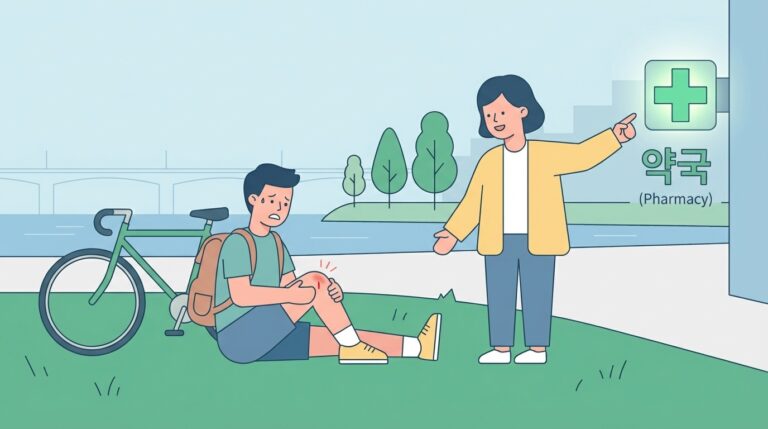
Picture this: It’s a beautiful spring day in Seoul. You’ve rented a green ‘Ttareungi’ (Seoul’s public bike) and you’re cycling along the sparkling Han River. The breeze is perfect, your favorite K-Pop playlist is in your ears, and then… BAM! You hit a bump and take a tumble.
Your knee is scraped. A kind Korean passerby rushes over, looking concerned, and asks, “괜찮아요?” (Are you okay?)
You want to say, “I’m hurt!” or “It hurts!” but your mind goes blank. You might remember the textbook word for ‘hospital’, but how do you actually explain that you are injured without causing a massive panic?
If you don’t know the right words, you might end up waving your hands and saying “I’m fine” while wincing in pain. But don’t worry! As a veteran tutor who has seen students freeze up in emergencies, I’ve got your back. Today, we’re going to learn exactly how to handle minor (and major) bumps and bruises in Korea like a true insider.
Note: This guide is based on real experiences of our beginner (A1) students who survived their own clumsy moments in Korea!
Phase 2: Core Expressions Deep Dive
Let’s look at the 3 absolute must-know phrases when you get hurt.
1. 다쳤어요 (I got hurt / I am injured)
- Pronunciation: [da-chyeot-seo-yo] 🗣️ ‘da’ sounds like the ‘ta’ in taco, ‘chyeot’ sounds like ‘chut’, ‘seo’ sounds like ‘so’ with a sharp hiss, ‘yo’ is like a yo-yo.
- Meaning: Literal = I received an injury. / Real nuance = I got hurt (physical wound).
- K-Culture Moment: In K-Dramas, when the heroine trips and hides her bleeding knee, the male lead grabs her wrist, sees the scrape, and angrily but affectionately asks, “너 다쳤어?!” (You got hurt?!).
- Editor’s Insight: This is the most direct way to state a physical injury. Use this when you have a visible cut, scrape, or sprain.
- Situation Spectrum:
- Casual (Friends): ✅ (Drop the ‘yo’ -> 다쳤어)
- Semi-formal (Coworkers): ✅
- Formal (Elders/Strangers): ✅
- 🤔 Think About It: Why do Koreans often sound slightly angry when someone else gets hurt? It’s a cultural expression of worry and care. Does your culture express worry through scolding too?
2. 아파요 (It hurts / I am sick)
- Pronunciation: [a-pa-yo] 🗣️ ‘a’ like in apple, ‘pa’ like ‘pa’ in papa, ‘yo’ like yo-yo.
- Meaning: Literal = It is painful. / Real nuance = Ouch, it hurts! or I feel sick.
- K-Culture Moment: You’ll hear this in K-Pop lyrics when singing about a broken heart (마음이 아파요 – My heart hurts). But physically, if a doctor presses your bruised arm, you say “아파요!”
- Editor’s Insight: This is a versatile word. It can mean a physical pain (ouch!) or an illness (I have a cold). If you just stubbed your toe, shout “아파!”
- Situation Spectrum:
- Casual (Friends): ✅ (아파!)
- Semi-formal (Coworkers): ✅
- Formal (Elders/Strangers): ✅
- 🤔 Think About It: In English, “I am hurt” and “I am sick” are very different. In Korean, “아파요” covers both pain and illness. How does this simplify the way Koreans talk about not feeling well?
3. 도와주세요 (Please help me)
- Pronunciation: [do-wa-ju-se-yo] 🗣️ ‘do-wa’ sounds like ‘dough-wah’, ‘ju-se-yo’ sounds like ‘joo-say-yo’.
- Meaning: Literal = Please give me help. / Real nuance = Help me, please.
- K-Culture Moment: In a thriller K-Drama, the main character running from zombies will scream this. But in real life, you can say this politely to a convenience store clerk if you need help finding bandages.
- Editor’s Insight: This phrase is a lifesaver. Even if you don’t know any other Korean words, say this while pointing at your injury. Koreans are incredibly helpful to foreigners in distress.
- Situation Spectrum:
- Casual (Friends): ✅ (도와줘)
- Semi-formal (Coworkers): ✅
- Formal (Elders/Strangers): ✅
- 🤔 Think About It: The verb ends in ‘주세요’ (please give). In Korean, doing a favor is viewed as ‘giving’ a gift.
Phase 3: Textbook vs. Real Korean
| Situation | 📖 Textbook Korean | 🗣️ Real Korean | 💡 Why is it different? |
|---|---|---|---|
| Expressing sudden pain | 통증이 있습니다 (I have pain) | 앗! / 아야! / 아파요! | Textbooks teach clinical terms, but real life requires instant emotional reactions. |
| Asking for an ambulance | 구급차를 불러 주십시오 | 119(일일구) 불러주세요! | “119” (il-il-gu) is faster and universally understood as the emergency number. |
| Explaining a cut | 출혈이 있습니다 (There is bleeding) | 피 나요 (Blood is coming out) | “피 나요” is short, punchy, and instantly alerts people to the blood. |
Bottom Note: As an A1 beginner, don’t worry about complex medical terms. Pointing to your leg and saying “아파요” (It hurts) gets the job done perfectly!
Phase 4: Cultural Context — K-Culture Deep Dive
4-1. Non-Verbal Cues: The Art of “Nunchi” in Pain
When you get hurt in Korea, you don’t always have to yell. Koreans have high 눈치 (Nunchi)—the ability to read the room. If you are limping or holding your arm, people will notice. A polite, pained expression and pointing to your injury while saying “아파요” is enough. Do not aggressively grab someone for help unless it’s a severe emergency.
4-2. K-Culture Connection: K-Drama vs. Real Life
The K-Drama Piggyback Illusion:
We’ve all seen it. The female lead trips, sprains her ankle, and the handsome CEO insists on giving her a piggyback ride (어바부바 – eobabuba) all the way home.
Reality Check: If you sprain your ankle in Myeongdong, a handsome CEO will not appear. Instead, a very kind, fast-walking Korean Auntie (Ajumma) might rush over, click her tongue in sympathy (“쯧쯧 아이고!”), hand you a wet wipe, and aggressively point you to the nearest 약국 (Yakguk – Pharmacy).
Korean pharmacies are an essential part of travel culture. Unlike in some countries where you buy basic meds at a supermarket, in Korea, you go to the glowing green “약” (Yak) sign. The pharmacist (약사님) will give you the exact spray, patch, or pill you need for a few dollars.
Phase 5: Interactive Roleplay Scenario
Setting: It’s 3 PM on a sunny Saturday at Han River Park. You are riding a Seoul Bike. Suddenly, a small dog runs onto the path. You brake hard, fall off, and scrape your knee badly. It’s bleeding.
Characters:
– YOU (The Reader): A traveler who knows basic Korean.
– Ji-min (28): A friendly Korean local who was jogging nearby.
Dialogue:
Ji-min: 헉! 괜찮아요?! (Heok! Gwaenchanayo?!)
[Gasp! Are you okay?!]
(🎭 Stage Direction: Ji-min rushes over, looking worried, and crouches next to you)
YOU: 아… 네, 조금…
(A… ne, jogeum…)
[Ah… yes, a little…]
Ji-min: 피 나요! 무릎 다쳤어요.
(Pi nayo! Mureup dachyeosseoyo.)
[You’re bleeding! You hurt your knee.]
🔀 Your Turn! How do you respond?
– A) “안 아파요. 안녕히 계세요.” (I’m not hurt. Goodbye.)
– B) “네, 다쳤어요. 도와주세요.”
– C) “구급차! 병원!”✅ Best Choice: B — “Yes, I got hurt. Please help me.” It’s honest, polite, and uses the exact vocabulary you need for a minor injury.
⚠️ Choice A Analysis: You are bleeding! Don’t use Korean politeness to deny you need help.
⚠️ Choice C Analysis: A scraped knee doesn’t require an ambulance (구급차). It might cause unnecessary panic!
Ji-min: 저기 약국 있어요. 같이 가요.
(Jeogi yakguk isseoyo. Gachi gayo.)
[There is a pharmacy over there. Let’s go together.]
(🎭 Stage Direction: Ji-min helps you stand up)
YOU: 감사합니다.
(Gamsahamnida.)
[Thank you.]
🎬 Bonus Scenario: The Pharmacy (약국)
(You walk into the pharmacy with the green cross sign)
Pharmacist: 어서 오세요. 어디가 아파요?
(Eoseo oseyo. Eodiga apayo?)
[Welcome. Where does it hurt?]
YOU: 무릎 다쳤어요.
(Mureup dachyeosseoyo.)
[I hurt my knee.]
Pharmacist: 소독약하고 밴드 드릴게요.
(Sodogyakhago baendeudeurilgeyo.)
[I’ll give you antiseptic and bandages.]
Phase 6: 10-Second Shadowing Drill
Let’s practice your emergency pronunciation. Read this out loud in front of a mirror!
😢 저 / 무릎을 / 다쳤어요...
(jeo / mureup-eul / da-chyeot-seo-yo...)
[Emotion: Sad and in a little pain, pointing to your knee]
🥺 너무 / 아파요. / 도와주세요.
(neo-mu / a-pa-yo. / do-wa-ju-se-yo.)
[Emotion: Pleading, asking for a kind stranger’s help]
Phase 7: K-Culture Mini Dictionary
| Korean | Romanization | English | Context |
|---|---|---|---|
| 약국 | yak-guk | Pharmacy | Look for the green cross and the letter “약”. They are everywhere! |
| 119 | il-il-gu | Emergency Number | For fire and ambulance. It’s free of charge in Korea. |
| 파스 | pa-seu | Pain relief patch | Koreans love these medicated patches for muscle aches. Magic! |
| 눈치 | nun-chi | Reading the room | Sensing someone is hurt without them having to scream. |
| 반창고 / 밴드 | ban-chang-go / baen-deu | Band-aid | What you ask for when you have a minor cut. |
Phase 8: Traveler Survival Kit 🆘
Getting hurt on vacation is scary, but Korea has one of the best and most accessible healthcare systems in the world.
🆘 Survival Phrases for the Injured Traveler
– 🇰🇷 “여기 아파요.” (yeo-gi a-pa-yo.) -> It hurts here. (Point to the body part!)
– 🇰🇷 “가장 가까운 약국이 어디예요?” (ga-jang ga-kka-un yak-gug-i eo-di-ye-yo?) -> Where is the closest pharmacy?
– 🇰🇷 “살려주세요!” (sal-lyeo-ju-se-yo!) -> Save me! (ONLY use this in an extreme, life-threatening emergency or danger).📌 Editor’s Travel Note
– 119 vs 112: Call 119 for medical emergencies/fire. Call 112 for police. Operators often have translation services available!
– Pharmacy Hours: Most close around 7-8 PM, but search “심야 약국” (Late-night pharmacy) on Naver Maps if you need one at night.
– Convenience Stores: GS25, CU, and 7-Eleven sell basic first-aid items (bandages, headache pills, stomach medicine) 24/7!
Phase 9: Critical Thinking — “One Step Deeper”
🧠 Think Deeper: Media vs. Reality – The “Jeong” of the Streets
In K-Dramas, injuries are plot devices for romance. But in reality, observing how Koreans react to a stranger’s injury reveals the deep-rooted cultural concept of 정 (Jeong – collective affection and social bonding). Korea is a fast-paced society where people might bump into you on the subway without apologizing. However, the moment you actually fall and bleed, that invisible wall shatters. Strangers will suddenly act like your parents—scolding you to be careful while simultaneously wiping the dirt off your clothes and buying you a band-aid. The “cold city” facade drops, and community care takes over.
💬 Your Turn: Have you ever been helped by a stranger in a foreign country? Does your culture have a concept similar to “Jeong” when it comes to helping someone who is hurt? Let us know in the comments!
Phase 10: FAQ & Avoiding Mistakes
Q: Can I use “아파요” to say my feelings are hurt?
Yes! You can say “마음이 아파요” (My heart hurts), but it sounds very poetic or dramatic, like a K-Pop ballad. Don’t use it if your boss criticizes your work!
Q: Is it rude to ask a stranger for help?
No. In an emergency, Koreans are very willing to help. Just start with “죄송하지만…” (I’m sorry, but…) or directly say “도와주세요!”
❌ Common Mistake #1: Confusing 병원 (Hospital) and 약국 (Pharmacy).
✅ Do this instead: For a scraped knee, headache, or mild stomachache, go to a 약국. Hospitals (병원) are for more serious injuries. Pharmacists in Korea are highly trained to consult and provide over-the-counter medication.❌ Common Mistake #2: Saying “다쳤어요” when you have a cold.
✅ Do this instead: “다쳤어요” (I got injured) is for physical trauma (cuts, broken bones). If you have a fever or cold, just say “아파요” (I am sick) or “감기 걸렸어요” (I caught a cold).
Phase 11: Summary & Action Items
🌟 One-Liner Summary: If you take a tumble in Korea, just point and say “다쳤어요” (I’m hurt) or “아파요” (It hurts), and the nearest pharmacy will be your best friend!
🎯 Your Action Missions:
– 🥉 Bronze (Solo): Look in the mirror, point to your arm, and say “아파요!” with a pained expression 3 times.
– 🥈 Silver (Online): Go to Google Street View, drop yourself in the middle of Seoul (like Gangnam or Hongdae), and look around until you spot a green 약 (Pharmacy) sign.
– 🥇 Gold (Real Life): Next time you watch a K-Drama, listen closely when someone gets into an accident. Can you catch them saying “다쳤어?” or “도와주세요”?
🗣️ Let’s Chat!
Have you ever had a minor injury while traveling? How did you communicate? Share your survival stories below!
Phase 12: Quiz — Interactive Challenge
Test your survival skills!
1. Fill in the blank:
You accidentally cut your finger with paper. You show it to your friend and say, “____ 나요!”
A) 물 (Water)
B) 눈 (Snow)
C) 피 (Blood)
2. True or False – K-Culture Edition:
If you have a minor headache at 2 AM, your only option is to go to the hospital emergency room. (T/F)
3. Situational Judgment:
You sprained your ankle on the stairs and can’t walk. A Korean person stops and asks “괜찮아요?”. What is the MOST effective A1 response?
A) 네, 괜찮아요. (Yes, I’m okay.)
B) 다쳤어요. 도와주세요. (I’m hurt. Please help me.)
C) 병원이 어디에 설립되었습니까? (Where was the hospital established? – very formal)
👀 Click here for Answers!
1. C) 피 (Blood). “피 나요” means “I’m bleeding!”
2. False. You can go to a 24-hour convenience store (편의점) to buy basic headache medicine like Tylenol!
3. B. Always be direct and ask for help when you need it. “A” will make them leave, and “C” sounds like a robot reading a history book!
Frequently Asked Questions (FAQ)
Q: What does "다쳤어요 (I got hurt / I am injured)" mean in Korean and how do you pronounce it?
A: In Korean, "다쳤어요 (I got hurt / I am injured)" is pronounced [da-chyeot-seo-yo] and means: Literal = I received an injury. / Real nuance = I got hurt (physical wound).
Q: What does "아파요 (It hurts / I am sick)" mean in Korean and how do you pronounce it?
A: In Korean, "아파요 (It hurts / I am sick)" is pronounced [a-pa-yo] and means: Literal = It is painful. / Real nuance = Ouch, it hurts! or I feel sick.
Q: What does "도와주세요 (Please help me)" mean in Korean and how do you pronounce it?
A: In Korean, "도와주세요 (Please help me)" is pronounced [do-wa-ju-se-yo] and means: Literal = Please give me help. / Real nuance = Help me, please.







