

Phase 1: Empathy (The Immersive Open)
Hello there! I’m the Senior Editor of Daily Hangul, your veteran tutor and local cultural navigator.
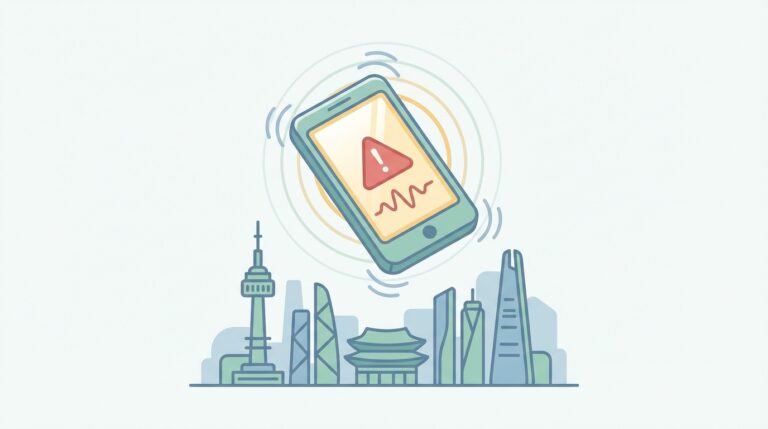
Picture this: You are sitting in a trendy cafe in Yeonnam-dong, sipping an iced Americano. The vibe is perfect. Suddenly, an ear-piercing siren blares—not just from your phone, but from the phones of every single person in the cafe simultaneously. BEEEEEP! BEEEEEP! It’s the infamous 재난문자 (Jaenan Munja – Emergency Alert Text). Before you can even reach for your phone to translate the Korean text, the pendant lamps above you start to sway slightly.
In K-Dramas like Concrete Utopia or D-Day, this is the moment people start screaming. But in reality? You look around, and Koreans are remarkably calm. They check their phones, quietly pack their laptops, and look toward the cafe staff for cues.
As a C1-level learner living in or visiting Korea, navigating a natural disaster isn’t just about knowing the word for “earthquake” (지진 – jijin). It’s about understanding the high-level formal instructions broadcasted over the speakers, reading the room (yes, Nunchi applies to emergencies, too!), and knowing how to communicate efficiently under pressure.
Today, we are moving beyond textbook vocabulary. We are diving into the exact phrases you will hear, read, and need to say if the ground ever shakes in Korea. Let’s make sure you’re both linguistically and culturally prepared.
Phase 2: Core Expressions Deep Dive
1. 침착하게 대피해 주시기 바랍니다.
- Pronunciation: [Chimchakage daepihae jusigi baramnida.] / Chim-cha-ka-ge sounds like a rhythmic drum beat—steady and calm.
- Meaning: (Literal) We desire that you evacuate calmly. / (Real nuance) Please evacuate calmly and in an orderly fashion.
- K-Culture Moment: This is the exact phrase you will hear echoing through subway stations, department stores, or apartment PA systems. It’s the voice of authority in Korea—authoritative yet extremely polite.
- Editor’s Insight: The use of
~시기 바랍니다(We hope/request that you…) is a hallmark of C1/C2 Korean. It softens a direct command into a polite request, preventing panic while maintaining social order.- Situation Spectrum:
[🚫 Casual] ———— [⚠️ Semi-formal] ———— [✅ Public/Broadcast]
- Casual with friends: 🚫 (Sounds like a robot)
- Public announcements: ✅
- 🤔 Think About It: Why does Korean authority use such highly elevated honorifics (
~시기 바랍니다) during life-or-death emergencies instead of sharp, direct commands? Does your native language prioritize politeness or directness in a crisis?2. 머리를 보호하고 탁자 밑으로 들어가세요.
- Pronunciation: [Meorireul bohohago takja miteuro deureogaseyo.]
- Meaning: Protect your head and go under the table.
- K-Culture Moment: Every Korean student has practiced this during nationwide civil defense drills (민방위 훈련). When the siren goes off, millions of students slide under their desks seamlessly.
- Editor’s Insight: Notice the imperative
~(으)세요. It’s direct enough for quick action but still maintains interpersonal respect. In an office setting, your Korean boss will likely use this exact phrasing to direct the team.- Situation Spectrum:
[🚫 Inappropriate] ———— [✅ Universal Action Command] ———— [✅ Highly Recommended]- 🤔 Think About It: The combination of two actions using
~고(and) is crucial in survival situations. Can you think of other emergency combinations? (e.g., 잠그고 나가세요 – Lock it and leave).3. 여진이 발생할 수 있으니 주의하세요.
- Pronunciation: [Yeojini balsaenghal su isseuni juuuihaseyo.]
- Meaning: Aftershocks may occur, so please be careful.
- K-Culture Moment: After the initial shock of an earthquake (like the 2016 Gyeongju or 2017 Pohang earthquakes), the news anchors will repeat this phrase endlessly. It’s also the standard closing line in emergency text alerts.
- Editor’s Insight:
~ㄹ/을 수 있으니(Since it is possible that…) is an essential advanced grammar point for expressing cause and potential consequence. It shows foresight and caution.- Situation Spectrum:
[🚫 Absolute Prohibition] ———— [✅ News/Alerts] ———— [✅ Giving Advice]
Phase 3: Textbook vs. Real Survival Korean
When the ground shakes, the PA system sounds different from the people next to you. Let’s compare.
| Situation | 📖 Textbook / Broadcast Korean | 🗣️ Real Survival Korean | 💡 Why the difference? |
|---|---|---|---|
| Realizing it’s an earthquake | 지진이 발생했습니다. (An earthquake has occurred.) | 헐, 방금 지진 났어? 흔들렸지? (Whoa, was that an earthquake? It shook, right?) | Casual speech relies heavily on sensory verbs (흔들리다) and seeking immediate validation from others. |
| Telling people to leave | 안전한 곳으로 대피하십시오. (Evacuate to a safe place.) | 야, 일단 밖으로 나가자! (Hey, let’s just get outside for now!) | 일단 (for now/firstly) is the ultimate Korean crisis word. Action first, details later. |
| Dealing with gas/fire | 가스 밸브를 차단해 주세요. (Please shut off the gas valve.) | 가스 불 껐어?! (Did you turn off the gas fire?!) | In everyday life, Koreans refer to the physical fire (불) rather than the mechanical valve (밸브). |
Bottom Note: As a C1 learner, you must comprehend the formal broadcast but speak the “Real Survival Korean” to coordinate with your friends or coworkers instantly.
Phase 4: Cultural Context — K-Culture Deep Dive
4-1. Non-Verbal Communication: Emergency Nunchi (눈치)
If an earthquake hits, don’t just listen to the words; read the room. Koreans possess a highly developed collective sense of Nunchi. If the emergency text goes off but Koreans around you are simply swiping it away and continuing to eat their noodles, it means the epicenter is far away and the perceived threat is low. However, if the restaurant owner suddenly stops, looks at the ceiling, and opens the front door wide—that is your non-verbal cue to act. Always follow the local flow.
4-2. The K-Food Connection: The BBQ Grill Hazard
Let’s connect safety to something you love: Korean food. You are at a K-BBQ restaurant (고깃집). There is a literal open fire on your table, often connected to a gas line or burning charcoal. In the event of an earthquake, the greatest immediate danger isn’t just falling debris; it’s fire. The phrase “불판 조심해!” (Watch out for the grill!) or “가스부터 잠가요!” (Turn off the gas first!) is the most authentic, culturally specific emergency response you can have in Korea. Understanding the environment (K-Food culture) dictates your survival vocabulary.
Phase 5: Real-Life Roleplay Scenario
Setting: Friday night, 7:30 PM. A bustling Samgyeopsal (pork belly) restaurant near Gangnam Station. The room is filled with smoke, chatter, and clinking Soju glasses. You are out with your Korean team.
Characters:
– YOU: An expat professional, trying to bond with the team.
– Minsu (32): Your friendly, slightly loud Korean coworker who is currently in charge of grilling the meat with tongs and scissors.
(The table suddenly vibrates. Your Soju glass rattles. Half a second later, five phones at your table scream with the Emergency Alert siren.)
Minsu: 어? 뭐야? 방금 땅 흔들리지 않았어요?
(eo? mwoya? banggeum ttang heundeulliji anasseoyo?)
(Huh? What is that? Didn’t the ground just shake?)
YOU: 네, 제 의자도 흔들렸어요. 지진인가 봐요.
(ne, je uijado heundeullyeosseoyo. jijininga bwayo.)
(Yes, my chair shook too. I guess it’s an earthquake.)
Minsu: (Looking around nervously, holding the tongs)
헐, 재난문자 떴네요. [포항 지역 규모 4.5 지진 발생. 서울 지역 여진 주의]
(heol, jaenanmunja tteonneyo. Pohang jiyeok gyumo 4.5 jijin balsaeng. Seoul jiyeok yeojin juuui)
(Whoa, the emergency text is up. [Magnitude 4.5 earthquake in Pohang. Beware of aftershocks in Seoul area])
🔀 YOUR TURN! The ground rumbles slightly again. How do you respond?
– A) “빨리 식당 밖으로 도망갑시다!” (Let’s run away outside the restaurant quickly!)
– B) “민수 씨, 일단 가스 불부터 끄고 상황을 봐요!” (Minsu, let’s turn off the gas fire first and assess the situation!)
– C) “지진이 발생했습니다. 탁자 밑으로 들어가십시오.”✅ Best Choice: B — You correctly identified the immediate K-Food hazard (the gas grill) and used
일단(firstly/for now) to sound incredibly natural.
⚠️ Choice A Analysis:도망가다means “to run away/flee” (like from a criminal). In disasters, Koreans use대피하다(evacuate) or나가다(go out).
🚫 Choice C Analysis: You sound like the public broadcast system. Minsu will think you swallowed a robot.
Phase 6: 10-Second Shadowing Drill
Master the tone of an authoritative yet caring colleague during an emergency.
😤 단호하고 침착하게 (Firm and calm):
여러분, / 당황하지 마시고 / 일단 / 밖으로 나가세요!
(yeoreobun, / danghwanghaji masigo / ildan / bakkeuro nagaseyo!)
“Everyone, / don’t panic / and for now / go outside!”
💡 Editor's Tip: Emphasize 일단 (ildan). It immediately draws attention and signals that you have a practical first step in mind.
Phase 7: K-Culture Mini Dictionary (Safety Edition)
| Korean | Romanization | English | Contextual Meaning |
|---|---|---|---|
| 재난문자 | jaenanmunja | Emergency Alert Text | The loud cellular broadcast alerts sent for COVID, earthquakes, or missing persons. |
| 여진 | yeojin | Aftershock | A critical word to listen for in the hours following an initial quake. |
| 대피소 | daepiso | Shelter / Evacuation site | Often located in subway stations or school basements. Look for the green signs. |
| 생존배낭 | saengjonbaenang | Survival backpack | “Go-bags” that became a trend in Korea after the 2016 earthquakes. |
| 눈치 | nunchi | Situational awareness | Crucial during minor tremors to gauge whether locals are panicking or staying put. |
Phase 8: Traveler Survival Kit
Even if you’re a C1 speaker, panic can make you forget your words. Here are the absolute lifesavers.
🆘 Survival Phrases for Emergencies
– 🇰🇷 “가장 가까운 대피소가 어디예요?” (gajang gakkaun daepisoga eodiyeyo?)
– 🗣️ Meaning: Where is the nearest evacuation shelter?
– 📍 Use it: To a police officer, hotel concierge, or convenience store worker.
- 🇰🇷 “외국인인데, 영어 통역 부탁드립니다.” (oegugininde, yeongeo tongyeok butakdeurimnida.)
- 🗣️ Meaning: I am a foreigner, please provide English interpretation.
- 📍 Use it: If you call 119 (Korea’s 911). They have a three-way translation system!
📌 Editor’s Travel Note
– The App You Need: Download the “Emergency Ready App” (안전디딤돌). It provides Korean emergency alerts translated into English, Chinese, and Japanese in real-time.
– Subway Safety: Korean subways are often deep underground and double as bomb/disaster shelters. If you’re on the street and unsure where to go, heading into a major subway station is usually a safe bet.
Phase 9: Critical Thinking — “One Step Deeper”
The Global Era of Korean: The “Jaenan Munja” Dilemma
For years, Korea’s highly efficient Jaenan Munja (Emergency Alert) system was entirely in Korean. During natural disasters, this left expats and tourists in a state of sheer panic, receiving loud, aggressive alarms they couldn’t decipher. As Korea transitions into a truly global society, there has been a massive push to make safety multilingual. Today, major alerts in areas with high foreigner populations sometimes include English, or are routed through global apps.
🧠 Think Deeper:
When an emergency hits, should a country be obligated to broadcast warnings in multiple languages, or is it the visitor’s responsibility to understand the local language? How does Korea’s rapid shift to accommodating foreigners in safety broadcasts reflect its changing global identity?💬 Your Turn: How does your home country handle emergency alerts for tourists? Share in the comments below!
Phase 10: FAQ & Mistake Prevention
Q: Can I use casual language (반말) if it’s an absolute life-or-death emergency?
Editor’s Answer: Yes! In a severe, immediate crisis (e.g., something is falling), politeness goes out the window. Shouting “피해!” (Watch out/Dodge!) or “나와!” (Get out!) to a senior colleague is completely acceptable to save a life. However, for a slow evacuation, stick to
~(으)세요.
Q: How do I turn off the Jaenan Munja? It wakes me up!
Editor’s Answer: You can turn them off in your phone’s notification settings (look for 긴급재난문자). However, as a local navigator, I highly advise against this. They warn you about everything from earthquakes to sudden flash floods.
❌ Common Mistake #1: Calling 112 for an ambulance.
✅ Do this instead: In Korea, 112 is for Police (crimes), and 119 is for Fire & Medical emergencies (earthquakes, fires, injuries). Dial 119 when the earth shakes and someone is hurt.
Phase 11: Summary & Action Items
One-Liner Summary: In a Korean earthquake, follow the formal broadcasts with your ears, execute safety actions using practical “survival Korean,” and always use your Nunchi to read the crowd.
Action Mission:
– 🥉 Bronze (Solo): Practice saying “가장 가까운 대피소가 어디예요?” out loud until it feels like muscle memory.
– 🥈 Silver (Online): Look up your home country’s embassy in Korea on Naver Maps or KakaoMap and bookmark the route.
– 🥇 Gold (Real World): Next time you walk into a subway station, actively search for the green “대피소” (Shelter) sign. Point to it and read it out loud!
K-Culture Mission: Download the “Emergency Ready App” (안전디딤돌) on your phone right now. It’s the ultimate badge of a savvy expat living in Korea.
Have you ever experienced an earthquake or an emergency alert in Korea? How did you react? Let me know in the comments! 👇
Phase 12: Quiz — Interactive Challenge
1. Situational Judgment: You are in a department store. The alarm rings and the PA system announces: “건물 밖으로 대피해 주시기 바랍니다.” What is the exact translation of this instruction?
– A) Please hide under the table.
– B) Please evacuate outside the building.
– C) Please wait for further instructions.
2. True or False – K-Culture Edition:
During an earthquake, Koreans will usually scream and run out onto the streets immediately, just like in K-Dramas.
– True / False
3. Fill in the Blank:
You are at a K-BBQ restaurant and the ground shakes. You want to tell your friend to turn off the gas first.
“일단 ____ 불부터 끄고 밖으로 나가자!”
(Answers: 1. B, 2. False – Koreans rely heavily on Nunchi and instructions, often remaining calm until told to move. 3. 가스)
Frequently Asked Questions (FAQ)
Q: What does "침착하게 대피해 주시기 바랍니다." mean in Korean and how do you pronounce it?
A: In Korean, "침착하게 대피해 주시기 바랍니다." is pronounced [Chimchakage daepihae jusigi baramnida.] and means: (Literal) We desire that you evacuate calmly. / (Real nuance) Please evacuate calmly and in an orderly fashion.
Q: What does "머리를 보호하고 탁자 밑으로 들어가세요." mean in Korean and how do you pronounce it?
A: In Korean, "머리를 보호하고 탁자 밑으로 들어가세요." is pronounced [Meorireul bohohago takja miteuro deureogaseyo.] and means: Protect your head and go under the table.
Q: What does "여진이 발생할 수 있으니 주의하세요." mean in Korean and how do you pronounce it?
A: In Korean, "여진이 발생할 수 있으니 주의하세요." is pronounced [Yeojini balsaenghal su isseuni juuuihaseyo.] and means: Aftershocks may occur, so please be careful.







