

Hello! I’m your Daily Hangul Editor.
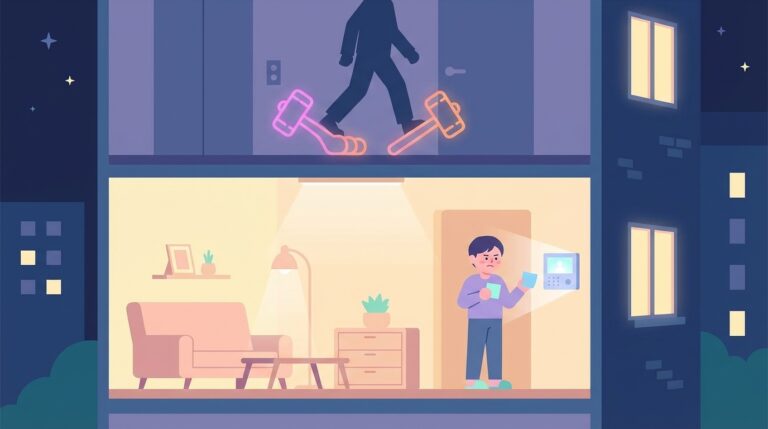
Picture this: It’s 11:30 PM in your beautiful Seoul apartment. You’re winding down, perhaps watching an episode of Hospital Playlist, when suddenly—thump, thump, thump. It sounds like a baby elephant is practicing tap dance on your ceiling. Welcome to the infamous world of 층간소음 (Cheung-gan-so-eum, Inter-floor noise).
In K-Dramas, neighbors often knock on each other’s doors holding a plate of warm tteok (rice cakes) to say hello. But in real-life modern Korea, going upstairs and knocking on a neighbor’s door to complain about noise is not just considered aggressive—it can actually be legally problematic!
Navigating conflict in a high-context society like Korea requires extreme finesse. You can’t just yell, “Keep it down!” Instead, you must master the delicate art of the passive-aggressive polite complaint, choosing between the heavily structured Intercom call or the hyper-courteous Post-it note. As an advanced (C2) Korean learner, mastering this will not only solve your noise issues but also elevate your understanding of Korean social pragmatics to a native level. Let’s dive in!
Phase 2: Core Expressions Deep Dive
Here are the most sophisticated ways to handle the “Foot-hammer” (발망치) upstairs.
1. “다름이 아니오라, 층간소음 때문에 조심스레 메모 남깁니다.”
- Pronunciation: [Dareumi aniora, cheung-gan-soeum ttaemune josimseure memo namgimnida.]
(‘Dareumi aniora’ sounds like a very gentle throat-clearing before making a formal request.)- Meaning: (Lit.) It is nothing other than, because of inter-floor noise, I am carefully leaving a note. / (Real nuance) I’m writing this note because the noise is becoming an issue, but I’m trying to be incredibly polite about it.
- K-Culture Moment: You’ll see this phrase written on neat, pastel-colored Post-it notes attached to a neighbor’s door, sometimes accompanied by a small Vitamin C drink or a packaged snack. It’s the ultimate Korean “kill them with kindness” strategy.
- Editor’s Insight: “다름이 아니오라” is a C2-level formal opener used in business emails and serious notes. It instantly signals to the reader, “I am educated, rational, and not attacking you.” Paired with “조심스레” (cautiously), it protects the receiver’s Kibun (pride/feelings).
- Situation Spectrum:
[🚫 절대 금지] ———— [⚠️ 주의] ———— [✅ 자유롭게]
- Close Friends (Casual): 🚫 (Too formal, sounds sarcastic)
- Neighbors/Colleagues (Semi-formal/Formal): ✅
- 🤔 Think About It: Why do Koreans often attach a small snack when leaving a complaint note? How does “gift-giving” alter the power dynamic of a complaint in your culture?
2. “늦은 시간에 죄송합니다만, 소리가 조금 울리는 것 같아서요.”
- Pronunciation: [Neujeun sigane joesonghamnidaman, soriga jogeum ullineun geot gataseoyo.]
- Meaning: (Lit.) I am sorry at this late hour, but it seems like the sound is echoing a bit. / (Real nuance) It’s late and you’re being loud, but I’m going to blame the building’s architecture instead of you.
- K-Culture Moment: This is the golden script for the Intercom (인터폰) call. When the upstairs neighbor answers, you must begin by apologizing for calling late, even though they are the ones causing the problem.
- Editor’s Insight: Notice the indirectness! Instead of saying “You are loud” (시끄러워요), you say “The sound seems to be echoing” (소리가 울리는 것 같아서요). By blaming the structure of the apartment, you remove personal blame and allow them to save face.
- Situation Spectrum:
[🚫 절대 금지] ———— [⚠️ 주의] ———— [✅ 자유롭게]
- Strangers/Neighbors: ✅ (The standard, safest approach)
- 🤔 Think About It: In English, we might say “Could you please keep it down?” which is direct but polite. Why does Korean prefer shifting the blame to an inanimate object (the echoing sound)?
3. “서로 배려하는 이웃이 되었으면 좋겠습니다.”
- Pronunciation: [Seoro baeryeohaneun iusi doeeosseumyeon jokesseumnida.]
- Meaning: (Lit.) I hope we can become neighbors who consider each other. / (Real nuance) Please fix your behavior so we don’t have a bigger problem.
- K-Culture Moment: This is the standard closing line on almost every official notice posted in the apartment elevator by the Management Office (관리사무소).
- Editor’s Insight: “배려” (Consideration) is a cornerstone of Korean civic duty. By invoking this word, you aren’t just making a personal complaint; you are reminding them of their societal obligation.
Phase 3: Textbook vs. Real Korean
How do advanced speakers navigate conflict without starting a war?
| Situation | 📖 Textbook Korean | 🗣️ Real Korean (C2 Level) | 💡 Why the difference? |
|---|---|---|---|
| Complaining about noise | 너무 시끄러워요. (It’s too noisy.) | 윗집인데요, 발망치 소리가 좀 심해서요. (I’m from downstairs, the ‘foot-hammer’ sound is a bit severe.) | “발망치” (foot-hammer) is a highly specific native slang for heavy walking. |
| Asking them to stop | 조용히 해 주세요. (Please be quiet.) | 매트 하나 깔아주시면 감사하겠습니다. (I’d appreciate it if you could lay down a mat.) | Real complaints offer specific, practical solutions (like noise-canceling mats) rather than just saying “stop.” |
| Leaving a note | 소음 때문에 편지를 씁니다. (I’m writing a letter due to the noise.) | 다름이 아니오라, 아이들 뛰는 소리가 조금 크게 들려서요. (It’s nothing else but, the sound of kids running is being heard a bit loudly.) | Softening the impact with “다름이 아니오라” and passive verbs (들려서요 vs 들어요). |
Phase 4: Cultural Context — K-Culture Deep Dive
4-1. The Non-Verbal “Nunchi” of Complaining
If you use the intercom, your tone of voice is 80% of the message. You cannot sound angry. You must sound slightly apologetic, exhausted, and remarkably calm. If you leave a Post-it note, your handwriting matters. Using cute handwriting or a polite, neat font, combined with a smiley face emoji ^^, softens the blow. In Korea, how you deliver the criticism often matters more than the criticism itself.
4-2. The Legal Reality of Apartment Living
If you’ve watched K-Dramas like Happiness or The Penthouse, you know that apartment living is practically a religion in Korea. Over 60% of Koreans live in apartments. Because of this extreme vertical density, 층간소음 is taken very seriously.
Crucial Rule: Never go upstairs and knock on the door or ring the doorbell in person. Under recent Korean legal precedents, directly confronting a neighbor over noise can be classified as harassment or trespassing! The socially and legally accepted route is:
1. Call the Management Office (관리사무소) to make an anonymous broadcast.
2. Use the building’s Intercom system.
3. Leave a polite Post-it note.
Phase 5: Real-Life Roleplay Scenario
Setting: It’s 12:30 AM on a Tuesday. You have an important presentation tomorrow, but the upstairs neighbor seems to be moving furniture and dropping bowling balls. You decide to use the wall Intercom to call them directly.
Characters:
– YOU: A long-term expat in Seoul, trying to be polite but desperate for sleep.
– Neighbor (윗집 주민): A Korean man in his 40s. He might not realize how loud he’s being.
Dialogue:
YOU: (Presses the ‘Call Upstairs’ button. Ring ring)
Neighbor: 네, 여보세요?
(Ne, yeoboseyo?)
[Yes, hello?]
YOU: 아, 늦은 시간에 정말 죄송합니다. 아랫집인데요.
(A, neujeun sigane jeongmal joesonghamnida. Araetjibindeyo.)
[Ah, I’m really sorry for the late hour. I’m from downstairs.]
Neighbor: 아… 네. 무슨 일이시죠?
(A… ne. Museun irisijyo?)
[Ah… yes. What’s the matter?]
🔀 YOUR TURN! How do you frame the complaint?
– A) “지금 자정인데 너무 시끄러운 거 아닙니까?” (It’s midnight, aren’t you being too loud?)
– B) “혹시 지금 뭐 조립하시나요? 소리가 너무 크게 울려서요.”
– C) “경찰 부르기 전에 조용히 하세요.” (Be quiet before I call the police.)✅ Best Choice: B — “혹시 지금 뭐 조립하시나요? 소리가 너무 크게 울려서요.” (Are you perhaps assembling something right now? The sound is echoing quite loudly.)
Why? It gives them an “out.” By asking if they are assembling something, you assume they have a valid reason for the noise. Using “울려서요” (echoing) blames the building.
⚠️ Choice A & C Analysis: Both are instant relationship-destroyers in Korea. Option A will make them defensive, and Option C is considered a threat.
(Continuing with Choice B)
Neighbor: 아! 죄송합니다. 내일 이사가 있어서 짐을 좀 싸고 있었거든요. 주의하겠습니다.
(A! Joesonghamnida. Naeil isaga isseoseo jimeul jom ssago isseotgeodeunyo. Juuihagetseumnida.)
[Ah! I’m sorry. I have to move out tomorrow so I was packing. I will be careful.]
(🎭 Stage Direction: You hear him genuinely whispering now out of embarrassment.)
YOU: 아, 이사하시는군요. 네, 조금만 조심해 주시면 감사하겠습니다. 수고하세요.
(A, isahasineungunyo. Ne, jogeumman josimhae jusimyeon gamsahagetseumnida. Sugohaseyo.)
[Ah, you are moving. Yes, I’d appreciate it if you could be a little careful. Take care.]
Phase 6: 10-Second Shadowing Drill
Practice the “polite but firm” hesitation. Emphasize the long pause and soft tone.
🥺 늦은 시간에 / 죄송합니다만... (Pause) / 소리가 / 조금 / 크게 울려서요.
(neujeun sigane / joesonghamnidaman... / soriga / jogeum / keuge ullyeoseoyo.)
Phase 7: K-Culture Mini Dictionary
| Korean | Romanization | English | Context |
|---|---|---|---|
| 층간소음 | cheung-gan-so-eum | Inter-floor noise | The number one cause of neighborly disputes in Korea. |
| 관리사무소 | gwalli-samuso | Management Office | The mediator for all apartment issues. Call them first! |
| 발망치 | bal-mangchi | Foot-hammer | Slang for someone who walks heavily on their heels. |
| 배려 | baeryeo | Consideration | A keyword in Korean society; being mindful of others’ comfort. |
| 보복소음 | bobok-so-eum | Revenge noise | Intentionally making noise (like hitting the ceiling with a rubber mallet) to get back at the upstairs neighbor. (Highly illegal!) |
Phase 8: Expat Survival Kit (Apartment Edition)
Living in a Korean Officetel (오피스텔) or Apartment? You need to know these!
🆘 Survival Expressions for the Management Office
– 🇰🇷 “윗집 층간소음 때문에 전화드렸는데요. 방송 좀 부탁드릴게요.”
– 🗣️ (Witjip cheung-gan-soeum ttaemune jeonhwadeuryeonneundeyo. Bangsong jom butakdeurilgeyo.)
– 🇬🇧 “I’m calling about noise from the unit above. Could you please make a broadcast announcement?”
– 💡 Pro Tip: Elevators in Korean apartments have screens or speakers. The management office will make a polite, general announcement to the whole building to “please walk quietly,” preventing direct conflict.📌 Editor’s Living Note
– Elevator Notices (안내문): Always read the papers taped inside the elevator! They often contain warnings about noise, fire drills, or days when the water will be shut off.
– Slippers (층간소음 슬리퍼): Koreans don’t wear outside shoes indoors, but they DO wear padded indoor slippers specifically designed to absorb the “bal-mangchi” sound.
Phase 9: Critical Thinking — “One Step Deeper”
🧠 Think Deeper: Language, Space, and the Preservation of ‘Kibun’
In Western cultures, confronting someone who is bothering you is often seen as standing up for your rights. If someone is loud, you tell them they are loud. However, the Korean language strategies surrounding cheung-gan-so-eum highlight a profound cultural priority: the preservation of the community’s 기분 (Kibun – mood/face/harmony) over individual righteousness. By saying “the sound echoes” instead of “you are stomping,” the Korean language acts as a social shock-absorber. It prevents the other person from feeling attacked, which ironically is the most effective way to get them to change their behavior. In a country where millions live stacked on top of each other in massive concrete grids, linguistic softness isn’t just polite; it’s a survival mechanism.
💬 Your Turn: How is neighborly conflict handled in your home country? Would a Post-it note with a smiley face be seen as polite or incredibly passive-aggressive? Let us know in the comments!
Phase 10: FAQ & Avoiding Misunderstandings
- Q: Can I just go upstairs, ring the bell, and kindly explain the situation face-to-face?
- A: NO. While this might be the most mature approach in your home culture, in Korea, appearing at someone’s door uninvited to complain is deeply unsettling and can trigger stalking/harassment laws. Stick to the intercom or management office.
- Q: What if they ignore my Post-it note?
- A: Call the Management Office (관리사무소). Let the building manager be the “bad guy.” They are trained to handle this.
❌ Common Mistake: Using translating apps to write a note and ending up with “당신은 너무 시끄럽습니다” (You are too loud). This sounds like a declaration of war.
✅ Do this instead: Use the C2 pattern: “다름이 아니오라… 조심스레 메모 남깁니다.”
Phase 11: Summary & Action Items
- One-Liner Summary: In Korea, combat inter-floor noise not with anger, but with extreme politeness, passive verbs, and the Management Office.
-
Action Mission 3 Steps:
- 🥉 Bronze: Stand in your living room, look at the ceiling, and practice saying, “소리가 조금 크게 울려서요” out loud 3 times.
- 🥈 Silver: Write out the ultimate polite Post-it note complaint in Korean on a real sticky note.
- 🥇 Gold: Next time you ride an elevator in a Korean building, try to find the word “층간소음” or “배려” on the notice board!
- K-Culture Mission: Watch a clip of the thriller K-Drama Strangers from Hell or Happiness. Notice how apartment tension builds up and how neighbors interact (or fail to interact) before things go terribly wrong!
Phase 12: Quiz — Interactive Challenge
1. Situational Judgment: It’s 2 AM. Your upstairs neighbor is having a loud party. What is the most culturally appropriate and legally safe first step in Korea?
– A) Go upstairs and bang on the door.
– B) Call the Management Office (관리사무소) to complain.
– C) Hit the ceiling with a broomstick.
2. Fill in the Blank (C2 Level):
“( ______________ ), 층간소음으로 인해 메모를 남깁니다.”
Hint: The formal, gentle opener meaning ‘It is nothing other than…’
3. True or False: Attaching a small snack to a complaint note in Korea is considered sarcastic and rude. (T/F)
(Answers: 1: B / 2: 다름이 아니오라 / 3: False – It is actually highly recommended to soften the tension!)
Frequently Asked Questions (FAQ)
Q: What does ""다름이 아니오라, 층간소음 때문에 조심스레 메모 남깁니다."" mean in Korean and how do you pronounce it?
A: In Korean, ""다름이 아니오라, 층간소음 때문에 조심스레 메모 남깁니다."" is pronounced [Dareumi aniora, cheung-gan-soeum ttaemune josimseure memo namgimnida.] and means: (Lit.) It is nothing other than, because of inter-floor noise, I am carefully leaving a note. / (Real nuance) I'm writing this note because the noise is becoming an issue, but I'm trying to be incredibly polite about it.
Q: What does ""늦은 시간에 죄송합니다만, 소리가 조금 울리는 것 같아서요."" mean in Korean and how do you pronounce it?
A: In Korean, ""늦은 시간에 죄송합니다만, 소리가 조금 울리는 것 같아서요."" is pronounced [Neujeun sigane joesonghamnidaman, soriga jogeum ullineun geot gataseoyo.] and means: (Lit.) I am sorry at this late hour, but it seems like the sound is echoing a bit. / (Real nuance) It's late and you're being loud, but I'm going to blame the building's architecture instead of you.
Q: What does ""서로 배려하는 이웃이 되었으면 좋겠습니다."" mean in Korean and how do you pronounce it?
A: In Korean, ""서로 배려하는 이웃이 되었으면 좋겠습니다."" is pronounced [Seoro baeryeohaneun iusi doeeosseumyeon jokesseumnida.] and means: (Lit.) I hope we can become neighbors who consider each other. / (Real nuance) Please fix your behavior so we don't have a bigger problem.







