

Phase 1: 공감 (몰입형 오프닝)
안녕하세요! 매일한글(Daily Hangul) 에디터입니다.
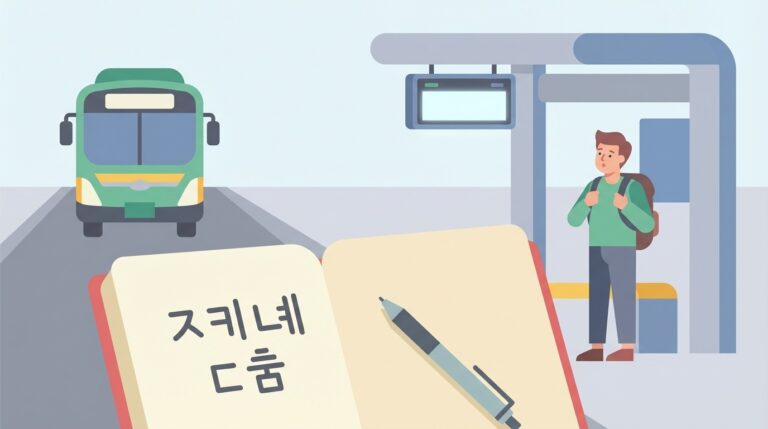
Picture this: You are standing at a bus stop in Seoul. You just missed the bus. In a classic K-Drama, this is the exact moment the main character sighs, looks at the sky, and magically, the love interest appears with an umbrella. ☔
But in real life? You’re just standing there, staring at the digital board, wondering, “Do I wait 5 minutes or 50 minutes? Should I just take a taxi?”
Navigating public transportation in a new country can be super intimidating, especially for A1 beginners. What if you’re waiting for a small village bus (마을버스) that doesn’t have an electronic display? Don’t worry! I’ve been there, and I know exactly what you need. Today, we are going to learn the easiest, most natural ways to ask about bus schedules in Korea. No complicated textbook grammar—just the survival phrases you can use right on the streets of Seoul!
Phase 2: 핵심 표현 심층 분석
1. 버스 언제 와요?
- Pronunciation: beoseu eonje wayo? [buh-seu un-jeh wah-yo?]
- Meaning: When does the bus come?
- K-Culture Moment: You are waiting with a Korean friend to go to a K-Pop pop-up store. You keep checking your phone, stamping your feet, and asking your friend this exact phrase.
- Editor’s Insight: This is your #1 lifesaver phrase. “언제 (when)” is the magic word. We don’t use the future tense (“will come”) here; Koreans simply use the present tense (“comes”). It’s short, sweet, and gets you the answer instantly.
- Situation Spectrum:
[🚫 절대 금지] ———— [⚠️ 주의] ———— [✅ 자유롭게]
- Friends (Casual): ⚠️ (Drop the ‘yo’ -> 버스 언제 와?)
- Strangers at bus stop: ✅
- Bus driver / Elders: ✅
- 🤔 Think About It: In English, we might ask, “What time is the bus arriving?” but Koreans just say, “When does it come?” Why do you think Korean prefers such direct and simple verbs in daily life?
2. 얼마나 자주 와요?
- Pronunciation: eolmana jaju wayo? [ull-mah-nah jah-joo wah-yo?]
- Meaning: How often does it come? (Asking the bus interval)
- K-Culture Moment: You traveled to a beautiful, quiet K-Drama filming location in the countryside. There is no digital bus board. You see a local grandmother waiting and ask her this phrase to know if you’ll be stuck there for hours!
- Editor’s Insight: The dictionary word for “interval” is 배차 간격 (baecha gangyeok), but that sounds like a robot! “얼마나 (how much/how long)” + “자주 (often)” is the natural, human way to ask.
- Situation Spectrum:
[🚫 절대 금지] ———— [⚠️ 주의] ———— [✅ 자유롭게]
- Friends (Casual): ⚠️ (Drop the ‘yo’ -> 얼마나 자주 와?)
- Strangers/Locals: ✅
- Elders: ✅
- 🤔 Think About It: Knowing the exact bus interval is crucial in Korea’s fast-paced society. How important is public transit timing in your home country?
Phase 3: 교과서 vs 진짜 한국어
Let’s compare what you see in language books with what you actually hear on the streets of Hongdae!
| 상황 | 📖 교과서 한국어 | 🗣️ 진짜 한국어 | 💡 왜 다를까? |
|---|---|---|---|
| Asking the interval | 버스의 배차 간격은 어떻게 됩니까? | 버스 얼마나 자주 와요? | “배차 간격” is a formal Sino-Korean term mostly used on apps or news, not in casual chats! |
| Asking for the next bus | 다음 버스가 언제 도착합니까? | 다음 차 언제 와요? | Koreans love making things shorter. We often use “차” (car/vehicle) instead of “버스” (bus). |
Bottom Note: Stick to “언제 와요?” (When does it come?). It’s polite, natural, and perfect for A1 learners!
Phase 4: 문화적 맥락 — K-Culture 딥다이브
4-1. 비언어적 요소 (Non-verbal Cues)
When asking a stranger at a bus stop, don’t stare intensely into their eyes. In Korean culture, heavy eye contact with strangers can feel burdensome. Instead, look at the bus schedule board, make a slight bowing motion with your head, say “저기요…” (Excuse me…), and then ask your question. It shows excellent Nunchi (social awareness)!
4-2. K-Travel 연결 고리
Korea has a world-class public transit system. At most bus stops in Seoul, you won’t even need to ask! You’ll see an electronic display board (버스 정보 안내 단말기) telling you exactly how many minutes are left until your bus arrives.
However, if you take a smaller 마을버스 (Maeul Bus – Village Bus) to climb up a steep hill to a hidden hipster cafe or a K-Drama shooting spot, the boards might be missing. That’s when your new Korean phrases will save the day!
Phase 5: 실전 롤플레이 시나리오
Setting: Friday 8 PM. You are at a bustling bus stop in Gangnam, trying to get to a famous Korean BBQ restaurant. You are looking at your map, looking confused. You decide to ask a friendly-looking Korean college student waiting next to you.
Characters:
– YOU: A beginner Korean learner, hungry for Samgyeopsal! 🥩
– 민수 (Minsu): 22-year-old local college student, casually listening to K-Pop.
Dialogue:
YOU: 저기요! (jeogiyo!)
(English) Excuse me!
(🎭 Stage Direction: You give a slight, polite nod.)
민수: 네? (Ne?)
(English) Yes?
YOU: 144번 버스 언제 와요? (baek-sasip-sabeon beoseu eonje wayo?)
(English) When does bus 144 come?
민수: 아, 그거 방금 지나갔어요. (Ah, geugeo banggeum jinagasseoyo.)
(English) Ah, that just passed by.
(🎭 Stage Direction: Minsu points down the street.)
YOU: 헉! 얼마나 자주 와요? (Heok! eolmana jaju wayo?)
(English) Gasp! How often does it come?
민수: 음… 15분마다 와요. 보드에 써 있어요. (Eum… sipo-bunmada wayo. Bodeue sseo isseoyo.)
(English) Hmm… It comes every 15 minutes. It’s written on the board.
🔀 당신의 차례! 어떻게 대답할까요?
– A) “아, 감사합니다!” (Ah, gamsahamnida! / Ah, thank you!)
– B) “대박!” (Daebak! / Awesome/Shocking!)
– C) “빨리 와라…” (Ppal-li wara… / Come quickly…)✅ Best Choice: A — Always end a conversation with a stranger politely. “감사합니다” is your best friend!
⚠️ Choice B & C 분석: “대박” or talking to yourself like “빨리 와라” is okay to mumble under your breath, but saying it directly to a stranger as a response is a bit too casual and might confuse them!
Phase 6: 10초 섀도잉 드릴
Let’s practice! Follow the emotion tags and pause where you see the /.
😊 밝게 (Polite & Bright):
저기요, / 다음 버스 / 언제 와요?
(jeogiyo, / daeum beoseu / eonje wayo?)
😢 아쉽게 (A bit disappointed you missed it):
아… / 얼마나 / 자주 와요?
(Ah… / eolmana / jaju wayo?)
Phase 7: K-Culture 미니 사전
| 한국어 | Romanization | 영어 | 맥락 설명 |
|---|---|---|---|
| 정류장 | jeongnyujang | Bus stop | The physical place you wait for the bus. |
| 마을버스 | maeul beoseu | Village bus | Smaller green buses that run short routes through local neighborhoods. |
| 환승 | hwanseung | Transfer | Tapping your card to change buses or subway lines for free within 30 minutes! |
| 눈치 | nunchi | Social awareness | The Korean superpower of reading the room. Crucial when navigating crowded buses! |
Phase 8: 여행자 서바이벌 키트
If you are traveling in Korea, these are the absolute must-know phrases when taking the bus!
🆘 서바이벌 표현 TOP 3
1. 🇰🇷 “이거 강남역 가요?” (igeo gangnam-yeok gayo?)
🗣️ “Does this go to Gangnam station?”
2. 🇰🇷 “내려주세요!” (naeryeojuseyo!)
🗣️ “Please let me off!” (If the bus is too crowded to reach the bell!)
3. 🇰🇷 “얼마예요?” (eolmayeyo?)
🗣️ “How much is it?” (If you are paying with cash—though cards are highly recommended!)📌 Editor’s Travel Note
– Apps: Google Maps doesn’t work well for walking/transit in Korea. Download KakaoMap or Naver Map!
– The Magic Card: Get a T-money card at any convenience store.
– Crucial Rule: ALWAYS tap your card when you get ON AND when you get OFF the bus! If you don’t tap off, you get charged extra next time! 😱
Phase 9: 비판적 사고 코너 — “한 발 더 깊이”
🧠 Think Deeper: 빨리빨리 (Pali-pali) Culture and Technology
Have you noticed how Korean bus stops have digital boards that count down the exact minutes and seconds? This is deeply connected to Korea’s “빨리빨리” (hurry hurry) culture. In a fast-paced society where efficiency is everything, waiting without knowing the exact arrival time causes anxiety. The language reflects this too: Koreans want the shortest, most direct way to get information.💬 Your Turn: Does your city have digital countdowns for public transit? How does your culture handle “waiting”? Let us know in the comments!
Phase 10: FAQ & 오해 방지
Q: Can I ask the bus driver “언제 와요?”
A: Bus drivers in Seoul are very focused on driving safely through heavy traffic. It’s much better to ask the waiting passengers or check your app!
Q: Do I say “안녕히 계세요” (Goodbye) to the driver when leaving?
A: Some people say “감사합니다” (Thank you) when tapping off, but it’s not strictly required. A simple head nod is great!
❌ 흔한 실수 (Common Mistake):
Asking “버스 어디 있어요?” (Where is the bus?).
✅ 이렇게 하세요:
Koreans don’t usually ask where the bus is geographically; they care about when it will arrive. Always stick to “버스 언제 와요?” (When does the bus come?).
Phase 11: 요약 및 액션 아이템
✨ One-Liner Summary: To find out about your bus, just ask: “버스 언제 와요?” (When does the bus come?)
🎬 Action Mission:
– 🥉 Bronze: Say “버스 언제 와요?” out loud 3 times right now.
– 🥈 Silver: Download KakaoMap or Naver Map, find a bus stop near a famous Korean landmark, and imagine asking someone there!
– 🥇 Gold (For travelers): Next time you are in Korea, ask a local “얼마나 자주 와요?” instead of just looking at your phone!
Phase 12: 퀴즈 — 인터랙티브 챌린지
1. You are at a bus stop and want to know when the bus is arriving. What is the most natural A1 phrase?
A) 버스 어디 있어요? (Where is the bus?)
B) 배차 간격이 어떻게 됩니까? (What is the interval?)
C) 버스 언제 와요? (When does the bus come?)
2. True or False – K-Culture Edition:
You only need to tap your T-money transit card when you get ON the bus in Seoul. (T/F)
👉 정답 확인하기 (Click for Answers)
1. 정답: C (A is awkward, B is too textbook/formal. C is perfect!)
2. 정답: False! (You MUST tap off when you leave the bus to avoid extra charges and get free transfers!)
Frequently Asked Questions (FAQ)
Q: What does "버스 언제 와요?" mean in Korean and how do you pronounce it?
A: In Korean, "버스 언제 와요?" is pronounced [beoseu eonje wayo? [buh-seu un-jeh wah-yo?] and means: When does the bus come?
Q: What does "얼마나 자주 와요?" mean in Korean and how do you pronounce it?
A: In Korean, "얼마나 자주 와요?" is pronounced [eolmana jaju wayo? [ull-mah-nah jah-joo wah-yo?] and means: How often does it come? (Asking the bus interval)






