

Phase 1: Empathy
Hello! Daily Hangul Editor here.
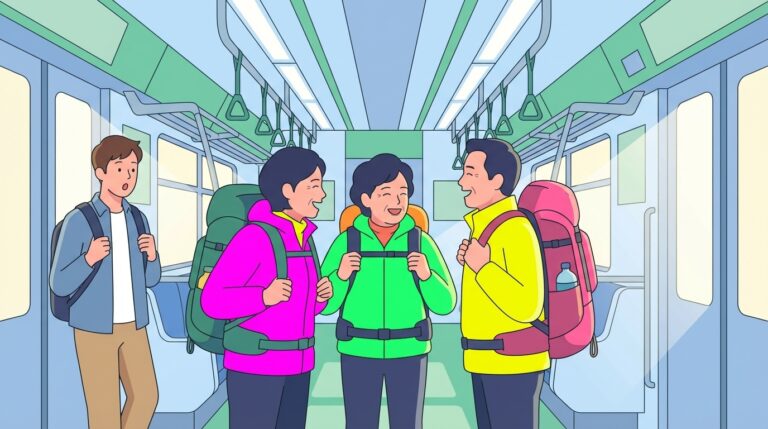
Imagine this: It’s 8:00 AM on a Saturday in Seoul. You’re standing on Subway Line 3, sipping your morning coffee, feeling half-asleep. Suddenly, the train doors open, and a blinding wave of neon colors floods the carriage. Bright pinks, fluorescent yellows, lime greens. You see high-tech backpacks, trekking poles, and matching visors.
Did you accidentally board a train to a Mount Everest base camp? Nope! You’ve just encountered one of Korea’s most iconic weekend phenomenons: The Ahjumma and Ahjussi Hiking Squad.
If you’ve watched K-Dramas, you might have noticed that whenever a character’s parents need to have a serious talk or clear their minds, they put on $1,000 worth of professional Gore-Tex gear just to hike a 500-meter local mountain.
But why are they dressed like that? And why is the hiking trail in Korea one of the most chatty, food-filled places you’ll ever visit? Today, we are going to decode the secret language and culture of Korea’s weekend hiking squads. If you master these B1-level expressions, you might just earn yourself a free cup of Makgeolli or a handful of cherry tomatoes from a friendly stranger on your next hike!
(Note: This guide is based on real questions from expat students who were delightfully overwhelmed by Korean trail culture!)
Phase 2: Deep Dive into Core Expressions
Let’s look at the absolute must-know phrases to survive (and thrive) among the neon hiking squads.
1. 수고하십니다 / 수고하세요
- Pronunciation: sugo-hasimnida / sugo-haseyo
- Sound-alike guide: ‘Soo-go-ha-seem-nee-da’. Make the ‘oo’ long and polite!
- Meaning: (Literal) You are making a great effort. vs (Real nuance) “Hello, keep up the good work!” / “Have a safe hike!”
- K-Culture Moment: You’re walking up Bukhansan Mountain, sweating profusely. A group of older hikers passes you going down. Instead of “안녕하세요 (Hello),” they nod and say, “수고하십니다~” It’s the ultimate acknowledgment of shared suffering and effort.
- Editor’s Insight: This is the magic password of the mountain. Saying “안녕하세요” is fine, but saying “수고하십니다” as you pass someone on a steep trail instantly makes you sound like a local who respects the hustle.
- Situation Spectrum:
[🚫 Never] ———— [⚠️ Be Careful] ———— [✅ Go Ahead]
- Hikers passing by (Strangers): ✅
- Your boss sweating on the trail: ⚠️ (Say “고생 많으십니다” instead to be safer)
- A younger child hiking: 🚫 (Just say “안녕!”)
- 🤔 Think About It: Why does Korean have so many phrases acknowledging effort rather than just saying “Hello”? Does your native language have a greeting specifically for people who are working hard or struggling?
2. 막걸리 한잔 어때요?
- Pronunciation: makgeolli hanjan eottaeyo?
- Sound-alike guide: ‘Mak’ sounds like the ‘Mac’ in Mac & Cheese + ‘Gull-lee’.
- Meaning: (Literal) How is one glass of makgeolli? vs (Real nuance) “Let’s go grab a drink together after this hike!”
- K-Culture Moment: The hike is over. You’re at the base of the mountain. You see rows of restaurants smelling like green onion pancakes (파전). Someone in your group wipes their sweat and drops this phrase. It means the real purpose of the hike is about to begin.
- Editor’s Insight: Hiking in Korea is 30% exercise and 70% eating afterwards. This phrase is an invitation to bond.
- Situation Spectrum:
[🚫 Never] ———— [⚠️ Be Careful] ———— [✅ Go Ahead]
- Friends / Casual hiking group: ✅
- Coworkers after a team hike: ✅
- Formal business partners: ⚠️
- 🤔 Think About It: In many cultures, alcohol is for nightlife. In Korea, Makgeolli after a morning hike is a cherished tradition. Why do you think hiking and this specific traditional rice wine are tied together?
3. 정상까지 얼마나 남았어요?
- Pronunciation: jeongsang-kkaji eolmana namasseoyo?
- Sound-alike guide: ‘Jeong-sang’ (Summit) + ‘kka-jee’ (until) + ‘eol-ma-na’ (how much) + ‘na-ma-sseo-yo’ (left).
- Meaning: (Literal) How much is left until the summit? vs (Real nuance) “Please tell me we are almost there, I am dying.”
- K-Culture Moment: You are panting on a staircase of rocks. You ask a Korean hiker coming down this question. They will ALWAYS smile and say, “다 왔어요~ (You’re almost there~)” … Spoiler alert: They are lying. You probably have 30 more minutes. It’s a culturally accepted white lie to give you hope!
- Editor’s Insight: Use this when you need a breather and want to strike up a quick conversation.
- Situation Spectrum:
[🚫 Never] ———— [⚠️ Be Careful] ———— [✅ Go Ahead]
- Strangers coming down the mountain: ✅
- To the group leader who planned the hike: ✅
- Complaining loudly to your boss: ⚠️
- 🤔 Think About It: Why do Korean hikers always say “You’re almost there” even when you aren’t? It reflects the cultural trait of encouraging group morale over cold, hard facts!
Phase 3: Textbook vs. Real Korean
| Situation | 📖 Textbook Korean | 🗣️ Real Korean | 💡 Why the difference? |
|---|---|---|---|
| Greeting on the trail | 안녕하세요. (Hello.) | 수고하십니다~ (Keep up the hard work!) | Acknowledges the shared physical effort of the activity. |
| Asking about distance | 산 꼭대기가 어디입니까? (Where is the top of the mountain?) | 정상 멀었어요? (Is the summit far?) | ‘정상(Summit)’ is the most natural word, and dropping particles makes it conversational. |
| Suggesting food after | 등산 후에 식사합시다. (Let’s have a meal after hiking.) | 하산주 한잔 해야지! (We gotta have a post-hike drink!) | ‘하산주’ (drink upon descending) is a massive subculture keyword in Korea! |
| Resting | 여기서 쉬겠습니다. (I will rest here.) | 아이고, 좀 쉬다 가자. (Aigoo, let’s take a break and go.) | “아이고” adds the essential dramatic flair of physical exhaustion. |
Phase 4: Cultural Context — K-Culture Deep Dive
4-1. Non-Verbal Cues: The Art of the Cucumber
On a Korean mountain, words aren’t always necessary. The real language of the hiking squad is sharing food. If an older hiker makes eye contact with you and holds out a piece of raw cucumber (오이), a cherry tomato (방울토마토), or a cup of sweet instant coffee (믹스커피), it is the ultimate sign of Jeong (정 – deep connection/affection).
Rule of thumb: Do not politely refuse multiple times as you might in a formal setting. On the mountain, eagerly accepting the snack with two hands and a bright “감사합니다! (Thank you!)” will make their day.
4-2. K-Food Connection: The Holy Trinity of the Mountain
Why are the subway cars so crowded with hikers on weekends? Because Korean mountains are essentially giant appetizers for the main course: Makgeolli (막걸리), Pajeon (파전 – green onion pancake), and Dubu Kimchi (두부김치 – tofu with stir-fried kimchi).
In Korea, hiking is a communal activity. The mountain isn’t just about nature; it’s a social hub. Eating together at a bustling outdoor restaurant at the base of the mountain is where relationships are solidified. When your Korean friends invite you hiking, they are actually inviting you to this delicious post-hike feast!
Phase 5: Interactive Roleplay Scenario
Setting: Saturday morning, 9:00 AM. You are on Subway Line 3 heading to Gupabal Station to hike Bukhansan. The carriage is packed with older Koreans in blinding neon outdoor gear. You are squeezed next to a friendly-looking Ahjussi wearing head-to-toe bright yellow Gore-Tex.
Characters:
– YOU: An expat who decided to go hiking today in a simple t-shirt and running shoes.
– Mr. Kim (55): A veteran hiker, carrying a backpack that looks like it has survival gear for a month, but actually just contains cucumbers, kimbap, and makgeolli.
Dialogue:
Mr. Kim: (Looks at your regular sneakers) 학생, 산에 가요? 🏔️
(haksaeng, sane gayo?)
[Student, are you going to the mountain?]
(🎭 Stage Direction: Mr. Kim smiles warmly, leaning on his trekking pole.)
YOU: 네, 북한산 가려고요.
(ne, bukhansan garyeogoyo.)
[Yes, I’m planning to go to Bukhansan.]
Mr. Kim: 아이고, 그 신발 신고? 북한산 돌산이라 미끄러운데!
(aigo, geu sinbal singo? bukhansan dolsanira mikkeureounde!)
[Aigoo, wearing those shoes? Bukhansan is a rocky mountain, it’s slippery!]
YOU: 아, 정말요? 조심해서 갈게요.
(a, jeongmallyo? josimhaeseo galgeyo.)
[Oh, really? I’ll be careful going up.]
Mr. Kim: 혼자 왔어요? 이거 하나 먹어요.
(honja wasseoyo? igeo hana meogeoyo.)
[Did you come alone? Here, eat this.]
(🎭 Stage Direction: Mr. Kim unzips a pocket on his vest and pulls out a perfectly wrapped piece of ginseng candy (홍삼 캔디) and offers it to you.)
🔀 Your Turn! How do you respond?
– A) “아니요, 괜찮습니다.” (No, I’m okay.)
– B) “우와! 감사합니다. 잘 먹겠습니다!” (Wow! Thank you. I will enjoy it!)
– C) “이게 뭐예요? 저 홍삼 안 좋아해요.” (What is this? I don’t like red ginseng.)✅ Best Choice: B — Why? In Korean mountain/subway culture, accepting a small treat from an elder is the best way to show respect and friendliness.
⚠️ Choice A Analysis: While polite in Western cultures to not take candy from strangers, rejecting a well-meaning Ahjussi’s candy can make things awkward and make him feel his Jeong was rejected.
🚫 Choice C Analysis: Way too direct! Even if it tastes like dirt, you take the ginseng candy and smile!
YOU: 우와! 감사합니다. 잘 먹겠습니다!
Mr. Kim: 허허, 한국말 잘하네! 다치지 않게 수고해요!
(heoheo, hangungmal jalhane! dachiji anke sugohaeyo!)
[Haha, you speak Korean well! Don’t get hurt and keep up the good work!]
YOU: 네, 아저씨도 수고하세요!
(ne, ajeossido sugohaseyo!)
[Yes, sir, have a great hike too!]
Phase 6: 10-Second Shadowing Drill
Practice speaking like a true Korean hiker! Pay attention to the pauses (/) and the prolonged vowels (~~~) for maximum emotion.
😊 하산하고 / 마시는 막걸리가 / 기가 막히죠!
(hasanhago / masineun makgeolliga / giga makhijo!)
“The makgeolli you drink / after descending / is unbelievably good!”
🥵 다 왔다고 했는데... / 아까부터 / 다 왔대요...
(da watdago haenneunde… / akkabuteo / da watdaeyo…)
“They said we were almost there… / but they’ve been saying that / since earlier…”
😤 정상까지 / 포기하지 말고 / 파이팅!
(jeongsang-kkaji / pogihaji malgo / paiting!)
“Until the summit / don’t give up / and fighting!”
Phase 7: K-Culture Mini Dictionary
| Korean | Romanization | English | Context |
|---|---|---|---|
| 등산복 | deungsanbok | Hiking clothes | Often bright neon, highly technical, and a major fashion statement for middle-aged Koreans. |
| 정(情) | jeong | Deep affection / Bonding | The unspoken emotional connection that compels a Korean to share their mountain snacks with you. |
| 하산주 | hasanju | Post-hike drink | Literally “descending mountain alcohol.” The mandatory drinking session after hiking. |
| 등린이 | deungnini | Hiking beginner | A cute slang combining ‘등산(hiking)’ and ‘어린이(child)’. Used for newbies. |
| 야호 | yaho | Yahoo | The sound Koreans shout when they reach the top of a mountain (though it’s banned on some trails now for noise!). |
Phase 8: Traveler Survival Kit
Taking the subway to a mountain in Seoul? Here are your essential survival tools.
🆘 Survival Phrases for the Trail & Subway
– 🇰🇷 “여기 앉으세요.” (yeogi anjeuseyo)
– 🗣️ Meaning: Please, sit here.
– 📍 Where to use: On the subway. If you see an older hiker carrying heavy gear, offering your seat is a huge cultural win!
– 🇰🇷 “입구가 어디예요?” (ipguga eodiyeyo?)
– 🗣️ Meaning: Where is the entrance?
– 📍 Where to use: Outside the subway station when trying to find the actual mountain trail.
– 🇰🇷 “먼저 가세요.” (meonjeo gaseyo)
– 🗣️ Meaning: Please go ahead.
– 📍 Where to use: When a super-fast Ahjumma squad is right behind you on a narrow trail.📌 Editor’s Travel Note
– Navigating: Use Naver Map or KakaoMap. Google Maps does not give accurate walking directions in Korea!
– Dress Code: Do not wear jeans to a Korean mountain unless you want older hikers to click their tongues in worry. Leggings or athletic wear are perfectly fine if you don’t own neon Gore-Tex.
– Trail Etiquette: Many popular mountains (like Bukhansan) have strict “No Drinking on the Summit” rules now. Save the Makgeolli for the restaurants at the bottom!
Phase 9: Critical Thinking Corner — “Going One Step Deeper”
🧠 Think Deeper: Food, Identity, and the Concept of ‘We’
In Korean culture, eating is rarely an individual act. The culture of sharing food on the mountain—whether it’s passing around a giant thermos of hot water for cup noodles or forcing a cherry tomato into a stranger’s hand—is deeply tied to Korea’s agrarian roots. Historically, farming communities survived by sharing resources and labor (a concept called Pumasi 품앗이). Even today, in the hyper-modern city of Seoul, this communal identity survives on the mountain trails. When a Korean hiker offers you food, they are momentarily inviting you into their “in-group.” The mountain strips away titles and statuses, leaving only shared sweat and shared meals.
💬 Your Turn:
Does your culture have a specific place or activity where strangers suddenly act like family? How do people show hospitality to strangers in your country? Let us know in the comments!
Phase 10: FAQ & Avoiding Common Mistakes
Q: “Can I join a post-hike Makgeolli party if I don’t drink alcohol?”
Yes! Just order Cider (사이다 – Korean Sprite) or pour water into your cup. The most important thing is to participate in the Geonbae (건배 – Cheers) and clink glasses with the group. It’s about the vibe, not the alcohol.
Q: “Is it rude to pass people on the trail without saying anything?”
Not strictly rude, especially on crowded trails. But a slight bow of the head or a soft “수고하십니다” goes a long way, especially if the trail is narrow and they stepped aside for you.
❌ Common Mistake #1: Calling older hikers “할아버지(Grandpa)” or “할머니(Grandma)”.
✅ Do this instead: Even if they look older, stick to “아저씨 (Ahjussi)” and “아주머니 (Ajumoni)” or “사장님 (Sajangnim)”. Nobody wants to be called a grandparent while they are crushing a 10km hike!❌ Common Mistake #2: Pouring your own drink at the post-hike dinner.
✅ Do this instead: In Korean drinking culture, you pour for others, and they pour for you. Keep an eye on your hiking buddy’s glass!
Phase 11: Summary & Action Items
🎯 One-Liner Summary:
Surviving Korea’s neon hiking squads is all about respecting the effort (“수고하십니다”), accepting shared snacks with a smile, and preparing your stomach for post-hike Makgeolli.
🚀 Action Mission 3 Steps:
– 🥉 Bronze (Solo): Stand in front of a mirror, wipe imaginary sweat from your forehead, and say “아이고, 정상 언제 나와요?” (Aigoo, when is the summit coming?) with true exhaustion.
– 🥈 Silver (Online): Find a Korean hiking vlog on YouTube and leave a comment saying: “다들 등산 파이팅! 수고하셨습니다~”
– 🥇 Gold (Real-world): Next time you are in Korea, take Subway Line 3 to Gupabal Station on a Saturday morning. Just observe the neon wave, and if you go hike, successfully say “수고하십니다” to someone!
🎒 K-Culture Special Mission:
Go to any outdoor brand store in Korea (like BlackYak, K2, or Nepa). Notice how fashionable and expensive the gear is compared to basic hiking gear back home. It’s a massive industry here!
Phase 12: Quiz — Interactive Challenge
Q1. You are panting heavily on the trail. A bright pink Ahjumma passes by and says “다 왔어요~ (You’re almost there!)”. What does this ACTUALLY mean in Korean hiking culture?
1. You are exactly 1 minute away. Run!
2. You are not close at all, but she is giving you emotional support.
3. She wants to give you a cucumber.
Q2. Fill in the blank:
등산이 끝났어요! 우리 파전이랑 _____ 한잔 어때요?
(The hike is over! How about Pajeon and a glass of _____?)
1. 소주 (Soju)
2. 막걸리 (Makgeolli)
3. 아메리카노 (Americano)
Q3. True or False – K-Culture Edition:
“If an older Korean hiker offers you a cherry tomato on the train or trail, you should firmly say ‘No thank you’ to be polite.”
(Answers: Q1: 2 – It’s a beautiful white lie! / Q2: 2 – Makgeolli is the law of the mountain. / Q3: False – Accept it joyfully with two hands!)
Frequently Asked Questions (FAQ)
Q: What does "수고하십니다 / 수고하세요" mean in Korean and how do you pronounce it?
A: In Korean, "수고하십니다 / 수고하세요" is pronounced [sugo-hasimnida / sugo-haseyo] and means: (Literal) You are making a great effort. vs (Real nuance) "Hello, keep up the good work!" / "Have a safe hike!"
Q: What does "막걸리 한잔 어때요?" mean in Korean and how do you pronounce it?
A: In Korean, "막걸리 한잔 어때요?" is pronounced [makgeolli hanjan eottaeyo?] and means: (Literal) How is one glass of makgeolli? vs (Real nuance) "Let's go grab a drink together after this hike!"
Q: What does "정상까지 얼마나 남았어요?" mean in Korean and how do you pronounce it?
A: In Korean, "정상까지 얼마나 남았어요?" is pronounced [jeongsang-kkaji eolmana namasseoyo?] and means: (Literal) How much is left until the summit? vs (Real nuance) "Please tell me we are almost there, I am dying."







