

Phase 1: Empathy (The K-Culture Cold Open)
Hello! I’m your Daily Hangul Editor, your local culture navigator and veteran tutor.
Imagine this: You are walking around Hongdae, and you stumble upon a massive Kyobo Bookstore. You spot the physical copy of that famous Webtoon you read online, the one that recently turned into a massive K-Drama hit. Excitement takes over! You grab the book, but wait… it’s tightly sealed in plastic. You want to peek inside to see the artwork. Your fingers pinch the plastic wrapper, about to tear it open—and suddenly, the bookstore staff starts power-walking toward you with wide eyes!
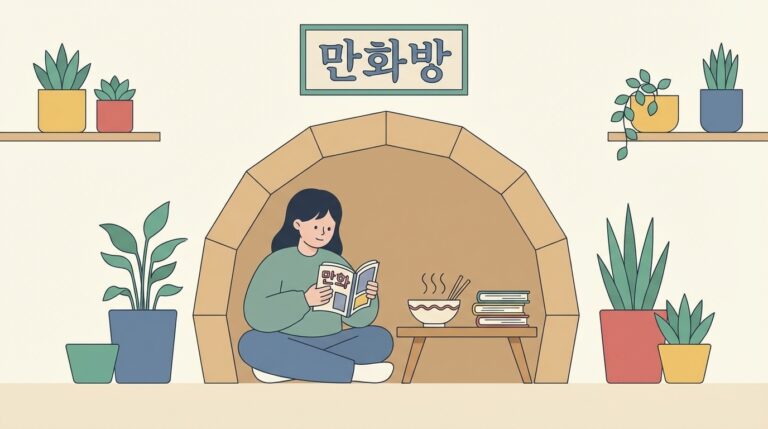
Or perhaps you want to visit a Manhwa Cafe (만화카페, Comic Cafe), just like the cozy, cave-like spots where K-Drama couples eat ramen and read manga together. But how do you ask where a specific comic is? How do you ask if you can read it there?
If you don’t know the right phrases, you might end up buying a book you just wanted to browse, or you might accidentally break a major bookstore rule. Don’t worry! This guide is built from the real, slightly embarrassing experiences of my past students. Let’s make sure you get the insider treatment!
Phase 2: Core Expressions Deep Dive
Here are the absolute must-know survival phrases for A2 learners visiting a Korean bookstore or comic cafe.
1. 이 만화책 어디 있어요?
- Pronunciation: I manhwa-chaek eodi isseoyo? [ee-mahn-hwa-check uh-dee ee-suh-yo?]
(Tip: ‘어’ sounds like the ‘u’ in ‘uh-oh’.)- Meaning: Where is this comic book? (Literal: This comic book, where is it?)
- K-Culture Moment: You walk into a comic cafe with over 10,000 books. You have a screenshot of a webtoon on your phone. You show it to the part-timer at the counter and ask this.
- Editor’s Insight: Korean sentences often drop the subject (I/You) and put the most important thing first. You’re holding the phone, so “이 만화책” (this comic book) becomes the star of the sentence.
- Situation Spectrum:
[🚫 Never] ———— [⚠️ Be Careful] ———— [✅ Freely Use]
- Close Friends (Casual): ⚠️ (To a friend, drop the ‘요’: 이 만화책 어디 있어?)
- Store Staff (Semi-formal): ✅
- Boss/Elders (Formal): ✅ (Perfectly polite for service situations)
- 🤔 Think About It: Why do Koreans use ‘이거’ (this) and point so often instead of using long descriptions? How does this reflect the “Ppalli-Ppalli” (hurry, hurry) culture?
2. 비닐 뜯어도 돼요?
- Pronunciation: Binil tteudeodo dwaeyo? [bee-neel ddeu-duh-doh dway-yo?]
(Tip: ‘뜯’ sounds like a sharp, tense ‘dd’—imagine the sound of plastic stretching and snapping!)- Meaning: Can I open the plastic wrap? (Literal: Plastic wrap tear-off is it okay?)
- K-Culture Moment: You are in a major bookstore. Almost all new comic books and webtoon volumes are sealed in shrink-wrap to prevent damage. You hold the book up to the staff to ask permission.
- Editor’s Insight: This is a lifesaver! If you tear it without asking, you must buy it. Spoiler alert: The answer in a bookstore is almost always “아니요” (No), but asking shows you are a respectful customer.
- Situation Spectrum:
[🚫 Never] ———— [⚠️ Be Careful] ———— [✅ Freely Use]
- Close Friends (Casual): ⚠️ (Drop the ‘요’: 뜯어도 돼?)
- Store Staff (Semi-formal): ✅
- Boss/Elders (Formal): 🚫 (Use a more formal structure: 개봉해도 될까요?)
- 🤔 Think About It: Why are almost all books in Korea sealed? It shows the Korean consumer’s strong preference for pristine, untouched new items. Is it the same in your country?
3. 여기서 읽어도 돼요?
- Pronunciation: Yeogiseo ilgeodo dwaeyo? [yuh-gee-suh eel-guh-doh dway-yo?]
(Tip: ‘읽’ has a complex spelling, but it is pronounced simply as ‘ilg’.)- Meaning: Can I read it here?
- K-Culture Moment: You found a great book in a large bookstore. You see people sitting on the floor or at massive reading tables (like at Kyobo Gwanghwamun). You ask a staff member if it’s okay to sit and read.
- Editor’s Insight: The magic grammar pattern here is
~아/어도 돼요?(Is it okay if I…?). You can attach it to any action! Eat here? 먹어도 돼요? Sit here? 앉아도 돼요?- Situation Spectrum:
[🚫 Never] ———— [⚠️ Be Careful] ———— [✅ Freely Use]
- Close Friends (Casual): ⚠️ (여기서 읽어도 돼?)
- Store Staff (Semi-formal): ✅
- Boss/Elders (Formal): ✅
Phase 3: Textbook vs. Real Korean
| Situation | 📖 Textbook Korean | 🗣️ Real Korean | 💡 Why the difference? |
|---|---|---|---|
| Looking for a book | 만화책을 찾고 있습니다. (I am looking for a comic book.) | 이거 어딨어요? (Where is this?) | Real life values speed. Dropping particles and using ‘이거’ (this) + showing your phone is the fastest way! |
| Asking to open | 이것을 개봉해도 됩니까? (May I unseal this item?) | 비닐 뜯어도 돼요? (Can I tear the plastic?) | “개봉” is a very formal, written word. “비닐 뜯다” is what everyone actually says. |
| Asking to stay | 이곳에서 독서를 해도 될까요? (May I engage in reading at this location?) | 여기서 읽어도 돼요? (Can I read it here?) | Natural spoken Korean favors simple verbs (읽다) over formal noun-verbs (독서하다). |
Bottom Note: For A2 learners, mastering
~도 돼요?(Is it okay to…?) is your golden ticket. It instantly makes you sound like a polite, considerate local!
Phase 4: Cultural Context — K-Culture Deep Dive
4-1. Non-verbal Elements (Nunchi in the Bookstore)
In Korea, reading the room (Nunchi) is everything. When asking a busy bookstore clerk a question, do not yell across the aisle. Approach them, make slight eye contact, do a quick “head bow” (a tiny nod), hold up your phone with the book cover, and ask quietly. Bookstores in Korea are treated almost like libraries!
4-2. K-Drama & K-Food Connection: The “Manhwa Cafe” (만화카페)
If you’ve watched K-Dramas like True Beauty or Business Proposal, you’ve seen the characters hang out in a Manhwa Cafe. These aren’t just libraries! They are trendy, aesthetic spaces filled with tiny, cozy “caves” where you take off your shoes, lie down on pillows, and read comic books for hours.
But here is the best part—the K-Food connection. It is an absolute cultural rule: You MUST eat ramen in a Manhwa Cafe. The staff cooks it for you, often topped with a perfectly soft-boiled egg and green onions. Ordering food there is just as important as picking a book!
Critical View: While dramas make it look like a quiet romantic spot where the male lead stares lovingly at the female lead, real Manhwa cafes on a weekend are packed with people aggressively slurping noodles and binge-reading 20 volumes of their favorite webtoon!
Phase 5: Real-Life Roleplay Scenario
Setting: A trendy Manhwa Cafe in Hongdae, Friday at 8 PM. You just paid for a 2-hour pass and a cozy “cave” spot. The smell of spicy ramen fills the air. You want to find the hit webtoon “True Beauty” (여신강림), but the shelves are overwhelming.
Characters:
– YOU: A K-Drama fan, excited to experience a real Manhwa cafe.
– Jihoon (22): The part-time staff member. Friendly, but currently juggling three pots of boiling ramen.
Dialogue:
YOU: 저기요… 질문 있어요. 🙋♀️
(Jeogiyo… jilmun isseoyo.)
[Excuse me… I have a question.]
Jihoon: 네, 손님! 찾으시는 책 있으세요?
(Ne, sonnim! Chajeusineun chaek isseuseyo?)
[Yes, customer! Is there a book you are looking for?]
YOU: (Showing your phone) 이 만화책 어디 있어요?
(I manhwa-chaek eodi isseoyo?)
[Where is this comic book?]
Jihoon: 아, ‘여신강림’이요! B구역 3번 웹툰 칸에 있습니다.
(Ah, ‘Yeosingangnim’iyo! B-guyeok 3-beon weptun kane itseumnida.)
[Ah, ‘True Beauty’! It’s in Section B, shelf 3, the webtoon section.]
YOU: 감사합니다! 아, 그리고… 🍜
(Gamsahamnida! Ah, geurigo…)
[Thank you! Ah, and…]
🔀 YOUR TURN! How do you ask for food?
– A) 라면 주세요. (Ramen, please.)
– B) 여기서 라면 먹어도 돼요? (Can I eat ramen here?)
– C) 나 배고파. (I’m hungry.)✅ Best Choice: B — Asking
먹어도 돼요?(Can I eat?) is polite and confirms if you can eat inside your reading “cave” (which you usually can!).
⚠️ Choice A Analysis: A bit blunt for a cafe setting unless you are clearly at the ordering register.
🚫 Choice C Analysis: Banmal (informal language)! Never use this with service staff.
(Continuing with B)
YOU: 여기서 라면 먹어도 돼요?
(Yeogiseo ramyeon meogeodo dwaeyo?)
[Can I eat ramen here?]
Jihoon: 네, 당연하죠! 자리로 가져다 드릴까요?
(Ne, dangyeonhajyo! Jariro gajyeoda deurilkkayo?)
[Yes, of course! Shall I bring it to your seat?]
YOU: 네, 감사합니다!
(Ne, gamsahamnida!)
[Yes, thank you!]
(🎭 Stage Direction: You happily crawl into your cozy cave with volume 1 of your webtoon, waiting for your ramen.)
🎁 Bonus Roleplay: The Plastic Wrap Disaster
Setting: A large Kyobo Bookstore.
YOU: (Holding a new, sealed comic book) 이거 비닐 뜯어도 돼요? (Can I tear the plastic?)
Staff: 헉! 아니요, 뜯으시면 구매하셔야 합니다! (Gasp! No, if you tear it, you have to purchase it!)
YOU: 아… 네, 알겠습니다. (Ah… yes, I understand.)
(Crisis averted thanks to asking first!)
Phase 6: 10-Second Shadowing Drill
Let’s practice your pronunciation and flow! Pay attention to the pauses (/) and the emotion tags.
- 🥺 Polite & Curious: 저기요 / 이 만화책 / 어디 있어요?
(jeogiyo / i manhwa-chaek / eodi isseoyo?) - 😳 Cautious: 이거 / 비닐 뜯어도 / 돼요?
(igeo / binil tteudeodo / dwaeyo?) - 😊 Happy & Anticipating: 여기서 / 라면 먹어도 / 돼요?
(yeogiseo / ramyeon meogeodo / dwaeyo?)
Phase 7: K-Culture Mini Dictionary
| Korean | Romanization | English | Context |
|---|---|---|---|
| 만화카페 | manhwa kape | Comic Cafe | A modern, trendy lounge to read comics, sleep, and eat. |
| 웹툰 | weptun | Webtoon | Korean digital comics optimized for scrolling on smartphones. |
| 정주행 | jeongjuhaeng | Binge-watching/reading | Reading a comic from episode 1 to the very end without stopping. |
| 비닐 | binil | Plastic wrap / vinyl | The plastic shrink-wrap protecting new books. |
| 단행본 | danhaengbon | Physical volume | The printed book version of a webtoon. |
Phase 8: Traveler Survival Kit 🎒
Going to a bookstore or Manhwa cafe? Take these flashcards with you!
🆘 Survival Phrases Top 3
1. 🇰🇷 “계산 어디서 해요?” (gyesan eodiseo haeyo?)
– 🗣️ Meaning: Where do I pay?
– 📍 Use it: When you’re ready to leave the bookstore or cafe.
2. 🇰🇷 “화장실 어디 있어요?” (hwajangsil eodi isseoyo?)
– 🗣️ Meaning: Where is the restroom?
3. 🇰🇷 “이거 카카오페이 돼요?” (igeo kakaopei dwaeyo?)
– 🗣️ Meaning: Do you accept Kakao Pay for this?📌 Editor’s Travel Note
– Kyobo vs. Manhwa Cafe: At a bookstore (like Kyobo or YP Books), you cannot eat, and you cannot open sealed books. At a Manhwa Cafe, you pay an hourly fee, you can read everything, and you must try the cafe food!
– Payment in Cafes: Manhwa cafes usually give you a card or a bracelet when you enter. You order food and scan the card. You pay for everything at the end when you leave (후불 – post-pay).
Phase 9: Critical Thinking — “One Step Deeper”
🧠 Think Deeper: Media vs Reality (The Evolution of Comic Culture)
In the past, Korean comic rooms were called Manhwabang (만화방). They were often dark, filled with cigarette smoke, and considered places for middle-aged men to kill time. However, as Webtoons exploded into a massive global industry, the culture shifted completely. Today’s Manhwa Cafes are bright, highly aesthetic ‘dating courses’ marketed to Gen Z and Millennials. It reflects how Korea rapidly reinvents physical spaces to match digital trends. The physical book is no longer just reading material; it’s an aesthetic experience paired with food and comfort.💬 Your Turn: Have physical bookstores or comic shops changed in your country recently? Do they offer food or cozy seating? Share in the comments!
Phase 10: FAQ & Avoiding Misunderstandings
Q: Can I take photos inside a Korean bookstore?
A: Taking photos of yourself or the general store is usually fine (like the famous aesthetic wall at Starfield Library). However, taking close-up photos of the inside pages of a book or magazine is strictly prohibited due to copyright.
Q: Do I have to buy a drink at a Manhwa Cafe?
A: Usually, yes. Most Manhwa cafes require you to buy a “Base Pass” which includes 1 or 2 hours of reading + 1 basic drink (like an Americano or Iced Tea).
❌ Common Mistake #1: Tearing the plastic wrap on a new book!
✅ Do this instead: Look for a sticker that says “견본” (Sample) or “샘플” (Sample). Bookstores usually leave one unwrapped copy for people to flip through. If there isn’t one, you must buy it to read it.❌ Common Mistake #2: Wearing outside shoes in a Manhwa cafe.
✅ Do this instead: Manhwa cafes usually have shoe lockers at the entrance. Put your shoes in, wear the provided indoor slippers, and take the locker key to the front desk!
Phase 11: Summary & Action Items
One-Liner Summary: To survive a Korean bookstore or comic cafe, always ask ~도 돼요? (Is it okay to…?) before opening a book or taking a seat!
🎯 Action Missions:
– 🥉 Bronze (Solo): Look at a book in your room and say out loud: “이거 비닐 뜯어도 돼요?”
– 🥈 Silver (Online): Go to a Webtoon app (like Naver Webtoon) and try to find the Korean title of your favorite webtoon.
– 🥇 Gold (Real Life): Visit a Korean bookstore in your country (or when you travel) and ask the staff “이 만화책 어디 있어요?” showing them a picture.
– 🍜 K-Culture Mission: Search “Korean Manhwa Cafe Vlog” on YouTube. Look closely at how they order food and take off their shoes at the entrance!
Phase 12: Quiz — Interactive Challenge
1. Situational Judgment: You are at Kyobo Bookstore. You really want to see the art style inside a newly released, plastic-wrapped graphic novel. What should you do?
– A) Tear it slightly so no one notices.
– B) Ask: “비닐 뜯어도 돼요?”
– C) Look for a copy with a “견본” (Sample) sticker on it.
2. Fill in the Blank: You want to ask the staff if you can sit at the large table and read.
“여기서 ( ______ ) 돼요?”
3. True or False (K-Culture Edition):
– In a Korean Manhwa Cafe, you must pay for all your food and reading time immediately when you walk in. (T/F)
(Scroll down for answers!)
Click to reveal answers
- Best Answer: C. (If you choose B, they will just tell you ‘No’. Finding the sample is your best bet! Never do A.)
- 읽어도 (ilgeodo – read)
- False (F). Most Manhwa cafes use a “post-pay” (후불) system. You scan a card for everything you order and pay at the very end when you leave.
How did you do on the quiz? Let me know in the comments if you plan to visit a Manhwa Cafe on your next trip to Korea!
Frequently Asked Questions (FAQ)
Q: What does "이 만화책 어디 있어요?" mean in Korean and how do you pronounce it?
A: In Korean, "이 만화책 어디 있어요?" is pronounced [I manhwa-chaek eodi isseoyo? [ee-mahn-hwa-check uh-dee ee-suh-yo?] and means: Where is this comic book? (Literal: This comic book, where is it?)
Q: What does "비닐 뜯어도 돼요?" mean in Korean and how do you pronounce it?
A: In Korean, "비닐 뜯어도 돼요?" is pronounced [Binil tteudeodo dwaeyo? [bee-neel ddeu-duh-doh dway-yo?] and means: Can I open the plastic wrap? (Literal: Plastic wrap tear-off is it okay?)
Q: What does "여기서 읽어도 돼요?" mean in Korean and how do you pronounce it?
A: In Korean, "여기서 읽어도 돼요?" is pronounced [Yeogiseo ilgeodo dwaeyo? [yuh-gee-suh eel-guh-doh dway-yo?] and means: Can I read it here?






