

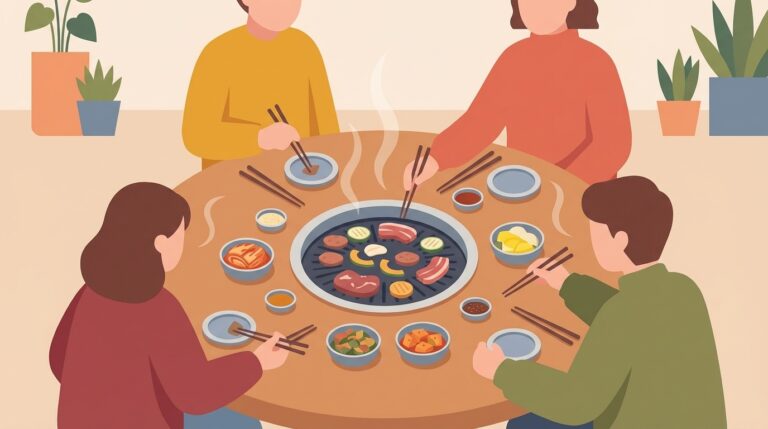
Phase 1: Empathy — The K-Culture Cold Open
Hello there! I’m your Daily Hangul Editor, your local guide to the heart of Korea.
Imagine this: You’re watching your favorite K-Drama. The handsome CEO is introducing his company to a rival, and the subtitle reads, “My company.” But if you listen closely to the Korean audio, he actually says, “Uri hoesa”—which literally translates to “Our company.”
Or even funnier: A married man is talking to his friends about his wife. The subtitle says, “My wife,” but he clearly says, “Uri anae” (Our wife). Wait… what? Are they sharing a wife?
If you’ve ever been confused by this linguistic quirk, you’re not alone! Many of my students at the B2 level hit a wall here. They know the vocabulary, but the mindset feels entirely foreign. Today, we are diving deep into the soul of Korean society: ‘Jeong’ (정) and the Korean Sense of Community.
If you don’t understand this collective mindset, you’ll forever sound like a textbook. But once you grasp it? You’ll unlock a level of fluency that will make locals treat you like an absolute insider. Let’s get started!
Phase 2: Core Expressions Deep Dive
Here are the three essential expressions you need to master the Korean collective mindset.
1. 우리 [Noun] (Our…)
- Pronunciation: [uri] + [Noun] — oo-ree
- Meaning: Literal: “Our” / Real nuance: “My (but acknowledging my place within the community)”
- K-Culture Moment: You’ll hear this everywhere. Koreans say 우리 엄마 (our mom), 우리 집 (our house), and 우리 나라 (our country). It reflects a society where the group’s identity often precedes the individual’s.
- Editor’s Insight: Using “내” (my) isn’t grammatically wrong, but saying “내 나라” (my country) sounds oddly selfish or overly individualistic to Korean ears. “우리” wraps the listener in a warm, communal blanket.
- Situation Spectrum:
[🚫 절대 금지] ———— [⚠️ 주의] ———— [✅ 자유롭게]
- Casual with friends: ✅
- Semi-formal at work: ✅
- Formal with elders: ✅ (Though you might use 저희, the humble form of 우리, when speaking to someone older).
- 🤔 Think About It: Why do you think language shapes our sense of ownership? Does your native language have any words that force you to think about others before yourself?
2. 내가 쏠게! (I’ll treat you!)
- Pronunciation: [naega ssolge] — nae-ga ssol-gge (Make sure that ‘ss’ sounds sharp and confident!)
- Meaning: Literal: “I will shoot!” / Real nuance: “It’s on me! / I’m paying!”
- K-Culture Moment: The dramatic fight at the K-BBQ counter! Two ahjusshis physically blocking each other from the cashier, both screaming, “I’ll pay! No, I’ll pay!”
- Editor’s Insight: In Korea, paying for the group is a massive display of Jeong. It’s not just about money; it’s about taking care of your people.
- Situation Spectrum:
[🚫 절대 금지] ———— [⚠️ 주의] ———— [✅ 자유롭게]
- Casual with friends: ✅
- Semi-formal at work: ⚠️ (Only if you are the senior/older person)
- Formal with elders/bosses: 🚫 (Never say this to your boss. Say “제가 대접하겠습니다” instead).
- 🤔 Think About It: In many Western cultures, “going Dutch” (splitting the bill) is the most polite way to avoid burdening others. Why is the opposite true in Korea?
3. 정들었어요 (I’ve grown attached)
- Pronunciation: [jeong-deureosseoyo] — jeong-deul-uh-sso-yo
- Meaning: Literal: “Jeong has entered” / Real nuance: “I’ve grown fond of you/this place/this thing through shared time.”
- K-Culture Moment: When a K-Pop group sheds tears at their final tour concert, saying they have “jeong-deureosseoyo” with the local fans and crew.
- Editor’s Insight: Jeong isn’t just love or friendship. You can even develop jeong for an old, broken phone, or a neighbor you occasionally argue with. It’s the emotional residue of shared existence.
- Situation Spectrum:
[🚫 절대 금지] ———— [⚠️ 주의] ———— [✅ 자유롭게]
- Casual with friends: ✅
- Formal settings: ✅ (A beautiful thing to say when leaving a company or a host family).
- 🤔 Think About It: Can you translate the exact feeling of Jeong into a single word in your language? Most linguists argue you can’t!
Phase 3: Textbook vs. Real Korean
Let’s see how the collective mindset transforms textbook phrases into real-world Korean.
| Situation | 📖 Textbook Korean | 🗣️ Real Korean | 💡 Why is it different? |
|---|---|---|---|
| Introducing family | 제 어머니입니다 (This is my mother) | 우리 엄마예요 (This is our mom) | Koreans conceptually share “possession” of family units as a community. |
| Paying the bill | 각자 냅시다 (Let’s pay individually) | 오늘은 내가 쏠게! (I’m treating today!) | Building Jeong happens through reciprocal giving, not exact math. |
| Splitting the bill (Modern) | 나눠서 결제합시다 (Let’s divide the payment) | N빵(엔빵) 하자 (Let’s split it N ways) | Young Koreans use this slang for efficiency when they don’t want the burden of treating. |
Bottom Note: For B2 learners, using “우리” perfectly will make locals instantly feel closer to you. If you’re with young friends, drop an “N빵 하자” (N-ppang haja) to sound incredibly street-smart!
Phase 4: Cultural Context — K-Culture Deep Dive
4-1. The Non-Verbal “Jeong” Dance
When someone says “내가 쏠게” (I’ll treat), you cannot just say, “Okay, thanks!” immediately. That’s a social faux pas! You must engage in the Push-and-Pull (Mil-dang) of paying.
1. They offer to pay.
2. You protest: “에이, 아니에요!” (Hey, no!).
3. They insist.
4. You finally concede with deep gratitude: “그럼 감사히 잘 먹겠습니다!” (Then I will eat well/gratefully!).
This requires Nunchi (social awareness) to know exactly when to stop protesting and accept the gift gracefully.
4-2. K-Food Connection: The Ultimate Community Builder
Why do Koreans eat from the same bubbling pot of jjigae (stew) with their own spoons? Why are side dishes (banchan) shared in the middle of the table?
In Korean food culture, eating together is the purest expression of community. In fact, the Korean word for family members is 식구 (Sikgu), which literally translates to “mouths that eat together.” Sharing food isn’t just about sharing calories; it’s about sharing breath, time, and Jeong. When a restaurant owner gives you a free soft drink and says “서비스예요” (It’s service), that’s not a marketing tactic—that’s Jeong on a plate.
Phase 5: Real-Life Roleplay Scenario
Setting: Friday night, 7 PM. A bustling K-BBQ place near Gangnam Station. The air is thick with the savory smoke of pork belly, and green soju bottles line the tables. You are with three of your Korean co-workers after a long week of business meetings.
Characters:
– YOU: A foreign professional, currently on day 3 of your Seoul business trip.
– Minsu (32): Your Korean colleague. He’s humorous, warm, and wants to make sure you love Korea.
Dialogue:
Minsu: 아, 오늘 고기 진짜 맛있네요!
(A, oneul gogi jinjja masinneyo!)
[Ah, the meat is really delicious today!]
YOU: 맞아요! 한국 바베큐는 최고예요.
(Majayo! Hanguk babekyuneun choegoyeyo.)
[Right! Korean BBQ is the best.]
Minsu: 그죠? 여러분, 오늘은 우리 팀이 고생했으니까, 오늘은 내가 쏠게! 🥩
(Geujyo? Yeoreobun, oneureun uri timi gosaenghaesseunikka, oneureun naega ssolge!)
[Right? Everyone, since our team worked hard today, I’m treating today!]
(Stage Direction: Minsu dramatically pulls out his corporate credit card and winks)
🔀 Your Turn! How should you respond?
– A) “아, 감사합니다! 잘 먹겠습니다!” (Oh, thank you! I will eat well!)
– B) “에이, 아니에요. 오늘은 제가 살게요!” (Hey, no way. I’ll buy today!)
– C) “진짜요? 대박! 무조건 콜!” (Really? Awesome! Absolutely yes!)✅ Best Choice: B — Why? As mentioned in the “Jeong Dance,” putting up a mild protest shows humility and politeness. Once Minsu insists again, you can transition to Answer A.
⚠️ Choice A Analysis: Safe and textbook-perfect, but doing the little protest first builds a stronger bond.
⚠️ Choice C Analysis: “Daebak” is fun, but slightly too casual for a work dinner, even if Minsu is friendly.
Phase 6: 10-Second Shadowing Drill
Practice the push-and-pull of paying the bill! Pay attention to the pauses (/) and the emotion tags.
😮 (Surprised) 에이, / 뭘 그래요! (E-i, / mwol geuraeyo!)
😊 (Warmly) 오늘은 / 제가 / 살게요. (Oneureun / jega / salgeyo.)
🙏 (Grateful) 그럼 / 감사히 / 잘 먹겠습니다! (Geureom / gamsahi / jal meokgetseumnida!)
Phase 7: K-Culture Mini Dictionary
| 한국어 | Romanization | English | Cultural Context |
|---|---|---|---|
| 눈치 | nunchi | Social intelligence / reading the room | The core Korean skill of assessing the mood and knowing how to act within the community. |
| 회식 | hoesik | Company dinner | The ultimate team-building ritual. It’s an extension of work, driven by the collective mindset. |
| 식구 | sikgu | Family (literally: mouths eating together) | Emphasizes that true bonds are formed by sharing meals, not just bloodlines. |
| 단합 | danhap | Unity / Teamwork | Often used in “단합대회” (Unity events) to build Jeong among groups. |
Phase 8: Traveler’s Survival Kit
Experiencing Jeong as a traveler is one of the best parts of visiting Korea. You might find yourself sharing a table in a crowded market or receiving extra food from a kind grandmother!
🆘 Survival Expressions TOP 3
– 🇰🇷 “서비스예요?” (seobiseuyeyo?) — Is this on the house?
– 📍 Where to use: When a restaurant owner suddenly brings you an egg roll you didn’t order. Say this with a big smile!
– 🇰🇷 “합석해도 될까요?” (hapseokaedo doelkkayo?) — Can we share this table?
– 📍 Where to use: Crowded traditional markets like Gwangjang Market where communal seating is the norm.
– 🇰🇷 “반찬 좀 더 주실 수 있나요?” (banchan jom deo jusil su innayo?) — Can I get more side dishes?
– 📍 Where to use: Any K-BBQ or traditional restaurant. Refills are usually free, thanks to Jeong!📌 Editor’s Travel Note
– Tip Culture: There is absolutely NO tipping in Korea. If you try to leave money on the table, the waiter might chase you down the street thinking you forgot your change! Excellent service is considered a given, part of communal hospitality.
Phase 9: Critical Thinking Corner — “One Step Deeper”
🨀 Think Deeper: Language & Power vs. Solidarity
The widespread use of “우리” (We/Our) reveals a fascinating tension in Korean society. On one hand, Korea has a strict hierarchical language system based on age and status (honorifics). Yet, paradoxically, the vocabulary of collectivism—like calling strangers “이모” (Auntie) at a restaurant or using “우리” for personal belongings—pulls everyone into a horizontal, family-like solidarity. It shows that beneath the strict social hierarchy, there is a deep craving for egalitarian connection and Jeong.
💬 Your Turn: Does your culture value individualism or collectivism more? How does that reflect in the way you address strangers or talk about your family? Let us know in the comments!
Phase 10: FAQ & Avoiding Misunderstandings
Q: Can I use “우리” (our) when talking to my boss?
Yes! But if you are referring to a group that includes you and the boss (e.g., “our team”), you use 저희 팀 (jeohui tim). “저희” is the humble form of “우리”. Never use “저희 나라” (our country) though; you don’t lower your country to be polite!
Q: Is it rude to eat alone in Korea?
Historically, yes, it looked a bit sad due to the community culture. But nowadays, 혼밥 (Hon-bap), which means “eating alone,” is incredibly trendy and common, especially among younger generations!
❌ Common Mistake #1: Saying “내 남폨” (My husband) or “내 아내” (My wife) when speaking to an older Korean.
✅ Do this instead: Say “저희 남폨” or “저희 아내”. It sounds much more natural and polite to Korean ears.
Phase 11: Summary & Action Items
✨ One-Liner Summary: To master Korean, you must shift your mindset from “I and My” to “We and Our” (우리), embracing the collective warmth of Jeong.
Your Action Missions:
– 🥉 Bronze: Say “우리 엄마” and “내가 쏠게” out loud in front of a mirror 3 times.
– 🥈 Silver: Leave a comment below using the word “우리” with a noun! (e.g., 우리 강아지 – our puppy).
– 🥇 Gold: Next time you go out with a Korean friend, beat them to the cashier and confidently say, “오늘은 내가 쏠게!”
🎬 K-Culture Mission: Watch one episode of your favorite K-Drama today. Listen carefully to how the characters introduce their family members or their company. Can you catch the moment they say “우리”?
Phase 12: Interactive Challenge Quiz
1. Fill in the Blank:
You want to introduce your dog to your Korean friend.
“이쪽은 ______ 강아지예요!” (This is my dog!)
– A) 내 (nae)
– B) 우리 (uri)
2. True or False – K-Culture Edition:
If a Korean friend offers to pay the bill for dinner, you should immediately hand them your half of the money in cash to be polite.
3. Situational Judgment:
You are at a K-BBQ restaurant and the owner brings you a steaming bowl of steamed egg (계란찜) that you didn’t order. What should you say?
– A) 저희 이거 안 시켰어요. (We didn’t order this.)
– B) 팁을 얼마나 드릴까요? (How much tip should I give?)
– C) 와, 서비스예요? 감사합니다! (Wow, is this service? Thank you!)
(Answers: 1. B – Using Uri sounds way more natural! / 2. False – Engage in the push-and-pull, then let them treat you. You can buy the coffee afterward! / 3. C – Accept the Jeong gracefully!)
Frequently Asked Questions (FAQ)
Q: What does "우리 [Noun] (Our...)" mean in Korean and how do you pronounce it?
A: In Korean, "우리 [Noun] (Our...)" is pronounced [uri] and means: Literal: "Our" / Real nuance: "My (but acknowledging my place within the community)"
Q: What does "내가 쏠게! (I'll treat you!)" mean in Korean and how do you pronounce it?
A: In Korean, "내가 쏠게! (I'll treat you!)" is pronounced [naega ssolge] and means: Literal: "I will shoot!" / Real nuance: "It's on me! / I'm paying!"
Q: What does "정들었어요 (I've grown attached)" mean in Korean and how do you pronounce it?
A: In Korean, "정들었어요 (I've grown attached)" is pronounced [jeong-deureosseoyo] and means: Literal: "Jeong has entered" / Real nuance: "I've grown fond of you/this place/this thing through shared time."







