

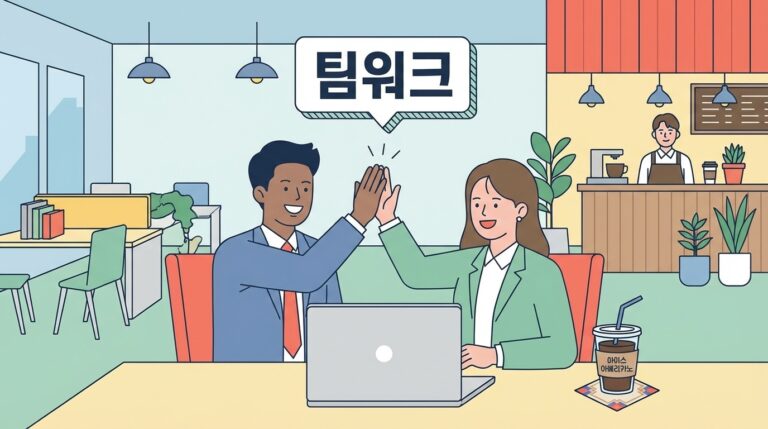
Survive Korean Office Life: Magic Phrases to Hype Up Teamwork!
Phase 1: Empathy (The K-Drama Office Vibe)
안녕하세요! I’m your Daily Hangul Editor.
Picture this: It’s 10 PM. You’re watching a K-Drama like Misaeng or Start-Up. The team has just averted a massive crisis. The exhausted team leader looks around the room, smiles, and says a single phrase. Suddenly, everyone cheers, grabs their coats, and heads out for some late-night Samgyeopsal (pork belly) and Soju.
The subtitles might just say, “Great job, everyone.” But was it really just that?
In Korean office culture, emphasizing “Teamwork” (팀워크) and collective effort is the ultimate cheat code to building strong relationships with your colleagues. If you only use textbook translations like “Cooperation is important,” you’ll sound like a robot. But if you know the real phrases that Koreans use to hype each other up, you won’t just be a foreign coworker—you’ll become a true “Insider” (인싸).
This guide is packed with real-world tips from my years of teaching expats working in Seoul. Let’s dive into the phrases that will make your Korean colleagues say, “Wow, how do you know that?”
Phase 2: Core Expressions Deep Dive
Here are the top 3 expressions to emphasize teamwork, straight from a Seoul office.
1. 손발이 척척 맞아요.
- Pronunciation: son-ba-ri cheok-cheok ma-ja-yo + [Sound analogy: cheok-cheok sounds like the rhythmic chopping of a knife or footsteps marching perfectly in sync.]
- Meaning: (Literal) Our hands and feet match perfectly. / (Real nuance) We have great chemistry; we are perfectly in sync.
- K-Culture Moment: You’re at a Korean BBQ place. Without saying a word, one person grills the meat, another cuts it, and you pour the drinks. Someone points this out and says, “Wow, our hands and feet match perfectly!”
- Editor’s Insight: This isn’t just for physical tasks. You can use it when you and a coworker finish a presentation smoothly without overlapping. It feels very rewarding!
- Situation Spectrum:
[🚫 절대 금지] ———— [⚠️ 주의] ———— [✅ 자유롭게]
- Casual (Friends): ✅
- Semi-formal (Coworkers): ✅
- Formal (Boss): ⚠️ (Use with polite endings, e.g., “저희 팀은 손발이 참 잘 맞는 것 같습니다.”)
- 🤔 Think About It: Why does Korean use body parts (hands and feet) to describe teamwork? Does your native language have a physical metaphor for good chemistry?
2. 우리 같이 으쌰으쌰 해봐요!
- Pronunciation: u-ri ga-chi eu-ssya-eu-ssya hae-bwa-yo! + [eu-ssya sounds like the grunt you make when lifting heavy boxes together.]
- Meaning: (Literal) Let’s do ‘eussya-eussya’ together! / (Real nuance) Let’s pump ourselves up and do this together! Let’s go team!
- K-Culture Moment: A K-Pop idol group is standing backstage before a huge concert. The leader gathers them in a circle, they put their hands in, and shout this to boost morale.
- Editor’s Insight: This is a very lively, positive, and slightly cute expression. It’s perfect for rallying your peers when everyone is feeling tired on a Wednesday afternoon.
- Situation Spectrum:
[🚫 절대 금지] ———— [⚠️ 주의] ———— [✅ 자유롭게]
- Casual (Friends): ✅
- Semi-formal (Coworkers): ✅
- Formal (Boss): 🚫 (Too playful to say to a CEO!)
- 🤔 Think About It: Koreans love using onomatopoeia (sound words) and mimetic words in daily conversation to add emotion. How does saying “eu-ssya-eu-ssya” feel different from simply saying “Let’s work hard”?
3. 백지장도 맞들면 낫다잖아요.
- Pronunciation: baek-ji-jang-do mat-deul-myeon nat-da-ja-na-yo
- Meaning: (Literal) Even a blank sheet of paper is better if lifted together. / (Real nuance) Two heads are better than one; let’s share the burden.
- K-Culture Moment: Your coworker is staring at their monitor, sighing deeply because they have too much data to enter. You slide your chair over and say this as you offer to take half the load.
- Editor’s Insight: This is a classic Korean proverb (속담). Using a proverb at the B1 level instantly makes you sound highly educated and empathetic.
- Situation Spectrum:
[🚫 절대 금지] ———— [⚠️ 주의] ———— [✅ 자유롭게]
- Casual (Friends): ✅
- Semi-formal (Coworkers): ✅
- Formal (Boss): ✅ (Shows you are a supportive team player)
- 🤔 Think About It: This proverb highlights that even the easiest task (lifting paper) should be shared. What does this tell you about the Korean value of “togetherness”?
Phase 3: Textbook vs. Real Korean
| Situation | 📖 Textbook Korean | 🗣️ Real Korean | 💡 Why is it different? |
|---|---|---|---|
| Praising good teamwork | 협동심이 아주 좋습니다. (Cooperation is very good.) | 우리 팀 완전 손발이 척척 맞네요! | “협동심” sounds like a military or school evaluation. Metaphors sound more natural and human. |
| Cheering the team up | 다 같이 열심히 일합시다. (Let’s all work hard.) | 우리 다 같이 으쌰으쌰 해봐요! 파이팅! | Standard phrases lack emotional energy. Sound words (으쌰으쌰) build instant hype! |
| Offering help to a busy teammate | 제가 당신을 돕겠습니다. (I will help you.) | 백지장도 맞들면 낫다잖아요. 제가 좀 거들게요. | Saying “I will help you” directly can sometimes hurt pride; proverbs make the offer feel culturally warm and obligatory. |
(Bottom Note: As a B1 learner, try swapping out dry vocabulary words for these vivid idioms. Your colleagues will be pleasantly surprised!)
Phase 4: Cultural Context — K-Culture Deep Dive
4-1. The Non-Verbal Language of Teamwork
In Korea, teamwork isn’t just about what you say; it’s about Nunchi (눈치). Nunchi is the art of reading the room. If your team is stressed and working late, sneaking out exactly at 6:00 PM without saying anything might be seen as lacking teamwork.
Even if you must leave, simply saying, “I’m so sorry I have to leave first, is there anything I can help with tomorrow morning?” shows you are a team player.
4-2. The “Hoesik” (회식) Culture
You can’t talk about Korean office teamwork without mentioning Hoesik (Company Dinners).
Have you seen this trope in K-Dramas? The team finishes a big project and immediately heads to a BBQ restaurant. In the past, Hoesik was almost mandatory and involved a lot of drinking. Today, it’s becoming much more casual—sometimes teams go to fancy cafes or watch a movie together instead!
However, the core purpose remains: breaking the ice. Sharing food from the same grill, pouring drinks for each other (remember: pour with two hands for your seniors!), and shouting “Geonbae!” (Cheers) is the ultimate Korean bonding ritual.
Phase 5: Real-world Roleplay Scenario
Setting: Friday evening, 7 PM. A smoky, bustling Samgyeopsal (pork belly) restaurant near Gangnam Station. Green Soju bottles line the table. You are sitting with three Korean colleagues after surviving a brutal week of presentations.
Characters:
– YOU: A foreign employee in your 3rd month at the Korean office. You want to bond with the team.
– Minsu (32): Your Korean coworker. Friendly, humorous, and currently holding the BBQ tongs.
Action! 🎬
Minsu: 아, 이번 주 진짜 힘들었죠? 그래도 프로젝트 잘 끝나서 다행이에요. 🥩
(a, i-beon ju jin-jja him-deu-reot-jyo? geu-rae-do peu-ro-jek-teu jal kkeun-na-seo da-haeng-i-e-yo.)
[Translation: Ah, this week was really tough, right? Still, I’m glad the project finished well.]
(🎭 Stage Direction: Minsu flips the pork belly perfectly and smiles at you)
YOU: 맞아요. 민수 대리님이 많이 도와주셔서 무사히 끝났어요.
(ma-ja-yo. Min-su dae-ri-ni-mi ma-ni do-wa-ju-syeo-seo mu-sa-hi kkeun-na-sseo-yo.)
[Translation: That’s right. Assistant Manager Minsu, thanks to your help, we finished it safely.]
Minsu: 에이, 무슨 소리예요! 다 같이 고생했죠.
(e-i, mu-seun so-ri-ye-yo! da ga-chi go-saeng-haet-jyo.)
[Translation: Hey, what are you talking about! We all worked hard together.]
🔀 YOUR TURN! How do you respond to hype up the team?
– A) “네, 감사합니다. 고기 맛있네요.”
– B) “그러게요! 우리 팀 완전 손발이 척척 맞잖아요!”
– C) “제가 최고죠!”✅ Best Choice: B — “I know, right! Our team’s hands and feet match perfectly (we have great chemistry)!” This praises everyone, uses a native idiom, and perfectly fits the warm, collaborative vibe of a Hoesik.
⚠️ Choice A Analysis: A bit too dry and textbook-like. It kills the celebratory mood.
❌ Choice C Analysis: “I’m the best!” Even if it’s a joke, boasting individually in a Korean team setting can sometimes be misinterpreted. Humility and praising “us” is always safer!
Phase 6: 10-Second Shadowing Drill
Let’s practice the rhythm! Pay attention to the pauses (/) and the emotion.
😤 (With determination) 이번 프로젝트 / 진짜 어려웠지만 / (😊 Brightly) 백지장도 / 맞들면 낫다잖아요! / 우리 같이 / 으쌰으쌰 해봐요!
(i-beon peu-ro-jek-teu / jin-jja eo-ryeo-wot-ji-man / baek-ji-jang-do / mat-deul-myeon nat-da-ja-na-yo! / u-ri ga-chi / eu-ssya-eu-ssya hae-bwa-yo!)
Phase 7: K-Culture Mini Dictionary
| 한국어 (Korean) | Romanization | English | Context |
|---|---|---|---|
| 눈치 | nunchi | Social sense / Tact | The ability to read the atmosphere. “눈치가 빠르다” means you catch on quickly. |
| 회식 | hoesik | Company dinner | An after-work gathering. Essential for team bonding in Korea. |
| 으쌰으쌰 | eu-ssya-eu-ssya | Heave-ho! / Let’s go! | A mimetic word used to encourage a group to work hard together. |
| 일행 | il-haeng | One’s party/group | Used when referring to the people you are traveling or eating with. |
Phase 8: Traveler Survival Kit (Teamwork Edition!)
Even if you aren’t working in an office, you need “teamwork” phrases when traveling in Korea with a group of friends!
🆘 Survival Expressions for Group Travel
– 🇰🇷 “저희 일행이에요.” (jeo-hui il-haeng-i-e-yo)
– 🗣️ English: We are together. (We are one party.)
– 📍 Where to use: When entering a crowded cafe, restaurant, or waiting in line.
- 🇰🇷 “같이 계산해 주세요.” (ga-chi gye-san-hae ju-se-yo)
- 🗣️ English: Please ring us up together. / We’ll pay together.
- 📍 Where to use: At the convenience store or restaurant counter.
📌 Editor’s Travel Note
– Splitting the bill (더치페이): In the past, the oldest person or the boss usually paid for everyone. Today, younger Koreans often split the bill (Dutch pay). You can say “따로 결제할게요” (We will pay separately) at cafes!
– Seating: If you are a group of 5 or more, it can be hard to find seating in small Seoul restaurants. Always ask: “다섯 명 앉을 자리 있나요?” (Do you have seats for five?)
Phase 9: Critical Thinking — “One Step Deeper”
🧠 Think Deeper: The Power of “Uri” (우리 – We/Our)
Have you ever noticed that Koreans say “Our mother” (우리 엄마), “Our country” (우리나라), or “Our company” (우리 회사) instead of “My mother” or “My company”?
In Korean culture, identity is deeply rooted in the community. Historically, Korea was an agricultural society where planting rice required an entire village to work perfectly in sync (hence, “hands and feet matching”). This collective mindset trickles down into modern language. When you emphasize “We” over “I” in a Korean office, you aren’t just being polite; you are tapping into a centuries-old cultural DNA that values harmony and shared destiny.
💬 Your Turn: Does your culture value individual achievement more, or collective teamwork? How does your language reflect that? Let me know in the comments!
Phase 10: FAQ & Avoiding Misunderstandings
Q: Can I say “파이팅!” (Hwaiting/Fighting) to my boss to cheer them up?
A: ⚠️ Maybe, but be careful! “파이팅” is a bit casual. If you say it to an older, strict boss, it might sound like you are treating them like a child. Instead, say “오늘도 좋은 하루 보내십시오!” (Have a great day today!) or simply show support through your actions.
❌ Common Mistake #1: Saying “수고하세요” (Work hard) to someone older/higher ranked.
✅ Do this instead: “수고하세요” sounds like a command. If you want to acknowledge their hard work, say “고생 많으셨습니다” (You’ve suffered/worked hard) or simply “감사합니다” (Thank you).❌ Common Mistake #2: Calling your coworker “당신” (You).
✅ Do this instead: NEVER use “당신” in the office! It can sound confrontational. Always use their title + 님 (e.g., 민수 대리님, 지민 팀장님).
Phase 11: Summary & Action Items
One-Liner Summary: To survive a Korean office, swap dry textbook words for vivid, culturally rich idioms like “손발이 척척 맞다” and “으쌰으쌰”!
🚀 Your Action Missions:
– 🥉 Bronze (Solo): Stand in front of a mirror and say “우리 같이 으쌰으쌰 해봐요!” with a big smile, complete with a fist pump!
– 🥈 Silver (Online): Go to a K-Pop idol’s YouTube video and leave a comment: “우리 팀 최고! 멤버들 손발이 척척 맞아요!”
– 🥇 Gold (Real World): Next time you tackle a group task or project with Korean friends/colleagues, surprise them by saying, “백지장도 맞들면 낫다잖아요. 제가 도울게요.”
🎭 K-Culture Mission: Watch one episode of a Korean office drama (like Misaeng, Start-Up, or Business Proposal). Count how many times they say “우리” (Uri – We/Our) instead of “내” (Nae – My) during team meetings!
Phase 12: Quiz — Interactive Challenge
1. Fill in the blank:
You and your coworker just assembled 50 gift boxes in record time without even speaking. You high-five and say:
“와, 우리 진짜 ( ) 척척 맞네요!”
(Hint: Body parts!)
2. Situational Judgment:
Your team leader looks exhausted carrying a heavy box of documents. What is the most culturally appropriate (B1 level) thing to say as you run over to help?
– A) 제가 하겠습니다. 당신은 쉬세요. (I will do it. You rest.)
– B) 백지장도 맞들면 낫다잖아요. 제가 같이 들게요. (Even a paper is lighter together. I’ll help you carry it.)
– C) 팀장님, 파이팅!
3. True or False (K-Culture Edition):
In a Korean office, leaving exactly at 6:00 PM without saying a single word to your team who is pulling an all-nighter is considered totally normal and acceptable. (T/F)
(Answers: 1. 손발이 / 2. B – Choice A uses the forbidden word ‘당신’ / 3. False – Always use Nunchi! A polite “먼저 들어가보겠습니다” and offering small help goes a long way.)
Frequently Asked Questions (FAQ)
Q: What does "손발이 척척 맞아요." mean in Korean and how do you pronounce it?
A: In Korean, "손발이 척척 맞아요." is pronounced [son-ba-ri cheok-cheok ma-ja-yo + [Sound analogy: cheok-cheok sounds like the rhythmic chopping of a knife or footsteps marching perfectly in sync.] and means: (Literal) Our hands and feet match perfectly. / (Real nuance) We have great chemistry; we are perfectly in sync.
Q: What does "우리 같이 으쌰으쌰 해봐요!" mean in Korean and how do you pronounce it?
A: In Korean, "우리 같이 으쌰으쌰 해봐요!" is pronounced [u-ri ga-chi eu-ssya-eu-ssya hae-bwa-yo! + [eu-ssya sounds like the grunt you make when lifting heavy boxes together.] and means: (Literal) Let's do 'eussya-eussya' together! / (Real nuance) Let's pump ourselves up and do this together! Let's go team!
Q: What does "백지장도 맞들면 낫다잖아요." mean in Korean and how do you pronounce it?
A: In Korean, "백지장도 맞들면 낫다잖아요." is pronounced [baek-ji-jang-do mat-deul-myeon nat-da-ja-na-yo] and means: (Literal) Even a blank sheet of paper is better if lifted together. / (Real nuance) Two heads are better than one; let's share the burden.







