

Phase 1: Empathy
Hello there! I’m the Lead Editor at Daily Hangul.
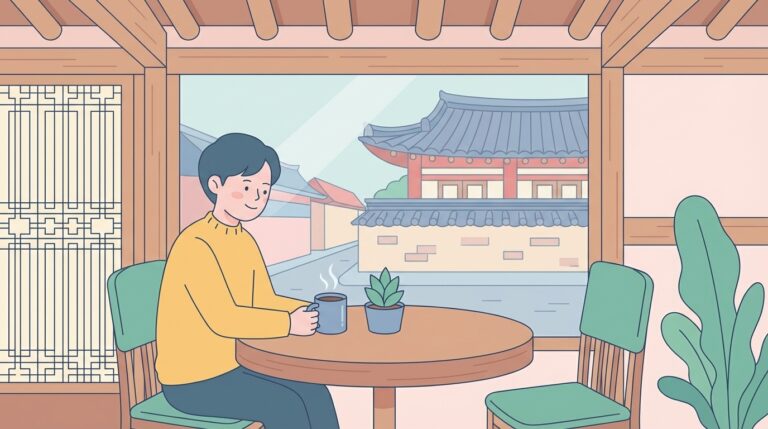
Picture this: You just scored the absolute best window seat in a trendy cafe in Seongsu-dong. The aesthetic is perfect, the vibe is immaculate, just like a scene straight out of a K-Drama. But there’s a problem—your friend is running 10 minutes late.
The barista catches your eye and walks over, menus in hand, asking with a polite smile if you’re ready to order. Panic sets in. Do you just say “Sorry”? Do you quickly buy a random drink you don’t even want just to secure the table? In K-Dramas, the protagonist might just gaze melancholically out the window while a ballad plays in the background. But in reality, standing there silently will just make things awkward.
Don’t worry! This is a classic pain point for many travelers and beginner learners. Knowing how to politely tell cafe staff that you are waiting for a friend won’t just save you from an awkward encounter—it will instantly make you look like a seasoned local who understands Korean cafe etiquette. Let’s dive into the phrases you actually need!
Phase 2: Deep Dive into Core Expressions
Here are the top three phrases you need to master. We are keeping it at an A2 level, so focus on the feeling and the vocabulary chunks rather than complex grammar.
1. 일행 기다리고 있어요. (I’m waiting for my party.)
- Pronunciation: [il-haeng gi-da-ri-go i-sseo-yo]
- Sound-alike guide: ‘il’ sounds like ‘eel’, ‘haeng’ rhymes with ‘hang’.
- Meaning: Literal: “I am waiting for my party/company.” / Real nuance: “I have people joining me, please give me a moment.”
- K-Culture Moment: This is the ultimate “Insider” word. Whether you are at a cafe, a BBQ restaurant, or a theme park, using the word 일행 (ilhaeng) instead of “friend” instantly elevates your Korean. It sounds polite, mature, and very natural.
- Editor’s Insight: This is your golden shield. It politely signals to the staff that you aren’t just loitering for free Wi-Fi, but you are a paying customer whose group isn’t fully assembled yet.
- Situation Spectrum:
[🚫 Never] ———— [⚠️ Caution] ———— [✅ Freely]
- Close Friends (Casual): ⚠️ (You wouldn’t use this to your friends, but about them to staff)
- Cafe Staff (Semi-formal): ✅
- Formal/Elders: ✅
- 🤔 Think About It: Notice how Korean uses a collective word like “party/group” (일행) instead of “my friend” in public service situations. How does this reflect Korea’s group-oriented culture compared to your home country?
2. 친구 오면 주문할게요. (I’ll order when my friend comes.)
- Pronunciation: [chin-gu o-myeon ju-mun-hal-ge-yo]
- Sound-alike guide: ‘o-myeon’ sounds like ‘oh-myon’ (if/when they come).
- Meaning: Literal: “If friend comes, I will order.” / Real nuance: “I’ll place my order once my friend gets here.”
- K-Culture Moment: Korean cafes are busy, and efficiency is key. By adding “I will order,” you reassure the cafe owner that you are aware of the “1인 1음료” (1 person, 1 drink) rule, which is a big deal in Korea!
- Editor’s Insight: The ending ‘-ㄹ게요’ (-lgeyo) shows your active intention or promise. It’s like saying, “I promise I will buy something soon!”
- Situation Spectrum:
[🚫 Never] ———— [⚠️ Caution] ———— [✅ Freely]
- Close Friends: 🚫 (Too formal for friends)
- Cafe Staff (Semi-formal): ✅
- Formal/Elders: ⚠️ (Slightly casual for very high-end hotel lounges, but perfect for regular cafes)
- 🤔 Think About It: Why do you think Korean cafes are so strict about the “one drink per person” rule?
3. 이따가 일행 오면 시킬게요. (I will order later when my party arrives.)
- Pronunciation: [i-tta-ga il-haeng o-myeon si-kil-ge-yo]
- Sound-alike guide: ‘i-tta-ga’ (ee-ttah-gah) means later. ‘si-kil-ge-yo’ is a more casual/spoken way to say “order.”
- Meaning: Literal: “Later, when party comes, I will order.” / Real nuance: “I’ll order in a bit when the rest of my group is here.”
- K-Culture Moment: The word ‘이따가’ (later) is used constantly in daily life. If your friend is taking forever because they are stuck on the Seoul subway, this is the phrase to use.
- Editor’s Insight: ‘주문하다’ (to order) is standard, but ‘시키다’ (to order/make someone do) is what locals use naturally in conversation.
- Situation Spectrum:
[🚫 Never] ———— [⚠️ Caution] ———— [✅ Freely]
- Cafe Staff: ✅ (Very natural and native-like)
Phase 3: Textbook vs. Real Korean
Let’s see how you sound when you step out of the textbook and into a bustling Hongdae cafe.
| Situation | 📖 Textbook Korean | 🗣️ Real Korean | 💡 Why the difference? |
|---|---|---|---|
| Telling staff you are waiting | 저는 친구를 기다립니다. (I am waiting for a friend.) | 일행 기다리고 있어요. (Waiting for my party.) | Textbooks teach formal endings (-ㅂ니다) and pronouns (저). Locals drop pronouns and use the softer (-아요/어요) ending. |
| Telling staff you will order later | 나중에 주문하겠습니다. (I will order later.) | 친구 오면 시킬게요. (I’ll order when my friend gets here.) | Using ‘시키다’ instead of ‘주문하다’ sounds much more casual and conversational in food settings. |
| Telling your friend where you are sitting | 나는 창문 옆에 앉아 있어. (I am sitting next to the window.) | 나 창가 자리 잡았어! (I grabbed a window seat!) | “자리 잡다” (to grab/secure a seat) is a crucial cultural concept in crowded Korean cafes! |
Phase 4: Cultural Context — K-Culture Deep Dive
4-1. Non-verbal Nunchi (눈치)
When you tell the barista you are waiting, you don’t need to over-apologize. A soft smile and a slight nod of the head (about 15 degrees) while saying “일행 기다리고 있어요” is perfect. In Korea, maintaining a harmonious atmosphere without being an inconvenience is part of 눈치 (Nunchi)—the art of reading the room.
4-2. The “Laptop & Belongings” Phenomenon
If you’ve watched K-Dramas or travel vlogs, you might have seen a peculiar sight: Koreans leaving their expensive laptops, smartphones, or designer bags on a cafe table and just walking away to the restroom.
This is the ultimate “seat reservation” (자리 맡기) culture! Korea is incredibly safe when it comes to personal belongings in cafes. If your friend says they are arriving in 5 minutes, it is perfectly normal to drop your bag at a table, go up to the counter, tell them “일행 오면 주문할게요” (I’ll order when my party arrives), and then wait.
Critical View: While physical items are safe, “space” is highly contested. That’s why the “1인 1음료” (1 person, 1 drink) rule exists. Since people study or chat for hours, cafe owners need to ensure every seat generates revenue. If you sit without ordering for too long, you might get some heavy nunchi from the staff!
Phase 5: Real-Life Roleplay Scenario
Setting: A popular dessert cafe in Yeonnam-dong. It’s Saturday afternoon, 2 PM. The place is packed, but you managed to secure a small table for two.
Characters:
– YOU: A traveler exploring Seoul. Your Korean friend is stuck in traffic.
– Barista (NPC): Wearing a neat apron, holding a menu, looking slightly stressed by the crowd.
Dialogue:
Barista: (Approaching your table) 안녕하세요, 혹시 주문하셨을까요? 😊
(Annyeonghaseyo, hoksi jumunhasyeosseulkkayo?)
[Hello, have you ordered by any chance?]
You: 아, 아직이요.
(Ah, ajigiyo.)
[Ah, not yet.]
Barista: 메뉴판 여기 있습니다. 카운터에서 주문 도와드릴게요.
(Menyupan yeogi itseumnida. Kaunteo-eseo jumun dowadeurilgeyo.)
[Here is the menu. I will help you order at the counter.]
🔀 YOUR TURN! How do you respond?
– A) “죄송합니다. 저는 친구를 기다립니다.” (Sorry. I am waiting for a friend.)
– B) “일행 오면 같이 주문할게요!” (I’ll order together when my party arrives!)
– C) “잠시만요!” (Hold on a second!)✅ Best Choice: B. It clearly communicates your situation politely and naturally.
Why not A? It sounds like a robot from a 1990s textbook.
Why not C? It can sound a bit abrupt and slightly rude to a busy worker if not said with an extremely polite tone.
(🎭 Stage Direction: You smile and choose Option B)
You: 일행 오면 같이 주문할게요!
(Ilhaeng omyeon gachi jumunhalgeyo!)
[I’ll order together when my party arrives!]
Barista: 네, 알겠습니다. 천천히 메뉴 보시고 카운터로 와주세요.
(Ne, algesseumnida. Cheoncheonhi menyu bosigo kaunteo-ro wajuseyo.)
[Yes, understood. Please take your time looking at the menu and come to the counter.]
K-Culture Bonus Scenario: Texting your friend
(Your friend texts: “Omg I’m so sorry, I’m 10 mins away! Did you order?”)
You: 괜찮아! 나 창가 자리 잡았어. 천천히 와~
(Gwaenchana! Na changga jari jabasseo. Cheoncheonhi wa~)
[It’s okay! I grabbed a window seat. Take your time~]
Phase 6: 10-Second Shadowing Drill
Practice speaking out loud! Follow the slashes for natural pauses and emphasize the bold syllables.
😊 (Polite & Brightly)
일행 / 기다리고 있어요.
(IL-haeng / gi-da-ri-go i-sseo-yo.)😌 (Reassuring the staff)
일행 오면 / 같이 / 주문할게요.
(IL-haeng o-myeon / ga-chi / ju-mun-hal-ge-yo.)
Phase 7: K-Culture Mini Dictionary
| Korean | Romanization | English | Context & Usage |
|---|---|---|---|
| 일행 | ilhaeng | One’s party/group | Used to refer to the people you are with or waiting for. |
| 1인 1음료 | il-in il-eumnyo | 1 person, 1 drink | The mandatory etiquette in almost all Korean independent cafes. |
| 눈치 | nunchi | Social awareness | Reading the room. E.g., “I felt nunchi sitting without ordering.” |
| 자리 잡다 | jari japda | To grab/secure a seat | What you do the moment you walk into a crowded cafe. |
| 진동벨 | jindongbel | Buzzer/Pager | The UFO-shaped device they give you to buzz when your coffee is ready. |
Phase 8: Traveler Survival Kit
If you are visiting Korea, cafes will be your sanctuary. Here are 3 must-know survival phrases for your cafe runs!
🆘 Survival Phrases
– 🇰🇷 “아이스 아메리카노 한 잔 주세요.” (Aiseu a-me-ri-ka-no han jan juseyo.)
– 🗣️ English: One iced Americano, please. (The national drink of Korea!)
- 🇰🇷 “와이파이 비밀번호가 뭐예요?” (Wa-i-pa-i bi-mil-beon-ho-ga mwo-yeyo?)
- 🗣️ English: What is the Wi-Fi password?
🇰🇷 “테이크아웃 할게요.” (Te-i-keu-a-ut hal-ge-yo.)
- 🗣️ English: I will get it to go. (Many cafes have different cups for dine-in vs. takeout by law!)
📌 Editor’s Travel Note
– Finding Cafes: Use Naver Map or KakaoMap. Google Maps doesn’t work well for walking directions in Korea!
– To Go vs. For Here: Due to environmental laws, if you say you are drinking in the cafe (매장 이용), they must serve it in a glass mug. If you get it in a plastic cup (테이크아웃), you cannot sit at the tables!
Phase 9: Critical Thinking Corner — “A Step Deeper”
Food, Space & Identity: Why are cafes so vital in Korea?
🧠 Think Deeper:
Have you ever wondered why there are so many cafes in Korea, sometimes 3 or 4 on a single street? In Korea, especially in cities like Seoul, most people live in apartments with their families until they get married. Houses aren’t typically places where you invite friends over to hang out. Therefore, cafes act as “rented living rooms.” They are spaces for dates, studying, business meetings, and catching up. This is why securing a table (자리 잡다) and the rule of ordering a drink per person (1인 1음료) to “pay” for that space are deeply ingrained in the culture. It is less about the coffee, and more about renting the atmosphere.💬 Your Turn: Do people in your country hang out more at each other’s houses, or do you also meet at cafes and public spaces? Share your culture in the comments!
Phase 10: FAQ & Preventing Mistakes
❌ Common Mistake #1: Saying “저는 친구를 기다립니다” to the staff.
✅ Do this instead: Say “일행 기다리고 있어요” (I’m waiting for my party). It sounds 100x more natural.❌ Common Mistake #2: Sitting at a table for 30 minutes with nothing on it.
✅ Do this instead: Even if you said you are waiting, if your friend is more than 15 minutes late, it is polite to order your drink first. You can say: “제 것 먼저 주문할게요” (I’ll order mine first).
Q: Can I tell the staff to just wait a minute while I look at the menu?
Yes! Just smile and say, “조금만 더 볼게요” (I’ll look a little longer) or “잠시만요” (Just a moment).
Q: Do I leave my tray on the table when I leave?
No. Unlike in some Western countries, in Korea, you almost always return your tray to the counter or a designated return station (반납구). Leaving it on the table is considered poor manners.
Phase 11: Summary & Action Items
☕ One-Liner Summary: When your friend is late to the cafe, confidently tell the staff “일행 오면 주문할게요” (I’ll order when my party arrives) to secure your spot gracefully!
🔥 Action Missions:
– 🥉 Bronze (Solo): Look in the mirror and practice saying “일행 기다리고 있어요” three times naturally with a polite smile.
– 🥈 Silver (Online): Next time you watch a K-Drama, look closely at the cafe scenes. See if you can spot anyone leaving their bags unattended on the table!
– 🥇 Gold (Real Life): Visit a Korean cafe (or a Korean-owned cafe in your area) and practice ordering or letting them know you are waiting for a friend in Korean!
Phase 12: Quiz — Interactive Challenge
1. You are at a cafe, and the staff asks if you want to order. Your friend is 5 minutes away. What is the MOST natural response?
– A) 저는 커피가 싫어요. (I hate coffee.)
– B) 일행 오면 주문할게요. (I’ll order when my party comes.)
– C) 친구가 늦어요. 화가 나요. (My friend is late. I am angry.)
(Answer: B! A and C are grammatically correct but culturally inappropriate for cafe staff.)
2. Fill in the blank:
In Korean cafes, there is a strict rule that every customer must order something. This is called “1인 1___” (One person, one…).
(Answer: 음료 – eumnyo, meaning drink/beverage.)
3. True or False: K-Culture Edition
If you order a drink in a disposable plastic cup (takeout cup), you are allowed to sit inside the cafe and chat for an hour.
(Answer: FALSE. Due to environmental laws, disposable cups are strictly for takeout. If you want to sit, you must order for “for here” / 매장 이용).
Good luck on your next Korean cafe adventure! ☕✨
Frequently Asked Questions (FAQ)
Q: What does "일행 기다리고 있어요. (I'm waiting for my party.)" mean in Korean and how do you pronounce it?
A: In Korean, "일행 기다리고 있어요. (I'm waiting for my party.)" is pronounced [il-haeng gi-da-ri-go i-sseo-yo] and means: a key conversational Korean expression covered in this lesson.
Q: What does "친구 오면 주문할게요. (I'll order when my friend comes.)" mean in Korean and how do you pronounce it?
A: In Korean, "친구 오면 주문할게요. (I'll order when my friend comes.)" is pronounced [chin-gu o-myeon ju-mun-hal-ge-yo] and means: a key conversational Korean expression covered in this lesson.
Q: What does "이따가 일행 오면 시킬게요. (I will order later when my party arrives.)" mean in Korean and how do you pronounce it?
A: In Korean, "이따가 일행 오면 시킬게요. (I will order later when my party arrives.)" is pronounced [i-tta-ga il-haeng o-myeon si-kil-ge-yo] and means: a key conversational Korean expression covered in this lesson.







