

Shout YAHO! The Secret Guide to Surviving & Enjoying Korean Hiking Culture
Phase 1: Empathy – The Mountain Peak Culture Shock
Hello! Daily Hangul Editor here.
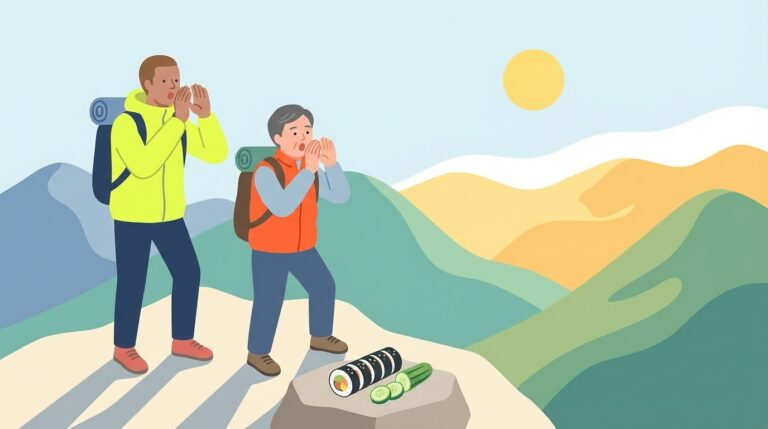
Picture this: You are watching a K-Drama. The main character has just gone through a terrible breakup or got fired from their job. What do they do? They climb a steep mountain, stand at the very peak, cup their hands around their mouth, and scream into the void.
If you actually go hiking in Seoul—like the famous Bukhansan—you won’t just see heartbroken drama characters. You’ll see groups of middle-aged Koreans in head-to-toe neon outdoor gear, sharing cucumbers, and loudly shouting “Ya-ho!” at the top of their lungs.
Why “Yaho”? And what should you say when these friendly strangers suddenly offer you a cup of makgeolli (rice wine)? Today, we are diving into Korea’s unique hiking culture. Knowing these simple A1-level phrases will turn you from a lost tourist into an instant mountain insider!
Transparency Note: This guide is based on real experiences of my foreign students who were delightfully shocked by how friendly Koreans become on a mountain!
Phase 2: Core Expressions Deep Dive
1. 야호! (Yaho!)
- Pronunciation: [ya-ho!] (Sounds like “Ya” + “Ho”, said with a long, loud echo)
- Meaning: Literal: Yaho! / Real nuance: “I made it!” or “Hello, mountain!”
- K-Culture Moment: You reach the peak. A colorful group of hikers is taking photos with the summit stone. Someone yells “Ya-ho!” to hear the echo bounce across the valleys. It’s the ultimate sound of Korean stress relief.
- Editor’s Insight: You don’t say this in daily life. It is strictly a mountain-peak expression. It feels victorious and incredibly refreshing!
- Situation Spectrum:
[🚫 Never] ———— [⚠️ Be Careful] ———— [✅ Go for it]
- With friends at the peak (Casual): ✅
- Middle of Seoul streets: 🚫
- (Note: Nowadays, some national parks ask you not to shout to protect wildlife, so read the room!)
- 🤔 Think About It: Why do Koreans love shouting on mountains? Could it be a reaction to the extremely fast-paced, high-pressure city life (the ‘Bali-bali’ culture) waiting for them at the bottom? How do people release stress in your country?
2. 안녕하세요! (Annyeong haseyo!)
- Pronunciation: [an-nyeong ha-se-yo!] (an-nyung ha-say-yo)
- Meaning: Hello!
- K-Culture Moment: In a busy Seoul subway, no one makes eye contact. But on a mountain trail? Koreans will warmly greet every single person they pass!
- Editor’s Insight: It’s the exact same “Hello” you learned in chapter 1 of your textbook, but on a mountain, it carries a feeling of “We are in this struggle together!” Give a slight nod of your head when you say it.
- Situation Spectrum:
[🚫 Never] ———— [⚠️ Be Careful] ———— [✅ Go for it]
- Passing strangers on a trail: ✅
3. 파이팅! (or 화이팅!) (Paiting!)
- Pronunciation: [pa-i-ting!] or [hwa-i-ting!]
- Meaning: Literal: Fighting! / Real nuance: “You can do it!” or “Keep going!”
- K-Culture Moment: You are heavily panting, struggling on steep rocks. An older Korean hiker going down smiles at you and says, “Almost there! Paiting!”
- Editor’s Insight: Konglish (Korean-English) at its finest. It has nothing to do with punching someone. It’s pure, positive encouragement.
- Situation Spectrum:
[🚫 Never] ———— [⚠️ Be Careful] ———— [✅ Go for it]
- Cheering up a struggling friend or stranger: ✅
Phase 3: Textbook vs. Real Korean
| Situation | 📖 Textbook Korean | 🗣️ Real Korean | 💡 Why is it different? |
|---|---|---|---|
| Greeting a stranger | 안녕하십니까? (Formal Hello) | 안녕하세요! or 수고하십니다! (Keep up the good work!) | Mountains strip away strict social hierarchies. People use friendly, everyday politeness. |
| Encouraging someone | 힘내세요. (Please cheer up.) | 파이팅! / 아자아자! (Paiting! / Aja-aja!) | Konglish and dynamic sound-words (Aja-aja) feel more energetic and fun on a tough hike. |
| Cheering at the top | 도착했습니다. (I have arrived.) | 야호! / 와, 대박! (Yaho! / Wow, awesome!) | Reaching the top is an emotional release, not a formal report! |
Bottom Note: As a beginner, sticking to “안녕하세요” and “야호” is perfect. Throw in a “파이팅” to get instant smiles from the locals!
Phase 4: Cultural Context — K-Culture Deep Dive
4-1. Non-verbal Elements: The Art of the ‘Mountain Nod’
When you say “안녕하세요” on the trail, don’t stare intensely into their eyes. Give a warm smile and a slight bow or nod. Also, if a Korean hiker offers you a piece of food (like a cherry tomato or cucumber), try to receive it with two hands. It shows deep respect!
4-2. K-Food Connection: The Holy Trinity of Korean Hiking
Why climb a mountain? For many Koreans, the exercise is just an excuse to eat!
1. Going up: You must have 오이 (Oi / Cucumber). It’s nature’s energy drink in Korea—hydrating and crunchy. Don’t be surprised if a stranger hands you half a cucumber.
2. At the top: Time for 김밥 (Gimbap). Eating a fresh roll of gimbap while looking down at the city is a core Korean memory.
3. At the bottom: The grand finale. 막걸리 (Makgeolli / Rice wine) and 파전 (Pajeon / Scallion pancake). The sizzling sound of the pancake matches the joy of a finished hike.
Critical View: Sharing food is deeply tied to the Korean concept of ‘Jeong’ (정) – a feeling of deep connection and affection. Sharing food means sharing your heart.
Phase 5: Real-world Roleplay Scenario
Setting: Saturday morning, 10 AM. You are near the peak of Bukhansan. Your legs are shaking, but the view is stunning. A friendly Korean Ahjusshi (middle-aged man) in bright neon orange hiking gear is resting nearby.
Characters:
– YOU: A traveler exploring Korea, slightly exhausted.
– Ahjusshi (Mr. Kim): A veteran hiker who loves chatting with foreigners.
Dialogue:
Mr. Kim: 학생, 파이팅! 다 왔어요! 🏔️
(haksaeng, paiting! da wasseoyo!)
[Student, fighting! You’re almost there!]
(🎭 Stage Direction: Mr. Kim smiles and gives you a thumbs up)
YOU: 아, 감사합니다! 하아… 너무 힘들어요.
(a, gamsahamnida! ha-a… neomu himdeureoyo.)
[Ah, thank you! pant… It’s so hard.]
Mr. Kim: 정상에서 소리 한 번 질러요! 스트레스가 다 날아가요.
(jeongsang-eseo sori han beon jilleoyo! seuteureseu-ga da naragayo.)
[Shout once at the peak! All your stress will fly away.]
YOU: 소리요? 어떻게 해요?
(soriyo? eotteoke haeyo?)
[Shout? How do I do that?]
Mr. Kim: 이렇게! 야~~~~호!!!! 자, 해봐요!
(ireoke! ya~~~~ho!!!! ja, haebwayo!)
[Like this! Ya~~~~ho!!!! Here, you try!]
🔀 Your Turn! How do you respond?
– A) (Quietly) “야호…” (yaho…)
– B) (Loudly with hands around mouth) “야~~~~호!!!!” (ya~~~~ho!!!!)
– C) “안 할래요.” (an hallaeyo – I won’t do it.)✅ Best Choice: B — Dive into the culture! Mr. Kim will probably clap and give you a snack.
⚠️ Choice C Analysis: It’s a bit too direct and might kill the friendly mood. If you really don’t want to shout, just smile and say “부끄러워요” (bukkeureowoyo – I’m shy).
(Roleplay continues…)
Mr. Kim: 오! 잘하네요! 자, 오이 하나 먹어요. 🥒
(o! jalhaneyo! ja, oi hana meogeoyo.)
[Oh! You’re good! Here, have a cucumber.]
(🎭 Stage Direction: He offers you a bright green cucumber)
YOU: 우와, 감사합니다! 잘 먹겠습니다!
(uwa, gamsahamnida! jal meokgetseumnida!)
[Wow, thank you! I will eat it well!]
Mr. Kim: 맛있게 먹고, 안전하게 내려가요! 파이팅!
(masitge meokgo, anjeonhage naeryeogayo! paiting!)
[Enjoy, and go down safely! Fighting!]
Phase 6: 10-Second Shadowing Drill
Let’s practice the energy! Pay attention to the pauses (/) and intonation.
😊 정상이다! / 야~~~호! / 너무 / 예뻐요!
(jeongsang-ida! / ya~~~ho! / neomu / yeppeoyo!)
(I’m at the peak! / Yaho! / It’s so / pretty!)
Pro-tip: Stretch the ‘ya’ and ‘ho’ as long as your breath allows!
Phase 7: K-Culture Mini Dictionary
| Korean | Romanization | English | Context |
|---|---|---|---|
| 야호 | yaho | Yaho! | The universal mountain shout in Korea. |
| 등산 | deungsan | Hiking / Mountain climbing | A beloved national pastime for Koreans. |
| 아저씨 | ajeossi | Middle-aged man | Often seen on mountains in full pro gear! |
| 파이팅 | paiting | You can do it! | The ultimate Konglish cheer. |
| 막걸리 | makgeolli | Rice wine | The traditional reward after a long hike. |
Phase 8: Traveler Survival Kit
If you are planning to hike in Korea, these are your absolute lifesavers!
🆘 Survival Expression #1: Asking for directions
– 🇰🇷 “정상이 어디예요?” (jeongsang-i eodiyeyo?)
– 🗣️ Pronunciation: [jung-sang-ee uh-dee-yay-yo?]
– 📍 Where to use: When you feel lost and want to know where the peak is.
– 💡 Pro Tip: Koreans will often say “Just 10 more minutes!” (조금만 가면 돼요). Do not trust them! It usually means 30 more minutes of hard climbing! 😆🆘 Survival Expression #2: Need a bathroom
– 🇰🇷 “화장실 어디예요?” (hwajangsil eodiyeyo?)
– 🗣️ Pronunciation: [hwa-jang-shil uh-dee-yay-yo?]
– 📍 Where to use: At the park entrance. (Mountains rarely have toilets at the top!)🆘 Survival Expression #3: Asking for water
– 🇰🇷 “물 좀 주세요.” (mul jom juseyo.)
– 🗣️ Pronunciation: [mool jom joo-say-yo.]
– 📍 Where to use: At rest stops or convenience stores near the mountain.📌 Editor’s Travel Note
– Useful Apps: Google Maps does NOT work well for hiking trails in Korea. Download KakaoMap or Naver Map; they have incredibly detailed hiking trail paths!
– Dress Code: You don’t have to wear neon, but wear good sneakers. Korean mountains are very rocky (lots of granite).
– Trash: There are no trash cans on the mountain. You must carry your trash all the way back down.
Phase 9: Critical Thinking — “One Step Deeper”
🧠 Think Deeper: Nature & Stress in a Mega-City
Have you ever wondered why hiking is practically a religion in Korea? Seoul is a highly competitive, hyper-modern city with over 9 million people. In a society where hierarchy, job titles, and the “hurry-hurry” (bali-bali) mindset dominate your weekdays, the mountain is the great equalizer. Once you put on your hiking boots, you aren’t a CEO or a stressed student anymore—you are just a hiker. Shouting “Yaho” is more than a fun echo game; it is a vital psychological release valve. By screaming into the open air, Koreans let go of their urban burdens.💬 Your Turn: Does your culture have a unique physical activity or place where people go to release the stress of daily life? Share it in the comments!
Phase 10: FAQ & Avoiding Misunderstandings
- “Can I shout Yaho on any mountain?”
- Maybe! While it’s a huge cultural trope, recently, many Korean national parks have put up signs asking hikers NOT to shout loudly in order to protect wild birds and animals. Look around—if others are doing it, it’s probably okay. If it’s a quiet nature reserve, just whisper your Yaho in your heart!
- “Is it safe to accept food from strangers on the mountain?”
- Yes! In the city, Koreans might be cautious, but the mountain activates their deep sense of ‘Jeong’ (community love). Sharing cucumbers, cherry tomatoes, or candy is their way of welcoming you.
- “Can I use ‘Paiting’ at work?”
- Yes, but carefully. It’s great for colleagues, but saying “Boss, Paiting!” might sound a bit too casual or cute.
❌ Common Mistake #1: Saying “안녕” (Annyeong – casual Hello) to an older hiker.
✅ Do this instead: Always use the polite form: “안녕하세요” (Annyeong haseyo). Even if you are both tired, politeness on the mountain goes a long way!
Phase 11: Summary & Action Items
One-Liner Summary: Conquer Korean mountains by greeting locals with a warm “안녕하세요”, shouting “야호” at the peak, and embracing the cucumber-sharing culture!
Action Mission:
– 🥉 Bronze (Solo): Stand in your room, stretch your arms, and practice saying “야~~~호!” with a big smile.
– 🥈 Silver (Online): Find a photo of a Korean mountain (like Bukhansan or Seoraksan) online, and leave a comment saying “야호! 파이팅!”
– 🥇 Gold (Real Life): Next time you visit Korea, hike a mountain and actually exchange a “안녕하세요” with a local hiker!
🎬 K-Culture Mission:
Search for “K-Drama hiking scenes” on YouTube. Notice how they dress, how they breathe, and yes—listen for that dramatic “Yaho!”
Did you ever experience something similar in your own travels? Let us know below!
Phase 12: Interactive Quiz
1. You are panting heavily on a steep trail. A Korean hiker walks past you. What is the BEST thing to say?
A) 야호! (Yaho!)
B) 안녕하세요! 파이팅! (Annyeong haseyo! Paiting!)
C) 아저씨! (Ajeossi!)
Click for Answer
Answer: B! You want to be polite and encouraging. Yaho is for the peak, and shouting Ajeossi is impolite.
2. True or False: If a Korean hiker tells you “The peak is just 5 minutes away,” you should completely trust them.
Click for Answer
Answer: False! It’s a running joke in Korea. A hiker’s “5 minutes” usually means at least 20 minutes of suffering!
3. Fill in the blank: The most popular vegetable to eat while hiking up a Korean mountain is ________.
A) Potato
B) Cucumber (오이)
C) Onion
Click for Answer
Answer: B! Cucumbers provide the perfect hydration and crunch.
Now you are fully prepared for your K-Hiking adventure. Grab your cucumbers, and see you at the top! 🏔️✨
Frequently Asked Questions (FAQ)
Q: What does "야호! (Yaho!)" mean in Korean and how do you pronounce it?
A: In Korean, "야호! (Yaho!)" is pronounced [ya-ho!] and means: Literal: Yaho! / Real nuance: "I made it!" or "Hello, mountain!"
Q: What does "안녕하세요! (Annyeong haseyo!)" mean in Korean and how do you pronounce it?
A: In Korean, "안녕하세요! (Annyeong haseyo!)" is pronounced [an-nyeong ha-se-yo!] and means: Hello!
Q: What does "파이팅! (or 화이팅!) (Paiting!)" mean in Korean and how do you pronounce it?
A: In Korean, "파이팅! (or 화이팅!) (Paiting!)" is pronounced [pa-i-ting!] and means: Literal: Fighting! / Real nuance: "You can do it!" or "Keep going!"







