

Phase 1: Empathy & Immersion (The K-Culture Cold Open)
Hello! I’m the Lead Editor at Daily Hangul.
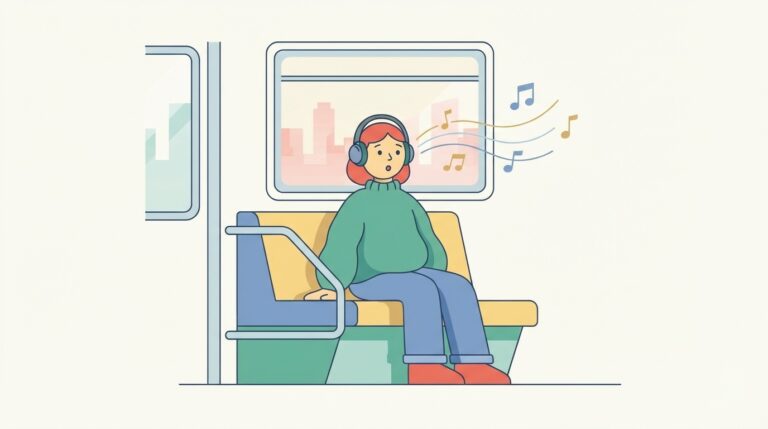
Imagine this: It’s 8:30 AM on a Tuesday. You’re squeezed into Seoul Subway Line 2—affectionately known as the ‘Hell Subway’ (지옥철). There are at least fifty people in your train car, yet it is completely, utterly silent. No one is talking. The only sound is the rhythmic clacking of the tracks.
You decide to make the commute better by blasting your favorite K-Pop track. Suddenly, the person next to you taps your shoulder, gives you a strained smile, and points at your ears.
Wait, your Bluetooth disconnected? No, it’s connected, but the volume is so loud that the whole carriage is getting a free concert. Welcome to one of the most common faux pas foreigners make in Korea: Sound leakage (소리 새어나옴).
In Korea, public transport is considered a shared sanctuary of silence. If you don’t know how to handle this situation politely—or how to tell someone else to keep it down—you might end up becoming the villain of someone’s morning commute. Today, as your local culture navigator, I’ll teach you exactly how to handle earphone etiquette like a true Seoulite.
Phase 2: Core Expressions Deep Dive
Let’s break down the most crucial phrases you need when someone’s music is leaking, or when you need to apologize for your own.
1. 이어폰 소리 좀 줄여주시겠어요?
- Pronunciation: [i-eo-pon so-ri jom ju-ryeo-ju-si-get-seo-yo?]
- Sound-alike Guide: Ee-uh-pon so-ree jom joo-ryuh-joo-she-get-suh-yo?
- Meaning: Literal: Would you please reduce your earphone sound a little? / Real nuance: Your music is loud, please turn it down.
- K-Culture Moment: You’ll often see this in K-Dramas when a polite office worker is trying to study on the bus, and a high school student is blasting a game. The ‘좀’ (a little) is the magic word here. It softens the blow.
- Editor’s Insight: This is the gold standard for polite confrontation. It doesn’t sound angry, just mildly inconvenienced.
- Situation Spectrum:
[🚫 절대 금지] ———— [⚠️ 주의] ———— [✅ 자유롭게]
- Strangers on the subway: ✅
- Close friends: ⚠️ (Too formal! Just say “야, 소리 너무 커!” – Hey, it’s too loud!)
- Elders: ⚠️ (Be very careful confronting elders; it might backfire.)
- 🤔 Think About It: Why do Koreans always insert ‘좀’ (a little) even when they want the sound turned completely down? How does your culture handle direct requests?
2. 소리가 다 새어나와요.
- Pronunciation: [so-ri-ga da sae-eo-na-wa-yo]
- Sound-alike Guide: So-ree-ga dah seh-uh-nah-wah-yo
- Meaning: Literal: The sound is all leaking out. / Real nuance: Everyone can hear what you’re listening to.
- K-Culture Moment: Imagine sitting in a quiet cafe in Hongdae. Someone’s AirPods aren’t sitting right in their ears. You lean over and whisper this so they don’t feel embarrassed.
- Editor’s Insight: ‘새어나오다’ means ‘to leak out’. It’s a very descriptive verb. You aren’t accusing them of being loud; you are simply informing them of a physical fact. It feels much less aggressive!
- Situation Spectrum:
[🚫 절대 금지] ———— [⚠️ 주의] ———— [✅ 자유롭게]
- Informing a colleague/stranger politely: ✅
- Scolding someone: 🚫
- 🤔 Think About It: Notice how the subject is ‘the sound’ (소리), not ‘you’ (당신). By blaming the sound, you save the other person’s face. Isn’t that a brilliant conflict-avoidance strategy?
3. 밖으로 안 새게 조심할게요.
- Pronunciation: [ba-kkeu-ro an sae-ge jo-sim-hal-kke-yo]
- Sound-alike Guide: Bah-kkoo-ro ahn seh-geh jo-sheem-hal-kkeh-yo
- Meaning: Literal: I will be careful so it doesn’t leak outside. / Real nuance: I’ll make sure to keep the volume down.
- K-Culture Moment: This is your survival response! When the tap on the shoulder happens, say this while frantically pressing the volume down button.
- Editor’s Insight: Using ‘-게’ (so that) shows you are actively modifying your behavior for the sake of public harmony.
- Situation Spectrum:
[🚫 절대 금지] ———— [⚠️ 주의] ———— [✅ 자유롭게]
- Responding to a complaint: ✅
- Casual apology: ✅
Phase 3: Textbook vs. Real Korean
How does the textbook differ from what you actually hear on the streets of Seoul?
| 상황 (Situation) | 📖 교과서 (Textbook) | 🗣️ 진짜 한국어 (Real Korean) | 💡 왜 다를까? (Why the difference?) |
|---|---|---|---|
| Asking someone to lower volume | 음악 소리를 낮추십시오. | 저기요, 소리가 좀 커서요… (trailing off) | Koreans often trail off sentences to soften complaints and avoid direct conflict. |
| Informing about sound leak | 이어폰 밖으로 소리가 납니다. | 이어폰 소리 다 새요. | ‘새다’ (to leak) is the absolute go-to verb for this situation. Shorter is more natural. |
| Apologizing | 나의 실수입니다. 미안합니다. | 앗, 몰랐어요. 죄송합니다! | Adding ‘앗’ (Oops) and ‘몰랐어요’ (I didn’t know) proves it was an honest mistake, preventing anger. |
Bottom Note: At a B1 level, try leaving your sentences slightly unfinished when complaining (e.g., “소리가 좀 커서요…”). It makes you sound like a true native speaker who understands Nunchi!
Phase 4: Cultural Context — K-Culture Deep Dive
4-1. The Non-Verbal ‘Nunchi’ on the Subway
When someone’s earphones are leaking sound, Koreans rarely yell, “Turn it down!” Instead, the Nunchi (눈치) game begins. First comes the stare. Then, a heavy sigh. Finally, if the person doesn’t notice, a gentle tap. If you are the one complaining, keep your voice low. Do not make a scene. Maintaining the quiet atmosphere of the train is more important than your anger.
4-2. The K-Drama Trope: The Embarrassing Sound Leak
We’ve all seen this K-Drama scene: The female lead is secretly watching a video of the handsome CEO, or listening to a very embarrassing voice note from her drunk self the night before. She thinks her AirPods are connected, but her phone speaker blasts it for the whole bus to hear.
* Reality check: While hilarious on screen, in real life, doing this on a Korean bus will earn you the collective glare of 30 exhausted commuters. Double-check your Bluetooth connection!
Phase 5: Interactive Roleplay Scenario
Setting: It’s 6:00 PM on a Friday. You are on the KTX (high-speed train) heading to Busan for a weekend trip. The cabin is incredibly peaceful. People are sleeping or working. You put on your noise-canceling headphones to watch a K-Drama.
Characters:
– YOU: An excited traveler catching up on your favorite show.
– Min-su (28): A tired office worker sitting in the seat next to you.
Dialogue:
(🎭 Stage Direction: You are laughing silently at the drama. Min-su sighs, hesitates, then gently taps your arm.)
Min-su: 저기요… 죄송한데요.
(Jeo-gi-yo… jwae-song-han-de-yo.)
[Excuse me… I’m sorry but.]
YOU: 네? 무슨 일이시죠?
(Ne? mu-seun i-ri-si-jyo?)
[Yes? What is it?]
Min-su: 지금 이어폰 소리가 다 새어나와서요. 조금만 줄여주시겠어요?
(Ji-geum i-eo-pon so-ri-ga da sae-eo-na-wa-seo-yo. Jo-geum-man ju-ryeo-ju-si-get-seo-yo?)
[Your earphone sound is leaking completely right now. Could you turn it down just a little?]
🔀 Your Turn! How should you respond?
– A) “아, 시끄러워요? 알겠어요.” (Oh, is it noisy? Got it.)
– B) “앗, 정말요? 연결이 끊겼나 봐요. 죄송합니다, 바로 줄일게요!” (Oops, really? The connection must have dropped. I’m sorry, I’ll turn it down right away!)
– C) “제 폰인데요?” (It’s my phone though?)✅ Best Choice: B — Acknowledging the mistake with “앗” (Oops) and immediately offering the solution shows excellent manners.
⚠️ Choice A Analysis: Asking “시끄러워요?” sounds a bit defensive or passive-aggressive.
🚫 Choice C Analysis: Do not choose this unless you want to become the star of a viral TikTok video about rude train passengers.
(Let’s continue with B)
YOU: 앗, 정말요? 밖으로 안 새게 조심할게요. 정말 죄송합니다.
(At, jeong-mal-yo? ba-kkeu-ro an sae-ge jo-sim-hal-kke-yo. jeong-mal jwae-song-ham-ni-da.)
[Oops, really? I’ll be careful so it doesn’t leak outside. I’m really sorry.]
Min-su: 아, 네. 괜찮습니다. 감사합니다.
(A, ne. gwaen-chan-seum-ni-da. gam-sa-ham-ni-da.)
[Ah, yes. It’s fine. Thank you.]
Phase 6: 10-Second Shadowing Drill
Time to practice! Follow the intonation guides.
😲 앗, / 몰랐어요. / 밖으로 안 새게 / 바로 / 줄일게요!
(At, / mol-lat-seo-yo. / ba-kkeu-ro an sae-ge / ba-ro / ju-ril-kke-yo!)
Editor’s Tip: Look slightly apologetic (😲) on the first part, and nod politely (😊) on the second part!
Phase 7: K-Culture Mini Dictionary
| 한국어 (Korean) | Romanization | Meaning | Contextual Explanation |
|---|---|---|---|
| 눈치 | nunchi | Social awareness | The absolute core of Korean social survival. Reading the room to know if your music is too loud. |
| 민폐 | minpye | Public nuisance | Being loud on public transport is considered ultimate ‘minpye’. Don’t be a minpye! |
| 노캔 | nokaen | Noise-canceling | Short for ‘노이즈 캔슬링’. Since everyone takes the subway, ANC earphones are a survival item in Korea. |
| 지옥철 | jiokcheol | Hell subway | Rush hour subway. Because it’s so crowded, people are sensitive. Keep your volume low here! |
Phase 8: Traveler’s Survival Kit
Even if you aren’t leaking sound, navigating Korean public transport requires some essential phrases.
🆘 Survival Phrases: Public Transport Edition
– 🇰🇷 “이번 역이 어디예요?” (i-beon yeo-gi eo-di-ye-yo?)
– 🗣️ Meaning: What station is this?
– 📍 Where to use: When you zoned out listening to music and missed the English announcement.
- 🇰🇷 “잠시만요, 내릴게요!” (jam-si-man-yo, nae-ril-kke-yo!)
- 🗣️ Meaning: Excuse me, I’m getting off!
- 📍 Where to use: When people are blocking the door on a crowded bus/subway.
📌 Editor’s Travel Note
– Phone calls on the train: If you MUST take a call on the subway or KTX, cover your mouth and whisper, or walk to the space between the train cars. Talking loudly on the phone is just as bad as leaking earphone sound!
– Apps: Download KakaoMetro or Naver Map. They tell you exactly which door to stand at for the fastest transfer!
Phase 9: Critical Thinking Corner — “One Step Deeper”
🧠 Think Deeper: Space, Language & Power
Why are Korean subways so intensely quiet compared to subways in New York or London? It comes down to the concept of shared public space in a highly dense society. In Korea, respecting the collective peace often outweighs individual freedom in public areas. This is reflected in the language: notice how Koreans say “소리가 커요” (The sound is loud) rather than “당신이 시끄러워요” (You are loud). By separating the person from the action, the language inherently tries to preserve social harmony and avoid direct confrontation.💬 Your Turn: In your country, is it normal to talk loudly or play music on public transport? How do people react to noise complaints? Share in the comments!
Phase 10: FAQ & Avoiding Mistakes
Q: If someone is playing TikTok videos out loud without earphones, can I tell them to be quiet?
Yes, but use caution. If it’s an older person (Ajusshi/Ajumma), confronting them directly might lead to a scolding. It’s often better to ask the train conductor (via the SOS button or app) to make an announcement.
Q: Can I just say “시끄러워요” (It’s noisy)?
Absolutely not to a stranger! That translates closer to “Shut up.” It is highly aggressive.
❌ Common Mistake #1: Saying “볼륨 다운해주세요” (Volume down please).
✅ Do This Instead: While some might understand the Konglish, “소리 좀 줄여주세요” (Please turn down the sound) is much more natural.
Phase 11: Summary & Action Items
💡 One-Liner Summary: On Korean public transport, silence is golden—if your sound leaks, soften your apology with “앗” and “조심할게요”.
🎯 Action Mission:
– 🥉 Bronze: Say “소리 밖으로 안 새게 조심할게요” out loud 3 times while adjusting your earphones.
– 🥈 Silver: Write a post on your language exchange app: “한국 지하철에서는 이어폰 소리가 안 새게 조심해야 해요!”
– 🥇 Gold: Next time you ride public transport (anywhere in the world!), try to practice the ‘Nunchi’ game. Observe the noise levels around you.
📺 K-Culture Mission:
Watch one episode of My Mister or Extraordinary Attorney Woo. Pay close attention to the subway scenes. Notice how quiet the background audio is and how passengers avoid eye contact!
Phase 12: Quiz — Interactive Challenge
1. Situational Judgment:
You are on the bus in Seoul. The person next to you is listening to a heavy metal song so loudly that you can hear the lyrics. How should you politely ask them to turn it down?
– A) 아저씨! 진짜 시끄러워요!
– B) 저기요, 이어폰 소리 좀 줄여주시겠어요?
– C) 음악이 너무 좋아요!
2. Fill in the Blank:
앗, 죄송합니다. 밖으로 안 ( _____ ) 조심할게요.
(Hint: leak)
3. True or False – K-Culture Edition:
It is totally acceptable to take a loud, 20-minute FaceTime call on the Seoul subway as long as you use earphones. (T/F)
👀 Click here for answers!
- B (A is extremely rude and will start a fight. C means ‘The music is great!’)
- 새게 (sae-ge)
- False. Even if you have earphones in, speaking loudly on the phone is considered a major ‘minpye’ (nuisance) on Korean subways.
Frequently Asked Questions (FAQ)
Q: What does "이어폰 소리 좀 줄여주시겠어요?" mean in Korean and how do you pronounce it?
A: In Korean, "이어폰 소리 좀 줄여주시겠어요?" is pronounced [i-eo-pon so-ri jom ju-ryeo-ju-si-get-seo-yo?] and means: Literal: Would you please reduce your earphone sound a little? / Real nuance: Your music is loud, please turn it down.
Q: What does "소리가 다 새어나와요." mean in Korean and how do you pronounce it?
A: In Korean, "소리가 다 새어나와요." is pronounced [so-ri-ga da sae-eo-na-wa-yo] and means: Literal: The sound is all leaking out. / Real nuance: Everyone can hear what you're listening to.
Q: What does "밖으로 안 새게 조심할게요." mean in Korean and how do you pronounce it?
A: In Korean, "밖으로 안 새게 조심할게요." is pronounced [ba-kkeu-ro an sae-ge jo-sim-hal-kke-yo] and means: Literal: I will be careful so it doesn't leak outside. / Real nuance: I'll make sure to keep the volume down.







