

Phase 1: Empathy
Hello! I’m your editor at Daily Hangul.
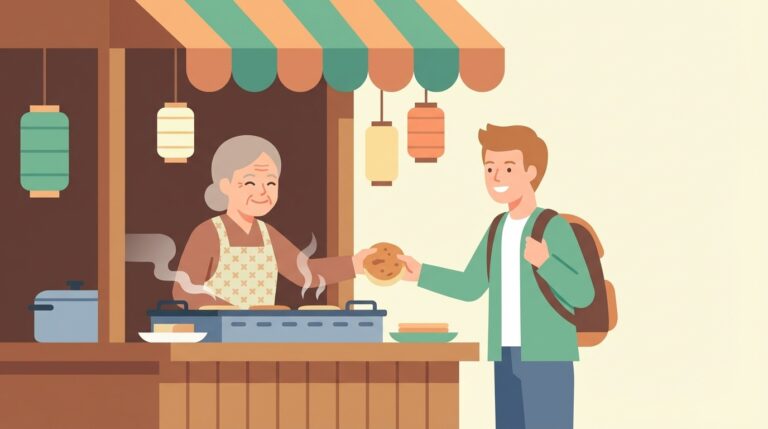
You’ve probably seen it in a K-Drama. The main character is wandering through a bustling traditional market (전통 시장), sitting on a plastic stool, eating a mountain of spicy Tteokbokki. Suddenly, the sweet old lady vendor scoops an extra handful of food onto their plate without asking for more money.
Is it a mistake? Should they pay more? No! Welcome to the magic of 시장 인심 (Sijang Insim)—the warm, generous heart of the Korean traditional market.
If you’re an absolute beginner (A1) traveling to Korea, you might feel intimidated by the loud, energetic vibe of places like Gwangjang Market or Namdaemun Market. But don’t worry! Knowing just a few key phrases will turn you from a nervous tourist into a beloved Dangol (regular customer) who gets showered with extra treats.
Note: This guide is based on real questions from our Daily Hangul learners who survived (and loved!) their first Korean market adventure.
Phase 2: Core Expressions Deep Dive
1. 많이 주세요!
- Pronunciation: man-i ju-se-yo! [Mahn-ee joo-seh-yo!]
- (Sound-alike guide: ‘man-i’ sounds a bit like the name “Manny”, and ‘ju-se-yo’ sounds like “juice-say-yo”.)
- Meaning: Literal: Please give me a lot. / Real nuance: “I have a big appetite, please be generous!”
- K-Culture Moment: You sit down at a street food stall. Before the vendor serves your food, you smile brightly and say this. The vendor will usually laugh and pile up your plate!
- Editor’s Insight: This isn’t considered greedy in a traditional market! It’s actually a cute way to show you are excited about their food.
- Situation Spectrum:
[🚫 Formal] ———— [⚠️ Semi-formal] ———— [✅ Casual/Market]
- Market Vendors / Friendly Aunties: ✅
- Modern Fancy Cafes: 🚫 (They have fixed measurements!)
- 🤔 Think About It: Why is asking for “more” totally fine in a market but weird in a franchise restaurant? Does your culture have a specific place where you can playfully ask for bigger portions?
2. 이거 덤이에요.
- Pronunciation: i-geo deom-i-e-yo. [Ee-guh duhm-ee-eh-yo.]
- (Sound-alike guide: ‘deom’ rhymes with “hum”.)
- Meaning: Literal: This is ‘deom’. / Real nuance: “This is free extra service just for you!”
- K-Culture Moment: You buy a bag of Korean mandarins. After weighing it, the vendor throws in two more apples and says “이거 덤이에요~”
- Editor’s Insight: You don’t say this; you hear this! When you hear the magic word 덤 (deom), do not pull out your wallet. Just smile and say thank you!
- Situation Spectrum:
[🚫 Formal] ———— [⚠️ Semi-formal] ———— [✅ Casual/Market]- 🤔 Think About It: Why do Korean vendors give away extra items instead of just lowering the price? How does giving a physical item build a better relationship than a simple discount?
3. 진짜 맛있어요!
- Pronunciation: jin-jja ma-si-sseo-yo! [Jeen-jah mah-shee-suh-yo!]
- Meaning: Literal: It’s really delicious! / Real nuance: “Oh my gosh, this is the best thing I’ve ever eaten!”
- K-Culture Moment: The moment you take a bite of that hot Hotteok (sweet pancake), your eyes widen. You look at the vendor and say this. They will beam with pride.
- Editor’s Insight: This is the ultimate “cheat code” to unlock market generosity. Vendors work hard, and acknowledging their cooking is the fastest way to their hearts.
- Situation Spectrum:
[🚫 Formal] ———— [⚠️ Semi-formal] ———— [✅ Casual/Market]
- Can be used anywhere, anytime to compliment food! ✅
- 🤔 Think About It: Complimenting food is a universal love language. What is the highest compliment you can give to a chef in your home country?
Phase 3: Textbook vs Real Korean
| Situation | 📖 Textbook Korean | 🗣️ Real Korean | 💡 Why is it different? |
|---|---|---|---|
| Expressing extreme gratitude for extra food | 대단히 감사합니다. (daedanhi gamsahamnida.) | 우와! 감사합니다! 잘 먹겠습니다! (uwa! gamsahamnida! jal meokgetseumnida!) | “대단히” is too stiff and business-like. Saying “I will eat well” shows genuine excitement. |
| Asking for a discount | 할인을 부탁드립니다. (harineul butakdeurimnida.) | 이모~ 쪼끔만 깎아주세요~ (imo~ jjokkeumman kkakkajuseyo~) | Markets thrive on informal, affectionate bonds. Calling the vendor “Auntie” (Imo) builds instant closeness. (Note: Only do this with a big smile!) |
Bottom Note for A1 Learners: Don’t stress about complex haggling phrases. A big smile and a simple “감사합니다” (Thank you) work miracles!
Phase 4: Cultural Context — K-Culture Deep Dive
4-1. Non-verbal Nunchi (눈치) at the Market
Language is only half the battle! When receiving extra food (deom), always use two hands to accept the plate or the bag. It’s a deep-rooted sign of respect in Korea. Also, make friendly eye contact and give a slight bow of your head when saying thank you.
4-2. K-Food Connection: The Street Food Experience
If you visit Gwangjang Market, you’ll sit elbow-to-elbow with locals. You might be eating Bindaetteok (mung bean pancake) and struggling with your chopsticks. Often, the vendor or even the Korean sitting next to you will notice (using their Nunchi) and hand you a fork or pour you some water. Korean food culture is deeply communal. Eating isn’t just about feeding yourself; it’s a shared experience. When the vendor gives you extra soup for free, they are treating you not as a tourist, but as a guest in their home.
Phase 5: Real-Life Roleplay Scenario
Setting: Friday, 6:30 PM at Gwangjang Market. The air is thick with the smell of sesame oil and sizzling pancakes. You are sitting at a tiny stall, eating a plate of spicy Tteokbokki.
Characters:
– YOU: A hungry traveler surviving on basic Korean.
– Halmeoni (Grandma): The 70-year-old vendor who has been running this stall for 30 years.
Dialogue:
Halmeoni: (Notices you finished your plate fast) 학생, 더 줄까?
(haksaeng, deo julkka?)
[English] Student, should I give you more?
YOU: 네! 진짜 맛있어요! 🤤
(ne! jin-jja ma-si-sseo-yo!)
[English] Yes! It’s really delicious!
(🎭 Stage Direction: Halmeoni smiles warmly and puts an extra boiled egg and more rice cakes on your plate.)
Halmeoni: 많이 먹어~ 이거 덤이야.
(mani meogeo~ i-geo deom-i-ya.)
[English] Eat a lot~ This is an extra (on the house).
🔀 YOUR TURN! How do you respond?
– A) “아니요, 괜찮아요.” (No, I’m okay / No thank you.)
– B) “이거 얼마예요?” (How much is this? – grabbing your wallet)
– C) “우와! 감사합니다! 잘 먹겠습니다!” (Wow! Thank you! I will eat well!)✅ Best Choice: C — Accept it with pure joy!
⚠️ Choice A & B Analysis: Refusing deom (A) or trying to pay for it (B) can accidentally hurt the vendor’s feelings. They are offering you their heart, not a business transaction!
✨ Bonus K-Drama Moment:
Imagine you are at the market and it starts raining, just like a romantic K-Drama. You duck into a stall to buy an umbrella. The vendor hands you one and says, “비 많이 오네, 조심해서 가요” (It’s raining a lot, go safely). Markets aren’t just for buying; they are hubs of human connection!
Phase 6: 10-Second Shadowing Drill
Speak out loud! Follow the pauses (/) and the emotion tags.
🥺 (Looking hungry)
사장님 / 많이 / 주세요!
(sajangnim / man-i / ju-se-yo!)
😊 (Eyes wide with amazement)
우와! / 이거 진짜 / 맛있어요!
(u-wa! / i-geo jin-jja / ma-si-sseo-yo!)
🥰 (Polite and grateful)
감사합니다! / 잘 먹겠습니다!
(gamsahamnida! / jal meokgetseumnida!)
Phase 7: K-Culture Mini Dictionary
| Korean | Romanization | English | Context |
|---|---|---|---|
| 인심 | insim | Generosity/Warmth | The generous heart of the people, especially in markets. |
| 정 | jeong | Emotional bond | The deep, unspoken connection and affection Koreans share. |
| 덤 | deom | Extra / Freebie | A little something extra given for free with a purchase. |
| 이모 | imo | Aunt | Literally ‘aunt’, but used to affectionately call female vendors. |
| 단골 | dangol | Regular customer | A loyal customer who visits often and gets lots of deom! |
Phase 8: Traveler Survival Kit 🎒
Are you heading to a Korean market soon? Save these flashcards!
🆘 Survival Phrase #1: How much is it?
– 🇰🇷 “이거 얼마예요?” (i-geo eolmayeyo?)
– 📍 Use it at: Markets, underground shopping malls, street vendors.
– 💡 Pro Tip: If you don’t understand the numbers they say, just hand them your phone with the calculator app open. They will gladly type the price for you!🆘 Survival Phrase #2: Please wrap it to go.
– 🇰🇷 “포장해 주세요.” (pojanghae juseyo.)
– 📍 Use it at: Any food stall when you want to take the food back to your hotel.📌 Editor’s Travel Note
– Cash is King: While Korea is a “credit card heaven,” traditional markets still highly prefer cash (won). Some tiny stalls might not accept cards at all. Always carry some 1,000 and 10,000 won bills!
– Tipping: NEVER tip in Korea! It can cause confusion. If you want to show appreciation, simply say “진짜 맛있어요!” (It’s really delicious!) instead of leaving coins on the table.
Phase 9: Critical Thinking — “One Step Deeper”
🧠 Think Deeper: Food & Identity
Why is giving free food (deom) so deeply ingrained in Korean market culture? Historically, Korea went through periods of extreme poverty and food scarcity. During those times, sharing what little food you had was the ultimate proof of love and survival. This created the concept of Jeong (정)—a collective social warmth. So, when a market vendor gives you an extra dumpling, they aren’t just giving you calories; they are practicing a generations-old tradition of saying, “I care about you. Don’t go hungry.”💬 Your Turn: Does your culture have a unique way of showing hospitality to strangers? Tell us in the comments!
Phase 10: FAQ & Avoiding Misunderstandings
Q: Can I haggle (bargain) at Korean markets?
A: Yes and no. If you are buying clothes or souvenirs in bulk at Namdaemun Market, you can try asking for a small discount. But never haggle over a $3 plate of street food! It’s considered rude.
Q: What if I have a peanut allergy or can’t eat spicy food?
A: Say “안 맵게 해 주세요” (an maepge hae juseyo – Please make it not spicy). For allergies, it’s best to have a translated card on your phone, as market vendors might not know the exact English ingredient names.
❌ Common Mistake #1: Trying to pay for “Deom” (extras).
✅ Do this instead: Accept it gracefully with two hands and a big “감사합니다!”❌ Common Mistake #2: Walking away while eating food on a skewer in a crowded market.
✅ Do this instead: Stand near the stall to eat your food, then throw the stick in the vendor’s trash bag. It’s much safer and more polite!
Phase 11: Summary & Action Items
🎯 One-Liner Summary:
Embrace the magic of Sijang Insim by cheerfully asking for more, gratefully accepting deom, and praising the delicious food!
🔥 Action Mission:
– 🥉 Bronze (Solo): Stand in front of a mirror and practice saying “진짜 맛있어요!” with the biggest, most genuine smile you can make.
– 🥈 Silver (Online): Find a YouTube walking tour of Gwangjang Market. Whenever you see a vendor handing over food, say “우와! 감사합니다!” out loud.
– 🥇 Gold (Real Life): Visit a Korean market (or a local Korean grocery store/restaurant in your area) and use “진짜 맛있어요” after your meal!
🌟 K-Culture Mission:
Watch an episode of Netflix’s Street Food: Asia (the Seoul episode). Look closely at the interactions between the vendors and the customers. Can you spot the Jeong and Insim we talked about today?
Have you ever received something for free at a market or restaurant? How did it make you feel? Let’s chat in the comments below! 👇
Phase 12: Quiz — Interactive Challenge
1. Situational Judgment: You buy 10 pairs of cute Korean socks. The vendor puts an 11th pair in your bag and says “이거 덤이에요.” What should you do?
– A) Say “Oh, I only asked for 10!” and give it back.
– B) Give them an extra 1,500 won for the socks.
– C) Say “우와! 감사합니다!” and take the bag with two hands.
2. Fill in the Blank:
To tell the vendor that their food is amazing, you say: “진짜 ( __________ )!”
– A) 많이 주세요
– B) 맛있어요
– C) 얼마예요
3. True or False:
You should always leave a 10% tip at a Korean market stall if the food is good.
– True / False
(Answers: 1: C, 2: B, 3: False – Tipping is not practiced in Korea!)
Frequently Asked Questions (FAQ)
Q: What does "많이 주세요!" mean in Korean and how do you pronounce it?
A: In Korean, "많이 주세요!" is pronounced [man-i ju-se-yo! [Mahn-ee joo-seh-yo!] and means: Literal: Please give me a lot. / Real nuance: "I have a big appetite, please be generous!"
Q: What does "이거 덤이에요." mean in Korean and how do you pronounce it?
A: In Korean, "이거 덤이에요." is pronounced [i-geo deom-i-e-yo. [Ee-guh duhm-ee-eh-yo.] and means: Literal: This is 'deom'. / Real nuance: "This is free extra service just for you!"
Q: What does "진짜 맛있어요!" mean in Korean and how do you pronounce it?
A: In Korean, "진짜 맛있어요!" is pronounced [jin-jja ma-si-sseo-yo! [Jeen-jah mah-shee-suh-yo!] and means: Literal: It's really delicious! / Real nuance: "Oh my gosh, this is the best thing I've ever eaten!"






