

Phase 1: The K-Drama Reality vs. Textbook Holidays
Hello! I’m your Daily Hangul Editor, your veteran tutor and local cultural navigator in Seoul.
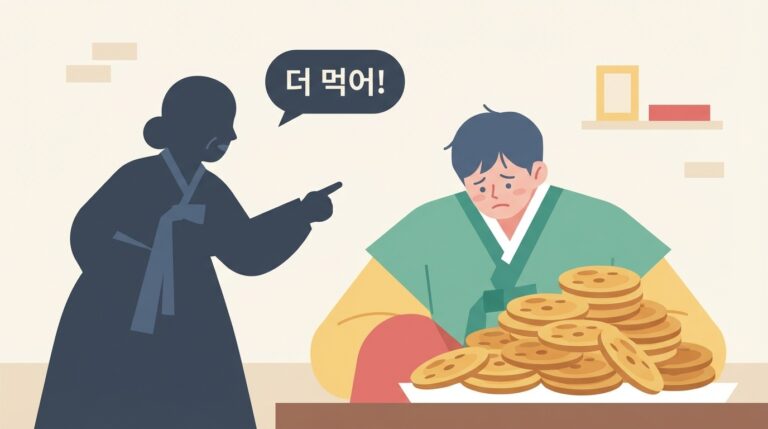
Picture this: You’re watching a classic K-Drama. It’s Chuseok (Korean Thanksgiving). The table is groaning under the weight of a feast, and the family is gathered. It looks picture-perfect. But suddenly, the camera zooms in on the eldest aunt. She looks at the protagonist, takes a slow sip of her drink, and drops the bomb: “So, when are you getting married?”
The background music stops. The protagonist forcefully stabs a piece of pancake with their chopsticks. Welcome to the reality of Korean traditional holidays!
While textbooks teach you to say, “Please have a joyful holiday,” they rarely teach you how to survive the relentless “interrogation” from well-meaning relatives. In Korea, this phenomenon is so common it even has a medical-sounding name: Holiday Syndrome.
If you’ve ever felt completely lost when your Korean friends complain about going home for the holidays, or if you’re ever invited to a Korean family gathering, knowing these expressions won’t just save you from awkwardness—it will instantly upgrade you to “Insider” (인싸) status. Let’s dive in!
Phase 2: Core Expressions Deep Dive
1. 잔소리 (Nagging / Unsolicited Advice)
- Pronunciation: jan-so-ri (The ‘소’ sounds like the ‘so’ in ‘soul’, but shorter!)
- Meaning: Literal: Small/trivial sound. Real nuance: Endless nagging, lecturing, or intrusive questions disguised as concern.
- K-Culture Moment: This is the word K-Pop idols jokingly use when their group leader tells them to clean their dorms. In a holiday context, it refers to the barrage of questions: “Did you get a job? Did you lose weight?”
- Editor’s Insight: Jan-so-ri isn’t always malicious. It’s often deeply rooted in the older generation’s way of showing affection (정 – jeong). They care, so they nag. But it still drives the younger generation crazy!
- Situation Spectrum:
[🚫 Never] ———— [⚠️ Be Careful] ———— [✅ Freely]
- Close friends (Casual complaining): ✅
- Co-workers (Semi-formal): ⚠️
- Boss/Elders (Formal): 🚫 (Never tell an elder “잔소리 하지 마세요” (Stop nagging) unless you want a bigger lecture!)
- 🤔 Think About It: In your culture, how do older relatives show they care? Is it through giving space, or through asking personal questions? Why do you think Korean culture leans heavily toward the latter?
2. 명절 증후군 (Holiday Syndrome)
- Pronunciation: myeong-jeol jeung-hu-gun
- Meaning: Literal/Real: Traditional Holiday Syndrome.
- K-Culture Moment: Post-holiday, news channels are flooded with reports about Myeong-jeol jeung-hu-gun. It refers to the extreme physical exhaustion (from cooking days in a row) and mental stress (from family conflicts) experienced during holidays.
- Editor’s Insight: If you use this phrase after a holiday weekend to your Korean coworkers, they will look at you with deep respect and say, “Wow, you really know Korea.”
- Situation Spectrum:
[🚫 Never] ———— [⚠️ Be Careful] ———— [✅ Freely]
- Casual / Semi-formal / Formal: ✅ (It’s a widely accepted sociological term, perfectly fine to use anywhere!)
- 🤔 Think About It: Why does a national holiday require a “syndrome” label? What does this say about the immense pressure of family duties in a collective society?
3. 눈치 보이다 (To walk on eggshells / feel self-conscious)
- Pronunciation: nun-chi bo-i-da (‘눈’ means eye. The ‘치’ sounds like a sharp sneeze.)
- Meaning: Literal: To have one’s nunchi seen. Real nuance: Feeling pressured to act a certain way because you are hyper-aware of what others are thinking.
- K-Culture Moment: You are resting on the sofa while your mother-in-law is aggressively washing dishes in the kitchen. The loud clanking of the plates makes you nunchi bo-i-da. You have to get up and help!
- Editor’s Insight: This isn’t just a holiday word; it’s a survival mechanism in Korean society. It’s that gut feeling that you are doing something that might displease the group.
- Situation Spectrum:
[🚫 Never] ———— [⚠️ Be Careful] ———— [✅ Freely]
- Used to describe your own feelings to others: ✅
- 🤔 Think About It: Does your language have a direct translation for feeling the subtle, unspoken pressure of a room?
Phase 3: Textbook vs. Real Korean
| Situation | 📖 Textbook Korean | 🗣️ Real Korean | 💡 Why the Difference? |
|---|---|---|---|
| Wishing a good holiday | 즐거운 명절 보내세요. (Have a joyful holiday.) | 많이 먹고 푹 쉬어! (Eat a lot and rest well!) | Close friends prioritize rest and food over formal joy, acknowledging holiday exhaustion. |
| Asking about family | 가족들은 잘 지내시나요? (Are your family members doing well?) | 이번에 고향 내려가? (Are you going down to your hometown this time?) | In reality, the stress is about going to the hometown, not just how the family is doing. |
| Replying to nagging | 조언 감사합니다. (Thank you for the advice.) | 아, 네… 제가 알아서 할게요. (Ah, yes… I’ll take care of it myself.) | “알아서 할게요” is the polite but firm way of saying “Mind your own business.” |
Phase 4: Cultural Context — K-Culture Deep Dive
4-1. The Non-Verbal Nunchi Game
Language is only half the battle. During Korean family gatherings, silence speaks volumes. If an aunt starts peeling an apple with aggressive, fast strokes without making eye contact, a storm is brewing. The appropriate response? Do not make direct eye contact, nod respectfully, and find an excuse to help in the kitchen.
4-2. The “Jeon-Baking” Trope in K-Dramas & K-Food
If you watch family K-Dramas, you’ll see a recurring trope: The daughter-in-law (며느리) sitting on the floor for 8 hours, frying hundreds of traditional Korean pancakes (전 – Jeon). Meanwhile, the men are in the living room watching television.
This specific scene is the core root of Holiday Syndrome. While modern Korea is rapidly changing (many families now buy pre-made food or order delivery!), the cultural memory of this gendered labor division remains a sensitive topic. When you eat Jeon at a Korean restaurant, remember—it’s a dish historically made with a lot of tears and sweat!
Phase 5: Real-Life Roleplay Scenario
Setting: A Friday evening right before the Seollal (Lunar New Year) holidays. You are at a local Korean BBQ joint with your Korean coworkers. The air is thick with the smell of roasting pork belly (삼겹살) and holiday anxiety.
Characters:
– YOU: An expat working in Seoul, trying to navigate office dynamics.
– Minsu (32, Male): Your friendly coworker, currently stressed about visiting his parents.
Dialogue:
Minsu: 하아… 벌써부터 머리가 아프네. 🤦♂️
(Haa… beol-sseo-bu-teo meo-ri-ga a-peu-ne.)
[Sigh… I have a headache already.]
(🎭 Stage Direction: Minsu pours himself a shot of Soju and stares blankly at the grill.)
YOU: 민수 씨, 왜 그래요? 어디 아파요?
(Minsu-ssi, wae geu-rae-yo? Eo-di a-pa-yo?)
[Minsu, what’s wrong? Are you sick?]
Minsu: 아니요, 다음 주가 설날이잖아요. 진짜 가기 싫다…
(A-ni-yo, da-eum ju-ga Seol-nal-i-ja-na-yo. Jin-jja ga-gi sil-ta…)
[No, next week is Seollal, you know. I really don’t want to go…]
YOU: 가족들 만나는 거 안 좋아요?
(Ga-jok-deul man-na-neun geo an jo-a-yo?)
[Don’t you like meeting your family?]
Minsu: 친척들 모이면 맨날 결혼 언제 하냐고 잔소리하니까요. 진짜 명절 증후군 걸릴 것 같아요.
(Chin-cheok-deul mo-i-myeon maen-nal gyeol-hon eon-je ha-nya-go jan-so-ri ha-ni-kka-yo. Jin-jja myeong-jeol jeung-hu-gun geol-ril geot ga-ta-yo.)
[Because when the relatives gather, they always nag me about when I’m getting married. I feel like I’m going to get Holiday Syndrome.]
🔀 Your Turn! How should you respond to comfort Minsu?
– A) “부모님 말씀이 맞아요. 빨리 결혼하세요!” (Your parents are right. Hurry up and get married!)
– B) “와, 진짜 스트레스받겠네요. 한잔 받으세요!” (Wow, that must be really stressful. Let me pour you a drink!)
– C) “가족들에게 잔소리하지 말라고 화내세요!” (Get angry and tell your family to stop nagging!)✅ Best Choice: B — Empathy is key! In Korea, acknowledging someone’s stress (스트레스받다) and offering a drink or food is the ultimate gesture of camaraderie.
⚠️ Choice A & C Analysis: Choice A will make Minsu feel betrayed. Choice C is a massive cultural faux pas; openly yelling at elders is deeply frowned upon in traditional settings.
Phase 6: 10-Second Shadowing Drill
When you are cornered with uncomfortable questions, use this polite but firm magical phrase. Practice out loud!
😊 아하하, / 제가 / 알아서 / 잘~~~ 할게요!
(Ahaha, / je-ga / a-ra-seo / jal~~~ hal-ge-yo!)
[Hahaha, / I will / take care of it / verrrry well on my own!]
Tip: The “아하하” (forced bright laugh) and the elongation of “잘~~~” are crucial. It shows respect but clearly signals “End of discussion!”
Phase 7: K-Culture Mini Dictionary
| Korean | Romanization | English | Cultural Context |
|---|---|---|---|
| 눈치 | nunchi | Nunchi | The art of sensing others’ moods. A vital survival skill at family gatherings. |
| 전 | jeon | Korean Pancake | The ultimate holiday food. Delicious to eat, a nightmare to cook in large batches. |
| 꼰대 | kkondae | Boomer/Lecturer | Slang for an older person who forces their outdated views on you. (Use carefully!) |
| 효 | hyo | Filial Piety | The traditional Confucian duty to obey and serve one’s parents. The root of all holiday obligations. |
Phase 8: Traveler’s Survival Kit
Even if you are just a tourist, being invited to a local’s home during the holidays is a massive honor! But when the grandmother asks how much money you make, you need an escape plan.
🆘 Survival Phrases for Awkward Questions
– 🇰🇷 “그건 비밀이에요~” (geu-geon bi-mil-i-e-yo~)
– 🗣️ Pronunciation Guide: “Geu-geon” (That is) + “bee-meal-ee-eh-yo” (a secret~)
– 📍 Where to use: When asked about your salary, age, or dating life.
– 💡 Pro Tip: Smile brightly and do a little “X” gesture with your fingers. Koreans love playful deflection!📌 Editor’s Travel Note: Holidays in Korea
– Ghost Town Seoul: During Chuseok and Seollal, Seoul empties out as everyone heads to their hometowns.
– What’s Open: Traditional palaces (Gyeongbokgung) are free and packed! But many local mom-and-pop restaurants will be closed. Always check Naver Map (네이버 지도) for holiday operating hours.
Phase 9: Critical Thinking — “One Step Deeper”
🧠 Think Deeper: Language & Power (The Double-Edged Sword of ‘Jeong’)
Why is “잔소리” (nagging) so prevalent in Korean holidays? It stems from the concept of 정 (Jeong)—a deep, collective affection and bond. In traditional Korean society, the boundary between “me” and “you” is blurred; your success is the family’s success. Therefore, asking “Did you get a promotion?” isn’t seen as invading privacy, but rather as showing love. However, as modern Korean youth embrace Western concepts of individualism and privacy, this “affectionate intrusion” creates intense friction. It’s a clash not just of generations, but of fundamentally different worldviews.💬 Your Turn: In your culture, where do you draw the line between “showing affection” and “invading privacy”? Let us know in the comments!
Phase 10: FAQ & Avoiding Misunderstandings
Q: If an older relative asks me when I’m getting married, can I just say “I don’t want to get married” (결혼 안 할 거예요)?
Yes, but brace yourself! While perfectly fine grammatically, this will likely trigger a 2-hour lecture. It’s often easier to smile and use the deflection phrases we learned above.
Q: Is Holiday Syndrome only for women?
Historically, yes. It mainly affected daughters-in-law due to intense cooking labor. Today, it affects men too (stress of driving for 10 hours in traffic, financial pressure of giving cash gifts to parents).
❌ Common Mistake #1: Saying “잔소리 멈춰!” (Stop nagging!) to an elder.
✅ Do This Instead: Say “걱정해 주셔서 감사합니다” (Thank you for worrying about me), then quickly change the subject to how delicious the food is.
Phase 11: Summary & Action Items
One-Liner Summary: Korean traditional holidays are filled with delicious food and deep affection, but also “Jan-so-ri” (nagging) that requires a lot of “Nunchi” to navigate gracefully.
Action Mission:
– 🥉 Bronze (Solo): Stand in front of a mirror and practice saying “제가 알아서 잘 할게요!” with a bright, polite smile.
– 🥈 Silver (Online): Go to a K-Drama YouTube clip featuring a family dinner and identify who is lacking Nunchi in the comments.
– 🥇 Gold (Real World): Ask your Korean friend or language partner, “이번 명절에 잔소리 많이 들었어요?” (Did you hear a lot of nagging this holiday?) and watch them vent!
K-Culture Mission:
The next time you watch a K-Drama, look closely at the dining table scenes. Who is doing the cooking? Who is sitting down? Pay attention to the subtle power dynamics—you’ll see the culture in a whole new light!
Phase 12: Quiz — Interactive Challenge
1. Situational Judgment: You are at a Korean family gathering. An uncle asks you how much money you make. What is the most culturally savvy response?
– A) Say “That’s none of your business.”
– B) Smile and say, “비밀이에요~” (It’s a secret~)
– C) Give him your exact bank account balance.
2. True or False — K-Culture Edition:
– T/F: Myeong-jeol jeung-hu-gun (Holiday Syndrome) is a medically recognized infectious disease.
(Answers: 1. B – It deflects the question politely without causing a scene. 2. False – It’s a sociological/psychological term for extreme stress from family duties, not an infectious disease!)
Frequently Asked Questions (FAQ)
Q: What does "잔소리 (Nagging / Unsolicited Advice)" mean in Korean and how do you pronounce it?
A: In Korean, "잔소리 (Nagging / Unsolicited Advice)" is pronounced [jan-so-ri (The '소' sounds like the 'so' in 'soul', but shorter!] and means: Literal: Small/trivial sound. Real nuance: Endless nagging, lecturing, or intrusive questions disguised as concern.
Q: What does "명절 증후군 (Holiday Syndrome)" mean in Korean and how do you pronounce it?
A: In Korean, "명절 증후군 (Holiday Syndrome)" is pronounced [myeong-jeol jeung-hu-gun] and means: Literal/Real: Traditional Holiday Syndrome.
Q: What does "눈치 보이다 (To walk on eggshells / feel self-conscious)" mean in Korean and how do you pronounce it?
A: In Korean, "눈치 보이다 (To walk on eggshells / feel self-conscious)" is pronounced [nun-chi bo-i-da ('눈' means eye. The '치' sounds like a sharp sneeze.] and means: Literal: To have one's nunchi seen. Real nuance: Feeling pressured to act a certain way because you are hyper-aware of what others are thinking.







