

Phase 1: Empathy (Immersive Opening)
Hello! This is the Chief Editor of Daily Hangul.
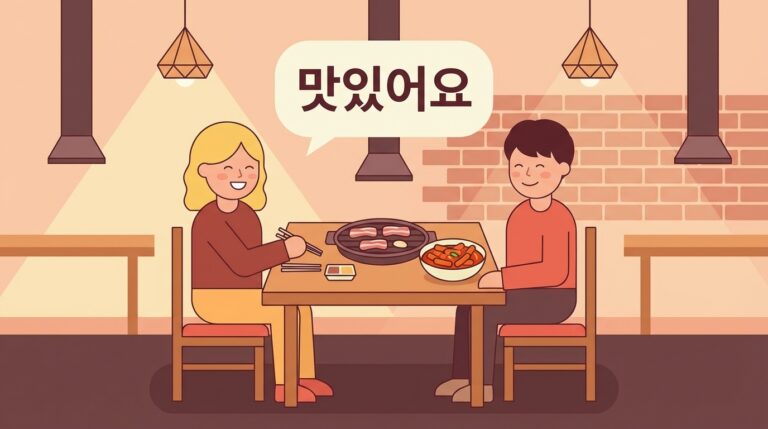
Picture this: You are sitting in a bustling K-BBQ restaurant in Seoul. The smell of sizzling pork belly fills the air, and clinking green soju glasses create a cheerful melody. The Korean friends you just met turn to you with sparkling eyes and ask, “So, what kind of Korean food do you like?”
Panic sets in. Your mind goes blank. You remember studying this in Chapter 2 of your textbook, but all you can manage to stammer is… “Kimchi… I like… Kimchi.”
They smile politely, but you can feel the missed opportunity to truly connect.
Food is practically a love language in Korea. If you can confidently talk about your favorite Korean dishes—and maybe throw in a joke about how you handle spicy food—you instantly upgrade from “tourist” to “insider.” This guide is based on real struggles my beginner students face. Today, we are going to ditch the textbook robot talk and learn how to express your culinary tastes like a true local!
Phase 2: Core Expressions Deep Dive
1. 저는 [음식]을/를 좋아해요. (I like [food].)
- Pronunciation: [jeo-neun (eum-sik)-eul/reul jo-a-hae-yo]
Sound-alike guide: ‘jo-a-hae-yo’ sounds like “Joe, ah, hey yo!” said really fast.- Meaning: I like [food]. (Literal & Real nuance are the same)
- K-Culture Moment: You are on a blind date (소개팅) and your date asks what you want to eat. You shyly say, “저는 떡볶이를 좋아해요” (I like Tteokbokki). It instantly breaks the ice because it’s such a relatable, everyday comfort food.
- Editor’s Insight: This is your bread and butter. Put any food before 을/를 (object markers). If the food ends in a consonant (like 김밥 gimbap), use 을. If it ends in a vowel (like 고기 gogi), use 를.
- Situation Spectrum:
[🚫 Do Not Use] ———— [⚠️ Caution] ———— [✅ Freely]
- Close Friends (Casual): ✅ (Drop ‘저는’ and just say “나 이거 좋아해!”)
- Coworkers (Semi-formal): ✅ (Perfect as is)
- Boss/Elders (Formal): ⚠️ (Use ‘좋아합니다’ instead of ‘좋아해요’)
- 🤔 Think About It: In Korean, we usually drop the subject “I” (저는) in casual conversations. Why do you think Koreans drop the “I” so often? Does your native language always require a subject?
2. 제일 좋아하는 한국 음식은 [음식]이에요/예요. (My favorite Korean food is [food].)
- Pronunciation: [je-il jo-a-ha-neun han-guk eum-si-geun (eum-sik)-i-e-yo/ye-yo]
- Meaning: My most liked Korean food is [food].
- K-Culture Moment: In K-Pop fan meetings, idols are constantly asked this by foreign fans. When an idol says, “제일 좋아하는 음식은 김치찌개예요!” (My favorite food is Kimchi Stew!), fans cheer because it shows their authentic local taste.
- Editor’s Insight: ‘제일’ (je-il) means ‘the most’ or ‘number one’. It’s the magic word to turn “like” into “favorite.”
- Situation Spectrum:
[🚫 Do Not Use] ———— [⚠️ Caution] ———— [✅ Freely]
- Close Friends (Casual): ✅
- Coworkers (Semi-formal): ✅
- Boss/Elders (Formal): ✅
- 🤔 Think About It: Notice how long this sentence is compared to the English “My favorite is…” Korean is an agglutinative language, meaning we stack parts together (most + liked + Korean + food + is).
3. 저는 매운 거 잘 못 먹어요. (I can’t eat spicy things well.)
- Pronunciation: [jeo-neun mae-un geo jal mot meo-geo-yo]
- Meaning: Literal: I cannot eat spicy things well. / Real nuance: I’m terrible with spicy food, please have mercy on my stomach!
- K-Culture Moment: You’re at a K-Food delivery app trying to order Chicken. It asks for the spice level: Mild, Original, or “Tears of Fire.” Knowing how to express your spice tolerance is a literal survival skill in Korea!
- Editor’s Insight: ‘잘 못 먹어요’ (can’t eat well) is a very polite and soft way to say “I hate it” or “I can’t do it.” Koreans prefer this indirect softening rather than saying a flat-out “No.”
- Situation Spectrum:
[🚫 Do Not Use] ———— [⚠️ Caution] ———— [✅ Freely]
- Close Friends (Casual): ✅
- Coworkers (Semi-formal): ✅
- Boss/Elders (Formal): ✅
- 🤔 Think About It: Why don’t Koreans just say “I hate spicy food”? How does this reflect the culture of harmony and not wanting to offend the chef or the host?
Phase 3: Textbook vs. Real Korean
| Situation | 📖 Textbook Korean | 🗣️ Real Korean | 💡 Why the difference? |
|---|---|---|---|
| Saying “I really like it” | 저는 비빔밥을 매우 좋아합니다. | 저 비빔밥 진짜 좋아해요! | ‘매우’ is for writing. ‘진짜’ (really/truly) is what everyone uses in speech! |
| Asking “What is your favorite?” | 가장 좋아하는 음식이 무엇입니까? | 무슨 음식 제일 좋아해요? | Dropping the subject and using ‘무슨’ (what kind of) is much more natural. |
| Admitting you can’t eat spicy food | 저는 매운 음식을 먹지 못합니다. | 저 맵찔이에요. (I’m a “spicy weakling”) | Slang alert! ‘맵찔이’ is a fun, self-deprecating term loved by younger generations. |
Bottom Note for A2 Learners: You don’t have to use heavy slang, but knowing the word ‘맵찔이’ (maep-jji-ri) will definitely make your Korean friends laugh!
Phase 4: Cultural Context — K-Culture Deep Dive
4-1. Non-verbal Expressions: The “Frown of Truth”
When you talk about a food you love, or when you take that first bite of amazing K-BBQ, don’t just smile! In Korea, there is a concept called 진실의 미간 (Jin-sil-ui mi-gan), which translates to “The Frown of Truth.” When food is unbelievably delicious, Koreans instinctively frown slightly between their eyebrows and nod vigorously. It means, “Wow, this is aggressively good.”
4-2. K-Food Connection: “Did you eat?”
In K-Dramas, you’ll often hear people greet each other not with “How are you?” but with “밥 먹었어?” (Did you eat?). Korea’s history of post-war poverty made food a symbol of care, survival, and affection. Sharing a meal—especially sharing a bubbling pot of stew (찌개)—is how Koreans break boundaries. When you enthusiastically share what Korean food you like, you are essentially telling them, “I am ready to be your friend.”
Phase 5: Real-world Roleplay Scenario
Setting: Friday night, 7 PM. A smoky, lively Samgyeopsal (pork belly) restaurant near Gangnam Station. The sound of meat sizzling is loud.
Characters:
– YOU: A foreigner on your 3rd day in Korea, invited to dinner by your new language exchange partner.
– Min-su (32): Your Korean language partner. Friendly, a bit of a foodie, and eager to show you the best of Seoul.
Min-su: 자, 많이 먹어요! 근데 한국 음식 중에 뭐 제일 좋아해요? 🥩
(Ja, mani meogeoyo! Geunde hanguk eumsik junge mwo jeil joahaeyo?)
[Here, eat a lot! By the way, what is your favorite Korean food?]
YOU: 저는 고기를 진짜 좋아해요. 삼겹살 최고예요! 👍
(Jeoneun gogireul jinjja joahaeyo. Samgyeopsal choegoyeyo!)
[I really like meat. Pork belly is the best!]
Min-su: 오~ 한국 사람 다 됐네요! 매운 것도 잘 먹어요?
(O~ hanguk saram da dwaenneyo! Maeun geotdo jal meogeoyo?)
[Oh~ You are practically Korean now! Can you eat spicy food well too?]
YOU: 아니요, 사실 저는 매운 거 잘 못 먹어요.
(Aniyo, sasil jeoneun maeun geo jal mot meogeoyo.)
[No, actually I can’t eat spicy things well.]
Min-su: 아, 진짜요? 그럼 우리 이따가 냉면 먹을 건데…
(A, jinjjayo? Geureom uri ittaga naengmyeon meogeul geonde…)
[Oh, really? Well, we are going to have cold noodles later…]
(🎭 Stage Direction: Min-su looks slightly concerned, holding the tongs)
🔀 Your Turn! How do you respond?
– A) “물냉면으로 주세요!” (Please give me Mul-naengmyeon! – non-spicy broth noodles)
– B) “비빔냉면 먹어볼게요!” (I’ll try Bibim-naengmyeon! – the spicy mixed ones)
– C) “저 완전 맵찔이에요… ㅠㅠ” (I’m a total maepjjiri… ㅠㅠ)✅ Best Choice: C or A!
If you choose C, Min-su will laugh out loud and definitely order the non-spicy water cold noodles (물냉면) for you. It’s a great way to use local humor!
K-Culture Bonus Roleplay: The Street Food Stall
(You are at Myeongdong Street Market looking at spicy red Tteokbokki)
Auntie (Owner): 삼촌, 떡볶이 줄까? (Samchon, tteokbokki julkka? – Uncle/Young man, want some Tteokbokki?)
YOU: 네! 근데 많이 매워요? (Ne! Geunde mani maewoyo? – Yes! But is it very spicy?)
Auntie: 에이~ 하나도 안 매워! 맛있게 매워~ (Ei~ hanado an maewo! Masitge maewo~ – Nah~ Not spicy at all! It’s deliciously spicy~)
(Editor’s warning: When a Korean says “it’s deliciously spicy,” it means it will burn your tongue!)
Phase 6: 10-Second Shadowing Drill
Read these out loud! Pay attention to the pauses (/) and emotions.
- 😊 밝게 (Brightly): 저는 / 한국 음식을 / 진~~~짜 좋아해요!
(jeo-neun / hanguk eum-si-geul / jin~~~jja jo-a-hae-yo!) - 🤤 기대하며 (With anticipation): 제일 좋아하는 음식은 / 치맥이에요!
(je-il jo-a-ha-neun eum-si-geun / chi-mae-gi-e-yo!) - 🥺 애교 섞어서 (Cute/Pleading): 사장님~ / 저 매운 거 / 잘 못 먹어요. 안 맵게 해주세요.
(sa-jang-nim~ / jeo mae-un geo / jal mot meo-geo-yo. An maep-ge hae-ju-se-yo.)
Phase 7: K-Culture Mini Dictionary
| 한국어 (Korean) | Romanization | English | Context/Meaning |
|---|---|---|---|
| 치맥 | chi-maek | Chicken and Beer | A cultural phenomenon. The ultimate late-night food pairing. |
| 맵찔이 | maep-jji-ri | Spicy weakling | Someone with a very low tolerance for spicy food. |
| 단짠단짠 | dan-jjan-dan-jjan | Sweet and Salty | The magical flavor combo Koreans love (e.g., eating salty fries with sweet ice cream). |
| 눈치 | nunchi | Social awareness | The art of reading the room. If a friend orders extreme spicy food, you use your nunchi to order a mild side dish. |
Phase 8: Traveler Survival Kit
If you are traveling to Korea, you won’t just talk about food; you have to order it! Here are your absolute survival phrases for Korean restaurants.
🆘 Survival Phrase #1: Customizing Spice
– 🇰🇷 “안 맵게 해 주세요.” (An maep-ge hae ju-se-yo.)
– 🗣️ Pronunciation: Ahn mep-geh heh joo-seh-yo.
– 📍 Where to use: Any restaurant serving stews, noodles, or stir-fry.
– 💡 Pro Tip: Even if you say this, some dishes (like Kimchi stew) are fundamentally spicy. If you want zero spice, ask for “하얗게 해 주세요” (Please make it white/clear).🆘 Survival Phrase #2: Asking for recommendations
– 🇰🇷 “여기 뭐가 제일 맛있어요?” (Yeo-gi mwo-ga je-il ma-si-sseo-yo?)
– 🗣️ Pronunciation: Yuh-gee mwo-gah jeh-il mah-shee-suh-yo?
– 📍 Where to use: Cafes, restaurants, street food stalls.
– 💡 Pro Tip: Look for items on the menu with a “BEST” or “HIT” sticker next to them!📌 Editor’s Travel Note
– Useful Apps: Yogiyo (요기요) or Baemin (배달의민족) for delivery. You can check the menus and spice levels there!
– Call Bells: Most Korean tables have a small button to call the waiter. Don’t shout; just press it gently!
– Tipping: Do NOT tip in Korea. It is not part of the culture and might confuse the staff.
Phase 9: Critical Thinking — “One Step Deeper”
🧠 Think Deeper: Food & Identity (음식과 정체성)
Have you ever noticed in K-Dramas that Koreans often share a single large pot of stew, everyone dipping their own spoons in? While this is slowly changing for hygiene reasons, this traditional sharing culture is rooted in the concept of 정 (Jeong)—a deep feeling of connection, affection, and shared destiny. By sharing food from the same bowl, the boundary between “you” and “me” dissolves into “us” (우리). When you say you like Korean food, locals don’t just hear “I like the taste”; they hear “I am ready to share ‘Jeong’ with you.”💬 Your Turn: Does your culture have a dish that is meant to be shared by everyone at the table? How do you express closeness through food in your country? Share in the comments!
Phase 10: FAQ & Avoiding Mistakes
Q: Is it okay to say “I hate Kimchi” to a Korean?
Editor’s advice: Honesty is good, but Koreans take great pride in Kimchi! Instead of saying “김치 싫어해요” (I hate Kimchi), try the softer “김치는 아직 잘 못 먹어요” (I can’t eat Kimchi well yet). The “yet” (아직 – a-jik) shows you are open-minded!
Q: What if I don’t know the Korean name of the food?
Editor’s advice: Just pull out your phone, show a picture, and say, “이거 좋아해요!” (I like this!).
❌ Common Mistake #1: Saying “저는 삼겹살은 좋아해요.”
✅ Do this instead: “저는 삼겹살을 좋아해요.”
Why? Using the topic marker (은/는) instead of the object marker (을/를) can subtly imply “I like Pork Belly (but I hate everything else).” Stick to 을/를 for a safe, positive vibe!
Phase 11: Summary & Action Items
One-Liner Summary: Replace your textbook robotic intro with “저 [음식] 진짜 좋아해요!” and don’t be afraid to admit if you are a 맵찔이 (spicy weakling)!
Action Mission 3 Steps:
– 🥉 Bronze (Solo): Look at your dinner tonight and say “저는 [Food]를 좋아해요” three times out loud.
– 🥈 Silver (Online): Go to a K-Pop idol’s YouTube vlog about food and leave a comment: “제일 좋아하는 한국 음식은 [Your favorite]예요!”
– 🥇 Gold (Real World): Next time you visit a Korean restaurant, tell the waiter or owner what your favorite dish is in Korean!
K-Culture Mission:
Open Google Street View, drop yourself in the middle of Hongdae or Myeongdong, “walk” up to a restaurant sign, and imagine ordering your favorite food using today’s phrases!
Phase 12: Quiz — Interactive Challenge
Q1. You are at a company dinner (회식). Your boss asks what you want to eat. What is the most natural and polite A2 level response?
1) 저 비빔밥 진짜 좋아해!
2) 저는 불고기를 좋아해요.
3) 김치 싫어해요.
4) 나 맵찔이야.
Q2. Fill in the blank:
“My favorite Korean food is Tteokbokki.”
-> 제일 좋아하는 한국 음식은 떡볶이(______)요.
Q3. True or False – K-Culture Edition:
If a Korean restaurant owner says a dish is “맛있게 매워요” (deliciously spicy), it means it is completely mild and safe for beginners. (T/F)
Click here for Answers!
Q1 Answer: 2. “저는 불고기를 좋아해요.” (1 and 4 are too casual/slang for a boss. 3 is a bit rude).
Q2 Answer: 에 (e) -> 떡볶이예요 (tteokbokki-ye-yo). Remember, words ending in a vowel take ‘예요’.
Q3 Answer: False! “Deliciously spicy” usually means it has a very strong kick that Koreans love. Proceed with caution if you are a 맵찔이!
Frequently Asked Questions (FAQ)
Q: What does "저는 [음식]을/를 좋아해요. (I like [food].)" mean in Korean and how do you pronounce it?
A: In Korean, "저는 [음식]을/를 좋아해요. (I like [food].)" is pronounced [jeo-neun (eum-sik] and means: I like [food]. (Literal & Real nuance are the same)
Q: What does "제일 좋아하는 한국 음식은 [음식]이에요/예요. (My favorite Korean food is [food].)" mean in Korean and how do you pronounce it?
A: In Korean, "제일 좋아하는 한국 음식은 [음식]이에요/예요. (My favorite Korean food is [food].)" is pronounced [je-il jo-a-ha-neun han-guk eum-si-geun (eum-sik] and means: My most liked Korean food is [food].
Q: What does "저는 매운 거 잘 못 먹어요. (I can't eat spicy things well.)" mean in Korean and how do you pronounce it?
A: In Korean, "저는 매운 거 잘 못 먹어요. (I can't eat spicy things well.)" is pronounced [jeo-neun mae-un geo jal mot meo-geo-yo] and means: Literal: I cannot eat spicy things well. / Real nuance: I'm terrible with spicy food, please have mercy on my stomach!







