

Phase 1: Empathy (Immersive Opening)
Hello! This is your Daily Hangul Editor, your local Seoul navigator and Korean tutor. 👋
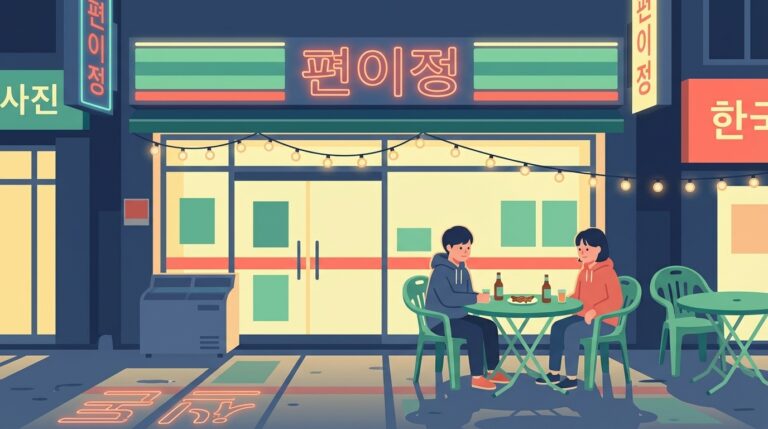
Picture this: It’s a warm Friday night by the Han River. The neon sign of a GS25 or CU convenience store is glowing. You see people sitting around green plastic tables, cracking open cold beers, peeling string cheese, and having the time of their lives. It looks just like a scene from your favorite K-Drama, right?
You confidently walk inside, grab four colorful beer cans for the famous “4-for-12,000 won” deal, and walk up to the counter. But suddenly, the cashier fires a rapid question at you: *
“Bongtu piryohaseyo?”*
You freeze. Wait, are they asking for my ID? Are they asking if I want a receipt? Did I grab the wrong beer? Panic sets in, and the line behind you is getting longer.
Don’t worry! I’ve been teaching Korean for years, and I know exactly where beginners freeze up. Today, we are going to learn the essential survival phrases for Korean Convenience Store Nightlife. By the end of this guide, you won’t just survive the checkout line—you’ll be enjoying your Pyeun-maek (convenience store beer) like a true Seoulite!
Phase 2: Core Phrases Deep Dive
Let’s break down the three most common phrases you will hear and use when buying beer at a Korean convenience store.
1. 봉투 필요하세요?
- Pronunciation: [bongtu piryohaseyo?]
Sound-alike guide: “Bong” (like a bell ringing) + “too” (like ‘me too’) + “pee-ryo-ha-seh-yo?” - Meaning: Do you need a plastic bag? (Literal: Is a bag necessary?)
- K-Culture Moment: You will hear this 100% of the time you buy multiple items. Cashiers say it super fast, so it often sounds like just “Bongtu-haseyo?”
- Editor’s Insight: You only need to know two words to answer this: “네” (Ne – Yes) or “아니요” (Aniyo – No). Keep it simple!
- Situation Spectrum:
[🚫 Don't Use] ———— [⚠️ Caution] ———— [✅ Use Freely]- Listening to cashiers: ✅ (You will hear it constantly)
- Casual/Friends: 🚫 (This is polite store-clerk language)
- 🤔 Think About It: Why do cashiers ask this instead of just giving you a bag? South Korea has strict environmental laws, so convenience stores must charge you about 20 to 50 won for a plastic bag. Does your country have similar rules?
2. 신분증 보여주세요.
- Pronunciation: [sinbunjeung boyeojuseyo.]
Sound-alike guide: “Shin” (like your shin bone) + “boon” (like a blessing) + “jjung” (like ‘jung’ with a tense, tight J) + “bo-yeo-joo-seh-yo.” - Meaning: Please show me your ID.
- K-Culture Moment: In K-Dramas, teenagers often try to sneakily buy beer, only to get caught by the sharp-eyed cashier asking this exact phrase!
- Editor’s Insight: Foreigners are almost always asked for ID when buying alcohol. Don’t take it personally; it’s the law! Your passport or ARC (Alien Registration Card) works perfectly.
- Situation Spectrum:
[🚫 Don't Use] ———— [⚠️ Caution] ———— [✅ Use Freely]- Listening to cashiers: ✅
- Asking a friend for their ID: ⚠️ (Only as a joke!)
- 🤔 Think About It: Even if you have a gray beard, cashiers might still ask for your ID because the POS (cash register) system prompts them. How does age verification work in your culture?
3. 이거 행사 상품이에요?
- Pronunciation: [igeo haengsa sangpumieyo?]
Sound-alike guide: “Ee-guh” (this) + “hang” (like hanging a picture) + “sah” (say ‘ah’ with an S) + “sang-poom-ee-eh-yo?” - Meaning: Is this an event/discount item?
- K-Culture Moment: Korean convenience stores are famous for “2+1” deals or “4 beers for 12,000 won” events. If you’re not sure if the beer you grabbed is part of the deal, use this phrase!
- Editor’s Insight: If you just say “이거 행사?” (Igeo haengsa?) while pointing at the beer, the cashier will completely understand you. Perfect for absolute beginners!
- Situation Spectrum:
[🚫 Don't Use] ———— [⚠️ Caution] ———— [✅ Use Freely]- To store clerks: ✅
- To friends: ⚠️ (A bit too formal)
Phase 3: Textbook vs. Real Korean
| Situation | 📖 Textbook Korean | 🗣️ Real Korean | 💡 Why is it different? |
|---|---|---|---|
| Buying 4 beers | 맥주 네 캔 주십시오. (Please give me 4 cans of beer.) | 이거 행사 맞죠? (This is the event deal, right?) | In real life, you pick up the beers yourself, so you just need to confirm the discount! |
| Asking for a bag | 비닐봉투를 주시겠습니까? (Would you please give me a plastic bag?) | 봉투 하나 주세요. (One bag, please.) | Real Korean values speed and efficiency (빨리빨리 – Ppalli-ppalli culture). |
| Handing over ID | 제 신분증은 여기 있습니다. (Here is my identification card.) | 여기요. (Here you go.) + Handing it over | Body language and context replace long sentences. |
Bottom Note: As an A1 learner, you don’t need long, poetic sentences. Pointing and saying “여기요 (Here you go)” or “이거 (This)” is incredibly natural and polite enough if you use a soft tone!
Phase 4: Cultural Context — K-Culture Deep Dive
4-1. The Magic of Non-Verbal “Nunchi”
When the cashier says “신분증 보여주세요” (ID please) or when it’s time to pay, how you hand over your card or ID is just as important as what you say.
Pro Tip: Hand your card to the cashier using two hands, or use your right hand to hand it over while your left hand lightly touches your right elbow or forearm. It’s a subtle sign of respect in Korea. Do this, and the cashier will instantly think, “Wow, this foreigner really knows our culture!”
4-2. Welcome to the World of “Pyeun-maek”
Have you ever wondered why K-Drama characters always seem to drink outside a convenience store when they are sad, broke, or falling in love?
This is called 편맥 (Pyun-maek) — a combination of 편의점 (Convenience Store) and 맥주 (Beer). It’s not just about cheap alcohol; it’s a cultural phenomenon. Drinking at a bar can be formal and expensive, but the plastic tables outside a convenience store (called Parasol) offer a relaxed, pressure-free zone where anyone can have a heart-to-heart conversation.
Phase 5: Real-Life Roleplay Scenario
Setting: Friday, 11:30 PM. Outside a busy CU convenience store in Yeonnam-dong. You and your Korean friend Min-ho just grabbed a basket full of snacks and 4 tall boys of beer. You walk up to the counter.
Characters:
– YOU: A foreigner visiting Seoul, eager to try out your new Korean skills.
– Min-ho: Your friendly local buddy.
– Cashier (알바생): A tired university student working the night shift.
Dialogue:
Cashier: 어서 오세요. 신분증 보여주세요.
(eoseo oseyo. sinbunjeung boyeojuseyo.)
[Welcome. Please show your ID.]
YOU: (Handing over your passport with two hands) 여기요.
(yeogiyo.)
[Here you go.]
Cashier: 네, 감사합니다. 결제 도와드릴게요.
(ne, gamsahamnida. gyeolje dowadeurilgeyo.)
[Yes, thank you. I’ll help you with the payment.]
(🎭 Stage Direction: The cashier scans the 4 beers, but the price comes out to 16,000 won instead of the 12,000 won deal!)
YOU: 어? 이거 행사 상품 아니에요?
(eo? igeo haengsa sangpum anieyo?)
[Huh? Isn’t this an event item?]
Cashier: 아, 손님. 이 맥주는 교차 할인이 안 돼요. 다른 걸로 바꿔오시겠어요?
(a, sonnim. i maekjuneun gyocha harini an dwaeyo. dareun geollo bakkwaosigesseoyo?)
[Ah, customer. This beer isn’t eligible for the mix-and-match discount. Would you like to swap it for another one?]
Min-ho: (Whispering to you) One of them is the wrong brand! Go swap it quickly.
YOU: 아! 네, 잠시만요!
(a! ne, jamsimanyo!)
[Ah! Yes, just a moment!]
(🎭 Stage Direction: You run and swap the beer, coming back breathless.)
Cashier: 봉투 필요하세요?
(bongtu piryohaseyo?)
[Do you need a bag?]
🔀 Your Turn! How should you reply?
– A) “나는 봉투를 원합니다.” (I want a bag.)
– B) “네, 주세요.” (Yes, please give me one.)
– C) “대박!” (Awesome!)✅ Best Choice: B — Simple, polite, and natural.
⚠️ Choice A Analysis: This sounds like a robot translating directly from English!
YOU: 네, 주세요.
(ne, juseyo.)
[Yes, please.]
Cashier: 12,200원입니다. 영수증 드릴까요?
(12,200(man-icheon-ibaek)won-imnida. yeongsujeung deurilkkayo?)
[It’s 12,200 won. Would you like the receipt?]
YOU: 아니요, 괜찮아요. 감사합니다!
(aniyo, gwaenchanayo. gamsahamnida!)
[No, it’s okay. Thank you!]
Phase 6: 10-Second Shadowing Drill
Time to practice! Follow the intonation marks (/) and match the emotion.
😊 Politely asking for the deal:
이/거 / 행/사 상품/이에/요?
(ee-guh / hang-sah sang-poom / ee-eh-yo?)
🥺 Asking for a bag smoothly:
봉투 / 하/나 / 주세/요.
(bong-too / ha-na / joo-seh-yo.)
Phase 7: K-Culture Mini Dictionary
| 한국어 (Korean) | Romanization | English | Cultural Context |
|---|---|---|---|
| 편맥 | pyeon-maek | Convenience Store Beer | A beloved Korean pastime of drinking beer outside a convenience store. |
| 민증 | min-jeung | ID Card | Slang for 주민등록증 (National ID). “민증 보여주세요” is super common. |
| 노상 | no-sang | Drinking on the street | Drinking alcohol outdoors (like at a park or convenience store table). |
| 알바 | al-ba | Part-timer | Short for Arbaite (German). Refers to the convenience store cashier. |
Phase 8: Traveler Survival Kit 🆘
Are you traveling to Seoul soon? Keep these 3 lifesaver phrases in your pocket for any convenience store run!
🆘 Survival Phrase #1: “얼마예요?” (eolmayeyo?)
– 🗣️ Pronunciation: ul-ma-yeh-yo?
– 📍 Meaning: How much is it?
– 💡 Pro Tip: If you can’t understand the numbers they reply with, just look at the screen on the cash register!🆘 Survival Phrase #2: “카드 돼요?” (kadeu dwaeyo?)
– 🗣️ Pronunciation: ka-deu dweh-yo?
– 📍 Meaning: Do you take credit cards?
– 💡 Pro Tip: Korea is a cashless society! 99% of places take cards, even for a 1,000 won bottle of water.🆘 Survival Phrase #3: “영수증 버려주세요.” (yeongsujeung beoryeojuseyo.)
– 🗣️ Pronunciation: young-soo-jeung buh-ryeo-joo-seh-yo.
– 📍 Meaning: Please throw away the receipt.
📌 Editor’s Travel Note:
Unlike many Western countries, South Korea allows you to buy alcohol 24/7. However, drinking at the convenience store tables is usually restricted after midnight out of respect for sleeping neighbors. If the cashier folds up the umbrella and table, it’s time to go!
Phase 9: Critical Thinking — “One Step Deeper”
Food & Identity: Why a Plastic Table?
🧠 Think Deeper:
In many cultures, nightlife revolves around fancy bars or clubs. But in Korea, some of the most meaningful conversations happen on cheap plastic chairs outside a GS25. Why? It all comes down to 정 (Jeong)—the Korean concept of deep emotional connection. The convenience store strips away the pressure of money, dress codes, or status. Whether you are a CEO or a broke university student, a 3,000 won beer under a parasol makes everyone equal. It’s the ultimate space for raw, authentic human connection.💬 Your Turn: Does your culture have a casual, cheap, late-night spot where everyone gathers just to talk? Share it in the comments!
Phase 10: FAQ & Avoiding Misunderstandings
Q: Can I just drink beer while walking down the street in Korea?
Yes, there are no open-container laws in Korea! However, culturally, Koreans usually sit down somewhere (like a park or outside a convenience store) to drink. Walking while drinking a beer might get you some curious looks.
Q: I’m 30. Do I really need my passport to buy beer?
YES! Korean laws are extremely strict on businesses that sell alcohol to minors. Many POS systems physically will not let the cashier proceed without scanning an ID or verifying age. Always bring your physical passport or ARC. (Photos on your phone often get rejected!)
❌ Common Mistake: Nodding when the cashier says “봉투 필요하세요?” (Do you need a bag?) but then not paying the extra 50 won.
✅ Do this instead: If you say yes, make sure your credit card is still inserted, or have a 100 won coin ready!
Phase 11: Summary & Action Items
🌟 One-Liner Summary: To conquer the Korean convenience store, remember to have your ID ready, listen for “Bongtu?” (Bag?), and check if your beer is a “Haengsa” (Event) item!
Your Mission for Today:
– 🥉 Bronze (Solo): Look in the mirror and practice saying “봉투 주세요” (Please give me a bag) with a polite smile.
– 🥈 Silver (Online): Find a photo of a Korean convenience store on Instagram and comment “편맥 최고!” (Pyeun-maek is the best!).
– 🥇 Gold (Real Life): Next time you are in Korea or at a Korean market in your town, buy a snack and say “이거 얼마예요?” (How much is this?) instead of using English!
🎬 K-Culture Mission:
Watch one episode of Itaewon Class or My Liberation Notes tonight and spot the characters drinking at the green plastic tables outside a convenience store. Notice how their body language changes in this relaxed setting!
How did you do with today’s phrases? Let me know in the comments below! 👇
Phase 12: Quiz — Interactive Challenge
Let’s test your new Pyeun-maek survival skills!
1. The cashier rings up your beer and says, “봉투 필요하세요? (Bongtu piryohaseyo?)” What do you say if you want to carry the beer in your hands?
A) 네, 주세요. (Ne, juseyo.)
B) 아니요, 괜찮아요. (Aniyo, gwaenchanayo.)
C) 이거 얼마예요? (Igeo eolmayeyo?)
2. True or False – K-Culture Edition:
“It is perfectly legal and common to drink beer at the tables directly outside a Korean convenience store.”
3. Fill in the blank:
To ask if a beer is part of the 4-for-1 discount deal, you point and say:
“이거 ______ 상품이에요?” (Igeo ______ sangpum-ieyo?)
🎯 Click here for Answers!
1. B) 아니요, 괜찮아요. (No, it’s okay.) You don’t need a bag!
2. True! It’s a beloved culture called 편맥 (Pyun-maek). Just remember to keep your voice down late at night!
3. 행사 (haengsa – event). Keep an eye out for those event tags on the fridge doors!
Frequently Asked Questions (FAQ)
Q: What does "봉투 필요하세요?" mean in Korean and how do you pronounce it?
A: In Korean, "봉투 필요하세요?" is pronounced [bongtu piryohaseyo?] and means: Do you need a plastic bag? (Literal: Is a bag necessary?)
Q: What does "신분증 보여주세요." mean in Korean and how do you pronounce it?
A: In Korean, "신분증 보여주세요." is pronounced [sinbunjeung boyeojuseyo.] and means: Please show me your ID.
Q: What does "이거 행사 상품이에요?" mean in Korean and how do you pronounce it?
A: In Korean, "이거 행사 상품이에요?" is pronounced [igeo haengsa sangpumieyo?] and means: Is this an event/discount item?







