

Phase 1: Empathy (Welcome to the Real Korea!)
Hello, language learners! Welcome back to Daily Hangul. I’m your Lead Editor and resident culture navigator.
Picture this: You’re watching a K-Drama. The protagonist just found out a shocking family secret, or maybe they are overwhelmed by toxic office politics. What do they do? They pack a small bag, take a long bus ride to a foggy mountain, and sweep the courtyard of a quiet Buddhist temple. Or, think about your favorite K-Pop idol’s birthday. Instead of just buying gifts, the fandom pools money to deliver coal briquettes to the elderly, often partnering with a local church or community center.
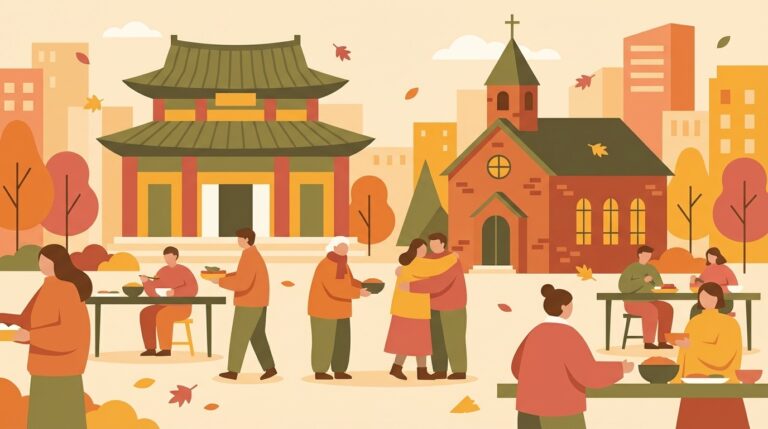
In Korea, religious facilities—whether Buddhist temples, Catholic cathedrals, or Protestant churches—aren’t just places of worship. They are massive social hubs, welfare centers, and community anchors. If you only know how to say “I go to church” (교회에 가요), you’re missing out on a huge chunk of advanced Korean social vocabulary. Today, we’re diving into the C1-level expressions that capture the deep social and spiritual roles these places play in Korean society. Let’s elevate your Korean from “textbook tourist” to “cultural insider”!
Phase 2: Core Expressions Deep Dive
Let’s look at three advanced expressions you’ll hear in news reports, office chats, and even K-Pop fandom spaces.
1. 마음을 비우다
- Pronunciation: ma-eu-meul bi-u-da (The ‘eu’ in ‘ma-eum’ sounds like the disgusted grunt you make when stepping in gum.)
- Meaning: Literal: To empty one’s mind. Real Nuance: To let go of greed, stress, or expectations; to clear one’s head.
- K-Culture Moment: You’ll hear this a lot from colleagues returning from a weekend Templestay (템플스테이). When the intense “Pali-Pali” (hurry up) culture of Seoul burns them out, Koreans go to temples to “empty their minds.”
- Editor’s Insight: This isn’t just about relaxing; it implies a spiritual or philosophical reset. It means accepting things as they are without forcing an outcome.
- Situation Spectrum:
[🚫 Never] ———— [⚠️ Be Careful] ———— [✅ Freely]
- Close Friends (Casual): ✅ “야, 다 잊고 마음 좀 비워.” (Hey, forget it all and clear your mind.)
- Coworkers (Semi-formal): ✅ “주말에 절에 가서 마음 좀 비우고 왔어요.”
- Superiors/Elders (Formal): ⚠️ (Use politely to describe your own state, not theirs!)
- 🤔 Think About It: Why is “emptying” the mind seen as a virtue in Korean society, rather than “filling” it with positive thoughts? How does this reflect Buddhist philosophies ingrained in daily life?
2. 선한 영향력을 펼치다
- Pronunciation: seon-han yeong-hyang-nyeok-eul pyeol-chi-da
- Meaning: Literal: To spread good influence. Real Nuance: To use one’s platform or community power for social good, charity, or volunteering.
- K-Culture Moment: This is the ultimate K-Pop and K-Celebrity buzzword! When an actor donates to a church-run orphanage, or a fandom volunteers at a temple’s soup kitchen, the media praises their “선한 영향력.”
- Editor’s Insight: At a C1 level, using “선한 영향력” instead of just “좋은 일” (good deed) instantly makes you sound highly educated and culturally attuned.
- Situation Spectrum:
[🚫 Never] ———— [⚠️ Be Careful] ———— [✅ Freely]
- Close Friends (Casual): ⚠️ (A bit too formal for casual drinking banter.)
- Coworkers (Semi-formal): ✅
- Superiors/Elders/Formal speeches (Formal): ✅ (Perfect for formal presentations or interviews.)
- 🤔 Think About It: Does your home country’s celebrity culture heavily emphasize “group charity” organized by fans?
3. 소외계층을 돕다
- Pronunciation: so-oe-gye-cheung-eul dop-da
- Meaning: Literal/Real Nuance: To help the marginalized/underprivileged classes.
- K-Culture Moment: As winter approaches, news channels show footage of religious groups making thousands of heads of Kimchi (김장 봉사) to distribute to the “소외계층.” It’s a staple of Korea’s year-end culture.
- Editor’s Insight: Religious institutions in Korea do the heavy lifting for social welfare. Using the term “소외계층” instead of “가난한 사람” (poor people) shows deep respect and C1-level tact.
- Situation Spectrum:
[🚫 Never] ———— [⚠️ Be Careful] ———— [✅ Freely]
- Close Friends (Casual): ✅
- Coworkers (Semi-formal): ✅
- Superiors/Elders (Formal): ✅
- 🤔 Think About It: Why do religious facilities take on such a massive role in feeding and helping the marginalized in modern cities like Seoul?
Phase 3: Textbook vs. Real Korean
| Situation | 📖 Textbook Korean | 🗣️ Real Korean | 💡 Why the difference? |
|---|---|---|---|
| Asking about weekend charity | 주말에 자원봉사를 합니까? | 주말에 성당/교회 봉사 가요? | “자원봉사” is formal. In conversation, people just say “봉사 가다” (go to volunteer). |
| Explaining a retreat | 불교 사찰에 다녀왔습니다. | 마음도 비울 겸 템플스테이 다녀왔어요. | “사찰” (temple) is very formal. “마음도 비울 겸” (to clear my mind) adds advanced emotional context! |
| Mentioning a donation | 돈을 기부했습니다. | 좋은 일에 쓰라고 후원 좀 했어요. | “기부” is direct. “후원” (sponsorship/support) sounds softer, and “좋은 일” (good deed) is a humble way to phrase it. |
Bottom Note: At the C1 level, it’s all about humility. Koreans downplay their good deeds. Instead of saying “I did amazing charity work,” say “I just helped out a bit for a good cause.”
Phase 4: Cultural Context — K-Culture Deep Dive
4-1. The Non-Verbal Nunchi (눈치) of Giving
In Korea, volunteering and charity are often communal. When volunteering at a religious facility’s soup kitchen (무료 급식소), you don’t boast. You work quietly, wearing a simple apron, and focus on the collective effort. The Nunchi here is about blending in—acting as one unit rather than seeking individual praise.
4-2. The K-Food Connection: Temple Food & Soup Kitchens
Have you heard of Temple Food (사찰음식)? It’s famous worldwide for being vegan, extremely healthy, and lacking the five pungent vegetables (garlic, green onion, etc.). But it’s more than a culinary trend; it’s a spiritual practice. Eating in a temple involves 발우공양 (Baru Gongyang), where you must eat absolutely every grain of rice and wash your bowl with water and a piece of pickled radish, then drink that water! It teaches gratitude and zero waste.
On the other hand, many churches and temples run 밥퍼 (Bap-peo) missions. “밥을 퍼주다” literally means “to scoop rice for someone.” In Korean culture, sharing rice is the ultimate expression of love and social responsibility.
Phase 5: Real-life Roleplay Scenario
Setting: Monday morning, 9:00 AM. The office pantry in a high-rise in Gangnam. You are making your morning coffee. Your coworker, Minji (32, friendly and very active in her community), walks in looking surprisingly energized.
Characters:
– YOU: An expat working in Seoul, Korean level C1. You want to connect more deeply with local life.
– Minji: Your Korean colleague.
Dialogue:
Minji: 주말 잘 보냈어요? 저는 주말 내내 김장하느라 허리가 끊어질 것 같아요. 😅
(jumaal jal bonaesseoyo? jeoneun jumaal naenae gimjang-haneura heoriga kkeuneojil geot gatayo.)
[Translation: Did you have a good weekend? My back is about to break from making Kimchi all weekend.]
(🎭 Stage Direction: Minji stretches her back but is smiling brightly.)
YOU: 김장 철이긴 하네요! 집에서 가족들이랑 하신 거예요?
(gimjang cheorigi-nhaneyo! jibeseo gajokdeurirang hasin geoyeyo?)
[Translation: It is Kimchi-making season! Did you do it at home with your family?]
Minji: 아뇨, 저희 성당에서 연말에 소외계층 분들 나눠드릴 김장 봉사가 있었거든요. 200포기나 담갔어요!
(anyo, jeohui seongdang-eseo yeonmare so-oe-gye-cheung bundeul nanwo-deuril gimjang bongsaga isseotgeodeunyo. ibeek-pogina damgasseoyo!)
[Translation: No, our cathedral had a Kimchi volunteering event for the marginalized for the year-end. We made 200 heads!]
🔀 Your Turn! How should you respond?
– A) “와, 진짜 피곤하시겠네요. 오늘 푹 쉬세요.” (Textbook, safe, but a bit conversation-ending.)
– B) “정말 선한 영향력을 펼치고 오셨네요! 다음엔 저도 같이 가서 마음 좀 비우고 싶어요.”
– C) “대박! 저도 김치 좋아하는데 좀 주시면 안 돼요?”✅ Best Choice: B — You validate her hard work using high-level vocabulary (“선한 영향력”), and smoothly express interest in joining, showing your willingness to engage in Korean community life.
⚠️ Choice C Analysis: Asking for the charity Kimchi for yourself is a major Nunchi failure!
Minji: 어머, 정말요? 마침 다음 달에 연탄 배달 봉사도 있는데 같이 가실래요? 끝나고 다 같이 국밥도 먹어요!
(eomeo, jeongmalyo? machim da-eum dare yeontan baedal bongsado inneunde gachi gasillaeyo? kkeunnago da gachi gukbapdo meogeoyo!)
[Translation: Oh my, really? We actually have a coal briquette delivery volunteer event next month, want to come along? We all eat soup and rice together afterward!]
YOU: 너무 좋죠! 좋은 일도 하고, 국밥도 먹고. 일정 꼭 알려주세요.
(neomu jochyo! jo-eun ildo hago, gukbapdo meokgo. iljeong kkok allyeojuseyo.)
[Translation: I’d love to! Doing a good deed and eating Gukbap. Please let me know the schedule.]
Phase 6: 10-Second Shadowing Drill
Practice this C1-level sentence. Pay attention to the pauses (/) and the emotional tone!
🥺 (With sincere admiration)
와~ / 주말에 쉬지도 못하셨을 텐데, / 정말 선한 영향력을 / 펼치셨네요!
(wa~ / jumare swijido mothasyeosseul tende, / jeongmal seonhan yeong-hyang-nyeogeul / pyeolchisyeonneyo!)
Wow, you must not have even been able to rest over the weekend, you truly spread a positive influence!
Phase 7: K-Culture Mini Dictionary
| Korean | Romanization | English | Context |
|---|---|---|---|
| 템플스테이 | templestay | Templestay | A cultural program where anyone can stay at a Buddhist temple, meditate, and experience monastic life. A huge part of K-Tourism! |
| 바자회 | bajahoe | Charity Bazaar | Very common in Korean churches/cathedrals. Members donate items or cook food to raise money for social welfare. |
| 연탄 봉사 | yeontan bongsa | Coal Briquette Delivery | A famous winter charity activity. Volunteers form human chains to deliver heavy coal to low-income homes in hilly neighborhoods. |
| 청년부 | cheongnyeonbu | Youth Group | The young adult group in a church. In Korea, this is a massive social networking, dating, and community hub for people in their 20s and 30s. |
Phase 8: Traveler’s Survival Kit
Even if you’re just traveling to Korea, you’ll likely visit famous religious sites like Jogyesa Temple or Myeongdong Cathedral. These sites are breathtaking but have specific rules!
🆘 Survival Expressions for Visiting Temples/Cathedrals
– 🇰🇷 “여기서 사진 찍어도 되나요?” (yeogiseo sajin jjigeodo doenayo?)
– 🗣️ Meaning: Is it okay to take pictures here?
– 📍 Where to use: Inside main halls (대웅전) or during ceremonies.
– 💡 Pro Tip: Never take a photo of the Buddha statue straight from the center door, and never use flash inside a prayer hall.
- 🇰🇷 “템플스테이 예약 확인하려고 하는데요.” (templestay yeyak hwaginharyeogo haneundeyo.)
- 🗣️ Meaning: I’d like to confirm my Templestay reservation.
📌 Editor’s Travel Note
– Appropriate Dress: Avoid sleeveless shirts, shorts, or flip-flops when entering religious buildings in Korea out of respect.
– Entry/Exit: At Buddhist temples, don’t use the center door (it’s for monks/Buddha). Use the side doors!
Phase 9: Critical Thinking Corner — “한 발 더 깊이”
Community & Identity: The Surrogate Hometowns of Seoul
🧠 Think Deeper:
Why are Korean churches and temples so intimately involved in people’s social lives, far beyond just weekend worship? Let’s look at history. During Korea’s rapid industrialization in the 1970s and 80s, millions of people moved from rural villages to Seoul. They left their families, friends, and hometowns (고향) behind. In the cold, fast-paced city, religious facilities stepped in to fill that void. They became the new “surrogate hometowns.” This is why Korean church members call each other “형제님” (Brother) and “자매님” (Sister) so naturally, and why they eat a massive communal lunch together every Sunday. The religious institution became the extended Korean family.💬 Your Turn: Does a specific institution act as an “extended family” or community hub in your culture? Share your thoughts in the comments!
Phase 10: FAQ & Avoiding Misunderstandings
Q: Can I participate in a Templestay or church bazaar if I am not religious?
Yes, absolutely! Templestays in Korea are largely seen as cultural and mental-wellness experiences. Similarly, anyone is welcome to buy food at a church bazaar; they love the community engagement.
Q: When I volunteer, should I offer to pay for the post-volunteer meal (회식)?
Usually, the religious organization or the senior members will cover the cost of the meal (like 국밥) afterward. Just say, “감사히 잘 먹겠습니다!” (I will enjoy the meal thankfully!).
❌ Common Mistake #1: Bragging about your volunteer work too loudly.
✅ Do this instead: Downplay it. Say “그냥 조금 도왔어요” (I just helped a little bit). Humility is key in Korean volunteering culture.❌ Common Mistake #2: Wearing strong perfume to a temple.
✅ Do this instead: Temples are places of meditation where incense (향) is burned. Strong perfumes are considered distracting and somewhat disrespectful. Go au naturel!
Phase 11: Summary & Action Items
- One-Liner Summary: In Korea, religious facilities are the heartbeats of social welfare and community, and expressing this requires humble, advanced vocabulary like “선한 영향력” and “마음을 비우다.”
-
Action Mission 3 Steps:
- 🥉 Bronze (Solo): Read the “마음을 비우다” shadowing sentence aloud 3 times, trying to sound authentically relieved and peaceful.
- 🥈 Silver (Online): Look up your favorite K-Pop idol + “선한 영향력” on Naver or Twitter to see what charity work their fandom has done.
- 🥇 Gold (Real-life): If you are in Korea, book a one-day Templestay or buy something from a local community bazaar!
- K-Culture Mission: Watch an episode of a K-Drama (like Hospital Playlist where Jeong-won loves his church, or My Mister with the temple scenes) and observe how the characters interact in these spaces. Is it loud? Quiet?
Phase 12: Quiz — Interactive Challenge
1. Fill in the Blank (C1 Level):
Your coworker donated a large sum of money to an orphanage run by a local cathedral. The news would describe this as:
“그분은 정말 ____ 영향력을 펼치시는 분이에요.”
A) 강한 (Strong)
B) 선한 (Good/Positive)
C) 비싼 (Expensive)
2. True or False — K-Culture Edition:
At a Korean Buddhist temple, it is polite to walk through the main center door of the prayer hall to show confidence.
– True / False
3. Situational Judgment:
You want to take a break from the fast-paced life of Seoul and do a Templestay. How do you naturally explain this to your boss?
A) “요즘 너무 불행해서 절에 갑니다.”
B) “마음도 비울 겸 주말에 템플스테이 다녀오려고요.”
C) “종교를 불교로 바꾸려고 합니다.”
(Answers: 1. B, 2. False – Always use the side doors!, 3. B – “마음도 비울 겸” is the perfect, natural C1 expression.)
Frequently Asked Questions (FAQ)
Q: What does "마음을 비우다" mean in Korean and how do you pronounce it?
A: In Korean, "마음을 비우다" is pronounced [ma-eu-meul bi-u-da (The 'eu' in 'ma-eum' sounds like the disgusted grunt you make when stepping in gum.] and means: Literal: To empty one's mind. Real Nuance: To let go of greed, stress, or expectations; to clear one's head.
Q: What does "선한 영향력을 펼치다" mean in Korean and how do you pronounce it?
A: In Korean, "선한 영향력을 펼치다" is pronounced [seon-han yeong-hyang-nyeok-eul pyeol-chi-da] and means: Literal: To spread good influence. Real Nuance: To use one's platform or community power for social good, charity, or volunteering.
Q: What does "소외계층을 돕다" mean in Korean and how do you pronounce it?
A: In Korean, "소외계층을 돕다" is pronounced [so-oe-gye-cheung-eul dop-da] and means: Literal/Real Nuance: To help the marginalized/underprivileged classes.






