

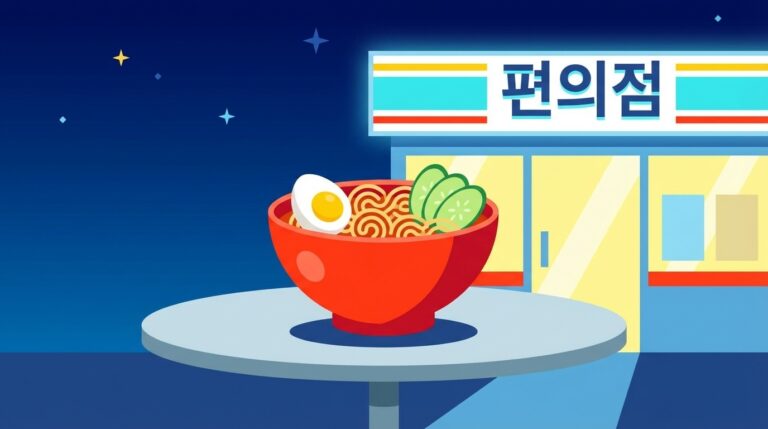
Phase 1: Welcome to the Late-Night K-Food Craving
Hello! I’m the lead editor at Daily Hangul.
Imagine a sweltering summer night in Seoul. You’re watching a K-Drama or tuning into your favorite K-Pop idol’s V-Live. They boil some instant noodles, immediately shock them in a bowl of ice water, vigorously mix in a crimson red sauce, and then—here’s the kicker—wrap the cold, spicy noodles around a sizzling piece of Samgyeopsal (pork belly) before taking a massive bite. You’re practically drooling.
Inspired, you run to the nearest Korean mart, grab that iconic blue package of Bibimmyeon (비빔면), and cook it exactly like regular ramen. The result? A warm, mushy, confusing mess. Why doesn’t yours taste like the ones on TV?
Because you missed the golden rules of Korean cold noodles! Today, we aren’t just learning how to read a recipe. We are diving deep into the vocabulary, the cultural nuance, and the “insider secrets” of making the perfect instant Bibimmyeon. This post is based on countless foreign friends I’ve had to rescue from eating soggy, hot Bibimmyeon. Let’s get cooking!
Phase 2: Core Expressions for the Perfect Bowl
Let’s look at the three essential phrases you need to understand the soul of this dish.
1. 찬물에 박박 헹궈주세요 (chan-mu-re bak-bak heng-gwo-ju-se-yo)
- Pronunciation: [chan-mu-re] sounds like “chan-moo-reh”. [bak-bak] sounds like a rhythmic drum beat. [heng-gwo-ju-se-yo] requires a soft ‘g’ sound.
- Meaning: (Literal) Please rinse vigorously in cold water. / (Real nuance) Shock the noodles in ice-cold water and scrub them until the starch is gone!
- K-Culture Moment: This is the make-or-break moment of Bibimmyeon. If you watch Korean reality shows like I Live Alone, you’ll see celebrities literally scrubbing their noodles under the tap. It’s the secret to that coveted bouncy texture.
- Editor’s Insight: The word “박박 (bak-bak)” is an onomatopoeia for scrubbing hard. We don’t just ‘wash’ the noodles; we ‘scrub’ them to get rid of the sticky starch.
- Situation Spectrum:
[🚫 Never] ———— [⚠️ Caution] ———— [✅ Freely]
- Casual with friends: ✅
- Semi-formal (co-workers cooking together): ✅
- Formal (telling your boss what to do): ⚠️ (Use softly: 찬물에 헹구시면 더 맛있습니다)
- 🤔 Think About It: Why does the Korean language have so many vivid sound-words (onomatopoeia) for cooking, like bak-bak (scrubbing), jijik (sizzling), or borgeul-borgeul (boiling)? How does your language describe cooking sounds?
2. 삼겹살이랑 같이 싸 드세요 (sam-gyeop-sa-ri-rang ga-chi ssa deu-se-yo)
- Pronunciation: [ssa] sounds like a sharp hissing ‘s’, similar to snake.
- Meaning: (Literal) Wrap and eat it together with pork belly. / (Real nuance) This is the ultimate flavor combo, wrap the meat with the noodles!
- K-Culture Moment: At a Korean BBQ restaurant, eating cold spicy noodles (Naengmyeon or Bibimmyeon) with your leftover meat is a cultural ritual. If you don’t do this, Koreans will look at you with genuine pity.
- Editor’s Insight: “싸다 (to wrap)” is a pillar of Korean food culture. We wrap meat in lettuce, but we also wrap meat in noodles.
- Situation Spectrum:
[🚫 Never] ———— [⚠️ Caution] ———— [✅ Freely]
- Casual: ✅ (Usually simply “삼겹살에 싸 먹어!”)
- Semi-formal: ✅
- Formal: ✅ (Very polite recommendation)
- 🤔 Think About It: Koreans love the concept of “꿀조합 (Honey Combination)”—finding two distinct foods that create synergy. Does your food culture emphasize individual dishes or pairing them together?
3. 오른손으로 비비고, 왼손으로 비비고 (o-reun-so-neu-ro bi-bi-go, oen-so-neu-ro bi-bi-go)
- Pronunciation: [bi-bi-go] sounds just like the famous Korean food brand!
- Meaning: (Literal) Mix with the right hand, mix with the left hand.
- K-Culture Moment: This is arguably the most famous commercial jingle in Korean history, created for “Paldo Bibimmyeon.” If you sing “오른손으로 비비고…” to any Korean, they will automatically finish the song for you.
- Editor’s Insight: “비비다” means to mix thoroughly. It’s the same verb used in Bibimbap!
- Situation Spectrum:
[🚫 Never] ———— [⚠️ Caution] ———— [✅ Freely]
- Casual: ✅ (Great for a laugh!)
- Formal: 🚫 (Don’t sing commercials to your CEO during a serious dinner)
- 🤔 Think About It: Advertising heavily influences modern language. What is a commercial catchphrase in your country that everyone uses in daily life?
Phase 3: Textbook vs. Real Korean
Let’s see how you’d sound in a textbook versus hanging out in a Korean dorm room at 1 AM.
| Situation | 📖 Textbook Korean | 🗣️ Real Korean | 💡 Why the difference? |
|---|---|---|---|
| Mixing the noodles | 면과 소스를 섞으세요. (Mix the noodles and sauce.) | 야, 맛있게 좀 비벼봐. (Hey, mix it up deliciously.) | “섞다” is just physically combining things; “비비다” implies a culinary soul. |
| Describing the taste | 아주 맛있습니다. (It is very delicious.) | 이거 완전 꿀조합이야! 존맛! (This is a honey-combo! Freaking delicious!) | Younger generations love compounding words. 꿀(Honey) = Awesome. 존맛 is a very casual slang for ‘extremely tasty’. |
| Texture of the noodles | 면이 부드럽습니다. (The noodles are soft.) | 와, 면발 쫄깃쫄깃한 거 봐. (Wow, look how chewy the noodles are.) | “Soft” is an insult for cold noodles. We want “chewy” (쫄깃쫄깃). |
(Bottom Note: For B2 learners, using “꿀조합” will instantly make you sound like a local. “존맛” is fun, but reserve it strictly for close friends!)
Phase 4: Cultural Context — K-Culture Deep Dive
4-1. The Non-Verbal Art of Slurping
In many Western cultures, slurping noodles is considered bad manners. In Korea, making a “호로록 (ho-ro-rok)” sound while eating Bibimmyeon is basically a standing ovation for the chef. It shows you are thoroughly enjoying the meal. Also, if the spicy sauce hits you hard, fan your mouth with your hand and inhale sharply through your teeth (sounds like “쓰읍-하!”).
4-2. The “Mukbang” Influence (K-Pop & K-Food)
Bibimmyeon recipes have evolved heavily due to K-Pop idols and Mukbang YouTubers. BTS’s Jungkook famously broke the internet with his custom “Bulguri” (Buldak + Neoguri) and his specific mayonnaise-added cold noodle recipes. In Korea, instant noodles aren’t just a quick meal; they are a blank canvas. Modifying instant noodles—adding soft-boiled eggs, sesame oil, cucumber strips, or pairing them with specific dumplings—is a popular hobby and a frequent topic of conversation on idol fan-cafe apps.
Phase 5: Real-Life Roleplay Scenario
Setting: Friday night, 11:30 PM. You and your Korean friend, Minji, just finished watching a thriller K-Drama. You’re both starving. You are standing in the kitchen of her Seoul apartment.
Characters:
– YOU: A foreign student who knows a thing or two about K-Food.
– Minji (25): Your energetic Korean friend who takes late-night snacking very seriously.
Minji: 야, 출출한데 비빔면 콜? 🍜
(Ya, chul-chul-han-de bi-bim-myeon kol?)
[Hey, I’m feeling a bit hungry, down for Bibimmyeon?]
YOU: 무조건 콜이지! 내가 끓일까?
(Mu-jo-geon ko-ri-ji! Nae-ga kkeu-ril-kka?)
[Absolutely yes! Should I boil them?]
Minji: 오~ 그럼 난 옆에서 대패삼겹살 구울게!
(O~ geu-reom nan yeo-pe-seo dae-pae-sam-gyeop-sal gu-ul-ge!)
[Oh~ Then I’ll grill some thinly sliced pork belly on the side!]
(🎭 Stage Direction: You boil the noodles for exactly 3 minutes.)
YOU: 민지야, 다 끓였어. 이제 소스 넣을까?
(Min-ji-ya, da kkeu-ryeo-sseo. I-je so-seu neo-eul-kka?)
[Minji, it’s done boiling. Should I put the sauce in now?]
Minji: (Horrified gasp) 😱 안 돼!! 너 찬물에 안 헹궜어?
(An dwae!! Neo chan-mu-re an heng-gwo-sseo?)
[NO!! You didn’t rinse it in cold water?]
🔀 Your Turn! How do you respond?
– A) “아, 맞다! 따뜻하게 먹는 줄 알았어.” (Ah, right! I thought we eat it warm.)
– B) “장난이지~ 당연히 찬물에 빡빡 헹궈야지! 얼음 어딨어?” (Just kidding~ Of course I have to scrub it in cold water! Where’s the ice?)
– C) “미안, 그냥 대충 먹자.” (Sorry, let’s just eat it however.)✅ Best Choice: B — You show you understand the absolute necessity of cold water for the jjolgit-jjolgit texture, playfully teasing her panic.
⚠️ Choice A & C Analysis: If you say C, a Korean friend might genuinely take the pot away from you. Food texture is sacred!
Minji: (Sighs in relief) 휴, 깜짝 놀랐네. 얼음 저기 냉동실에 있어.
(Hyu, kkam-jjak nol-lan-ne. Eo-reum jeo-gi naeng-dong-si-re i-sseo.)
[Phew, you scared me. Ice is over there in the freezer.]
Phase 6: 10-Second Shadowing Drill
Read this out loud. Pay attention to the slash (/) for pausing, and act out the emotion tag!
😤 단호하게 (Strictly, like a master chef):
비빔면은 / 무조건 / 찬물에 / 박~~~박 / 헹궈야 돼요!
(bi-bim-myeo-neun / mu-jo-geon / chan-mu-re / bak~~~bak / heng-gwo-ya dwae-yo!)
[Bibimmyeon / absolutely / in cold water / vigorously / must be rinsed!]
Phase 7: K-Culture Mini Dictionary
| Korean | Romanization | English | Context |
|---|---|---|---|
| 쫄깃쫄깃 | jjolgit-jjolgit | Chewy/Bouncy | The ideal texture for noodles and rice cakes. |
| 꿀조합 | kkul-jo-hap | Honey combination | The perfect pairing of two foods (e.g., Beer & Chicken, Bibimmyeon & Pork). |
| 야식 | ya-sik | Late-night snack | A massive part of Korean culture; food eaten usually after 10 PM. |
| 맵찔이 | maep-jjil-i | Spicy-food weakling | Slang for someone who can’t handle spicy food well. |
| 콜 | kol | Call! (I’m in!) | Konglish used to enthusiastically agree to a plan or suggestion. |
Phase 8: Traveler Survival Kit (Convenience Store Edition)
If you are visiting Korea, you’ll likely buy your instant noodles at a GS25, CU, or 7-Eleven. Here are your lifesavers:
🆘 Survival Phrases for the Convenience Store
– 🇰🇷 “젓가락 하나 챙겨주세요.” (jeot-ga-rak ha-na chaeng-gyeo-ju-se-yo)
– 🗣️ Meaning: Please give me one pair of disposable chopsticks.
– 🇰🇷 “얼음컵 큰 거 어디 있어요?” (eo-reum-keop keun geo eo-di i-sseo-yo?)
– 🗣️ Meaning: Where are the large ice cups? (Pro-tip: Buy an ice cup to shock your noodles if you cook them at the Han River!)
– 🇰🇷 “봉투는 괜찮아요.” (bong-tu-neun gwaen-cha-na-yo)
– 🗣️ Meaning: I don’t need a plastic bag. (Korean stores charge for bags by law).📌 Editor’s Travel Note:
If you cook instant noodles at a convenience store patio, you will see a hot water dispenser (온수기). Do not put hot water into a “Bibimmyeon” cup noodle and leave it. You must pour the hot water out through the little holes in the lid, then rinse with cold water from a water purifier or bottled water before adding the sauce!
Phase 9: Critical Thinking Corner — “One Step Deeper”
Food & Identity: The Culture of ‘Jo-hap’ (Combinations)
🧠 Think Deeper:
Why do Koreans place so much importance on “꿀조합” (perfect food pairings)? In Korean cuisine, food is rarely an isolated experience. Rice needs banchan (side dishes); grilled meat needs ssam (lettuce wraps); and Bibimmyeon needs pork belly or dumplings. This culinary philosophy mirrors the Korean social structure, which deeply values “우리” (We/Us) over the individual. A dish, much like a person, reaches its full potential when it harmonizes with others to create a synergistic balance.💬 Your Turn: Does your culture have a “꿀조합” that outsiders might find strange but locals absolutely love? Share it in the comments!
Phase 10: FAQ & Avoiding Misunderstandings
Q: “Is it rude to slurp my noodles in a restaurant?”
Maybe in New York, but not in Seoul! Slurping cold noodles is perfectly fine and often shows you are enjoying the meal. Just don’t splash the red sauce on the person sitting across from you!
Q: “Can I ask the convenience store worker to cook it for me?”
No. Convenience stores in Korea are strictly self-service when it comes to cooking instant noodles.
❌ Common Mistake #1: Treating Bibimmyeon like Ramen.
✅ How to fix it: If you see the word “비빔 (Bibim = Mixed)” or “볶음 (Bokkeum = Stir-fried)” on a noodle cup, it means you MUST DRAIN THE WATER before putting the sauce in. If you put the sauce in the boiling water, you will create a sad, tasteless red soup.
Phase 11: Summary & Action Items
One-Liner Summary: To master Korean Bibimmyeon, remember to scrub it in cold water (박박 헹구다) and pair it with meat for the ultimate honey combo (꿀조합)!
Your Missions for Today:
– 🥉 Bronze (Solo): Stand in your kitchen and practice saying “면발이 쫄깃쫄깃해요!” (The noodles are chewy!) 3 times.
– 🥈 Silver (Online): Find a K-Pop idol’s Mukbang video on YouTube and leave a comment: “완전 꿀조합이네요!”
– 🥇 Gold (Real-world): Go to a Korean supermarket, buy Bibimmyeon and pork belly, and cook the perfect combo using the “bak-bak” method!
Phase 12: Quiz — Interactive Challenge
1. Fill in the blank: To get the best texture, you must wash the noodles in cold water until they are __________.
A) 따뜻해요 (Warm)
B) 부드러워요 (Soft)
C) 쫄깃쫄깃해요 (Chewy)
(Answer: C! We want that bounce!)
2. True or False – K-Culture Edition: When eating instant Bibimmyeon from a cup, you put the sauce in with the boiling water and wait 3 minutes.
(Answer: FALSE! Drain the water first, rinse with cold water, THEN add the sauce. Don’t make the red soup mistake!)
3. Situational Judgment: Your Korean friend makes Bibimmyeon and pork belly for you. What is the most natural compliment to give them at B2 level?
A) “음식이 아주 좋습니다.”
B) “이거 완전 꿀조합이야!”
C) “섞어주세요.”
(Answer: B! It sounds incredibly natural and praises their pairing choice.)
Frequently Asked Questions (FAQ)
Q: What does "찬물에 박박 헹궈주세요 (chan-mu-re bak-bak heng-gwo-ju-se-yo)" mean in Korean and how do you pronounce it?
A: In Korean, "찬물에 박박 헹궈주세요 (chan-mu-re bak-bak heng-gwo-ju-se-yo)" is pronounced [chan-mu-re] and means: (Literal) Please rinse vigorously in cold water. / (Real nuance) Shock the noodles in ice-cold water and scrub them until the starch is gone!
Q: What does "삼겹살이랑 같이 싸 드세요 (sam-gyeop-sa-ri-rang ga-chi ssa deu-se-yo)" mean in Korean and how do you pronounce it?
A: In Korean, "삼겹살이랑 같이 싸 드세요 (sam-gyeop-sa-ri-rang ga-chi ssa deu-se-yo)" is pronounced [ssa] and means: (Literal) Wrap and eat it together with pork belly. / (Real nuance) This is the ultimate flavor combo, wrap the meat with the noodles!
Q: What does "오른손으로 비비고, 왼손으로 비비고 (o-reun-so-neu-ro bi-bi-go, oen-so-neu-ro bi-bi-go)" mean in Korean and how do you pronounce it?
A: In Korean, "오른손으로 비비고, 왼손으로 비비고 (o-reun-so-neu-ro bi-bi-go, oen-so-neu-ro bi-bi-go)" is pronounced [bi-bi-go] and means: (Literal) Mix with the right hand, mix with the left hand.







