

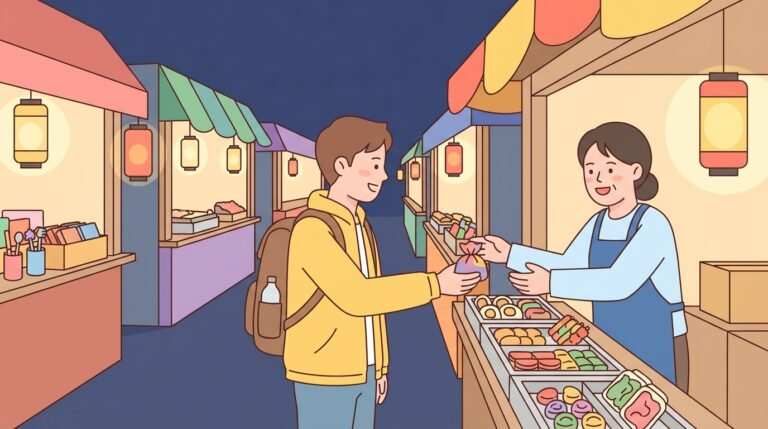
Phase 1: Empathy (The K-Culture Cold Open)
Hello! This is your Daily Hangul Editor.
Picture this: It’s 11 PM. You are wandering through the dazzling neon maze of the Dongdaemun Night Market or exploring a bustling underground shopping mall in Gangnam. You spot the perfect vintage jacket. You ask the price, and the friendly ajumma (middle-aged lady) says, “50,000 won.” You have exactly 40,000 won in your pocket.
In a K-Drama, this is the exact moment the plucky main character flashes a charming smile, unleashes some magical Korean phrases, and walks away with the jacket and a free pair of socks. But in reality? Your brain freezes. You translate “Can you reduce the price?” in your head, but it sounds so stiff and awkward that you just nervously bow and walk away.
Don’t worry! Every Korean learner has been there. Haggling in Korea isn’t a fierce battle; it’s a playful, relationship-building dance. Today, we are going to learn how to negotiate and ask for a discount—not like a textbook robot, but like a true Korean insider. Let’s dive in!
Phase 2: Core Expressions Deep Dive
1. 조금만 깎아주세요 (Jogeum-man kkakka juseyo)
- Pronunciation: [jo-geum-man kka-kka ju-se-yo] (‘kka’ sounds like the sharp, tense ‘k’ in “sky”, without blowing air out)
- Meaning: Literal: “Please cut it down just a little” / Real nuance: “Could you give me a little discount, please?”
- K-Culture Moment: You’ll see this in almost every Korean travel variety show when celebrities visit a traditional market. They put their hands together, smile brightly, and use this exact phrase to charm the vendors.
- Editor’s Insight: The magic word here is 조금만 (just a little). It softens your request. You aren’t demanding a massive price drop; you’re politely asking for a tiny favor. It makes the vendor feel respected.
- Situation Spectrum:
[🚫 절대 금지] ———— [⚠️ 주의] ———— [✅ 자유롭게]
- Friends (Casual): 🚫 (You don’t buy things from friends!)
- Market Vendors / Independent Shops: ✅
- Department Stores / Franchises (Formal): 🚫 (Prices are strictly fixed here!)
- 🤔 Think About It: Why do Koreans prefer saying “cut it down slightly” instead of “make it cheaper”? How does this reflect the Korean value of saving face (체면 – chemyeon) for both the buyer and the seller?
2. 아~ 너무 비싸요~ (Ah~ Neomu bissayo~)
- Pronunciation: [ah~ neo-mu bi-ssa-yo~] (‘neo-mu’ sounds like ‘nuh-moo’)
- Meaning: Literal: “Ah, it is too expensive” / Real nuance: “Oof, that’s a bit out of my budget!”
- K-Culture Moment: When K-Pop idols go shopping on reality shows, you’ll often hear them drag out the end of this sentence with a bit of aegyo (cute display of affection) to melt the vendor’s heart.
- Editor’s Insight: If you just say “비싸요” (It’s expensive) with a straight face, it sounds like an insult to their goods. But if you add “아~” at the beginning, drag out the “요~” at the end, and smile like you’re slightly heartbroken, it becomes an invitation to negotiate.
- Situation Spectrum:
[🚫 절대 금지] ———— [⚠️ 주의] ———— [✅ 자유롭게]
- Market Vendors / Street Stalls: ✅
- High-end Boutiques: 🚫
- 🤔 Think About It: In your culture, is calling something “too expensive” to the seller’s face considered rude? In Korea, tone and body language entirely change the meaning of the words!
3. 현금으로 할게요 (Hyeon-geum-euro halgeyo)
- Pronunciation: [hyeon-geum-eu-ro hal-ge-yo]
- Meaning: Literal: “I will do it with cash” / Real nuance: “I’ll pay in cash (so can I get the cash discount?)”
- K-Culture Moment: In underground shopping malls like Goto Mall (Express Bus Terminal), you’ll often see price tags with two numbers: one for credit cards and a cheaper one for cash.
- Editor’s Insight: This is your ultimate trump card. In independent shops, vendors prefer cash to avoid credit card fees. Offering cash is the most practical way to successfully persuade a vendor to drop the price by 10%.
- Situation Spectrum:
[🚫 절대 금지] ———— [⚠️ 주의] ———— [✅ 자유롭게]
- Any small shop/market: ✅
Phase 3: Textbook vs. Real Korean
| Situation | 📖 Textbook Korean | 🗣️ Real Korean | 💡 Why is it different? |
|---|---|---|---|
| Asking for a lower price | 가격을 좀 인하해 주실 수 있습니까? (Could you reduce the price?) | 사장님~ 조금만 빼주세요! (Boss~ take a little bit off!) | Real Korean uses “사장님” (Boss) to build rapport, and “빼다” (subtract) is the daily slang for discounting. |
| Asking for freebies | 무료로 제공되는 것이 있나요? (Is there anything provided for free?) | 서비스 많이 주세요! (Please give me lots of service!) | “Service” (서비스) in Korea specifically means “free bonus items,” reflecting the culture of generosity. |
| Closing the deal | 그럼 이 가격에 사겠습니다. (Then I will buy it at this price.) | 앗싸, 감사합니다! 예쁘게 입을게요! (Yay, thank you! I’ll wear it nicely!) | Showing emotional gratitude makes the vendor feel good about giving you the discount. |
Bottom Note: For B1 learners, stick to “조금만 빼주세요” or “깎아주세요”. Avoid overly aggressive slang.
Phase 4: Cultural Context — K-Culture Deep Dive
4-1. Non-Verbal Elements: The Art of the Smile
In Western cultures, negotiation can sometimes feel like a standoff. You keep a poker face. In Korea, it’s the exact opposite! You need to use your Nunchi (눈치). If the vendor looks busy or stressed, don’t haggle. If they are chatting with you, smile broadly, make soft eye contact, and act slightly playfully. Handing over cash with two hands while doing a slight bow seals the deal perfectly.
4-2. K-Travel & K-Food Connection: The Power of “Service” (서비스)
If you go to a traditional Korean restaurant or a late-night Pojangmacha (street tent), “negotiation” isn’t just about money; it’s about food! If you order a lot of drinks and act friendly with the owner, they might suddenly drop a plate of rolled omelets on your table and say, “서비스!” (It’s on the house!). You don’t always have to ask for a discount; sometimes, expressing how delicious the food is will earn you more value than a 10% price cut!
Phase 5: Interactive Roleplay Scenario
Setting: A bustling phone case shop in the Hongdae shopping street. Neon lights are flashing, and K-Pop is blasting from a nearby speaker. You found a gorgeous phone case, but it’s slightly over your budget.
Characters:
– YOU: A B1 Korean learner, armed with charm and a little bit of cash.
– Sajang-nim (사장님): The shop owner (40s, friendly but a skilled merchant).
Dialogue:
YOU: 사장님, 이거 얼마예요? 📱
(Sajang-nim, igeo eolmayeyo?)
[Boss, how much is this?]
Sajang-nim: 아, 그거 신상이에요. 2만 5천 원!
(Ah, geugeo sinsang-ieyo. Iman ocheon won!)
[Ah, that’s a new arrival. 25,000 won!]
YOU: 헉, 2만 5천 원이요? 아~ 너무 비싸요~ 🥺
(Heok, iman ocheon won-iyo? Ah~ neomu bissayo~)
[Gasp, 25,000 won? Ah~ it’s too expensive~]
Sajang-nim: 에이, 진짜 좋은 물건이에요. 튼튼해!
(Ei, jinjja joeun mulgeon-ieyo. Teunteunhae!)
[Hey, it’s a really good product. It’s durable!]
🔀 YOUR TURN! How do you respond to persuade the owner?
– A) “그럼 안 살게요. 안녕히 계세요.” (Then I won’t buy it. Goodbye.)
– B) “사장님~ 제가 현금으로 할게요! 조금만 깎아주세요~” (Boss~ I’ll pay in cash! Please give me a little discount~)
– C) “만 원에 주세요!” (Give it to me for 10,000 won!)✅ Best Choice: B — Why? Offering cash (현금) is the best leverage you have. Combining it with “사장님” and “조금만 깎아주세요” is the golden trifecta of Korean haggling!
⚠️ Choice C Analysis: Cutting the price by 60% immediately is considered rude and aggressive. In Korea, aim for a 10-20% discount at most.
(Assuming you chose B)
Sajang-nim: (Laughs) 아유, 한국말 잘하시네! 알겠어요. 현금 주시면 2만 3천 원에 해줄게요.
(Ayu, hangungmal jalhasine! Algesseoyo. Hyeongeum jusimyeon iman samcheon won-e haejulgeyo.)
[Oh my, you speak Korean well! Alright. If you pay in cash, I’ll do it for 23,000 won.]
YOU: 우와! 감사합니다! 💸
(Uwa! Gamsahamnida!)
[Wow! Thank you!]
Phase 6: 10-Second Shadowing Drill
Practice making your voice soft and friendly. Follow the pauses (/)!
🥺 사장님~ / 이거 / 현금으로 할게요. / 조금만 / 깎아주세요!
(sa-jang-nim~ / i-geo / hyeon-geum-eu-ro hal-ge-yo. / jo-geum-man / kka-kka-ju-se-yo!)
Emotion Tag: Smile brightly, hold your cash visibly, and use a slightly higher, friendly pitch!
Phase 7: K-Culture Mini Dictionary
| 한국어 (Korean) | Romanization | English | Cultural Context |
|---|---|---|---|
| 흥정 | heung-jeong | Haggling / Bargaining | The act of negotiating a price. Usually only done in traditional markets, not franchises. |
| 사장님 | sa-jang-nim | Boss / Owner | The safest, most respectful way to address a shop owner or restaurant staff. |
| 덤 | deom | Extra / Bonus | An extra handful of goods (like apples or side dishes) given for free out of affection. |
| 서비스 | seo-bi-seu | Freebie | Something “on the house.” When a restaurant gives you a free soda, they say “It’s service!” |
| 현금가 | hyeon-geum-ga | Cash Price | A discounted price specifically for paying with physical cash or direct bank transfer. |
Phase 8: Traveler Survival Kit
🆘 Top 3 Survival Phrases for Markets
🇰🇷 1. “이거 현금가예요?” (igeo hyeon-geum-ga-yeyo?)
– 🗣️ Meaning: Is this the cash price?🇰🇷 2. “구경만 할게요.” (gugyeong-man halgeyo.)
– 🗣️ Meaning: I’m just looking around. (Use this to politely escape a pushy vendor!)🇰🇷 3. “영수증 버려주세요.” (yeongsujeung beoryeo-juseyo.)
– 🗣️ Meaning: Please throw away the receipt. (Very common to say after a card purchase).📌 Editor’s Travel Note:
Beware of 정찰제 (Fixed Price System)! If you are in a department store, Olive Young, convenience store, or any chain cafe, prices are fixed. Attempting to haggle there will only confuse the teenage part-time worker! Save your negotiation skills for Namdaemun, Dongdaemun, and underground subway malls.
Phase 9: Critical Thinking — “One Step Deeper”
🧠 Think Deeper: Food, Markets, and Identity (The Culture of ‘Jeong’)
In many cultures, business is business. A price is a mathematical fact. But in Korea, traditional markets operate on the concept of 정 (Jeong)—a deep feeling of emotional connection and community. When an ajumma gives you a discount or throws in an extra pair of socks as a Deom (덤), she isn’t just losing profit; she is initiating a relationship. She expects you to remember her warmth and return to her shop next time. The words “깎아주세요” (please give a discount) are less about saving $2, and more about engaging in this beautiful, invisible web of Korean community bonding.
💬 Your Turn: Does your culture have a concept similar to Jeong or Deom when shopping at local markets? Share your experiences in the comments!
Phase 10: FAQ & Avoiding Misunderstandings
Q: Can I use “조금만 깎아주세요” at a hospital or to my landlord?
A: 🚫 No! It is strictly for retail shopping (clothes, souvenirs, market food). Using it for professional services (doctors, lawyers, rent) is considered highly inappropriate.
Q: What if the vendor says “남는 게 없어요” (I have no profit left)?
A: This is a classic vendor phrase! It means they are at their lowest price. It’s best to either accept the price gracefully or politely walk away.
❌ Common Mistake:
Demanding a discount by saying “싸게 해라” (Make it cheap – informal/rude).
✅ Do This Instead:
Always use the polite form (-요) and address them respectfully: “사장님, 조금만 빼주세요~”
Phase 11: Summary & Action Items
✨ One-Liner Summary:
Korean haggling isn’t a battle of wits; it’s a friendly exchange of smiles, “Sajang-nim,” and cash!
🚀 Action Missions:
– 🥉 Bronze: Stand in front of a mirror, put on your most charming smile, and say “사장님~ 조금만 깎아주세요!” 3 times.
– 🥈 Silver: Leave a comment below translating this into Korean: “Boss, it’s too expensive! I will pay in cash!”
– 🥇 Gold: Next time you are in Korea (or at a local Korean market in your city), successfully ask for a cash discount using today’s phrases!
🎬 K-Culture Mission:
Search for a Korean market vlog on YouTube (search: “남대문 시장 브이로그”). Listen carefully—how many times can you hear people say “비싸요” or “깎아주세요”?
Phase 12: Quiz — Interactive Challenge
1. Situational Judgment: You are buying a cute BTS keychain in a Myeongdong street stall. The tag says 15,000 won. You want to ask for a discount nicely. What is the BEST thing to say?
A) 야, 깎아줘! (Hey, discount it!)
B) 사장님, 조금만 깎아주세요~ (Boss, please give me a little discount~)
C) 이거 무료로 주세요. (Give this to me for free.)
2. True or False – K-Culture Edition:
You can successfully haggle the price of an iced Americano at a Starbucks in Seoul. (T / F)
3. Fill in the Blank:
To get the best price at an underground mall, you should tell the owner: “_____으로 할게요!” (I will pay with cash!)
(Scroll down for answers!)
Click to reveal answers
1. B (A is extremely rude, C is literally asking to steal it!).
2. False! Franchise cafes strictly use fixed prices (정찰제).
3. 현금 (Hyeon-geum – Cash)
Frequently Asked Questions (FAQ)
Q: What does "조금만 깎아주세요 (Jogeum-man kkakka juseyo)" mean in Korean and how do you pronounce it?
A: In Korean, "조금만 깎아주세요 (Jogeum-man kkakka juseyo)" is pronounced [jo-geum-man kka-kka ju-se-yo] and means: Literal: "Please cut it down just a little" / Real nuance: "Could you give me a little discount, please?"
Q: What does "아~ 너무 비싸요~ (Ah~ Neomu bissayo~)" mean in Korean and how do you pronounce it?
A: In Korean, "아~ 너무 비싸요~ (Ah~ Neomu bissayo~)" is pronounced [ah~ neo-mu bi-ssa-yo~] and means: Literal: "Ah, it is too expensive" / Real nuance: "Oof, that's a bit out of my budget!"
Q: What does "현금으로 할게요 (Hyeon-geum-euro halgeyo)" mean in Korean and how do you pronounce it?
A: In Korean, "현금으로 할게요 (Hyeon-geum-euro halgeyo)" is pronounced [hyeon-geum-eu-ro hal-ge-yo] and means: Literal: "I will do it with cash" / Real nuance: "I'll pay in cash (so can I get the cash discount?)"







