

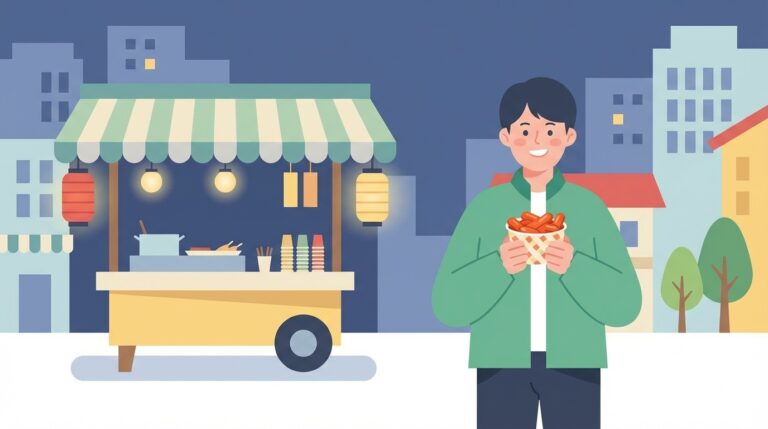
The Ultimate Guide to Korean Street Food: How to Order Like a Local\n\n### Phase 1: Empathy (The Chilly Streets of Seoul)\n\nHello! I’m the Lead Editor of Daily Hangul. Have you ever watched a K-Drama where the main characters stop at a cozy, steam-filled food tent (Pojangmacha) on a freezing winter night? They grab a skewer of fish cake, take a sip of hot broth from a tiny paper cup, and suddenly everything seems perfect. \n\nNow, imagine you are standing in the middle of Myeongdong or Hongdae. The smell of spicy Tteokbokki and sweet crispy chicken is everywhere. You want to try it, but you don’t want a massive restaurant portion—you just want to eat it while exploring the streets. But wait… how do you ask them to put it in one of those convenient little paper cups? \n\nIf you just point and say \”This, please,\” you might end up with a huge plastic takeout bag! Don’t worry. This guide is based on real struggles from my A2-level students. Today, I’ll teach you exactly how to order street food in a paper cup like a true Korean insider. Let’s dive in!\n\n—\n\n### Phase 2: Deep Dive into Core Expressions\n\nHere are the absolute must-know phrases for your street food adventure.\n\n> ### 1. 컵에 담아 주세요. (Put it in a cup, please.)\n> \n> – Pronunciation: keob-e dam-a ju-se-yo [Cup-eh dahm-ah joo-seh-yo]\n> – Sound-alike guide: \”Cup-eh\” sounds exactly like the English word ‘cup’ plus ‘eh’.\n> – Meaning: Literal: Please put it in a cup. / Real nuance: I want a small street-style portion to hold while walking.\n> – K-Culture Moment: If you visit a K-Pop idol’s food truck event, they always serve snacks in custom paper cups. Saying this at a regular street stall immediately tells the vendor, \”I know how street food works!\”\n> – Editor’s Insight: This is your magic spell for street food. Many vendors sell foods like Dakgangjeong (fried chicken) in boxes for groups, but they also have ‘cup sizes’ for solo travelers. \n> – Situation Spectrum: [🚫 Never] ———— [⚠️ Be Careful] ———— [✅ Freely]\n> – Close Friends (Casual): 🚫 (Use \”컵에 담아 줘\” instead)\n> – Street Vendors (Polite): ✅ \n> – Fancy Restaurants (Formal): 🚫 (They don’t use paper cups!)\n> – 🤔 Think About It: Why do Koreans love paper cups for street food? It perfectly reflects the \”Pali-pali\” (hurry hurry) culture—it’s fast, convenient, and leaves one hand free to hold your shopping bags or smartphone!\n\n> ### 2. 국물 좀 주세요. (Please give me some broth.)\n> \n> – Pronunciation: gung-mul jom ju-se-yo [Goong-mool johm joo-seh-yo]\n> – Sound-alike guide: \”Goong\” rhymes with ‘moon’, \”mool\” rhymes with ‘pool’.\n> – Meaning: Literal: Give me some soup. / Real nuance: Can I get some of that delicious fish cake broth in a cup?\n> – K-Culture Moment: In K-Dramas, characters always drink this broth after a breakup or a stressful day at work. It’s the ultimate Korean comfort drink.\n> – Editor’s Insight: Fish cake (Eomuk) broth is usually free if you buy something! But you need a paper cup to drink it. Often, vendors just leave a stack of paper cups out for you to serve yourself.\n> – Situation Spectrum: [🚫 Never] ———— [⚠️ Be Careful] ———— [✅ Freely]\n> – Close Friends (Casual): 🚫 \n> – Street Vendors (Polite): ✅\n> – Work Boss (Formal): ⚠️ (You wouldn’t ask your boss for soup this way)\n> – 🤔 Think About It: In many cultures, soup is eaten with a spoon sitting down. In Korea, drinking broth from a cup while standing in the cold is a shared communal experience. Does your country have a \”standing food\” culture?\n\n> ### 3. 이쑤시개 어디 있어요? (Where are the toothpicks?)\n> \n> – Pronunciation: i-ssu-si-gae eo-di isseo-yo? [Ee-ssoo-shee-gae uh-dee ee-suh-yo?]\n> – Sound-alike guide: \”Ee-ssoo\” sounds like a sneeze, and ‘으’ (eu) sounds like the disgusted sound you make when stepping in gum.\n> – Meaning: Literal/Real: Where are the toothpicks?\n> – K-Culture Moment: You got your cup of Tteokbokki! But how do you eat it? Street food in a cup is almost always eaten by stabbing it with a long wooden toothpick.\n> – Editor’s Insight: Sometimes they are hidden behind the sauce bottles. Don’t use your hands! Ask this phrase and the vendor will happily point them out.\n> – Situation Spectrum: [🚫 Never] ———— [⚠️ Be Careful] ———— [✅ Freely]\n> – Close Friends (Casual): ⚠️ (Use \”어디 있어?\” instead)\n> – Street Vendors (Polite): ✅\n\n—\n\n### Phase 3: Textbook vs. Real Korean\n\n| Situation | 📖 Textbook Korean | 🗣️ Real Korean | 💡 Why is it different? |\n|—|—|—|—|\n| Asking for a cup | 종이컵 하나 주시겠습니까? (Would you please give me a paper cup?) | 컵 하나만 주세요. (Just one cup, please.) | Street vendors are busy. Shorter, polite phrases are much preferred over formal textbook grammar. |\n| Sharing food | 이 음식을 나누어 먹겠습니다. (We will divide and eat this food.) | 같이 먹게 종이컵 하나만 더 주세요. (One more paper cup to share, please.) | Koreans love sharing food. Asking for an extra cup to share is incredibly common. |\n| Asking about eating | 여기서 식사하고 가시겠습니까? (Will you dine here?) | 먹고 가요? 포장이에요? (Eating here? Or to-go?) | Efficiency! Vendors use quick, punchy nouns rather than full verbs. |\n\n—\n\n### Phase 4: Cultural Context — K-Culture Deep Dive\n\n#### 4-1. Non-Verbal Tips: The \”Cup-Holding\” Nunchi\nWhen eating street food from a paper cup, there’s a specific etiquette! \n- Don’t walk inside stores: While it’s okay to walk on the street with your cup, never take it into clothing or cosmetic shops in Myeongdong. It’s bad Nunchi (social awareness).\n- Two-handed receiving: When the vendor hands you the hot cup, receive it with both hands, or lightly place your left hand under your right arm. It shows respect!\n\n#### 4-2. K-Food Connection: The Skewer & Cup Culture\nIn Korea, eating street food is a highly interactive experience. You stand near the cart, eat your Tteokbokki from a paper cup, and maybe grab a fish cake skewer directly from the boiling pot. \n- Crucial Rule: NEVER double-dip your skewer or your food into the communal soy sauce tray! If you need more sauce, vendors usually provide a spray bottle, or you can use a clean onion slice (provided by the vendor) to brush the sauce onto your food.\n- Trash etiquette: When you’re done, hand the empty paper cup and toothpicks back to the vendor. Street trash cans are rare in Korea!\n\n—\n\n### Phase 5: Interactive Roleplay Scenario\n\nSetting: It’s 8:00 PM on a crisp autumn evening at the Gwangjang Market. The glowing lights of the food stalls illuminate the steam rising from the pots. You are craving some famous Korean fried chicken (Dakgangjeong).\n\nCharacters:\n- YOU: A hungry traveler exploring Seoul.\n- Ajumma (Vendor): A friendly, energetic stall owner in an apron.\n\nDialogue:\n\nAjumma: 어서 오세요! 닭강정 맛있어요~ 🍗\n(eoseo oseyo! dakgangjeong masisseoyo~)\n[Welcome! The sweet crispy chicken is delicious~]\n(🎭 Stage Direction: She smiles and points to the shiny, red-sauced chicken.)\n\nYOU: 안녕하세요! 이거 작은 거 하나 주세요.\n(annyeonghaseyo! igeo jageun geo hana juseyo.)\n[Hello! I’ll have one small size of this, please.]\n\nAjumma: 네~ 포장해 드릴까요?\n(ne~ pojanghae deurilkkayo?)\n[Okay~ Shall I pack it to go? (in a box)]\n\n> 🔀 Your Turn! How do you answer?\n> – A) \”네, 감사합니다!\” (Yes, thank you!)\n> – B) \”아니요, 먹고 갈게요. 컵에 담아 주세요!\” (No, I’ll eat it now. Please put it in a cup!)\n> – C) \”이쑤시개 어디 있어요?\” (Where are the toothpicks?)\n>\n> ✅ Best Choice: B — If you choose A, she will pack it in a sealed box with tape, which is hard to eat while walking. B is the perfect local response!\n> ⚠️ Choice C Analysis: It’s too early! Wait until she gives you the food before asking for the toothpicks.\n\nAjumma: (Smiling) 네, 알겠어요. 자, 여기 컵에 담았어요. 맵지 않아요~\n(ne, algesseoyo. ja, yeogi keobe damasseoyo. maepji anayo~)\n[Yes, understood. Here, I put it in a cup. It’s not spicy~]\n(🎭 Stage Direction: She hands you a paper cup overflowing with chicken and hands you a long toothpick.)\n\nYOU: 우와, 감사합니다! 잘 먹겠습니다!\n(uwa, gamsahamnida! jal meokgetseumnida!)\n[Wow, thank you! I will eat well!]\n\n—\n\n### Phase 6: 10-Second Shadowing Drill\n\nPractice your rhythm and intonation! Follow the slash (/) for pauses.\n\n😊 사장님~ / 이거 / 컵에 담아 주세요! \n(sajangnim~ / igeo / keobe dama juseyo!)\n[Boss~ / This / please put it in a cup!]\n\n🥺 혹시 / 어묵 국물 / 마셔도 돼요?\n(hoksi / eomuk gungmul / masyeodo dwaeyo?)\n[By any chance / fish cake broth / is it okay to drink?]\n\n—\n\n### Phase 7: K-Culture Mini Dictionary\n\n| Korean | Romanization | English | Context |\n|—|—|—|—|\n| 포장마차 | pojangmacha | Street food tent | Literally \”covered wagon.\” The classic late-night street food stalls you see in dramas. |\n| 어묵 국물 | eomuk gungmul | Fish cake broth | The warm, savory soup served at street stalls. Usually free! |\n| 이쑤시개 | issushigae | Toothpick | The primary \”utensil\” for eating street food from a cup. |\n| 포장 | pojang | To-go / Takeout | Used when you want your food packed up in a bag or box to take home. |\n| 길거리 음식 | gilgeori eumsik | Street food | General term for any food sold by street vendors. |\n\n—\n\n### Phase 8: Traveler Survival Kit\n\n> 🆘 Survival Phrases for the Street Food Stall\n> – 🇰🇷 \”이거 얼마예요?\” (igeo eolmayeyo?)\n> – 🗣️ Pronunciation: [Ee-guh ohl-mah-yeh-yo?]\n> – 📍 Where to use: Markets, street stalls.\n> – 💡 Pro Tip: If you don’t understand the numbers, just point to your phone’s calculator app. Vendors are very used to this!\n\n> 📌 Editor’s Travel Note\n> – Cash vs Card: While Korea is a cashless society, many traditional street food stalls (like in Myeongdong or Namdaemun) still prefer cash. However, they almost always accept account transfers if you have a Korean bank account.\n> – Napkins: Look for a roll of toilet paper hanging on a string! In Korea, using rolled toilet paper as napkins at casual street stalls is completely normal.\n> – Tipping: Do NOT tip! There is no tipping culture in Korea. Just a bright \”감사합니다\” (Thank you) is the best tip you can give.\n\n—\n\n### Phase 9: Critical Thinking Corner — \”One Step Deeper\”\n\nFood & Identity: The Power of the Paper Cup (종이컵)\n\n> 🧠 Think Deeper:\n> Why is the simple paper cup so iconic in Korean street food? In Korea, food is deeply tied to community and sharing (Jeong, 정). When a group of friends buys one large serving of Tteokbokki, the vendor will instinctively hand out multiple paper cups and toothpicks so everyone can share. The paper cup is more than just a container; it’s an enabler of Korea’s communal dining culture on the go. Furthermore, it perfectly matches the \”Pali-pali\” (fast-paced) lifestyle of modern Seoul, allowing people to enjoy warm, comforting food without slowing down.\n>\n> 💬 Your Turn: Does your culture have a specific container or way of eating that represents your lifestyle? Share it in the comments!\n\n—\n\n### Phase 10: FAQ & Common Mistakes\n\nQ: Do I pay before or after I eat at a street stall?\nNormally, you pay when you order or when they hand you the food. If you are standing at the cart eating multiple skewers over time, you count the sticks and pay at the end.\n\nQ: Can I ask for more broth?\nYes! Broth is usually \”무한 리필\” (unlimited refill). Just hold out your cup and smile.\n\n> ❌ Common Mistake #1: Throwing away your paper cup in the vendor’s cooking area.\n> ✅ Do this instead: Hand the empty cup directly back to the vendor or put it in the specific black trash bag hanging beside the cart.\n\n> ❌ Common Mistake #2: Taking the vendor’s large metal tongs to serve yourself.\n> ✅ Do this instead: Use the long toothpicks provided, or ask the vendor to serve you.\n\n—\n\n### Phase 11: Summary & Action Items\n\nOne-Liner Summary: To eat street food on the go like a local, confidently say \”컵에 담아 주세요!\” (Please put it in a cup!).\n\nYour Action Missions:\n- 🥉 Bronze (Solo): Stand in front of a mirror, hold an imaginary cup, and say \”사장님, 컵에 담아 주세요!\” 3 times.\n- 🥈 Silver (Online): Find a YouTube vlog about Korean street food and leave a comment identifying the \”종이컵\” (paper cup) when you see it.\n- 🥇 Gold (Real Life): Next time you visit a Korean market or festival, order your food in a cup using Korean!\n\n🎬 K-Culture Mission: Watch any winter-themed K-Drama episode. Count how many times the characters drink from paper cups at a street stall. (Hint: It happens a lot!)\n\nDid you find this helpful? What Korean street food are you dying to try? Let me know below!\n\n—\n\n### Phase 12: Quiz — Interactive Challenge\n\n1. Fill in the Blank: \nYou want your fried chicken in a cup to eat while walking. \n\”사장님, 이거 _____ 담아 주세요.\”\n(A) 가방에 (in a bag)\n(B) 컵에 (in a cup)\n(C) 박스에 (in a box)\n\n2. True or False – K-Culture Edition:\nIf you buy a fish cake skewer, you have to pay extra for the hot broth in the paper cup. (T/F)\n\n3. Situational Judgment:\nYou are sharing Tteokbokki with your friend at a food stall. What is the most natural thing to ask the vendor?\n(A) 종이컵 하나만 더 주세요. (One more paper cup, please.)\n(B) 포크 두 개 주세요. (Two forks, please.)\n(C) 메뉴판 주세요. (Give me the menu.)\n\n
\n
💡 Click here for the answers!
\n1. (B) 컵에. This is the ultimate street food hack!\n2. False! The broth (eomuk gungmul) is almost always free.\n3. (A). Vendors rarely have forks; they use toothpicks. Asking for an extra cup to share is the most local thing you can do!\n
💡 Click here for the answers!
\n1. (B) 컵에. This is the ultimate street food hack!\n2. False! The broth (eomuk gungmul) is almost always free.\n3. (A). Vendors rarely have forks; they use toothpicks. Asking for an extra cup to share is the most local thing you can do!\n
\n






