

Phase 1: Empathy (Immersive Open)
Hello! I’m the Lead Editor of Daily Hangul.
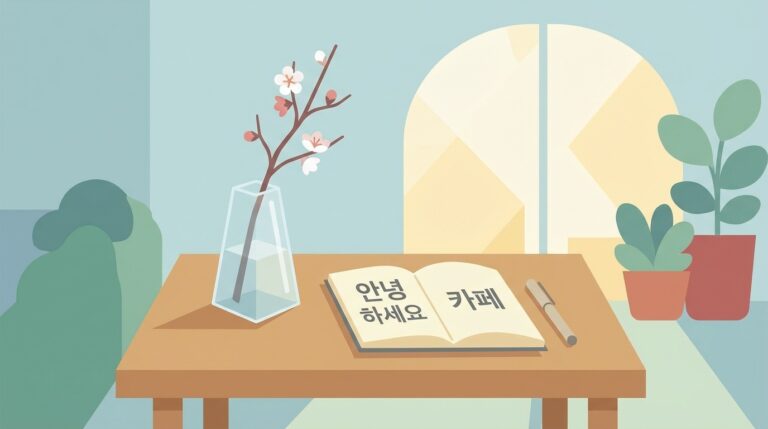
Picture this: You’re watching a sleek K-Drama, perhaps set in a high-end Gangnam penthouse, or you’re stepping into a trendy, minimalist cafe tucked away in an alley of Seongsu-dong. What do they have in common? The atmosphere is immaculate, tied together by perfectly curated greenery and a glass vase with just one or two elegantly drooping branches. It looks incredibly effortless, yet deeply intentional.
In Korea, “Planterior” (Plant + Interior) is more than just decorating; it’s a lifestyle, a healing process, and a massive trend among Millennials and Gen Z. As an advanced (C1) Korean learner, you already know basic vocabulary like 꽃 (flower) and 예쁘다 (pretty). But how do you describe that “effortless chic” aesthetic in Korean? What if you want to take a trendy one-day flower arrangement class in Yeonnam-dong, or negotiate like a local at the massive Yangjae Flower Market?
Today, we aren’t just learning vocabulary. We are diving deep into the sophisticated language of K-Aesthetics. Trust me, if you use these expressions, locals will think you’ve been living and breathing Seoul’s café culture for years. Let’s get started!
Phase 2: Core Expressions Deep Dive
Let’s explore how Korean florists and “plant butlers” (more on this later!) actually speak.
1. 무심한 듯 툭 꽂아주세요
- Pronunciation: [musimhan deut tuk kko-ja-ju-se-yo] + [Moo-shim-hahn deut took, kko-ja-joo-seh-yo]
- Meaning: (Literal) Stick it in as if you are indifferent. / (Real nuance) Arrange it casually so it looks effortlessly chic.
- K-Culture Moment: You will hear this constantly in Korean beauty, fashion, and planterior. It is the core of the 꾸안꾸 (Kku-an-kku: Effortlessly chic) aesthetic. If a K-Pop idol is wearing a loose shirt that looks casually thrown on but perfectly styled, or if a florist places a single ranunculus in a vase without over-arranging it, it’s “무심한 듯 툭.”
- Editor’s Insight: The word ‘무심하다’ usually means ‘indifferent’ or ‘careless’, but in the design world, it means ‘natural and unforced’. The sound word ‘툭’ implies dropping or tossing something lightly. It’s the ultimate compliment for modern aesthetics.
- Situation Spectrum:
[🚫 절대 금지] ———— [⚠️ 주의] ———— [✅ 자유롭게]
- Casual with friends / Instructors: ✅
- Semi-formal / Hobby classes: ✅
- Formal business settings: ⚠️ (Too trendy/casual for strict business)
- 🤔 Think About It: Why does modern Korean culture, known for its intense perfectionism and “Pali-pali” (hurry-hurry) mindset, idolize the “effortless, indifferent” aesthetic? Could it be a psychological rebellion against the pressure to look perfect all the time?
2. 여백의 미를 살려볼까요?
- Pronunciation: [yeobaegui mireul sallyeobolkkayo?] + [Yuh-baek-eui mee-reul sal-lyuh-bol-kka-yo?]
- Meaning: (Literal) Shall we revive the beauty of empty space? / (Real nuance) Let’s leave some empty space to make it look elegant.
- K-Culture Moment: This expression stems from traditional Korean art (like Sumukhwa, ink wash painting), where the unpainted white space is just as important as the ink. In a modern floral class, a teacher will say this when telling you not to cram too many flowers into the vase.
- Editor’s Insight: Using ‘살리다’ (to save/revive/bring to life) instead of just ‘만들다’ (to make) elevates your Korean to a C1/C2 level. It shows you understand how to emphasize a specific cultural aesthetic.
- Situation Spectrum:
[🚫 절대 금지] ———— [⚠️ 주의] ———— [✅ 자유롭게]
- Casual / Friends: ✅
- Hobby Classes / Art discussions: ✅
- Formal: ✅ (Highly sophisticated expression)
- 🤔 Think About It: Does your native language have a specific term for “the beauty of emptiness”? How does viewing empty space as an active design element change the way you arrange things?
3. 물올림을 잘해줘야 오래 가요
- Pronunciation: [mul-ollimeul jalhae-jwo-ya orae gayo] + [Mool-ol-leem-eul jal-hae-jwo-ya oh-rae ga-yo]
- Meaning: (Literal) You must do the water-lifting well for it to go a long time. / (Real nuance) You need to condition the flowers properly (for water uptake) so they last longer.
- K-Culture Moment: If you visit the Express Bus Terminal Flower Market (고터 꽃시장), the vendors will give you raw, unconditioned bundles of flowers wrapped in newspaper. They’ll hand it to you and throw in this advice.
- Editor’s Insight: “물올림” (Water-lifting) is the professional/hobbyist term for flower conditioning (cutting the stems at an angle, sometimes burning the ends, so they drink water well). Using this specific jargon instantly upgrades you from a “tourist buying flowers” to a “local plant enthusiast.”
- Situation Spectrum:
[🚫 절대 금지] ———— [⚠️ 주의] ———— [✅ 자유롭게]
- Flower markets / Talking to florists: ✅
- Casual conversations with plant lovers: ✅
Phase 3: Textbook vs Real Korean
How does standard textbook Korean compare to the aesthetic jargon used in Seoul’s trendiest studios?
| Situation | 📖 Textbook Korean | 🗣️ Real K-Aesthetic Korean | 💡 Why the difference? |
|---|---|---|---|
| Arranging naturally | 꽃을 자연스럽게 꽂으세요. | 무심한 듯 툭 꽂아주세요. | Focuses on the feeling and action (툭) rather than just the visual result. |
| Leaving empty space | 빈 공간을 남겨주세요. | 여백의 미를 살려주세요. | Connects modern planterior with deep-rooted traditional Korean art philosophy. |
| Matching colors | 비슷한 색으로 맞춰주세요. | 톤온톤(Tone-on-tone)으로 매치하면 무드가 확 살아요. | Korean design industries heavily use Konglish to sound modern, trendy, and sophisticated. |
| Fixing the shape | 식물 모양을 예쁘게 만드세요. | 수형(樹形)을 예쁘게 잡아주세요. | Uses specific horticultural Hanja (수형: tree shape) combined with the verb 잡다 (to catch/set) for professional flair. |
Phase 4: Cultural Context — K-Culture Deep Dive
4-1. The Non-Verbal “Kku-an-kku” (꾸안꾸)
When a Korean florist tells you to arrange things “무심한 듯” (indifferently), do not aggressively shove the flowers into the vase! The non-verbal cue here is to hold the stem lightly and let it fall against the rim of the vase naturally. It’s an exercise in restraint. In Korean culture, doing too much (투머치 – Too much) is often seen as tacky. The ultimate sophistication is making it look like you didn’t try at all.
4-2. The Rise of the “Sik-jip-sa” (Plant Butler) in K-Lifestyle
If you watch lifestyle vloggers or reality shows like I Live Alone (나 혼자 산다), you’ll notice celebrities obsessing over their indoor plants. They don’t just call them “plants”; they call them 반려식물 (Companion Plants).
Instead of being “plant owners,” Koreans proudly call themselves 식집사 (Sik-jip-sa), a portmanteau of 식물 (plant) + 집사 (butler, traditionally used for cat owners). This reflects a cultural shift. In a high-stress, hyper-competitive society, young Koreans are seeking “healing” by taking care of silent, beautiful living things. They wipe the leaves, monitor the humidity, and “serve” their plants. Knowing this context completely changes how you view a simple vase on a table!
Phase 5: Real-Life Roleplay Scenario
Setting: A sunny Saturday afternoon. You are attending a popular One-Day Flower Styling Class in a sunlit studio in Yeonnam-dong. The air smells of eucalyptus and fresh soil.
Characters:
– YOU: An advanced Korean learner who wants to decorate their Seoul apartment.
– Teacher Ji-yeon (32): A trendy, softly-spoken florist wearing a linen apron.
Dialogue:
지연 선생님: 자, 오늘은 이 화병에 센터피스를 만들어볼 건데요. 너무 꽉 채우지 말고 여백의 미를 살려서 꽂아볼게요.
(Ja, oneureun i hwabyeonge senteopiseureul mandeureobol geondeyo. Neomu kkwak chaeuji malgo yeobaegui mireul sallyeoseo kkoja-bolgeyo.)
[Teacher Ji-yeon: Alright, today we’re going to make a centerpiece in this vase. Let’s not pack it too tightly, and arrange it by bringing out the beauty of empty space.]
(🎭 Stage Direction: She hands you a beautiful but unruly branch of 조팝나무 (Spiraea).)
YOU: 이 가지는 선이 참 예쁘네요. 이건 어떻게 꽂는 게 좋을까요?
(I gajineun seoni cham yeppeuneyo. Igeon eotteoke kkonneun ge joeulkkayo?)
[YOU: The line (curve) of this branch is really beautiful. How should I arrange this one?]
지연 선생님: 그쵸? 그 가지는 수형(shape)이 생명이에요. 메인으로 쓸 거니까, 화병 한쪽에 무심한 듯 툭 걸쳐보세요.
(Geuchyo? Geu gajineun suhyeongi saengmyeongieyo. Meineuro sseul geonikka, hwabyeong hanjjoge musimhan deut tuk geolchyeoboseyo.)
[Teacher Ji-yeon: Right? The shape is the life of that branch. Since we’re using it as the main piece, try casually resting it on one side of the vase as if you’re indifferent.]
🔀 Your Turn! How do you respond and act?
– A) “네, 알겠습니다. 정확히 45도 각도로 꽂을까요?” (Yes, understood. Shall I place it at exactly a 45-degree angle?)
– B) “아, 이런 느낌이 꾸안꾸 스타일이군요! 물올림은 따로 안 해도 되나요?” (Ah, so this is the Kku-an-kku style vibe! Do I not need to do the water-conditioning separately?)
– C) “대박! 가지가 진짜 힙하네요.” (Daebak! The branch is seriously hip.)✅ Best Choice: B — Reason: As a C1 learner, Choice B brilliantly combines two advanced cultural concepts (꾸안꾸 and 물올림). You show you understand the aesthetic and the technical horticulture aspect. The teacher will be deeply impressed.
⚠️ Choice A Analysis: Missing the point! The teacher specifically asked for “무심한 듯 툭” (casual/effortless). Asking for an exact mathematical angle ruins the K-aesthetic vibe.
⚠️ Choice C Analysis: A bit too casual/slangy for an elegant one-day class setting, though the teacher might find your enthusiasm cute.
(Continuing with Choice B)
지연 선생님: 어머, 꾸안꾸랑 물올림이라는 말도 아세요? 한국분인 줄 알았어요! 물올림은 제가 미리 다 해뒀으니까 그냥 꽂으시면 돼요.
(Eomeo, kkuankkurang mul-ollimiraneun maldo aseyo? Hangukbun-in jul arasseoyo! Mul-ollimeun jega miri da haedwosseunikka geunyang kkojeusimyeon dwaeyo.)
[Teacher Ji-yeon: Oh my, you even know the words Kku-an-kku and Mul-ol-lim? I thought you were Korean! I already did all the water-conditioning beforehand, so you can just arrange it.]
Phase 6: 10-Second Shadowing Drill
Let’s practice the flow and rhythm of a K-Florist. Pay attention to the pauses (/) and the prolonged vowels (~~~).
😌 Softly and elegantly (like an ASMR florist):
이 꽃은 / 일부러 모양을 잡지 말고, / 화병에 / 무심한 듯 툭~ / 꽂아주는 게 / 포인트예요.
(I kkocheun / ilbureo moyangeul japji malgo, / hwabyeonge / musimhan deut tuk~ / kkoja-juneun ge / pointeuyeyo.)
Phase 7: K-Culture Mini Dictionary
| 한국어 (Korean) | Romanization | English Meaning | Cultural Context |
|---|---|---|---|
| 식집사 | sik-jip-sa | Plant Butler | A trendy term for someone who devotedly takes care of their indoor companion plants, treating them like pets. |
| 꾸안꾸 | kku-an-kku | Effortlessly Chic | Short for 꾸민 듯 안 꾸민 듯 (As if decorated, but not decorated). The pinnacle of Korean fashion and interior aesthetic. |
| 플랜테리어 | peullaenterieo | Planterior | Plant + Interior. Using plants as the main focal point of interior design. Highly popular in Seoul cafes. |
| 원데이 클래스 | won-de-i keullaeseu | One-Day Class | A 2-3 hour hobby workshop (baking, pottery, floristry). A hugely popular weekend date or “healing” activity for young Koreans. |
| 꽃시장 | kkot-sijang | Flower Market | Massive wholesale markets like Yangjae or Express Bus Terminal where locals go at dawn to buy cheap, fresh bundles of flowers. |
Phase 8: Traveler Survival Kit (Flower Market Edition)
If your planterior journey takes you to the famous Express Bus Terminal Flower Market (고속터미널 꽃시장) or Yangjae Flower Market (양재 꽃시장), you need “Survival Korean.” These markets are fast, crowded, and run by veteran merchants.
🆘 Survival Phrases for the Flower Market
– 🇰🇷 “이거 한 단에 얼마예요?” (igeo han dane eolmayeyo?)
– Meaning: How much is this for one bunch?
– 💡 Pro Tip: Flowers here aren’t sold by the stem; they are sold by the “단” (bunch). Always ask “한 단에” (per bunch) to sound like a local buyer.
- 🇰🇷 “신문지에 둘둘 말아주세요.” (sinmunjie duldul marajuseyo.)
- Meaning: Please just roll it up in newspaper.
- 💡 Pro Tip: Wholesale markets don’t do fancy wrapping. “둘둘 말다” means to roll something up roughly. It shows you know the drill.
📌 Editor’s Travel Note
– Timing is everything: The Express Bus Terminal market is primarily a midnight/dawn market (11:30 PM to 12:00 PM next day). Go around 10:00 AM for the biggest discount “closing sales”!
– Cash is King: While cards are accepted everywhere else in Korea, having cash (or Korean bank transfer apps) at the wholesale flower market will often get you a better deal and a smile.
Phase 9: Critical Thinking Corner — “한 발 더 깊이”
Media vs Reality: The ‘Healing’ Paradox of One-Day Classes
🧠 Think Deeper:
If you look at Korean Instagram or K-Dramas, it seems every young professional spends their weekends in sunlit studios, taking one-day classes to arrange flowers, bake madeleines, or throw pottery. It paints a picture of a deeply relaxed, aesthetic society. However, this booming “Healing (힐링) Economy” is actually a reflection of the exact opposite. Korea’s hyper-competitive work culture and “Pali-pali” lifestyle leave young adults severely burnt out.Spending 80,000 KRW on a 2-hour flower arrangement class isn’t just about getting a pretty vase; it’s about buying a highly structured, guaranteed 2 hours of peace. It is the commodification of relaxation. They crave the ‘illusion’ of a slow life (여백의 미) because their real life has no empty space at all.
💬 Your Turn: In your culture, how do busy professionals decompress? Do people pay for “hobby experiences” to force themselves to relax, or is relaxation more organic? Let us know in the comments!
Phase 10: FAQ & Mistake Prevention
Q: Can I haggle at the flower market like I see in dramas?
A: Maybe. If you are buying just one bunch, haggling (깎아주세요 – Please give me a discount) is often frowned upon and might annoy busy vendors. Instead, ask playfully: “사장님, 이거 두 단 사면 좀 잘해주실 수 있어요?” (Boss, if I buy two bunches, can you treat me well? / give me a deal?).
Q: Is it okay to use “무심한 듯 툭” when giving instructions at work?
A: No. It is strictly an aesthetic/creative term. If you tell your Korean coworker to “casually toss” a report onto the boss’s desk (무심한 듯 툭 놔주세요), you will cause a major office incident!
❌ Common Mistake Alert:
When talking about arranging flowers, don’t use the verb 만들다 (to make) too much. (e.g., 꽃을 예쁘게 만들어요 – I make the flowers pretty).
✅ Do this instead: Use the specific verbs 꽂다 (to insert/arrange in a vase) or 수형을 잡다 (to shape/style). It instantly elevates your Korean to C1 level.
Phase 11: Summary & Action Items
- One-Liner Summary: To master the Korean planterior aesthetic, stop trying so hard—embrace the “Kku-an-kku” vibe and casually place your flowers with “무심한 듯 툭.”
🎯 Action Mission:
– 🥉 Bronze (Solo): Look at a plant or vase in your room. Describe its aesthetic out loud in Korean using “여백의 미” or “수형.”
– 🥈 Silver (Online): Go to a Korean YouTube vlog about “식집사” (Plant Butler) or “플랜테리어” (Planterior). Leave a comment: “무심한 듯 툭 꽂은 꽃이 너무 예뻐요!” (The casually arranged flowers are so pretty!)
– 🥇 Gold (Real-world): Visit a Korean florist (or any local florist), buy a single stem, and practice asking them how to properly do the “물올림” (water-conditioning) for that specific flower.
Phase 12: Quiz — Interactive Challenge
1. Situational Judgment: You are at a trendy florist in Seoul buying a gift. You want the arrangement to look very modern, not like a traditional, tightly packed, round bouquet. What should you say?
– A) “꽃을 최대한 많이 꽉꽉 채워주세요.”
– B) “여백의 미를 살려서, 무심한 듯 툭 꽂은 느낌으로 해주세요.”
– C) “물올림을 아주 강하게 해주세요.”
👉 Click to see the answer
Answer: B. This perfectly conveys the modern “Kku-an-kku” aesthetic. (A) asks to pack it as tightly as possible, which is the opposite of modern K-aesthetic. (C) is about conditioning the stem, not the design.
2. Fill in the Blank (Culture):
In Korea, someone who is incredibly devoted to taking care of their indoor companion plants (반려식물) is proudly called a “_____”.
👉 Click to see the answer
Answer: 식집사 (Sik-jip-sa / Plant Butler).
3. True or False – K-Culture Edition:
“If you go to the Express Bus Terminal Flower Market, you should only ask for 1 or 2 stems of flowers at a time, just like at a boutique florist.”
👉 Click to see the answer
Answer: False. Wholesale markets sell flowers by the bunch (단). You should ask “한 단에 얼마예요?” (How much for one bunch?).
Frequently Asked Questions (FAQ)
Q: What does "무심한 듯 툭 꽂아주세요" mean in Korean and how do you pronounce it?
A: In Korean, "무심한 듯 툭 꽂아주세요" is pronounced [musimhan deut tuk kko-ja-ju-se-yo] and means: (Literal) Stick it in as if you are indifferent. / (Real nuance) Arrange it casually so it looks effortlessly chic.
Q: What does "여백의 미를 살려볼까요?" mean in Korean and how do you pronounce it?
A: In Korean, "여백의 미를 살려볼까요?" is pronounced [yeobaegui mireul sallyeobolkkayo?] and means: (Literal) Shall we revive the beauty of empty space? / (Real nuance) Let's leave some empty space to make it look elegant.
Q: What does "물올림을 잘해줘야 오래 가요" mean in Korean and how do you pronounce it?
A: In Korean, "물올림을 잘해줘야 오래 가요" is pronounced [mul-ollimeul jalhae-jwo-ya orae gayo] and means: (Literal) You must do the water-lifting well for it to go a long time. / (Real nuance) You need to condition the flowers properly (for water uptake) so they last longer.







