

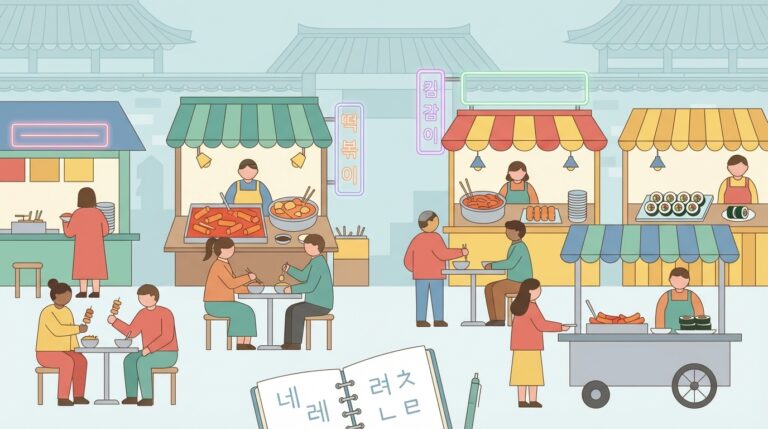
Phase 1: Empathy (The K-Culture Cold Open)
Hello there! I’m your Daily Hangul Editor, your veteran tutor and local cultural navigator.
Picture this: You are watching your favorite K-Drama. The main character has just had a tough day at work, so they stop by a glowing orange tent (pojangmacha) or a bustling traditional market. The steam from the dumplings is rising into the night air, they take a bite of fiery red tteokbokki, clink a glass of soju, and shout something to the stall owner. They look so cool, so integrated.
Now, cut to reality. You are standing in the middle of Gwangjang Market or Namdaemun Market. The smell of sizzling mung bean pancakes (bindaetteok) is heavenly, but the crowds are moving fast. An ajumma (middle-aged lady) looks at you and asks a rapid-fire question. Your mind goes blank. The textbook phrase you practiced—”이것은 얼마입니까?” (How much is this?)—suddenly feels too stiff, and you end up just pointing and holding up your fingers.
Don’t worry! Every foreign student I’ve taught has been there. To truly enjoy a Korean traditional market food tour, you don’t need perfect academic grammar. You need “Survival Street Smarts” and a dash of Nunchi (Korean situational awareness).
Today, we are going to learn the authentic, B2-level phrases that will turn you from a deer-in-the-headlights tourist into a confident local foodie who might even score some free 서비스 (service/extra food)! Let’s dive in.
Phase 2: Deep Dive into Core Expressions
Here are the top 3 phrases you absolutely need to navigate a Korean market food stall like a pro.
1. 이모(님), 여기 주문할게요!
- Pronunciation: imo(nim), yeogi jumunhalgeyo!
- Sound-alike guide: Ee-mo(neem), yuh-gee joo-moon-hal-geh-yo! (The ‘eu’ in jumun sounds like the slightly disgusted grunt you make when you step in gum: uh).
- Meaning: (Literal) Auntie, I will order here! / (Real Nuance) Excuse me, we’re ready to order!
- K-Culture Moment: In K-Dramas, whenever friends gather at a local pork belly restaurant or a market stall, they don’t use a bell. They raise their hand and confidently call out “이모님!” It immediately establishes a friendly, unpretentious vibe.
- Editor’s Insight: Calling a female stall owner Ajumma (아줌마) can sometimes sound a bit rude or overly blunt these days. Imo literally means “mother’s sister” (aunt), and adding nim (이모님) makes it perfectly respectful yet affectionate. It shows you know the culture.
- Situation Spectrum:
[🚫 Never] ———— [⚠️ Caution] ———— [✅ Freely]
- Friendly market stall owner: ✅
- A young server at a trendy cafe: 🚫 (They will be confused or offended! Use ‘저기요’ instead)
- Formal fine dining restaurant: 🚫
- 🤔 Think About It: Why do Koreans use family terms (aunt, older brother, older sister) for complete strangers? How does this reflect the traditional Korean view of society as one big extended family?
2. 먹고 갈게요 / 포장해 주세요
- Pronunciation: meokgo galgeyo / pojanghae juseyo
- Sound-alike guide: Muck-go gal-geh-yo / Poh-jang-heh joo-seh-yo
- Meaning: (Literal) I will eat and go / Please pack it. / (Real Nuance) For here / To go, please.
- K-Culture Moment: When you order a mountain of fried snacks (twigim) at a bustling market, the owner will rapidly ask, “먹고 가요? 포장?” (Eating here? Packing?). If you know these two phrases, you’ll keep the fast-paced market line moving, earning you an approving nod from the locals behind you.
- Editor’s Insight: Notice that in Korean, we completely drop the subject (“I”) and the object (“the food”). We just say the verbs: “Eat and go” or “Do packing.” At the B2 level, mastering this omission of unnecessary words makes you sound incredibly natural.
- Situation Spectrum:
[🚫 Never] ———— [⚠️ Caution] ———— [✅ Freely]
- Casual street food stall: ✅
- Ordering fast food/cafe drinks: ✅
- Fancy sit-down restaurant: ⚠️ (They usually assume you are eating there unless it’s a designated takeout place)
- 🤔 Think About It: “포장” (Pojang) originally means “packaging” or “wrapping.” Korea has a massive delivery and takeout culture. Why do you think “wrapping it up” became the standard way to say “to-go”?
3. 이거 1인분도 되나요?
- Pronunciation: igeo il-inbundo doenayo?
- Sound-alike guide: Ee-guh eel-een-boon-doh dweh-nah-yo?
- Meaning: (Literal) Does 1 portion of this work too? / (Real Nuance) Can I order just one portion of this?
- K-Culture Moment: You are traveling alone in Korea, and you see a massive pan of spicy stir-fried pork (jeyuk bokkeum). But the menu says “2인분 이상” (minimum 2 portions). Solo travel in Korea can sometimes be a culinary challenge because meals are inherently social.
- Editor’s Insight: This is a crucial B2 survival phrase. Instead of asking a direct “Can I buy one?” you are using the softer, more polite “-도 되나요?” (Is it also possible/allowed?). It shows consideration for the merchant’s rules.
- Situation Spectrum:
[🚫 Never] ———— [⚠️ Caution] ———— [✅ Freely]
- Traditional market with large pans of food: ✅
- Korean BBQ places: ⚠️ (Usually, meat is strictly minimum 2 portions, even if you are alone!)
- 🤔 Think About It: Why is eating alone (honbap) traditionally seen as unusual in Korea? What does this tell us about the “We” (우리) culture?
Phase 3: Textbook vs. Real Korean
Let’s compare what you studied in your B1/B2 textbook with what you will actually hear over the sizzling sounds of a market.
| Situation | 📖 Textbook Korean | 🗣️ Real Korean | 💡 Why is it different? |
|---|---|---|---|
| Calling the staff | 종업원 선생님! (Mr. Staff!) | 이모님! / 사장님! (Auntie! / Boss!) | Using family or business titles builds a pseudo-relationship and shows respect. |
| Asking the price | 이것은 얼마입니까? (How much is this?) | 이거 얼마예요? (How much?) | Spoken Korean prefers the soft ‘-요’ ending over the rigid formal ‘-습니다’ ending. |
| Praising the food | 아주 맛있습니다. (It is very delicious.) | 와, 진짜 대박이에요! (Wow, this is truly a big hit/amazing!) | Emotional reactions are key in Korean dining. ‘대박’ (Daebak) shows genuine excitement. |
| Paying | 계산하겠습니다. (I will calculate.) | 계산해 주세요. / 여기요! (Please ring me up. / Over here!) | Market dining is fast-paced; keeping it short and action-oriented is preferred. |
Bottom Note: As a B2 learner, you want to sound polite but not like a news anchor. Stick to the ‘-요’ form and use expressive adverbs like ‘진짜’ (really) or ‘너무’ (so much) to show your enthusiasm!
Phase 4: Cultural Context — K-Culture Deep Dive
4-1. The Non-Verbal Menu of the Market
Speaking Korean is only half the battle. In a traditional market, Nunchi (눈치) is your best friend.
* The Seat Grab: If you see an empty stool at a popular kalguksu (knife-cut noodle) stand, don’t wait for a host to seat you. Make eye contact with the 이모님, point to the seat, give a quick nod, and sit down.
* The Point and Smile: Market menus are often just vertical text on a hanging banner. If you can’t read it fast enough, politely pointing at the food cooking on the grill and holding up your fingers for the quantity is perfectly acceptable.
4-2. K-Food Connection: The Magic of “서비스” (Service)
If you watch K-Dramas or Korean food vlogs, you’ll often see vendors tossing an extra dumpling or a handful of extra fries into the bag. This isn’t a mistake; it’s Jeong (정)—the Korean concept of affection, warmth, and community bonding.
In the market, this manifests as “서비스” (Service). It means “on the house.” If you use the Korean phrases you learn today, smile, and compliment the food (“진짜 맛있어요!”), your chances of experiencing this heartwarming Jeong (and free food) skyrocket.
Phase 5: Interactive Roleplay Scenario
Setting: Gwangjang Market, 7:00 PM on a Friday. Neon signs are glowing, people are laughing over bottles of Makgeolli (rice wine), and the air is thick with the smell of sesame oil and frying batter. You are with your Korean friend, Min-su, trying to order at a busy stall.
Characters:
– YOU: An adventurous B2 Korean learner on a food tour.
– Min-su: Your Korean friend, local foodie.
– Ajumma (이모님): The energetic owner of the stall.
Dialogue:
Min-su: 야, 여기 빈대떡 진짜 미쳤어. 내가 주문할게.
(Ya, yeogi bindaetteok jinjja micheosseo. Naega jumunhalge.)
[Hey, the mung bean pancakes here are insane. I’ll order.]
(🎭 Stage Direction: Min-su looks around, trying to catch the owner’s attention)
YOU: 잠깐, 내가 해볼게! 배운 거 써먹어야지.
(Jamkkan, naega haebolge! Baeun geo sseomeogeoyaji.)
[Wait, let me try! I have to use what I learned.]
(🎭 Stage Direction: You take a deep breath and raise your hand)
YOU: 이모님! 여기 주문할게요!
(Imonim! Yeogi jumunhalgeyo!)
[Auntie! We’ll order here!]
Ajumma: 네~ 삼촌, 뭐 줄까?
(Ne~ samchon, mwo julkka?)
[Yes~ young man/nephew, what should I give you?]
YOU: 여기 빈대떡 하나랑, 마약김밥 1인분 주세요.
(Yeogi bindaetteok hanarang, mayakgimbap il-inbun juseyo.)
[One mung bean pancake here, and one portion of Mayak gimbap please.]
Ajumma: 먹고 가요? 포장?
(Meokgo gayo? Pojang?)
[Eating here? Packing?]
YOU: 먹고 갈게요!
(Meokgo galgeyo!)
[We’ll eat here!]
Ajumma: (Slicing the pancake quickly) 외국인이 한국말 참 잘하네~ 이거 서비스! 떡볶이 좀 줄게.
(Oegugini hangungmal cham jalhane~ igeo seobiseu! Tteokbokki jom julge.)
[A foreigner speaking Korean so well~ Here’s some service! I’ll give you some tteokbokki.]
🔀 Your Turn! How should you respond to the free food?
– A) “아니요, 괜찮습니다. (No, it’s okay.)”
– B) “얼마예요? (How much is it?)”
– C) “와! 감사합니다! 진짜 최고예요! (Wow! Thank you! You’re truly the best!)”✅ Best Choice: C — Reason: Accept “service” with big enthusiasm! Rejecting it (A) might hurt her feelings (Jeong), and asking the price (B) ruins the generous mood. “최고예요” (You’re the best) with a thumbs up will make her day!
Phase 6: 10-Second Shadowing Drill
Ready to sound like a local? Practice this sentence. Pay attention to the pauses (/) and the emotion tags!
😊 이모님~! / (imo-nim~!)
🤤 여기 / (yeo-gi)
🥢 떡볶이 1인분 / (tteokbokki il-in-bun)
🥺 먹고 갈게요! (meok-go gal-ge-yo!)
(Pro Tip: Drag out the “nim~” slightly to sound friendly, rather than barking it like a military command!)
Phase 7: K-Culture Mini Dictionary
Here are some market-specific keywords to keep in your back pocket.
| 한국어 | Romanization | English | Cultural Context |
|---|---|---|---|
| 이모님 | imonim | Auntie (respectful) | Used for female staff in casual eateries. Never use it in a formal setting or for very young staff. |
| 서비스 | seobiseu | “On the house” / Freebie | A cornerstone of Korean hospitality. Free side dishes, drinks, or extra portions given out of goodwill. |
| 1인분 | il-inbun | One portion | Korean food is often communal. Asking for “1인분” is essential for solo travelers. |
| 포장 | pojang | Takeout / To-go | Literally means “wrapping.” If a stall only does takeout, you’ll see “포장 전문” (Takeout Specialty) written. |
| 단골 | dangol | Regular customer | If you go to the same stall often, you become a “dangol.” This guarantees better portions and extra seobiseu! |
Phase 8: Traveler’s Survival Kit
If you are visiting a Korean market next week, screenshot this immediately!
🆘 Survival Phrases TOP 3
– 🇰🇷 “계좌이체 되나요?” (gyejoa-iche doenayo?)
– 🗣️ Meaning: Do you take bank transfers?
– 📍 Note: Many small stalls prefer cash or Korean bank transfers. (As a tourist, bring physical Won!)
– 🇰🇷 “조금만 덜 맵게 해 주세요.” (jogeumman deol maepge hae juseyo.)
– 🗣️ Meaning: Please make it a little less spicy.
– 📍 Note: “Korean mild” is often still fiery for foreigners. Protect your stomach!
– 🇰🇷 “카드 결제 되나요?” (kadeu gyeolje doenayo?)
– 🗣️ Meaning: Do you accept credit cards?
– 📍 Note: Korea is a cashless society, but traditional street stalls are the rare exception.
📌 Editor’s Travel Note:
– Tipping Culture: Do NOT leave a tip. There is zero tipping culture in Korea. If you leave money on the counter, the ajumma will literally chase you down the street thinking you forgot your change!
– Trash: You will notice a severe lack of public trash cans in Korea. If you eat at a stall, leave your skewers and cups right there with the owner. Do not carry your trash to the next stall.
Phase 9: Critical Thinking Corner — “A Step Deeper”
Food & Identity: The “We” Culture on a Plate
🧠 Think Deeper:
Have you ever wondered why it’s so hard to find single portions of K-BBQ or big stews in Korea? Traditional Korean dining is fundamentally communal. Meals are not just about consuming calories; they are rituals of solidarity. Sharing one large bubbling pot of jjigae (stew) or eating from the same plates of side dishes (banchan) breaks down boundaries between people. When a market vendor calls you “Nephew” or “Auntie” and gives you extra food, they are inviting you into this temporary communal circle. Language and food in Korea are tools to turn “You and I” into “Us” (우리).💬 Your Turn: Does your culture have a tradition of sharing food from a central plate, or is dining strictly individualized? How do you feel about sharing a soup pot with friends? Let us know in the comments!
Phase 10: FAQ & Avoiding Misunderstandings
Q: Can I call a male vendor “이모님”?
No! Imonim is strictly for women. For a middle-aged male owner, you can call them “사장님” (Sajangnim – Boss/Owner) or “삼촌” (Samchon – Uncle) if the vibe is very casual.
Q: If I’m full, is it rude to leave food behind?
Not at all. While finishing your food shows you enjoyed it, leaving a little bit is perfectly fine. Just say “너무 배불러서요, 진짜 맛있었어요!” (I’m so full, it was really delicious!) to assure them it wasn’t bad.
❌ Common Mistake: Blocking the narrow market aisles while eating your street food.
✅ Do This Instead: Always stand close to the stall you bought it from. Market alleys are active roads for delivery scooters and busy merchants. Eat at the stall, return the stick/cup, and then move on!
Phase 11: Summary & Action Items
One-Liner Summary: To master a Korean market food tour, confidently call out “이모님!”, order with “먹고 갈게요/포장해 주세요”, and embrace the generous Jeong culture.
Your Action Missions:
– 🥉 Bronze (Solo): Stand in front of a mirror and practice saying “이모님, 여기 주문할게요!” with a bright smile, three times.
– 🥈 Silver (Online): Go to YouTube, search “Gwangjang Market Street Food Vlog,” and listen carefully. Comment below this post with the timestamp of when you hear a customer or owner say “포장” or “주문”.
– 🥇 Gold (Real World): Next time you visit a Korean restaurant or a market in Korea, use the phrase “먹고 갈게요” instead of English!
Phase 12: Quiz — Interactive Challenge
Let’s test your new street smarts!
1. Situational Judgment: You are traveling alone in Seoul. You see a delicious pan of Dakgalbi (spicy stir-fried chicken), but you only want food for yourself. What should you ask?
– A) 이거 1인분도 되나요?
– B) 포장해 주세요.
– C) 서비스 주세요!
2. True or False – K-Culture Edition:
“The street food was amazing, so I should leave a 2,000 won tip on the counter to show my appreciation.”
– True
– False
3. Fill in the Blank:
You want to take your Tteokbokki back to your hotel.
“이모님, 여기 떡볶이 1인분 ( _______ )해 주세요!”
(Answers below)
Click to reveal answers!
1. A (Can I order just 1 portion? Asking for service (C) before ordering is a big no-no!)
2. False (There is no tipping culture in Korea. Just give them a big compliment instead!)
3. 포장 (Pojang – to pack/to go)
Hope you enjoyed this market tour! See you in the next Daily Hangul lesson. 안녕! 👋
Frequently Asked Questions (FAQ)
Q: What does "이모(님), 여기 주문할게요!" mean in Korean and how do you pronounce it?
A: In Korean, "이모(님), 여기 주문할게요!" is pronounced [imo(nim] and means: (Literal) Auntie, I will order here! / (Real Nuance) Excuse me, we're ready to order!
Q: What does "먹고 갈게요 / 포장해 주세요" mean in Korean and how do you pronounce it?
A: In Korean, "먹고 갈게요 / 포장해 주세요" is pronounced [meokgo galgeyo / pojanghae juseyo] and means: (Literal) I will eat and go / Please pack it. / (Real Nuance) For here / To go, please.
Q: What does "이거 1인분도 되나요?" mean in Korean and how do you pronounce it?
A: In Korean, "이거 1인분도 되나요?" is pronounced [igeo il-inbundo doenayo?] and means: (Literal) Does 1 portion of this work too? / (Real Nuance) Can I order just one portion of this?







