

Hello! I’m your Daily Hangul Editor.
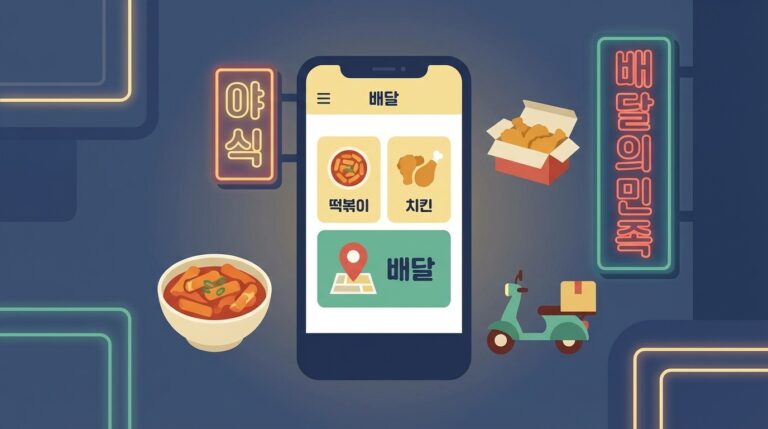
Picture this: It’s 11 PM on a Friday in Seoul. Rain is tapping against your window. You’re watching a K-Drama, and the main characters are sitting on the floor of their rooftop apartment, cracking open cold beers and digging into a glorious, steaming pile of spicy Tteokbokki paired perfectly with crispy, golden fried chicken. Your mouth waters. You open a Korean delivery app (like Baedal Minjok or Yogiyo), but suddenly… you freeze.
Sure, you know how to order a single dish. But in Korea, the true art of delivery food—known as Baedal (배달)—isn’t just about what you order; it’s about how you combine it. If you’ve ever wondered how Koreans intuitively know which foods to mix for that mind-blowing culinary synergy, you’re in the right place.
Today, we aren’t just learning how to order food. We’re diving into the C1-level slang and cultural nuances of recommending the ultimate delivery food combinations. Let’s upgrade you from a tourist to a true Seoulite insider!
Phase 2: Deep Dive into Core Expressions
Here are the absolute must-know terms when navigating Korean food combinations.
1. 꿀조합 (Kkul-johap)
- Pronunciation: [Kkul-jo-hap] (‘Kkul’ sounds like ‘gull’ but with a sharp, tense ‘kk’ sound, and the ‘L’ taps lightly behind your upper teeth. ‘Jo-hap’ is short and crisp.)
- Meaning: Literal = Honey combination / Real nuance = The ultimate, perfect pairing of things (especially food).
- K-Culture Moment: If you watch Korean Mukbang YouTubers, this word is their holy grail. “Today’s kkul-johap is spicy noodles and pork belly!”
- Editor’s Insight: Why ‘honey’? In modern Korean slang, ‘꿀’ (honey) is used as a prefix to mean ‘amazing’, ‘sweet’, or ‘super beneficial’ (e.g., 꿀팁 = great tip, 꿀알바 = easy/good part-time job). It instantly makes your Korean sound incredibly natural.
- Situation Spectrum:
[🚫 Never] ———— [⚠️ Caution] ———— [✅ Freely]
- Close friends (Casual): ✅
- Coworkers (Semi-formal): ✅ (Great for deciding on lunch!)
- Formal business dinner/Seniors: 🚫 (Too slangy. Use “궁합이 좋습니다” instead).
- 🤔 Think About It: Why do you think ‘honey’ became synonymous with ‘excellent’ in Korean slang? Does your native language have a food-related word used to describe something awesome?
2. 단짠단짠 (Dan-jjan-dan-jjan)
- Pronunciation: [Dan-jjan-dan-jjan] (The ‘jj’ is a tense, squeezed ‘j’ sound—imagine saying ‘John’ but with your jaw clenched.)
- Meaning: Literal = Sweet-salty-sweet-salty / Real nuance = The irresistible flavor loop of alternating sweet and savory foods so you never get full.
- K-Culture Moment: This is the foundational philosophy of Korean snacks and fast food. Think of eating sweet honey-butter chicken, then a bite of spicy-salty cheese tteokbokki. Your brain gets confused, and you keep eating!
- Editor’s Insight: It’s practically a scientific term in Korea now. When recommending a combo, if you say “이건 단짠단짠이라서 무한 흡입 가능해요” (Because it’s sweet and salty, you can inhale it endlessly), Koreans will nod in deep respect.
- Situation Spectrum:
[🚫 Never] ———— [⚠️ Caution] ———— [✅ Freely]
- Casual & Semi-formal: ✅
- Strict formal: ⚠️
3. 맵찔이 (Maep-jjiri)
- Pronunciation: [Maep-jji-ri]
- Meaning: Literal = Spicy-weakling / Real nuance = Someone with zero tolerance for spicy food.
- K-Culture Moment: Imagine a K-Pop idol on a variety show sweating profusely over a mild chili pepper, and the caption flashes: [Certified Maep-jjiri].
- Editor’s Insight: When building a 꿀조합, you must account for the maep-jjiri in the group. You combine a brutally spicy dish with a neutralizing side dish (like steamed egg or cool juice). It’s an affectionate, slightly teasing term.
- Situation Spectrum:
[🚫 Never] ———— [⚠️ Caution] ———— [✅ Freely]
- Friends/Teasing yourself: ✅
- To a boss or elder: 🚫 (Do not call your CEO a maep-jjiri!)
Phase 3: Textbook vs. Real Korean
Let’s see how a C1 learner bridges the gap between formal study and actual native speech.
| Situation | 📖 Textbook Korean | 🗣️ Real Korean (Slang/Nuance) | 💡 Why the difference? |
|---|---|---|---|
| Suggesting a food pairing | 이 두 음식을 같이 먹으면 맛있습니다. (These two foods are delicious together.) | 이거 완전 꿀조합이에요! (This is a total kkul-johap!) | Efficiency and emphasis. Slang adds emotional weight and excitement to the recommendation. |
| Admitting you can’t eat spicy food | 저는 매운 음식을 잘 못 먹습니다. (I cannot eat spicy food well.) | 저 맵찔이라서 덜 맵게 해주세요. (I’m a maep-jjiri, so please make it less spicy.) | Self-deprecating humor. It lightens the mood when ordering in a group. |
| Participating in a delivery app event | 리뷰를 남길 테니 무료 음식을 주세요. (I will leave a review, so give me free food.) | 리뷰 이벤트 참여할게요! (I’ll participate in the review event!) | App culture has standardized this exact phrasing. Direct translation sounds demanding. |
Bottom Note: At a C1 level, weaving words like kkul-johap and 단짠단짠 into grammatically perfect sentences shows high linguistic agility.
Phase 4: Cultural Context — K-Culture Deep Dive
4-1. The Unspoken Rules (Nunchi in Delivery)
When ordering delivery in a group, Nunchi (눈치 – the ability to read the room) is crucial. You never just order what you want. You ask, “혹시 매운 거 잘 드세요?” (By the way, do you handle spicy food well?) to accommodate the potential maep-jjiri. Also, it’s an unspoken rule that whoever pays for the food gets the final say on the restaurant, but the one who cleans up the plastic containers afterward is the true hero of the night.
4-2. The ‘Yasik’ (Midnight Snack) & Minimum Order Culture
Why is the 꿀조합 culture so huge in Korea? Part of it comes from the delivery apps’ 최소주문금액 (Minimum Order Amount). Often, one serving of Tteokbokki isn’t enough to meet the minimum for free or cheap delivery. So, what do Koreans do? They add fried seaweed rolls (김말이), a hot dog, or cheese balls. This economic necessity birthed a cultural phenomenon of experimenting with side dishes to create the perfect flavor profile.
Phase 5: Interactive Roleplay Scenario
Setting: Saturday night, 10 PM. You and your Korean friend, Min-ji, are sitting on the floor of your Airbnb in Hongdae. You both have the ‘Baedal Minjok’ app open, scrolling endlessly.
Characters:
– YOU: A foreign expat who loves Korean food but struggles with extreme spice.
– Min-ji (28): Your Korean friend. A self-proclaimed foodie who takes delivery combinations very seriously.
Dialogue:
Min-ji: 아, 배고프다. 우리 야식 시켜 먹을까? 📱
(A, baegopeuda. Uri yasik sikyeo meogeulkka?)
[Ah, I’m hungry. Should we order a midnight snack?]
(🎭 Stage Direction: Min-ji is already aggressively tapping her phone screen.)
YOU: 좋아요! 뭐 먹을까요? 치킨? 🍗
(Joayo! Mwo meogeulkkayo? Chikin?)
[Sounds good! What should we eat? Chicken?]
Min-ji: 음… 엽떡(매운 떡볶이)에 교촌 허니콤보 어때? 이거 완전 꿀조합이잖아!
(Eum… Yeoptteoge gyochon heonikombo eottae? Igeo wanjeon kkul-johabijana!)
[Hmm… How about Yeoptteok (spicy tteokbokki) with Kyochon Honey Combo chicken? This is a total kkul-johap!]
YOU: 오, 단짠단짠 제대로겠네요!
(O, dan-jjan-dan-jjan jedaerogenneyo!)
[Oh, that would be a proper sweet-and-salty combo!]
Min-ji: 그치? 근데 엽떡 매운맛 단계 어떻게 할까? 오리지널 괜찮아? 🌶️
(Geuchi? Geunde yeoptteok maeunmat dangye eotteoke halkka? Orijineol gwaenchana?)
[Right? But what spice level should we do for the Tteokbokki? Is ‘Original’ okay?]
🔀 YOUR TURN! How do you respond?
– A) “네! 오리지널로 가시죠!” (Yes! Let’s go with Original!)
– B) “저 사실 맵찔이라서… 착한 맛(제일 안 매운 맛)으로 하면 안 될까요?” (Actually, I’m a maep-jjiri… could we do the mildest flavor?)
– C) “매운 거 말고 그냥 샐러드 먹어요.” (Let’s not eat spicy food and just have salad.)✅ Best Choice: B — Why? Yeoptteok’s “Original” level is notoriously brutal, even for many Koreans! Admitting you are a maep-jjiri using C1-level slang will make Min-ji laugh and gladly lower the spice level.
⚠️ Choice A Analysis: Only pick this if you have an iron stomach. You might end up crying!
⚠️ Choice C Analysis: Suggesting a salad at 10 PM when a Korean friend proposes a kkul-johap midnight snack is almost a cultural crime! 😅
Min-ji: (Laughs) 아 맵찔이였어? 알았어, 착한 맛으로 시킬게. 대신 리뷰 이벤트로 치즈스틱 받아야겠다!
(A maep-jjiriyeosseo? Arasseo, chakan maseuro sikilge. Daesin ribyu ibenteuro chijeuseutik badayagetda!)
[Oh, you’re a maep-jjiri? Got it, I’ll order the mild flavor. Instead, I’ll get cheese sticks through the review event!]
YOU: 완벽해요. 결제는 제가 할게요! 💳
(Wanbyeokaeyo. Gyeoljeneun jaega halgeyo!)
[Perfect. I’ll pay!]
Phase 6: 10-Second Shadowing Drill
Practice your intonation. The slashes / indicate where to pause naturally.
- 😊 이거 / 완전 / 꿀조합 인정?
(i-geo / wan-jeon / kkul-jo-hap in-jeong?)
[You admit this is a total perfect combo, right?] -
🥺 제가 / 은근히 / 맵찔이라서요…
(je-ga / eun-geun-hi / maep-jji-ri-ra-seo-yo…)
[I’m actually secretly a weakling with spicy food…] -
😤 야식은 / 역시 / 단짠단짠이죠!
(ya-si-geun / yeok-si / dan-jjan-dan-jja-ni-jyo!)
[As expected, midnight snacks must be sweet-and-salty!]
Phase 7: K-Culture Mini Dictionary
| Korean | Romanization | English | Context |
|---|---|---|---|
| 야식 | yasik | Midnight Snack | Food ordered late at night. A huge part of Korean socializing and stress relief. |
| 배달팁 | baedaltip | Delivery Fee | The fee added by the delivery app. Not a ‘tip’ for the driver in the Western sense. |
| 최소주문금액 | choesojumungeumaek | Minimum Order Amount | The minimum you must spend to get the food delivered. The reason we order so many side dishes! |
| 리뷰 이벤트 | ribyu ibenteu | Review Event | Apps offer free side dishes if you promise to leave a 5-star review with a photo. |
| 먹튀 | meok-twi | Eat and Run | Slang for someone who gets the free review event food but doesn’t write the review. (Don’t do this!) |
Phase 8: Traveler Survival Kit
If you’re visiting Korea, ordering delivery can be tricky without a resident registration number or a Korean credit card. Here is your survival kit!
🆘 Survival Phrases for Food Delivery
– 🇰🇷 “프런트 데스크인데요, 혹시 배달 음식 시켜주실 수 있나요?”
(peureonteu deseukeu-indeyo, hoksi baedal eumsik sikyeojusil su innayo?)
– 🗣️ English: I’m at the front desk, could you perhaps order delivery food for me?
– 📍 Where to use: Hotel Concierge. If you can’t use the apps, polite hotel staff will often order for you if you pay them in cash.
– 💡 Pro Tip: Apps like Shuttle Delivery or Coupang Eats are increasingly friendly to foreign credit cards and offer English interfaces!📌 Editor’s Travel Note
– Meeting the driver: Most apps have a “문 앞에 두고 벨 눌러주세요” (Leave at the door and ring the bell) option. It’s safe and convenient.
– Tipping: Do NOT tip the delivery driver in cash. The “배달팁” (delivery fee) is already included in your app payment. Trying to hand them cash will confuse them!
Phase 9: Critical Thinking Corner — “One Step Deeper”
🧠 Think Deeper: Food & Identity (음식과 정체성)
Why is the concept of 꿀조합 (perfect combinations) so deeply ingrained in Korean culture? In Western dining, meals are often plated individually—your steak, your sides. But Korean culinary philosophy is built on the concept of bibim (mixing) and communal sharing. From wrapping meat, garlic, and ssamjang in a lettuce leaf, to mixing a plethora of side dishes into Bibimbap, Korean food is fundamentally about harmony and collective experience. Recommending a kkul-johap isn’t just about taste; it’s an act of care, an invitation to share an intimately crafted experience with someone else. The food on the table is meant to be navigated together.
💬 Your Turn: In your culture, is food typically served pre-mixed/combined, or is it kept separate on the plate? Do you have a culture of sharing midnight snacks? Share in the comments!
Phase 10: FAQ & Mistake Prevention
Q: Can I use “맵찔이” to describe someone else?
Yes, but only if you are close friends. If you say it to an acquaintance, it might sound a bit condescending. It’s safest to use it as a self-deprecating term: “저 맵찔이라서요…” (Because I’m a maep-jjiri…).
Q: What if I write the review for the ‘Review Event’, but the food was bad?
Culturally, if you received free food for the review event, it is considered highly rude to leave less than 5 stars. If the food is truly terrible, most Koreans will give 5 stars but leave a highly passive-aggressive, polite comment outlining the flaws.
❌ Common Mistake #1: Translating “What is the best combo?” literally as “가장 좋은 조합이 무엇입니까?”
✅ Do this instead: Sound like a native by asking, “사장님, 여기서 제일 잘 나가는 꿀조합이 뭐예요?” (Boss, what’s the best-selling kkul-johap here?)
Phase 11: Summary & Action Items
- One-Liner Summary: To master Korean delivery culture, learn to balance the 단짠단짠 (sweet and salty), embrace your inner 맵찔이 (spice weakling), and always hunt for the ultimate 꿀조합 (perfect combo)!
Action Mission:
– 🥉 Bronze (Solo): Read the shadowing drill sentences out loud 3 times with maximum emotion.
– 🥈 Silver (Online): Go to a K-Pop idol’s live stream chat or Weverse and ask: “오빠/언니의 야식 꿀조합은 뭐예요?” (What is your midnight snack kkul-johap?)
– 🥇 Gold (Real World): The next time you are at a Korean restaurant or ordering delivery, confidently say to your Korean friend, “이거 완전 꿀조합이네요!”
K-Culture Mission: Go to YouTube, search “엽떡 허니콤보 먹방” (Yeoptteok Honey Combo Mukbang), and listen for how many times the creator says “단짠단짠” or “꿀조합”!
Phase 12: Quiz — Interactive Challenge
1. Situational Judgment: You are ordering BHC Bburingkle Chicken (very sweet/cheesy) with a Korean coworker. What is the most culturally appropriate thing to say to suggest a pairing?
– A) “이 치킨은 달아요. 그래서 콜라를 마십시다.”
– B) “이거 달달하니까, 매콤한 떡볶이 시켜서 단짠단짠으로 갈까요?”
– C) “저는 맵찔이입니다. 치킨만 먹겠습니다.”
Click for the Answer
Answer: B. Suggesting a spicy tteokbokki to create a “단짠단짠” (sweet and salty) balance shows elite C1-level cultural and linguistic understanding!
2. True or False – K-Culture Edition: When ordering through a Korean delivery app, it is polite to prepare cash to tip the delivery driver when they arrive. (T/F)
Click for the Answer
False. Korea does not have a tipping culture. The delivery fee (배달팁) is already calculated and paid within the app. Giving cash will lead to an awkward misunderstanding!
Frequently Asked Questions (FAQ)
Q: What does "꿀조합 (Kkul-johap)" mean in Korean and how do you pronounce it?
A: In Korean, "꿀조합 (Kkul-johap)" is pronounced [Kkul-jo-hap] and means: Literal = Honey combination / Real nuance = The ultimate, perfect pairing of things (especially food).
Q: What does "단짠단짠 (Dan-jjan-dan-jjan)" mean in Korean and how do you pronounce it?
A: In Korean, "단짠단짠 (Dan-jjan-dan-jjan)" is pronounced [Dan-jjan-dan-jjan] and means: Literal = Sweet-salty-sweet-salty / Real nuance = The irresistible flavor loop of alternating sweet and savory foods so you never get full.
Q: What does "맵찔이 (Maep-jjiri)" mean in Korean and how do you pronounce it?
A: In Korean, "맵찔이 (Maep-jjiri)" is pronounced [Maep-jji-ri] and means: Literal = Spicy-weakling / Real nuance = Someone with zero tolerance for spicy food.







