

Hello! I’m the Lead Editor of Daily Hangul. Grab your favorite iced Americano, take a seat, and let’s dive into a side of Korea you rarely see in textbooks.
Picture this: You’re riding the Seoul Subway Line 2 at 9:00 AM. You peek at the smartphones of the commuters around you. They aren’t watching the latest K-Drama or scrolling through Instagram. Instead, they are intensely glaring at charts filled with jagged lines and flashing colors. Suddenly, the guy next to you lets out a deep, dramatic sigh.
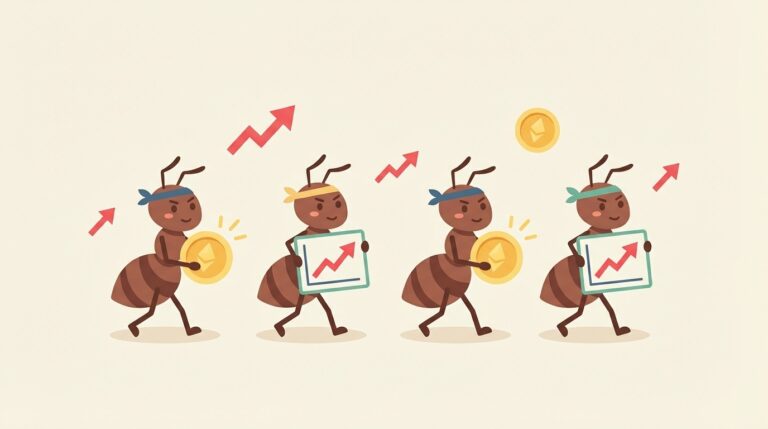
Welcome to the era of the “Ants” (개미).
To truly master C2-level Korean, you need to understand what Koreans are actually talking about over their lunchtime doenjang jjigae. Since 2020, that topic has been the stock market. Knowing how to discuss the “Donghak Ant Movement” won’t just improve your vocabulary; it will give you a VIP pass into the minds of modern Koreans, their economic anxieties, and their collective resilience.
Phase 2: Core Expressions Deep Dive
Let’s break down the ultimate insider vocabulary that will make Korean native speakers drop their jaws when you use them.
1. 동학 개미 (Donghak Gaemi)
- Pronunciation: [Dong-hak gae-mi]
- Meaning: (Literal) Donghak Ants / (Real Nuance) Korean retail investors who fought against foreign/institutional sell-offs.
- K-Culture Moment: During the 2020 market crash, foreign investors dumped Korean stocks. Retail investors—everyday citizens—banded together to buy the dip, “saving” the market. The media dubbed this the Donghak Ant Movement, echoing the 1894 Donghak Peasant Revolution where commoners fought against corruption and foreign influence.
- Editor’s Insight: This isn’t just a financial term; it’s a badge of honor. Calling someone an “ant” in the US might sound belittling, but in Korea, it symbolizes the power of the collective working class.
- Situation Spectrum:
[🚫 Never] ———— [⚠️ Caution] ———— [✅ Freely]
- Close Friends (Casual): ✅
- Coworkers (Semi-formal): ✅
- Formal Speeches/News: ✅ (It’s an officially recognized economic term now!)
- 🤔 Think About It: Why does Korean society often frame modern financial or social movements using historical references to peasant rebellions or collective struggles? What does this say about the Korean identity?
2. 영끌 (Yeong-kkeul)
- Pronunciation: [Yeong-kkeul] (‘kkeul’ sounds like the ‘gl’ in ‘glee’, spoken with tension)
- Meaning: (Literal) Scraping up one’s soul / (Real Nuance) Maxing out all possible loans and scraping every penny together to invest or buy real estate.
- K-Culture Moment: You’re at a company hoesik (dinner), and the youngest employee confesses he bought an apartment or Bitcoin by doing yeong-kkeul. The senior colleagues sigh, offering him an extra shot of Soju.
- Editor’s Insight: This word carries a heavy, somewhat dark cultural weight. It reflects the desperation of Millennials and Gen Z (the MZ generation) who feel that without taking massive, debt-fueled risks, they will never afford a home in Seoul.
- Situation Spectrum:
- Close Friends: ✅
- Coworkers: ⚠️ (Can be a sensitive topic if someone is losing money)
- Boss/Elders: 🚫 (Avoid using it to describe their actions, as it implies desperation)
3. 떡상하다 (Tteok-sang-hada) & 떡락하다 (Tteong-nak-hada)
- Pronunciation: [Tteok-sang-ha-da] / [Tteong-nak-ha-da]
- Meaning: To skyrocket (moon) / To plummet (crash).
- K-Culture Moment: A crypto or stock YouTuber yelling into the mic, “삼성전자 떡상 가즈아!!!” (Samsung Electronics to the moon, let’s go!!!)
- Editor’s Insight: Tteok means rice cake. While the exact etymology is debated, it implies a sudden, massive surge (like dough expanding) or drop. It’s highly informal, punchy, and used daily by the younger generation.
- Situation Spectrum:
- Close Friends: ✅
- Casual online forums: ✅
- Business meetings: 🚫 (Stick to 급등하다 / 급락하다)
Phase 3: Textbook vs. Real Korean
How do you sound less like a news anchor and more like a local trader at a Gangnam cafe?
| Situation | 📖 Textbook Korean | 🗣️ Real Korean | 💡 Why the difference? |
|---|---|---|---|
| Retail Investors | 개인 투자자 (Gae-in tuja-ja) | 개미 (Gaemi) | “Ants” perfectly captures the feeling of being a small player in a giant ecosystem. |
| “Hold the stock!” | 주식을 팔지 말고 보유하세요. | 존버해! (Jonbeo-hae!) | Jonbeo is a harsh slang meaning “f***ing hold on.” It shows the emotional pain of waiting for a stock to rise. |
| Buying the dip / Averaging down | 평균 단가를 낮추다 | 물타기 하다 (Multagi hada) | Borrowed from the concept of diluting soup with water, making the loss “less concentrated.” |
Bottom Note for C2 Learners: Using Jonbeo (존버) in the boardroom will get you fired. Use it over beers with friends, and you’ll be treated like a local legend.
Phase 4: Cultural Context — K-Culture Deep Dive
4-1. The Ultimate Visual Shock: Red vs. Blue 📈
If you take away only one thing from this lesson, let it be this: In Korea, RED means UP (Good) and BLUE means DOWN (Bad).
If you open a Korean stock app and see a sea of red (빨간불), people are celebrating. If it’s blue (파란불), someone is probably crying in the bathroom. This is the exact opposite of Wall Street! When you talk to a Korean friend about stocks, never say “I’m in the red” to mean you are losing money. They will congratulate you!
4-2. Nunchi (눈치) at the Office
In K-Dramas like Misaeng or Reborn Rich, office dynamics are everything. When the stock market is crashing (파란불), the office atmosphere will inexplicably become icy. This is where your Nunchi comes in. If the KOSPI index drops 3%, do not cheerfully ask your coworker how their Samsung stocks are doing.
Phase 5: Interactive Roleplay Scenario
Setting: It’s 7:00 PM on a Friday. You are at a smoky Samgyeopsal restaurant in Yeouido (the Wall Street of Seoul) with your Korean coworkers. The Soju is flowing. Your colleague, Min-su, keeps refreshing his stock app and sighing.
Characters:
– YOU: A savvy foreign expat trying to blend in.
– Min-su (32): Your coworker. He did yeong-kkeul to buy tech stocks, and they are currently plummeting.
Dialogue:
민수: 아… 내 주식 파란불 떴네. 또 물렸어요. 😭
(A… nae jusik paran-bul tteot-ne. Tto mullyeosseoyo.)
[Ah… my stocks are showing blue lights. I’m stuck (bitten) again.]
(🎭 Stage Direction: Min-su aggressively flips the pork belly on the grill.)
YOU: 헐, 카카오 주식이에요? 어떡해요.
(Heol, Kakao jusig-ieyo? Eotteokhaeyo.)
[OMG, is it Kakao stock? What are you going to do?]
민수: 지금 물타기 할 타이밍 같은데, 총알(현금)이 없네요. 영끌을 너무 심하게 했나 봐요.
(Jigeum multagi hal taiming gateunde, chong-al(hyeongeum)-i eomneyo. Yeongkkeul-eul neomu simhage haenna bwayo.)
[I feel like it’s time to average down (water-ride), but I have no bullets (cash). I guess I scraped my soul too hard.]
🔀 Your Turn! How should you respond?
– A) “그냥 다 팔아버리세요! 손절이 답이에요.” (Just sell it all! Cutting losses is the answer.)
– B) “아이고… 당분간 주식 앱 지우고 존버합시다! 제가 소주 한 병 더 시킬게요!” (Oh man… let’s just delete the stock app for a while and HODL! I’ll order another bottle of Soju!)
– C) “전 오늘 테슬라로 떡상했는데!” (My Tesla stocks went to the moon today though!)✅ Best Choice: B — You show empathy, use native slang (jonbeo), and offer Soju. You just became his best friend.
⚠️ Choice A Analysis: Too direct. Giving financial advice is risky.
🚫 Choice C Analysis: Absolute Nunchi failure. Never brag when a Korean friend’s chart is blue!
Phase 6: 10-Second Shadowing Drill
Time to get the rhythm right. Follow the pacing marks (/) and match the emotion!
🥺 “아이고, / 저도 삼성전자에 / 물렸는데, / 우리 같이 / 존버합시다!”
(Aigo, / jeodo Samseong-jeonja-e / mullyeonneunde, / uri gachi / jonbeo-hapsida!)
“Oh man, I’m also stuck in Samsung Electronics. Let’s HODL together!”
Pro-tip: Drag out the “아이고 (Aigo)” for maximum empathetic effect.
Phase 7: K-Culture Mini Dictionary
| Korean | Romanization | English | Context |
|---|---|---|---|
| 물리다 | mul-li-da | To be bitten/stuck | Buying a stock at a high price and being unable to sell because it dropped. |
| 상투 잡다 | sangtu japda | Catching the topknot | Buying at the absolute peak. (Historical ref: A topknot is on top of the head). |
| 손절 | son-jeol | Cutting losses | Selling at a loss to prevent further bleeding. Also used for cutting toxic people out of your life! |
| 줍줍 | jup-jup | Picking up | Buying stocks or real estate at a bargain when prices crash. |
Phase 8: Traveler Survival Kit (Economy Edition)
Even if you aren’t trading stocks in Korea, you will definitely talk about the economy. Taxi drivers love discussing housing prices and the economy with foreigners!
🆘 Survival Expressions for Talking to Taxi Drivers
– 🇰🇷 “요즘 물가가 진짜 많이 올랐죠?” (Yojeum mulga-ga jinjja mani ollatjyo?)
– 🗣️ “Prices have really gone up lately, haven’t they?”
– 📍 Where to use: Taxis, local markets, talking to older shop owners.
– 💡 Pro Tip: If you agree with a Korean elder complaining about the economy, they will instantly treat you like family.📌 Editor’s Travel Note
– Card vs. Cash: Korea is a cashless society. Even a 1,000 KRW ($0.75) pack of gum can be bought with a card. But if you’re at a traditional market like Gwangjang Market, cash or bank transfers (계좌이체) are preferred.
Phase 9: Critical Thinking — “One Step Deeper”
🧠 Think Deeper: Wealth & Identity (The Tragedy of Yeong-kkeul)
Why did the Donghak Ant Movement happen? Why are young Koreans doing yeong-kkeul to buy stocks and crypto? It’s not just greed; it’s systemic despair. In the past, Koreans could save money in a bank, earn high interest, and eventually buy a house. Today, Seoul’s real estate prices have skyrocketed out of reach. For the MZ generation, investing in high-risk stocks isn’t seen as gambling—it’s viewed as the only remaining ladder to the middle class. The language of investing in Korea is laced with survival mechanics. When they say yeong-kkeul (scraping the soul), it highlights a society where hard work alone is no longer enough to secure a future.
💬 Your Turn: Does your generation in your home country feel the same way about housing and investing? How do you express this frustration in your language? Share in the comments!
Phase 10: FAQ & Avoiding Misunderstandings
- Q: “Can I use ‘개미 (Gaemi)’ to describe a senior boss who invests?”
- A: NO. While “ant” is a proud term for the collective public, calling your 50-year-old Director an “ant” to his face sounds slightly condescending. Use “개인 투자자” (Retail investor) in formal settings.
- Q: “Is it rude to ask a Korean how much money they made in stocks?”
- A: YES. It is a huge taboo. You can ask what they are investing in (“요즘 어떤 주식 보세요?”), but never ask about their exact profits or account balance.
❌ Common Mistake #1: Congratulating a Korean friend because their stock chart is “Blue” (thinking blue means clear skies/good).
✅ Do This: Remember: RED = Party. BLUE = Panic.
Phase 11: Summary & Action Items
One-Liner Summary: The “Donghak Ants” represent the fierce, collective spirit of modern Koreans navigating a tough economy through stocks, using terms like yeong-kkeul and tteok-sang to express their survival.
Action Mission:
– 🥉 Bronze: Stand in front of a mirror and dramatically sigh while saying, “아… 삼성전자에 물렸어 (I’m stuck in Samsung).”
– 🥈 Silver: Go to a Korean news site (like Naver Finance) and spot the words 빨간불 (Red light) or 개미 (Ant) in the headlines.
– 🥇 Gold: Next time you talk to a Korean friend, ask them: “요즘 동학 개미 운동은 어때요?” (How is the Donghak Ant movement going these days?) and watch them be utterly amazed by your Korean level!
Phase 12: Quiz — Interactive Challenge
1. Situational Judgment: Your friend shows you their phone. The chart is completely covered in BLUE. What is the most culturally appropriate response?
A) “Wow! You must be rich!”
B) “아이고… 존버합시다. 제가 밥 살게요.” (Oh man… let’s HODL. I’ll buy dinner.)
C) “떡상 가즈아!” (To the moon!)
2. Fill in the Blank:
“집을 사기 위해 영혼까지 끌어모아 대출을 받는 것을 _____(이)라고 합니다.”
(To scrape your soul together to get a loan to buy a house is called _____.)
3. True or False:
In Korea, calling retail investors “Ants (개미)” is deeply insulting and should never be used on TV. (T/F)
👀 Click here for Answers!
1. B (Blue means the stock crashed. They need comfort and food, not congratulations!)
2. 영끌 (Yeong-kkeul)
3. False (It’s a very common, slightly affectionate, and widely used term even in official news broadcasts!)
Until next time, keep your charts red and your Korean skills tteok-sang! 📈🔥
Frequently Asked Questions (FAQ)
Q: What does "동학 개미 (Donghak Gaemi)" mean in Korean and how do you pronounce it?
A: In Korean, "동학 개미 (Donghak Gaemi)" is pronounced [Dong-hak gae-mi] and means: (Literal) Donghak Ants / (Real Nuance) Korean retail investors who fought against foreign/institutional sell-offs.
Q: What does "영끌 (Yeong-kkeul)" mean in Korean and how do you pronounce it?
A: In Korean, "영끌 (Yeong-kkeul)" is pronounced [Yeong-kkeul] and means: (Literal) Scraping up one's soul / (Real Nuance) Maxing out all possible loans and scraping every penny together to invest or buy real estate.
Q: What does "떡상하다 (Tteok-sang-hada) & 떡락하다 (Tteong-nak-hada)" mean in Korean and how do you pronounce it?
A: In Korean, "떡상하다 (Tteok-sang-hada) & 떡락하다 (Tteong-nak-hada)" is pronounced [Tteok-sang-ha-da] and means: To skyrocket (moon) / To plummet (crash).







