

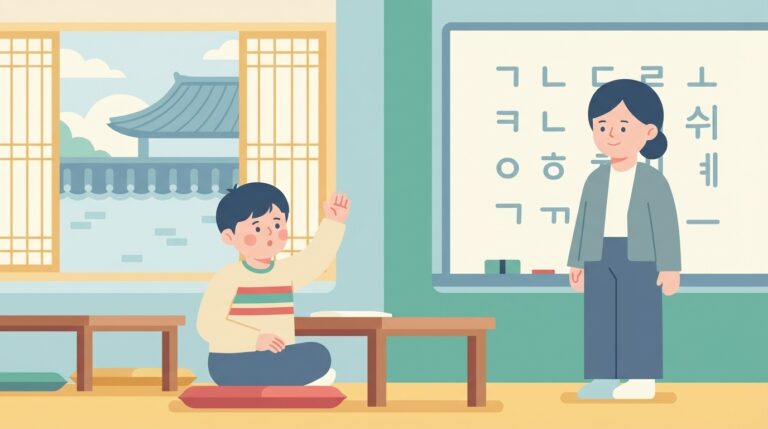
Phase 1: Empathy (Welcome to the Classroom)
Hello there! I’m your lead editor and cultural navigator at Daily Hangul.
Imagine this: You are sitting in a Korean language class in Seoul. Maybe it looks just like a scene from the K-Drama Crash Course in Romance. The teacher is enthusiastically explaining a grammar rule, chalk flying across the board. Suddenly, you’re lost. You need help. You want to ask, “Wait, what does that mean?”
But your heart starts racing. How do you interrupt politely in Korea? If you just shout “Excuse me!”, will the whole class stare at you?
In Korean culture, the classroom is a space of immense respect. Knowing exactly how to catch your teacher’s attention without breaking etiquette won’t just solve your confusion—it will make you look like a highly respectful, culturally aware “Insider” (인싸). Don’t worry! I’ve seen countless A1 beginners freeze up in this exact moment. Today, I’ll give you the exact tools you need to survive and thrive in a Korean classroom.
Phase 2: Core Expressions Deep Dive
Here are the top 3 lifesaver phrases every beginner needs.
1. 선생님, 질문 있어요!
- Pronunciation: seon-saeng-nim, jil-mun i-sseo-yo!
- (Sound-alike guide: “sun-sang-neem, chill-moon ee-so-yo!”)
- Meaning: (Literal) Teacher, a question exists! / (Real nuance) Teacher, I have a question!
- K-Culture Moment: You’ll hear this in every Korean school drama. The student slightly raises their hand, makes eye contact, and politely calls out to the teacher.
- Editor’s Insight: Always, always start by calling the teacher “선생님” (seon-saeng-nim). In English, you might just raise your hand and say “I have a question,” but in Korean, omitting the title feels too abrupt and slightly rude.
- Situation Spectrum:
[🚫 Never] ———— [⚠️ Caution] ———— [✅ Freely]
- Close Friends (Casual): 🚫 (Friends aren’t your teachers!)
- Workplace (Semi-formal): ⚠️ (Use ‘Manager/Director, I have a question’)
- Teacher/Professor (Formal): ✅
- 🤔 Think About It: Why do Koreans call out the title (Teacher!) before stating their purpose? How does this reflect the importance of acknowledging someone’s status before making a request?
2. 다시 한 번 설명해 주세요.
- Pronunciation: da-si han beon seol-myeong-hae ju-se-yo.
- (Sound-alike guide: “dah-she han bun soul-myung-heh joo-say-yo”)
- Meaning: (Literal) Again one time explanation please give. / (Real nuance) Could you please explain that one more time?
- K-Culture Moment: Picture a rigorous K-Pop idol trainee evaluation. A trainee didn’t quite catch the dance choreographer’s feedback. They bow slightly and use this exact phrase to ask for clarification.
- Editor’s Insight: The magic word here is 주세요 (ju-se-yo), meaning “please give (me the favor of).” It softens your request, making it sound like you are humbly asking for their precious time and wisdom.
- Situation Spectrum:
[🚫 Never] ———— [⚠️ Caution] ———— [✅ Freely]
- Close Friends (Casual): 🚫 (Too formal. Just say “다시 말해줘” – Say it again)
- Teacher/Professor (Formal): ✅
3. 이게 무슨 뜻이에요?
- Pronunciation: i-ge mu-seun tteu-si-e-yo?
- (Sound-alike guide: “ee-geh moo-soon ttoo-she-eh-yo?”)
- Meaning: (Literal) This, what meaning is it? / (Real nuance) What does this mean?
- K-Culture Moment: You are studying at a cozy cafe in Hongdae with your Korean language exchange partner. You point at a word in your textbook and ask this. It’s the ultimate learning phrase!
- Editor’s Insight: This phrase is incredibly versatile. You can use it in class when reading a text, or even while shopping when you see a sign you don’t understand.
- Situation Spectrum:
[🚫 Never] ———— [⚠️ Caution] ———— [✅ Freely]
- Close Friends (Casual): ⚠️ (Drop the ‘yo’ and say “이거 무슨 뜻이야?”)
- Teacher/Professor (Formal): ✅
Phase 3: Textbook vs Real Korean
| Situation | 📖 Textbook Korean | 🗣️ Real Korean | 💡 Why is it different? |
|---|---|---|---|
| Calling the teacher | 선생님, 안녕하십니까. | 선생님! (seon-saeng-nim!) | “Hello” is too long when you just need their attention. Calling the title is enough! |
| Saying “I don’t know” | 저는 이해하지 못했습니다. | 잘 모르겠어요. (jal mo-reu-ge-sseo-yo) | The textbook is too robotic. “I don’t really know/understand” is softer and more natural. |
| Asking “What is this?” | 이것은 무엇입니까? | 이게 뭐예요? (i-ge mwo-ye-yo?) | Spoken Korean loves to shorten syllables for speed and rhythm. |
Phase 4: Cultural Context — K-Culture Deep Dive
4-1. The Art of Non-Verbal Questions (눈치 – Nunchi)
In Korea, asking a question isn’t just about the words; it’s about timing. This is where Nunchi (the ability to read the room) comes in.
Don’t raise your hand while the teacher is in the middle of a sentence. Wait for a natural pause. Raise your hand gently (no aggressive arm waving), make eye contact, and give a slight head nod as you say, “선생님!”
4-2. The K-Drama Classroom Trope
If you’ve watched dramas like True Beauty or Extraordinary You, you’ll notice how the teacher holds absolute authority in the classroom. When a student has a question, they stand up, or at least sit very straight. While language institutes for adults (like at Yonsei or SNU) are more relaxed, the core vibe remains: You are the humble learner, and they are the respected master.
Critical View: While dramas sometimes show rebellious students using casual language (반말) to teachers for dramatic effect, doing this in real life will shock the entire room. Always stick to 존댓말 (Polite language – ends in ‘yo’ or ‘nida’)!
Phase 5: Interactive Roleplay Scenario
Setting: Monday morning, 10:00 AM. You are in a bright, modern classroom at a Korean Language Institute in Seoul. Teacher Kim has just written a complex grammar formula on the whiteboard. You are totally lost.
Characters:
– YOU: An A1 Korean learner, eager but a bit confused.
– Teacher Kim: 40s, friendly but speaks a little too fast.
Dialogue:
Teacher Kim: 자, 여러분. 이 문법 이해했어요? 👨🏫
(ja, yeo-reo-bun. i mun-beop i-hae-hae-sseo-yo?)
[Alright, everyone. Did you understand this grammar?]
YOU: (Silence… looking at your notes)
Teacher Kim: 질문 있는 사람?
(jil-mun in-neun sa-ram?)
[Anyone with questions?]
🔀 YOUR TURN! How do you respond?
– A) “저기요! 질문!” (Excuse me! Question!)
– B) “선생님, 질문 있어요!” (Teacher, I have a question!)
– C) “당신, 다시 설명해 주세요.” (You, explain it again.)✅ Best Choice: B — Perfect balance of respect and clarity.
⚠️ Choice A Analysis: “저기요” (Excuse me) is used for calling waiters in a restaurant, NEVER for a teacher! It sounds very rude here.
🚫 Choice C Analysis: Never call a Korean “당신” (You) unless you want to start a street fight. It’s considered aggressive in spoken Korean.
(Assuming you chose B)
YOU: 선생님, 질문 있어요! 🙋♂️
(seon-saeng-nim, jil-mun i-sseo-yo!)
[Teacher, I have a question!]
Teacher Kim: 네, 데이비드 씨. 무슨 질문이에요?
(ne, de-i-bi-deu ssi. mu-seun jil-mun-i-e-yo?)
[Yes, David. What is your question?]
YOU: ‘은/는’하고 ‘이/가’ 차이를 잘 모르겠어요. 다시 한 번 설명해 주세요.
(‘eun/neun’ha-go ‘i/ga’ cha-i-reul jal mo-reu-ge-sseo-yo. da-si han beon seol-myeong-hae ju-se-yo.)
[I don’t really understand the difference between ‘eun/neun’ and ‘i/ga’. Could you please explain it one more time?]
Teacher Kim: 아, 좋은 질문이에요! 다시 설명해 줄게요.
(a, jo-eun jil-mun-i-e-yo! da-si seol-myeong-hae jul-ge-yo.)
[Ah, good question! I will explain it again.]
YOU: 감사합니다, 선생님! 😊
(gam-sa-ham-ni-da, seon-saeng-nim!)
[Thank you, teacher!]
Phase 6: 10-Second Shadowing Drill
Let’s practice your pronunciation! Pay attention to the pauses (/) and the emotion tags.
🙋♂️ Politely asking for help:
🥺 선생님 / 질문 / 있어요! (seon-saeng-nim / jil-mun / i-sseo-yo!)
🙏 Asking for a repeat:
🥺 다시 한 번 / 설명해 / 주세요. (da-si han beon / seol-myeong-hae / ju-se-yo.)
💡 When you finally understand:
😊 아~! / 이제 / 알겠어요! (a~! / i-je / al-ge-sseo-yo!) (Ah~! Now I get it!)
Phase 7: K-Culture Mini Dictionary
| Korean | Romanization | English | Cultural Context |
|---|---|---|---|
| 선생님 | seon-saeng-nim | Teacher | The safest and most respectful title. Always attach ‘님’ (nim) for respect! |
| 질문 | jil-mun | Question | Used in schools, interviews, and Q&A sessions. |
| 눈치 | nunchi | Social awareness | The Korean superpower of reading the room before acting or speaking. |
| 학식 | hak-sik | School cafeteria food | A very common slang among university students! (학교 + 식당) |
Phase 8: Traveler’s Survival Kit
Even if you aren’t in a classroom, being a traveler in Korea means you are a “student” of the streets! You will have questions for locals.
🆘 Survival Phrases for Travelers
– 🇰🇷 “저기요, 길 좀 물어봐도 될까요?” (jeo-gi-yo, gil jom mu-reo-bwa-do doelkka-yo?)
– 🗣️ Meaning: Excuse me, may I ask for directions?
– 📍 Where to use: Asking a local on the street when your Naver Map fails you.
– 💡 Pro Tip: Unlike the classroom, using “저기요” (jeo-gi-yo / Excuse me) is perfectly fine when getting the attention of a stranger on the street or a waiter in a restaurant!📌 Editor’s Travel Note
Don’t be afraid to ask questions! Koreans might seem rushed, but if you start with a polite “저기요” and show your phone map, they will often go out of their way to physically walk you to your destination. We call this “정” (Jeong – warm-heartedness).
Phase 9: Critical Thinking Corner — “One Step Deeper”
🧠 Think Deeper: Language & Power (언어와 권력)
In English, you might call your favorite teacher “Mr. Smith” or even “John” if the class is progressive. But in Korea, a teacher’s title (선생님) completely replaces their name. You never say “안녕, 민수” (Hi, Minsoo) to Teacher Minsoo. By stripping away the personal name and elevating the title, the Korean language constantly reinforces social hierarchy and deep respect for education.💬 Your Turn: Does your culture use titles or first names for teachers? How does that change the classroom atmosphere? Share in the comments!
Phase 10: FAQ & Common Mistakes
Q: Can I use “선생님 (seonsaengnim)” for people who aren’t actually teachers?
Yes! If you meet an older, respectable person (like a doctor, or an older gentleman giving you directions), calling them “선생님” is a highly polite way to show respect, even if they don’t work at a school.
Q: What if I want to ask a question to my Korean friend?
Do not use “선생님, 질문 있어요”. Just say “야, 물어볼 거 있어” (Hey, I have something to ask) or “이거 뭐야?” (What is this?).
❌ Common Mistake #1: Raising your hand and shouting “저기요!” (Excuse me!) in a classroom.
✅ Do This Instead: Raise your hand and say “선생님!”❌ Common Mistake #2: Translating “I have a question” word-for-word and saying “나는 질문을 가지고 있다.” (Sounds like a robot from a sci-fi movie).
✅ Do This Instead: “질문 있어요” (A question exists / I have a question).
Phase 11: Summary & Action Items
One-Liner Summary: To survive a Korean classroom, always start by respectfully calling “선생님” (Teacher) before saying “질문 있어요” (I have a question)!
Action Mission:
– 🥉 Bronze (Solo): Stand in front of a mirror, raise your hand slightly, and say “선생님, 질문 있어요!” three times with a polite smile.
– 🥈 Silver (Online): Leave a comment on this blog post asking me a question using the exact phrase you learned today!
– 🥇 Gold (Real Life): Next time you are in your Korean class or language exchange meetup, use “이게 무슨 뜻이에요?” (What does this mean?) to ask about a new word.
🎬 K-Culture Mission:
Watch one episode of a Korean school drama (like Twenty Five Twenty One or Weightlifting Fairy Kim Bok-joo). Count how many times the students say “선생님” (seonsaengnim).
Phase 12: Quiz — Interactive Challenge
1. You are in a university classroom. You want to ask the professor a question. What should you say to get their attention?
– A) 저기요! (jeo-gi-yo!)
– B) 당신! (dang-sin!)
– C) 선생님! (seon-saeng-nim!)
👉 Click to see the answer
Correct Answer: C. “선생님” (or “교수님” for college professors) is the only respectful way. “저기요” is for restaurants, and “당신” is highly offensive!
2. True or False: In a Korean classroom, it’s totally fine to call your teacher by their first name (e.g., “Minsoo, I have a question”).
👉 Click to see the answer
False. You must ALWAYS use their title (선생님). Using a first name to a teacher is considered extremely disrespectful in Korea.
3. Fill in the blank: You want the teacher to explain something one more time.
“다시 한 번 _______ 주세요.”
👉 Click to see the answer
설명해 (seol-myeong-hae). The full sentence is “다시 한 번 설명해 주세요” (Please explain it one more time).
Frequently Asked Questions (FAQ)
Q: What does "선생님, 질문 있어요!" mean in Korean and how do you pronounce it?
A: In Korean, "선생님, 질문 있어요!" is pronounced [seon-saeng-nim, jil-mun i-sseo-yo!] and means: (Literal) Teacher, a question exists! / (Real nuance) Teacher, I have a question!
Q: What does "다시 한 번 설명해 주세요." mean in Korean and how do you pronounce it?
A: In Korean, "다시 한 번 설명해 주세요." is pronounced [da-si han beon seol-myeong-hae ju-se-yo.] and means: (Literal) Again one time explanation please give. / (Real nuance) Could you please explain that one more time?
Q: What does "이게 무슨 뜻이에요?" mean in Korean and how do you pronounce it?
A: In Korean, "이게 무슨 뜻이에요?" is pronounced [i-ge mu-seun tteu-si-e-yo?] and means: (Literal) This, what meaning is it? / (Real nuance) What does this mean?






