

Phase 1: Empathy (The “I Woke Up at 5 AM for This?” Moment)
Hello! I’m your Daily Hangul Editor, your resident language tutor and local culture navigator.
Imagine this: You’ve watched the K-Drama Jirisan, and you’re inspired. You went to a department store in Myeongdong, dropped a small fortune on high-tech, neon-colored hiking gear (because in Korea, having the right gear is half the hike), woke up at 5:00 AM, and took a two-hour intercity bus to a national park. The autumn air is crisp. You’re ready to conquer the peak.
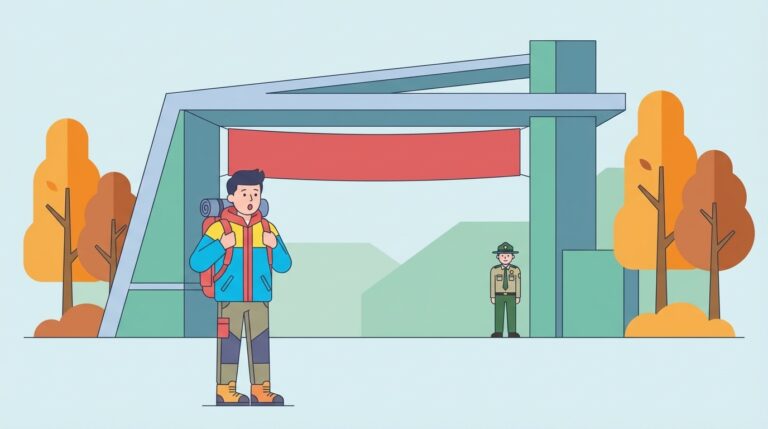
But as you approach the trailhead, you see a glaring red banner blocking the path. A park ranger politely crosses their arms. You look at your translation app, and it just says, “Mountain Entry Control.” What?
Welcome to Korea’s 국립공원 입산 통제 기간 (National Park Trail Closure Period). If you don’t know the vocabulary surrounding this unique system, your epic hiking weekend might end in a very expensive fine—or at least, a lot of confusion.
This guide is built from the exact pain points of advanced learners who thought they had their travel plans locked down. Let’s decode the bureaucratic Korean that stands between you and the summit, so you can hike—and pivot—like a true local.
Phase 2: Deep Dive into Core Expressions
At the C1 level, you need to understand more than just “closed.” You need to grasp the administrative and formal nuances of Korean public notices.
1. 입산 통제 기간
- Pronunciation: [Ipsan tongje gigan] (ip-sahn / tong-jeh / gee-gahn)
- Sound Guide: ‘ip’ (like ‘sip’), ‘sahn’ (like San Diego), ‘tong’ (like ‘tone’ with an ‘ng’), ‘jeh’ (like ‘jelly’), ‘gee-gahn’ (like ‘geese gone’).
- Meaning: Mountain entry restriction period (Literal: Mountain-enter Control Period).
- K-Culture Moment: You will see this printed on massive red and yellow banners hanging across trailheads every Spring (Feb-May) and Autumn (Nov-Dec). It’s the ultimate “plot twist” for unprepared hikers.
- Editor’s Insight: Notice the word 통제 (tongje – control/regulation) rather than 금지 (geumji – absolute ban). Korea’s mountains aren’t “shut down”; access is carefully managed to let nature recover and prevent forest fires.
- Situation Spectrum:
[🚫 Never use] ———— [⚠️ Be careful] ———— [✅ Freely use]- Official signs and news reports: ✅
- Explaining to a friend why you can’t go: ✅
- 🤔 Think About It: Why does Korean use heavy Sino-Korean (Hanja) words like 통제 for public signs instead of pure, simple Korean words like 막힘 (blocked)? How does the use of Hanja add authoritative weight to public policy?
2. 산불 조심 기간
- Pronunciation: [Sanbul josim gigan] (sahn-bool / joh-shim / gee-gahn)
- Meaning: Forest fire prevention period (Literal: Mountain fire careful period).
- K-Culture Moment: During these months, Korean TV is flooded with public service announcements, and emergency alert texts (재난문자) buzz on your phone warning you about dry weather.
- Editor’s Insight: This is the reason for the closure. If you use this phrase, Koreans will be deeply impressed by your contextual understanding. “아, 지금 산불조심기간이라 통제됐죠?” (Ah, it’s restricted right now because it’s fire prevention season, right?)
- Situation Spectrum:
- Casual/Formal conversations: ✅
3. 과태료가 부과됩니다
- Pronunciation: [Gwataeryoga bugwadoemnida] (gwa-tae-ryo-ga / boo-gwa-doem-nee-da)
- Sound Guide: ‘gwa’ like ‘guava’, ‘ryo’ requires a soft flick of the tongue. ‘Bugwa’ sounds like ‘boo-gwa’.
- Meaning: A fine will be imposed.
- K-Culture Moment: You ignored the rope, stepped over it for a quick selfie, and suddenly a drone starts broadcasting a warning from above. Yes, Korean national parks use drones with speakers!
- Editor’s Insight: 과태료 (gwataeryo) is a civil fine. 부과되다 (bugwadoeda) is passive, meaning “is imposed.” Bureaucratic Korean loves the passive voice to sound objective and detached.
- Situation Spectrum:
- Reading official warnings: ✅
- Using it on your friends (as a joke): ✅ (e.g., “If you’re late again, gwataeryoga bugwadoemnida!”)
Phase 3: Textbook vs. Real Korean
At the C1 level, bridging the gap between textbook grammar and real-world application is everything.
| Situation | 📖 Textbook Korean | 🗣️ Real Korean | 💡 Why the difference? |
|---|---|---|---|
| Realizing the trail is closed | 이 산은 지금 갈 수 없습니다. (I cannot go to this mountain now.) | 아, 오늘 통제 구간이네. 막혔어요. (Ah, it’s a restricted section today. It’s blocked.) | ‘막히다’ (to be blocked) is much more natural and vividly describes the physical barrier than the generic ‘갈 수 없다’. |
| Asking if a trail is open | 이 길은 열려 있습니까? (Is this road open?) | 여기 탐방로 개방 됐나요? (Is the trail open here?) | ‘탐방로’ (trail/path) and ‘개방’ (opening) are the specific domain vocabulary used by hikers and park apps. |
| Suggesting an alternative | 다른 곳으로 갑시다. (Let’s go somewhere else.) | 아쉽지만 둘레길이나 걷고 파전 먹으러 가죠. (It’s a bummer, but let’s just walk the Dulle-gil and go eat Pajeon.) | Koreans pivot fast. If the peak is closed, the immediate cultural reflex is to hit the lower trails and start drinking Makgeolli earlier! |
Bottom Note: Instead of sounding like a robot reading a dictionary, dropping words like “통제 구간” (restricted section) instantly elevates your Korean to native-like fluency.
Phase 4: Cultural Context — K-Culture Deep Dive
4-1. Non-Verbal Communication: Dealing with Park Rangers
If you accidentally enter a restricted zone and a 국립공원공단 직원 (Park Ranger) stops you, your non-verbal language is crucial.
– The Nunchi Check: Do not argue. In Korea, rules regarding nature preservation are strictly enforced by the community. Pleading “I came all the way from America!” won’t work. Bow slightly, say “아, 몰랐습니다. 죄송합니다” (Ah, I didn’t know. I’m sorry), and step back. They are just doing their job protecting the mountain.
4-2. The “Gorpcore” Flex and the Post-Hike Ritual (K-Travel & K-Food)
In Korea, hiking isn’t just exercise; it’s a runway and a culinary journey rolled into one.
– 장비발 (Jangbi-bal): This means “the power of gear.” Koreans are famous for wearing Himalayan-expedition-level gear just to hike a 300m neighborhood hill. It’s a sign of respect for the mountain and a fashion statement.
– The Golden Rule of Failure: If the peak is closed, the trip isn’t ruined. Every mountain base (산 밑) in Korea has a village of restaurants. The cultural rule is: 등산의 완성은 하산주 (A hike is completed by the post-hike drink). You sit on plastic chairs, order 해물파전 (Seafood Scallion Pancake) and 막걸리 (Makgeolli / Rice Wine). Sometimes, finding out the trail is closed is just a great excuse to start eating at 10 AM!
Phase 5: Real-Life Roleplay Scenario
Let’s put you in the scene. You are the protagonist.
- Setting: 8:00 AM, the entrance of Seoraksan National Park. The autumn leaves are peaking. You are with your Korean coworker, Min-su.
- Characters:
- YOU: An expat working in Seoul, excited for your first major K-hike.
- Min-su (34): Your coworker. He brought three types of trail mix and is wearing a 500,000 KRW windbreaker.
- Park Ranger: Standing in front of a red barricade.
Min-su: 아… 대박. 우리 운 진짜 없다.
(A… daebak. uri un jinjja eopda.)
[Translation: Ah… wow. We are so unlucky.]
(🎭 Stage Direction: Min-su points at the massive banner reading “입산통제”)
YOU: 헐, 왜요? 오늘 날씨 진짜 좋은데.
(Heol, waeyo? oneul nalssi jinjja joeunde.)
[Translation: OMG, why? The weather is so good today.]
Min-su: 지금 가을철 산불조심기간이라서 고지대는 다 막혔대요.
(Jigeum gaeulcheol sanbuljosimgiganiraseo gojidaeneun da makhyeotdaeyo.)
[Translation: They say all the high-altitude areas are blocked right now because it’s the autumn forest fire prevention period.]
Ranger: 네, 맞습니다. 오늘부터 대청봉 올라가는 탐방로는 전면 통제입니다.
(Ne, matseumnida. oneulbuteo Daecheongbong ollaganeun tambangnoneun jeonmyeon tongjeimnida.)
[Translation: Yes, that’s correct. Starting today, the trail going up to Daecheongbong Peak is completely restricted.]
🔀 YOUR TURN! How do you respond?
– A) “저희 멀리서 왔는데 조금만 들어가면 안 될까요?” (We came from far away, can’t we just go in a little bit?)
– B) “과태료 낼 테니까 그냥 갈게요!” (I’ll pay the fine, I’m just going to go!)
– C) “아, 그렇군요. 혹시 지금 개방된 둘레길 코스가 있을까요?”✅ Best Choice: C — “Ah, I see. By any chance, are there any Dulle-gil (lower trail) courses open right now?”
Why? Option A ignores strict Korean laws and shows a lack of Nunchi. Option B will get you reported to the police. Option C accepts the reality smoothly and uses C1-level vocabulary (개방된 둘레길) to pivot the plan like a local.
Ranger: 아, 네! 저기 폭포 쪽으로 가는 하단 코스는 현재 개방되어 있습니다.
(A, ne! jeogi pokpo jjogeuro ganeun hadan koseuneun hyeonjae gaebangdoeeo itseumnida.)
[Translation: Ah, yes! The lower course heading toward the waterfall over there is currently open.]
Min-su: 그래, 거기 걷고 빨리 파전이나 먹으러 가자!
(Geurae, geogi geotgo ppalli pajeonina meogeureo gaja!)
[Translation: Yeah, let’s walk there and hurry up and go eat Pajeon!]
Phase 6: 10-Second Shadowing Drill
Master the rhythm of advanced Korean. Pay attention to the pauses (/) and intonation.
😢 아, / 오늘이 / 산불 조심 기간이라 / 통제되는 줄 / 몰랐어요.
(Ah, / oneuri / sanbul josim giganira / tongjedoeneun jul / mollasseoyo.)
[Ah, I didn’t know it was restricted today because of the forest fire prevention period.]
Pro-tip: Stretch the “아~” slightly to show genuine disappointment. Drop your pitch at “몰랐어요” to sound humble and polite.
Phase 7: K-Culture Mini Dictionary
| 한국어 (Korean) | Romanization | English | Context |
|---|---|---|---|
| 둘레길 | dulle-gil | Perimeter trail | Flat, scenic walking paths around the base of a mountain. Never closed! |
| 단풍놀이 | danpung-nori | Autumn foliage viewing | The massive seasonal migration of Koreans to mountains to see autumn leaves. |
| 장비발 | jangbi-bal | Gear-flex | Achieving confidence through expensive, professional-grade equipment. |
| 하산주 | hasanju | Post-hike drink | The alcoholic drink (usually Makgeolli) consumed immediately after coming down the mountain. |
| 고지대 / 저지대 | gojidae / jeojidae | High altitude / Low altitude | Terms you must know to read the National Park app. High altitude is usually closed; low altitude remains open. |
Phase 8: Traveler Survival Kit
Don’t get caught off guard. Here are the tools to check restrictions before you pack your backpack.
🆘 Survival Phrases for the Trailhead
– 🇰🇷 “여기 언제 다시 개방해요?” (yeogi eonje dasi gaebanghaeyo?)
– 🗣️ Meaning: When does this open again?
– 🇰🇷 “정상 가는 길, 오늘 열렸나요?” (jeongsang ganeun gil, oneul yeollyeonnayo?)
– 🗣️ Meaning: Is the path to the peak open today?📌 Editor’s Travel Note: The Holy Grail of Hiking Apps
– The App: Download the 국립공원공단 (Korea National Park Service) app. It has a real-time “입산통제” (Trail Closure) map.
– The Seasons: Closures usually happen from mid-Feb to mid-May (Spring) and mid-Nov to mid-Dec (Autumn).
– The Loophole: Neighborhood mountains (동네 산) like Bukhansan or Namsan in Seoul rarely have total closures, unlike massive regional parks like Seoraksan or Jirisan.
Phase 9: Critical Thinking Corner — “One Step Deeper”
Nature and Collective Responsibility in Korea
In some cultures, nature is seen as an absolute public right—you hike at your own risk, whenever you want. But Korea views nature differently. With 70% of the land covered in mountains and a dense population, the environmental impact of hikers is staggering. The “산불 조심 기간” (Forest Fire Prevention Period) isn’t just a safety warning; it’s a legally enforced collective sacrifice. Koreans willingly give up their right to hike for a few months twice a year to let the ecosystem breathe and prevent catastrophic fires. It reflects a society where the preservation of the community’s assets strongly overrides individual freedom.
💬 Your Turn: Does your country close down public nature reserves to “let them rest” or to prevent fires? Or is access mostly unregulated? Let’s discuss in the comments!
Phase 10: FAQ & Avoiding Misunderstandings
- Q: “Can I just sneak past the barricade? Who’s going to know?”
- A: ABSOLUTELY NOT. Korea is covered in CCTVs, and national parks are patrolled by both rangers and drones. The fine (과태료) for entering a restricted area starts at 100,000 KRW and can go up to 500,000 KRW. Worse, if you get injured in a restricted zone, you face severe legal penalties.
- Q: “Does this mean I can’t go to ANY mountain during this period?”
- A: No. Usually, only the trails leading to the highest peaks (고지대) are closed. The lower walking paths (둘레길) and temples at the base remain open all year round.
❌ Common Mistake: Confusing 휴무일 (Closed day for business) with 통제 (Restricted access).
✅ Do this instead: Restaurants have 휴무일 (like “We are closed on Mondays”). Mountains and roads have 통제 (Restricted for safety/policy). Never say “산이 휴무예요” (The mountain is having a day off).
Phase 11: Summary & Action Items
- One-Liner Summary: Before you flex your K-drama hiking gear, always check if it’s the 입산 통제 기간 to avoid fines and disappointment!
-
Action Mission:
- 🥉 Bronze: Say “아, 오늘 통제 구간이네” out loud 3 times with a dramatic sigh.
- 🥈 Silver: Leave a comment below using the word 둘레길 (e.g., “I prefer Dulle-gil because I’m lazy!”).
- 🥇 Gold: Search “설악산 입산통제” on Naver right now and see if you can spot the dates for the current or upcoming closure period!
- K-Culture Mission: Next time you watch a Korean drama and see a scene where characters are drinking Makgeolli at a rustic outdoor table, look closely—they are probably at the base of a mountain (하산주)!
Phase 12: Quiz — Interactive Challenge
1. Situational Judgment: You traveled to Jirisan, but a ranger tells you the peak is in a 입산 통제 기간. What is the most culturally appropriate and C1-level response?
– A) “저기요, 저 외국인인데요?” (Excuse me, I’m a foreigner?)
– B) “과태료 낼 테니까 비키세요.” (I’ll pay the fine, move.)
– C) “아쉽네요. 개방된 하단 코스로 갈게요.” (What a shame. I’ll go to the open lower course.)
2. Fill in the Blank:
“가을에는 건조해서 ______ 조심 기간이에요.”
(In autumn, it’s dry, so it’s the ________ warning period.)
– A) 장비 (gear)
– B) 산불 (forest fire)
– C) 파전 (scallion pancake)
3. True or False – K-Culture Edition:
If the mountain peak is closed, Koreans generally pack up, go home immediately, and cry. (T / F)
(Answers: 1. C, 2. B, 3. False – They immediately find a restaurant at the mountain base to eat Makgeolli and Pajeon!)
Frequently Asked Questions (FAQ)
Q: What does "입산 통제 기간" mean in Korean and how do you pronounce it?
A: In Korean, "입산 통제 기간" is pronounced [Ipsan tongje gigan] and means: a key conversational Korean expression covered in this lesson.
Q: What does "산불 조심 기간" mean in Korean and how do you pronounce it?
A: In Korean, "산불 조심 기간" is pronounced [Sanbul josim gigan] and means: Forest fire prevention period (Literal: Mountain fire careful period).
Q: What does "과태료가 부과됩니다" mean in Korean and how do you pronounce it?
A: In Korean, "과태료가 부과됩니다" is pronounced [Gwataeryoga bugwadoemnida] and means: a key conversational Korean expression covered in this lesson.







