

Hello! I’m the Senior Editor of Daily Hangul. Welcome back to another deep dive into the Korean language and culture.
Imagine this: You’re watching the hit K-Drama D.P., and your heart aches for the characters. Or perhaps you’re scrolling through Twitter, and the entire fandom is crying because your favorite K-Pop idol just announced their enlistment.
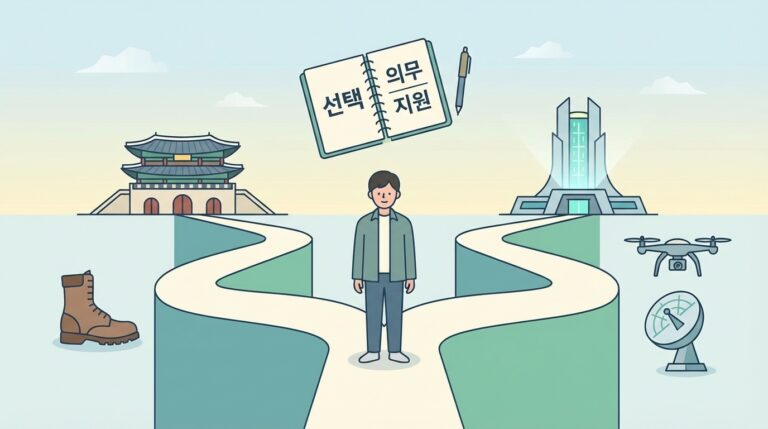
The military (군대, gundae) isn’t just a government institution in South Korea; it’s a deeply emotional, socially complex, and intensely debated topic. Because South Korea is technically still at war under an armistice agreement, mandatory conscription applies to all able-bodied men. But lately, a massive debate has been brewing on news panels, in college pubs, and across social media: Should Korea transition from a conscription system to a volunteer military?
At the C2 (Mastery) level, your goal isn’t just to order a spicy pork bowl at a cafeteria. You want to watch the 9 PM news, read editorials, and engage in profound sociopolitical debates with your Korean friends over a pint of beer. Today, we are tackling the heavy-duty vocabulary of the military transition debate (모병제 전환 논의) and national defense (국방력).
Let’s dive into the words that will make you sound like a true Korean intellectual!
Phase 2: Core Expressions Deep Dive
Let’s break down the essential C2 expressions you’ll hear in news broadcasts and late-night debates.
1. 징병제에서 모병제로의 전환 (Transition from conscription to a volunteer system)
- Pronunciation: [jing-byeong-je-e-seo mo-byeong-je-ro-ui jeon-hwan]
- Sound-alike guide: Jing-byung-jeh-eh-so mo-byung-jeh-ro-we jun-hwan
- Meaning: The shift from mandatory military service to an all-volunteer force.
- K-Culture Moment: This is the headline you see flashing on YTN or KBS News when politicians debate election pledges. It’s also the central theme of heated debates in university dongari (club) rooms.
- Editor’s Insight: 징병제 means “conscription” (forcing people to serve), and 모병제 means “volunteer system” (recruiting those who want to serve). The key word is 전환 (transition/shift). Using this exact phrasing instantly signals that you have a highly advanced grasp of Korean current affairs.
- Situation Spectrum:
[🚫 절대 금지] ———— [⚠️ 주의] ———— [✅ 자유롭게]
- Casual with friends: ✅ (Great for deep, late-night talks)
- Formal debates/Essays: ✅ (Perfect, highly academic)
- Small talk with strangers: 🚫 (Too heavy for casual weather talk)
- 🤔 Think About It: In many Western countries, a volunteer military is the norm. Why do you think the word 징병제 carries such a unique, collective weight in the Korean male psyche?
2. 인구 절벽 (Demographic cliff)
- Pronunciation: [in-gu jeol-byeok]
- Sound-alike guide: In-goo jul-byuk
- Meaning: A sudden, steep decline in the working-age (and in this context, military-age) population due to a drastically low birth rate.
- K-Culture Moment: You can’t discuss the Korean military without discussing this. Because Korea’s birth rate is the lowest in the world, the military simply doesn’t have enough young men to draft anymore. This phrase is thrown around in every economic and defense debate.
- Editor’s Insight: 절벽 literally means “cliff.” It paints a terrifying picture of the population numbers suddenly dropping off an edge. It’s a powerful, evocative noun phrase.
- Situation Spectrum:
[🚫 절대 금지] ———— [⚠️ 주의] ———— [✅ 자유롭게]
- Professional/Academic: ✅
- Casual discussions: ✅
- 🤔 Think About It: How does your language describe demographic crises? Is it as dramatic as falling off a “cliff”?
3. 국방력 공백을 최소화하다 (To minimize the vacuum in national defense)
- Pronunciation: [guk-bang-nyeok gong-bae-geul choe-so-hwa-ha-da]
- Sound-alike guide: Gook-bang-nyuk gong-baeg-eul chweh-so-hwa-ha-da
- Meaning: To ensure there is no weakness or gap in military readiness during a transition or crisis.
- K-Culture Moment: This is the primary counter-argument from conservative politicians and older generations. They argue, “If we switch to a volunteer system, who will guard the DMZ? We will have a 공백 (vacuum).”
- Editor’s Insight: 국방력 means “national defense capability,” and 공백 means “blank space” or “vacuum.” 최소화하다 means “to minimize.” It’s a highly sophisticated colocation.
- Situation Spectrum:
[🚫 절대 금지] ———— [⚠️ 주의] ———— [✅ 자유롭게]
- News/Formal writing: ✅
- Casual chats: ⚠️ (A bit too formal for a casual chat, unless you are quoting the news)
- 🤔 Think About It: Why is the “vacuum” concept so sensitive in South Korea specifically? (Hint: The geopolitical reality of the Korean peninsula).
Phase 3: Textbook vs. Real Korean
How do textbooks teach this vs. how young Koreans actually argue about it?
| Situation | 📖 Textbook Korean | 🗣️ Real Korean (C2 Slang & Colloquialisms) | 💡 Why the difference? |
|---|---|---|---|
| Advocating for a volunteer system | 군대를 자원하는 제도로 바꾸어야 합니다. (We must change it to a voluntary system.) | 이제 우리도 모병제 논의할 때 안 됐나? 솔직히 인구수 떡락하는데. (Isn’t it time we discussed a volunteer system? Honestly, the population is crashing.) | Real debates use trending internet slang like 떡락 (crashing/plummeting) to emphasize the urgency of the population crisis. |
| Expressing concern about defense | 국방력이 약해질까 봐 걱정됩니다. (I am worried the defense will weaken.) | 모병제 하면 휴전선은 누가 지키냐? 안보 공백 생기는 건 팩트지. (If we do a volunteer system, who guards the armistice line? A security vacuum is a fact.) | Koreans often use rhetorical questions and direct terms like 팩트 (fact/truth) in heated geopolitical arguments. |
| Discussing modern warfare | 현대전은 첨단 무기가 중요합니다. (Advanced weapons are important in modern warfare.) | 요즘은 머릿수보다 첨단 전력 싸움이지. 드론이 다 하는 시대인데. (These days it’s a battle of high-tech forces rather than headcounts. It’s an era where drones do everything.) | 머릿수 (headcount) is a slightly cynical, pragmatic way to refer to conscripted troops. |
Bottom Note: At the C2 level, seamlessly weaving in words like 안보 공백 (security vacuum) with colloquialisms like 머릿수 (headcount) shows true native-like fluency.
Phase 4: Cultural Context — K-Culture Deep Dive
4-1. Non-verbal Nuances: The Heavy Sigh
When discussing the military (군대 이야기), especially conscription, you will often hear a heavy sigh (한숨) from Korean men. It’s a complex mix of pride, trauma, nostalgia, and frustration. If you bring up the “모병제” debate, lean in, nod thoughtfully, and maintain a serious demeanor. This isn’t a lighthearted topic; it involves two years of a young man’s life and the country’s survival.
4-2. The K-Pop Connection: 군백기 (Gun-baek-gi)
If you are a K-Pop fan, you know the dread of a boy group’s enlistment era. This period is called 군백기 (a portmanteau of 군대 [military] + 공백기 [hiatus]).
The debate over whether world-class artists like BTS should be exempt from the draft or if the whole country should just shift to a volunteer system (모병제) was a massive cultural earthquake. Understanding the 모병제 debate helps you understand the intense societal pressure K-Pop idols face regarding their service. To the general public, military service is the ultimate test of fairness (공정성). Any perceived special treatment ignites national outrage.
Phase 5: Real-Life Roleplay Scenario
Let’s put you in the hot seat.
Setting: It’s 10 PM on a Friday. You are at a bustling Hof (Korean pub) near Sinchon with your Korean university friends. The TV on the wall is showing a late-night debate program titled “Demographic Cliff: The Future of the Korean Military.” The table is littered with empty beer glasses and fried chicken plates.
Characters:
– YOU: A foreign exchange student/expat who closely follows Korean politics.
– Min-soo (25): Your Korean friend who recently finished his military service (예비역). He is pragmatic and slightly cynical.
– Ji-yoon (24): Another friend, very interested in social justice and economic efficiency.
Dialogue:
Min-soo: 아, 또 저 얘기네. 인구 절벽 때문에 군대 갈 사람도 없다면서? 🍺
(Ah, tto jeo yaegine. In-gu jeol-byeok ttaemune gundae gal saramdo eopdamyeonseo?)
[Ah, that topic again. They say there’s no one to go to the military because of the demographic cliff?]
(🎭 Stage Direction: Min-soo pours you another glass of beer, sighing)
Ji-yoon: 그러니까. 이제 진짜 모병제 진지하게 논의해야 돼. 언제까지 20대 청춘들 희생만 강요할 거야?
(Geureonikka. Ije jinjja mo-byeong-je jinji-hage non-ui-haeya dwae. Eonje-kkaji isip-dae cheong-chun-deul hui-saeng-man gang-yo-hal geoya?)
[Exactly. We really need to seriously discuss a volunteer system now. How long are we going to force the youth in their 20s to sacrifice?]
Min-soo: 근데 모병제 하면 당장 휴전선은 누가 지켜? 국방비 예산도 엄청 깨질 텐데.
(Geunde mo-byeong-je hamyeon dang-jang hyu-jeon-seon-eun nuga jikyeo? Guk-bang-bi ye-san-do eom-cheong kkae-jil ten-de.)
[But if we do a volunteer system, who will guard the DMZ right now? The defense budget will also be totally shattered.]
Ji-yoon: (Turning to you) 너희 나라는 모병제지? 넌 어떻게 생각해? 한국도 전환 가능할까?
🔀 Your Turn! How do you answer as a C2 Master?
– A) 네, 모병제가 더 좋습니다. (Yes, a volunteer system is better.) – Grammatically correct, but extremely boring for C2.
– B) 솔직히 인구 절벽 상황을 보면, 머릿수 채우기보다는 첨단 전력으로 국방력 공백을 메우는 방향으로 가야 하지 않을까요?
– C) 대박! 완전 찬성! 군대 가기 싫잖아요! (Awesome! Totally agree! Nobody wants to go to the army!) – Too childish for a serious geopolitical debate.✅ Best Choice: B — “Honestly, looking at the demographic cliff situation, shouldn’t we move towards filling the defense vacuum with high-tech forces rather than just filling a headcount?”
Why? It acknowledges both sides. You use top-tier vocabulary (인구 절벽, 첨단 전력, 국방력 공백) while phrasing it softly as a question (…하지 않을까요?), which is the polite Korean way to present a strong opinion.
Bonus K-Culture Scenario: Consoling a Fan
Your friend is crying at a cafe because her favorite idol just enlisted.
Friend: 우리 오빠들 군백기 어떡해… 18개월을 어떻게 기다려 ㅠㅠ
YOU: 그러니까 말이야. 이참에 진짜 모병제로 싹 바뀌어야 되는데. 오빠들 다치지 말고 건강하게만 제대했으면 좋겠다.
(I know, right. They really should just switch everything to a volunteer system at this point. I just hope they get discharged safely and healthily.)
Phase 6: 10-Second Shadowing Drill
Practice this C2-level sentence to sound exactly like a Korean news pundit.
😤 인구 절벽 / 시대에, / 모병제 전환은 / 더 이상 / 피할 수 없는 / 과제입니다.
(in-gu jeol-byeok / si-dae-e, / mo-byeong-je jeon-hwan-eun / deo i-sang / pi-hal su eom-neun / gwa-je-im-ni-da.)
“In the era of the demographic cliff, the transition to a volunteer military is a task that can no longer be avoided.”
Pro-Tip: Pause exactly where the slashes are, and put emphasis on 절벽 and 전환.
Phase 7: K-Culture Mini Dictionary
Master these terms to navigate any Korean military conversation.
| 한국어 | Romanization | English | Contextual Explanation |
|---|---|---|---|
| 징병제 | jing-byeong-je | Conscription | The current mandatory military draft system for South Korean men. |
| 모병제 | mo-byeong-je | Volunteer military | The proposed system where individuals choose to enlist as a career. |
| 군백기 | gun-baek-gi | Military hiatus | The agonizing 1.5 to 2-year period where fans must wait for their idol. |
| 예비역 | ye-bi-yeok | Reservist | Someone who has completed active duty and is now in the reserve forces. |
| 첨단 전력 | cheom-dan jeon-nyeok | High-tech military force | The modern alternative to “headcount” (drones, AI, advanced missiles). |
Phase 8: Traveler’s Survival Kit
Even as a traveler, you might encounter Korea’s military reality, especially if you visit the DMZ (Demilitarized Zone) or see soldiers on leave (휴가) at Seoul Station.
🆘 Survival Phrases for the DMZ / Military Areas
– 🇰🇷 “여기서 사진 찍어도 되나요?” (yeo-gi-seo sa-jin jji-geo-do doe-na-yo?)
– 🗣️ Meaning: Am I allowed to take photos here?
– 📍 Where to use: DMZ tours, near military bases.
– 💡 Pro Tip: South Korea has strict security laws. If you see a fence with barbed wire and red signs saying 군사기지 (Military Base) or 사진촬영 금지 (No Photography), put your camera away immediately. Taking photos of military installations is illegal.📌 Editor’s Travel Note
If you are taking the KTX train on a Friday evening, you will see hundreds of young men in uniform with short hair. They are soldiers going on leave (휴가, hyuga). It’s a very unique, slightly poignant Korean sight. Give them an encouraging smile!
Phase 9: Critical Thinking — “One Step Deeper”
Let’s analyze the society behind the language.
🧠 Think Deeper: Media vs Reality & The Politics of Fairness
In K-Dramas like Descendants of the Sun, military life is romanticized with handsome officers and dramatic helicopter rescues. However, realistic shows like D.P. expose the harsh realities of bullying and the rigid hierarchy of conscription.
The debate over 모병제 (Volunteer System) isn’t just about defense capabilities; it’s deeply rooted in the concept of 공정성 (Fairness). In Korea, serving in the military is seen as a great equalizer—rich or poor, famous or unknown, every man must serve. Therefore, transitioning to a volunteer system brings up fears of class division: will only the poor volunteer for the military while the rich opt out? Understanding this anxiety explains why changing the system is so politically difficult in Korea.💬 Your Turn: Does your country have conscription or a volunteer system? How is military service viewed in your society? Is it a career choice or a civic duty? Share your thoughts in the comments!
Phase 10: FAQ & Avoiding Misunderstandings
Q: Can I ask a Korean man I just met about his military service?
Yes, but tread carefully! Asking “군대 다녀오셨어요? (Have you served in the military?)” is a common icebreaker among men. However, never judge or make light of their service. It’s often a period of immense stress, so showing respect for their time served is highly appreciated.
Q: Can I use the word “군백기” for non-celebrities?
No. “군백기” is almost exclusively internet/fandom slang used for celebrities. For regular people, use “군 복무 기간” (military service period).
❌ Common Mistake: Confusing 징병 (Drafting) with 제대 (Discharge).
– 징병 (Jing-byeong) = Being drafted IN to the military.
– 제대 (Je-dae) = Being discharged OUT of the military.
✅ Correct usage: “BTS 진이 제대했어요!” (BTS Jin was discharged!) – Do not say 진이 징병했어요!
Phase 11: Summary & Action Items
One-Liner Summary: To debate Korea’s military future like a native, contrast the urgency of the “demographic cliff” (인구 절벽) with the need to prevent a “defense vacuum” (국방력 공백) when discussing the shift to a volunteer system (모병제 전환).
Action Mission:
– 🥉 Bronze: Shadow the 10-second drill sentence in Phase 6 three times in front of a mirror, focusing on a serious, persuasive tone.
– 🥈 Silver: Go to a Korean news YouTube channel (like YTN or KBS), search “모병제”, and leave a comment using the word 인구 절벽.
– 🥇 Gold: The next time a Korean friend brings up politics or the military, ask them: “한국은 모병제 전환에 대해 어떻게 생각해요?” (What do you think about Korea transitioning to a volunteer system?)
K-Culture Mission:
Watch one episode of D.P. on Netflix. Pay attention to the atmosphere and the hierarchy. Think about how the 모병제 (volunteer system) debate we learned today could change the lives of the characters in the show.
Phase 12: C2 Mastery Quiz
Test your advanced political Korean!
1. Fill in the Blank:
한국은 출산율 하락으로 인한 [ ______ ] 때문에, 현재의 병력 규모를 유지하기 어렵습니다.
(Due to the [ ______ ] caused by the falling birth rate, it is difficult for Korea to maintain its current troop levels.)
A) 예비역
B) 인구 절벽
C) 군백기
D) 첨단 전력
2. Situational Judgment:
A conservative politician is arguing against the volunteer military system. Which phrase are they most likely to use?
A) “모병제로 전환해야 합니다.”
B) “20대 청춘의 희생을 멈춰야 합니다.”
C) “국방력 공백이 우려됩니다.”
3. True or False – K-Culture Edition:
“군백기” is a formal military term used by generals to describe a gap in defense strategies. (T / F)
🚨 Click here for Answers!
1. B) 인구 절벽 (Demographic cliff). It perfectly describes the population crisis affecting troop numbers.
2. C) “국방력 공백이 우려됩니다.” (I am concerned about a vacuum in national defense.) This is the classic argument for maintaining the current conscription system.
3. False. “군백기” is K-Pop fandom slang for the period when an idol is away in the military. The formal term for a defense gap is “안보 공백” or “국방력 공백”.
Did you learn something new today? Politics and society are tough topics, but mastering them pushes you from “speaking Korean” to “thinking Korean.” See you in the next Daily Hangul post! 😊
Frequently Asked Questions (FAQ)
Q: What does "징병제에서 모병제로의 전환 (Transition from conscription to a volunteer system)" mean in Korean and how do you pronounce it?
A: In Korean, "징병제에서 모병제로의 전환 (Transition from conscription to a volunteer system)" is pronounced [jing-byeong-je-e-seo mo-byeong-je-ro-ui jeon-hwan] and means: The shift from mandatory military service to an all-volunteer force.
Q: What does "인구 절벽 (Demographic cliff)" mean in Korean and how do you pronounce it?
A: In Korean, "인구 절벽 (Demographic cliff)" is pronounced [in-gu jeol-byeok] and means: A sudden, steep decline in the working-age (and in this context, military-age) population due to a drastically low birth rate.
Q: What does "국방력 공백을 최소화하다 (To minimize the vacuum in national defense)" mean in Korean and how do you pronounce it?
A: In Korean, "국방력 공백을 최소화하다 (To minimize the vacuum in national defense)" is pronounced [guk-bang-nyeok gong-bae-geul choe-so-hwa-ha-da] and means: To ensure there is no weakness or gap in military readiness during a transition or crisis.







