

Phase 1: Empathy (The K-Culture Cold Open)
Hello! Daily Hangul Editor here.
Have you ever watched a K-Drama like Descendants of the Sun or a celebrity documentary where the main characters head overseas for volunteer work? Think of those sweeping shots of rural villages, the heartfelt smiles, and that inevitable moment where the protagonist stares into the sunset and says something incredibly profound. The subtitles usually just say, “It was a good experience,” but if you listen closely, they are saying something much deeper.
At a C1 (Advanced) level, talking about volunteering and donations isn’t just about saying “I helped people” (도와줬어요). It’s about articulating personal growth, expressing cultural humility, and describing how your worldview has expanded. If you only use textbook phrases to describe your overseas volunteer experience, Koreans might think you’re just stating facts. But if you use the expressions we’re about to learn, they’ll look at you with deep respect and say, “Wow, your Korean is incredibly mature.”
This guide is based on real conversations I’ve had with advanced students who returned from NGO trips and wanted to express their complex, beautiful emotions in natural Korean. Let’s dive in!
Phase 2: Core Expressions Deep Dive
1. 오히려 제가 더 많이 배우고 왔어요.
- Pronunciation: [o-hi-ryeo je-ga / deo ma-ni bae-u-go / wa-sseo-yo] (Sound-alike: Oh-hee-ryuh jeh-gah duh mah-nee bae-oo-go wah-ssuh-yo)
- Meaning: Literal = Rather, I learned a lot more and came back. / Real nuance = I actually learned more from them than I helped them.
- K-Culture Moment: This is the absolute classic response whenever a famous Korean actor or idol returns from a charity trip abroad and is interviewed by reporters. It shows immense humility (겸손).
- Editor’s Insight: This phrase completely flips the power dynamic. It shows that you don’t view yourself as the “superior savior,” but as an equal who gained valuable life lessons from the locals.
- Situation Spectrum:
[🚫 절대 금지] ———— [⚠️ 주의] ———— [✅ 자유롭게]
- Close Friends (Casual): ✅ (Change to: 오히려 내가 더 많이 배웠어)
- Coworkers (Semi-formal): ✅
- Boss/Elders (Formal): ✅
- 🤔 Think About It: Why is “humility” (겸손) such a mandatory virtue in Korean society, especially when doing a good deed? Is it the same in your culture, or is it more acceptable to take pride in your charitable actions?
2. 제가 우물 안 개구리였다는 걸 깨달았죠.
- Pronunciation: [je-ga / u-mul an gae-gu-ri-yeot-da-neun geol / kkae-da-rat-jyo] (Sound-alike: Jeh-gah oo-mool ahn gae-goo-ree…)
- Meaning: Literal = I realized I was a frog in a well. / Real nuance = I realized how narrow-minded/sheltered I was.
- K-Culture Moment: When a character in a drama goes through a massive character arc, realizing the world is much bigger and more complex than their wealthy Seoul neighborhood.
- Editor’s Insight: This traditional idiom is perfect for C1 learners. It proves you not only know the language but understand Korean metaphors. It expresses a profound shift in worldview after experiencing different cultures or hardships.
- Situation Spectrum:
[🚫 절대 금지] ———— [⚠️ 주의] ———— [✅ 자유롭게]
- Close Friends (Casual): ✅
- Coworkers (Semi-formal): ✅
- Boss/Elders (Formal): ✅
- 🤔 Think About It: “A frog in a well” only sees a small patch of the sky. Does your native language have a similar idiom for being narrow-minded or sheltered?
3. 가슴이 벅차오르는 뜻깊은 시간이었습니다.
- Pronunciation: [ga-seu-mi beok-cha-o-reu-neun / tteut-gi-peun si-ga-ni-eot-seum-ni-da] (Sound-alike: Gah-sue-mee buck-cha-oh-reu-neun…)
- Meaning: Literal = It was a meaningful time where my chest filled up. / Real nuance = It was an overwhelmingly meaningful and moving experience.
- K-Culture Moment: Picture an NGO documentary narrator or an idol delivering a heartfelt speech at a year-end awards ceremony after a charity campaign.
- Editor’s Insight: ‘벅차오르다’ is a beautifully poetic verb. It’s that feeling when your heart is so full of emotion (pride, joy, or being moved) that it feels like it might burst. It elevates your sentence from a simple “It was good” to an eloquent, emotional reflection.
- Situation Spectrum:
[🚫 절대 금지] ———— [⚠️ 주의] ———— [✅ 자유롭게]
- Close Friends (Casual): ⚠️ (A bit too poetic for casual chats. Better for speeches/posts)
- Interviews/Presentations (Formal): ✅
- 🤔 Think About It: Notice how Koreans often describe physical sensations (chest swelling) to express abstract emotions. Can you think of other Korean phrases that connect the body to feelings?
Phase 3: Textbook vs. Real Korean
| Situation | 📖 Textbook Korean | 🗣️ Real Korean (C1 Level) | 💡 Why is it different? |
|---|---|---|---|
| Describing the act | “가난한 사람들을 도왔습니다.” (I helped poor people.) | “조금이나마 힘을 보태고 싶었어요.” (I wanted to add my small strength/pitch in.) | “Poor people” sounds condescending. “Adding strength” emphasizes solidarity over superiority. |
| Feeling proud | “제가 자랑스럽습니다.” (I am proud of myself.) | “오히려 제 마음이 더 따뜻해졌어요.” (Actually, my heart became warmer.) | Direct self-praise is often seen as arrogant; focusing on emotional warmth is preferred. |
| Doing pro bono work | “무료로 일했습니다.” (I worked for free.) | “재능 기부를 하고 왔습니다.” (I did a talent donation.) | “Talent donation” is the trendy, respectful K-Culture term for pro bono or skilled volunteer work. |
Bottom Note: At the C1 level, vocabulary choice is less about being “correct” and more about displaying empathy and social grace (눈치).
Phase 4: Cultural Context — K-Culture Deep Dive
4-1. Non-verbal Elements
When sharing an overseas volunteer experience in Korea, tone is everything. Speak softly and reflectively. Avoid boasting gestures (like crossing your arms or leaning back). Instead, lean forward slightly, maintain gentle eye contact, and perhaps smile wistfully. Korean culture highly values the “hidden good deed” (오른손이 하는 일을 왼손이 모르게 하라 – Let not your left hand know what your right hand is doing).
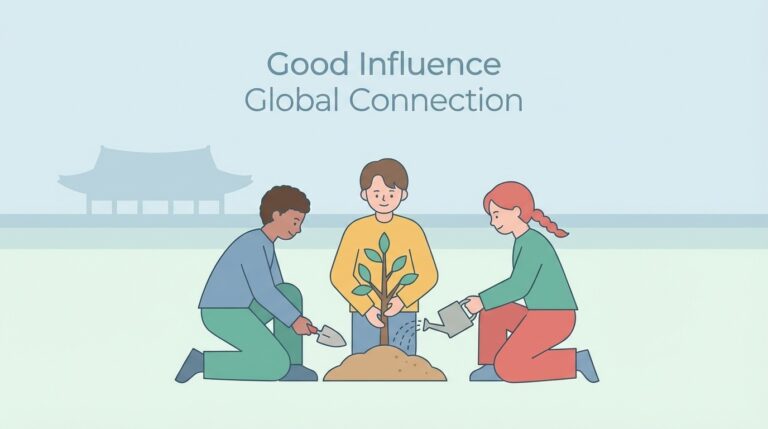
4-2. The K-Pop Connection: “Good Influence” (선한 영향력)
If you follow K-Pop or K-Actors, you’ve definitely heard the phrase 선한 영향력 (seonhan yeonghyangnyeok – Good Influence).
In the past, charity in Korea was a quiet, private affair. But K-Pop fandoms completely revolutionized this! When an idol’s birthday approaches, fans don’t just buy them luxury gifts anymore. They organize massive global campaigns—building schools in Africa, adopting endangered animals, or donating tons of “Rice Wreaths” (쌀화환) to local charities under the idol’s name.
Idols, in return, often volunteer at animal shelters or orphanages during their breaks, creating a positive feedback loop. When talking about your own volunteer work, mentioning that you wanted to spread “선한 영향력” will make you sound like a true Korean insider!
Phase 5: Real-Life Roleplay Scenario
Setting: A cozy, warmly lit café in Hongdae on a Sunday afternoon. You’ve just returned from a two-week overseas volunteer camp in Southeast Asia. You are meeting Min-ji, a senior coordinator from the NGO who sent you.
Characters:
– YOU: A passionate foreign resident in Korea, continuously looking to grow.
– Min-ji (32): Your Korean mentor. Warm, encouraging, and heavily involved in international charity work.
Dialogue:
Min-ji: 오랜만이에요! 무사히 잘 다녀와서 다행이에요. 안 힘들었어요?
(O-raen-ma-ni-e-yo! Mu-sa-hi jal da-nyeo-wa-seo da-haeng-i-e-yo. An him-deu-reo-sseo-yo?)
[It’s been a while! I’m glad you came back safely. Wasn’t it hard?]
YOU: 체력적으로는 조금 힘들었는데, 정말 뜻깊은 시간이었어요.
(Che-ryeok-jeo-gu-ro-neun jo-geum him-deu-reot-neun-de, jeong-mal tteut-gi-peun si-ga-ni-eo-sseo-yo.)
[Physically it was a bit tough, but it was a truly meaningful time.]
Min-ji: 사진 보니까 아이들이랑 정말 잘 놀아주던데요? 아이들이 진짜 좋아했겠어요.
(Sa-jin bo-ni-kka a-i-deu-ri-rang jeong-mal jal no-ra-ju-deon-de-yo? A-i-deu-ri jin-jja jo-a-haet-ge-sseo-yo.)
[Looking at the photos, you played so well with the kids! They must have really loved you.]
🔀 Your Turn! How should you respond?
– A) 네, 제가 영어를 가르쳐줘서 아이들에게 큰 도움이 됐어요! (Yes, me teaching them English was a huge help!)
– B) 에이, 아니에요. 오히려 제가 아이들한테 더 많은 걸 배우고 왔어요. (Oh, not at all. Actually, I learned much more from the kids.)
– C) 맞아요, 제가 인기가 좀 많았죠! (That’s right, I was pretty popular!)✅ Best Choice: B — Reason: It perfectly captures the Korean virtue of humility and uses our core advanced expression.
⚠️ Choice A/C Analysis: A sounds highly arrogant in Korean culture. C is okay as a joke among very close friends, but to a senior coordinator, it lacks the depth expected from a volunteer experience.
(Continuing with Choice B)
Min-ji: (Smiling warmly) 역시… 그럴 줄 알았어요. 가보니까 어때요? 한국이랑 많이 다르죠?
(Yeok-si… geu-reol jul a-ra-sseo-yo. Ga-bo-ni-kka eo-ttae-yo? Han-gu-gi-rang ma-ni da-reu-jyo?)
[As expected… I knew you’d say that. How was it there? Very different from Korea, right?]
YOU: 네. 솔직히 그동안 제가 우물 안 개구리였다는 걸 깨달았어요.
(Ne. Sol-jik-hi geu-dong-an je-ga u-mul an gae-gu-ri-yeot-da-neun geol kkae-da-ra-sseo-yo.)
[Yes. Honestly, I realized I had been a frog in a well all this time.]
Min-ji: 맞아요. 저도 처음 해외 봉사 갔을 때 똑같이 느꼈거든요.
(Ma-ja-yo. Jeo-do cheo-eum hae-oe bong-sa ga-sseul ttae ttok-ga-chi neu-kkyeot-geo-deun-yo.)
[Exactly. I felt the exact same way when I went on my first overseas volunteer trip.]
YOU: 아이들의 밝은 웃음을 보면서 가슴이 벅차오르더라고요.
(A-i-deu-reul bal-geun u-seu-meul bo-myeon-seo ga-seu-mi beok-cha-o-reu-deo-ra-go-yo.)
[Seeing the kids’ bright smiles, my heart just swelled with emotion.]
Min-ji: 너무 멋지네요. 자, 오늘 수고한 의미로 커피랑 케이크는 제가 쏠게요! 먹고 싶은 거 다 골라요!
(Neo-mu meot-ji-ne-yo. Ja, o-neul su-go-han eui-mi-ro keo-pi-rang ke-i-keu-neun je-ga ssol-ge-yo! Meok-go si-peun geo da gol-la-yo!)
[That’s so wonderful. Well, to celebrate your hard work, coffee and cake are on me! Pick anything you want!]
YOU: 앗, 감사합니다! 그럼 선배님 추천 메뉴로 먹을게요!
(At, gam-sa-ham-ni-da! Geu-reom seon-bae-nim chu-cheon me-nyu-ro meo-geul-ge-yo!)
[Oh, thank you! Then I’ll have whatever you recommend!]
Phase 6: 10-Second Shadowing Drill
Speak aloud with the guide below. Follow the pauses (/) and match the emotion!
🥺 (Deeply moved and humble tone)
솔직히 / 제가 도와주러 간 건데, / 오히려 / 제가 더 많은 걸 / 배우고 왔어요.
(sol-ji-ki / je-ga do-wa-ju-reo gan geon-de, / o-hi-ryeo / je-ga deo ma-neun geol / bae-u-go wa-sseo-yo.)
Phase 7: K-Culture Mini Dictionary
| Korean | Romanization | English | Cultural Context |
|---|---|---|---|
| 선한 영향력 | seonhan yeonghyangnyeok | Good influence | A massive buzzword in K-Pop/K-Media referring to celebrities inspiring fans to do charity. |
| 재능 기부 | jaeneung gibu | Talent donation | Pro bono work. Using your professional skills (e.g., photography, translation) for free to help others. |
| 조공 / 역조공 | jogong / yeokjogong | Tribute / Reverse Tribute | Fans donating/buying gifts for idols (조공). Idols renting food trucks or giving gifts back to fans (역조공). |
| 뿌듯하다 | ppudeutada | To feel proud/rewarded | A warm feeling in your chest when you’ve accomplished something meaningful. |
Phase 8: Traveler’s Survival Kit
Even if you’re not going overseas, you might do volunteer work in rural Korea, or find yourself helping a local while traveling!
🆘 Survival Phrases for Helping Out
– 🇰🇷 “제가 뭐 도와드릴 일 있을까요?” (je-ga mwo do-wa-deu-ril il i-sseul-kka-yo?)
– 🗣️ English: Is there anything I can help with?
– 📍 Where to use: Seeing an elderly person struggling with bags, or at a volunteer site.
- 🇰🇷 “어떻게 하는 건지 한 번만 보여주시겠어요?” (eo-tteo-ke ha-neun geon-ji han beon-man bo-yeo-ju-si-ge-sseo-yo?)
- 🗣️ English: Could you show me how to do it just once?
- 📍 Where to use: When learning a new task at a volunteer site or rural farm.
📌 Editor’s Travel Note: Rural Korea Edition
– Transport: If you volunteer in rural Korea (시골), Kakao T (taxi app) might not catch cars easily. Always ask locals for the local call-taxi number (콜택시).
– The “Jeong” (정) Overload: Rural grandmothers might feed you constantly. If you’re full, don’t just say “No.” Say “너무 맛있는데, 배가 터질 것 같아요!” (It’s so delicious, but I think my stomach will explode!) with a big smile.
Phase 9: Critical Thinking Corner — A Step Deeper
🫠 Think Deeper: Language, Power, and the Evolution of Charity (Media vs Reality)
In traditional Korean culture, rooted in Confucianism, true charity was invisible. Boasting about helping others ruined the virtue of the act. However, the rise of K-Pop and global media has birthed a new paradigm: 선한 영향력 (Good Influence). Today, publicizing your donations or overseas volunteer work isn’t seen as “showing off” if the goal is to inspire others to join in. Fandoms publicly compete to see who can donate more in their idol’s name. This represents a fascinating shift from a collectivist, quiet morality to a modern, networked activism. Yet, the language we use—saying “I learned from them” instead of “I saved them”—remains fiercely humble, retaining the core of traditional Korean respect.
💬 Your Turn: How is charity viewed in your culture? Is it better to donate anonymously, or to post about it to inspire others? Share your thoughts in the comments!
Phase 10: FAQ & Mistake Prevention
Q: Can I boast about my volunteer work in a Korean job interview?
Yes, but how you say it matters. Don’t say “I am a great person because I helped them.” Instead, frame it as: “Through this experience, I learned how to communicate with diverse people and realized the value of teamwork.”
❌ Common Mistake #1: Using “동정하다” (to pity) or “불쌍하다” (pitiful).
Example: “그 사람들이 불쌍해서 도와줬어요.” (I helped them because they are pitiful.)
✅ Do this instead: Never use these words; they sound incredibly condescending in Korean. Use “안타깝다” (feel sorry for the situation) or “공감하다” (empathize).❌ Common Mistake #2: Trying to use K-Pop fandom slang (조공) in professional settings.
✅ Do this instead: Stick to “기부” (donation) or “봉사” (volunteering) during interviews or NGO meetings.
Phase 11: Summary & Action Items
💡 One-Liner Summary: True volunteering in Korean is expressed not by highlighting how much you helped, but by humbly reflecting on how much your worldview expanded (우물 안 개구리) and what you learned (오히려 배웠다).
Action Mission:
– 🥉 Bronze: Say “오히려 제가 더 많이 배우고 왔어요” 3 times in front of the mirror with your hand on your heart.
– 🥈 Silver: Write a short journal entry in Korean about a time you helped someone but ended up learning a lesson.
– 🥇 Gold: Use these expressions in a language exchange meetup when talking about travel or volunteering!
🎬 K-Culture Mission:
Search YouTube for “[Your Favorite Idol’s Name] 선한 영향력” or “해외 봉사 활동” and listen to how humbly they speak about their experiences. Try to catch the words “배우고 왔습니다”!
Phase 12: Interactive Challenge Quiz
1. Fill in the Blank (Situational Judgment):
You are at an NGO sharing session. Someone asks what you gained from the trip.
“사실, 제가 가서 도와주려고 한 건데… ___________________.”
A) 제가 제일 똑똑했어요. (I was the smartest.)
B) 오히려 제가 더 많이 배우고 왔습니다. (Actually, I learned much more.)
C) 거긴 너무 우물 안 개구리예요. (They are frogs in a well.)
2. True or False – K-Culture Edition:
In modern Korean idol culture, it is highly frowned upon for fans to donate money in an idol’s name because charity should be private. (T/F)
(Answers: 1: B – It shows the perfect level of humility. / 2: False – It is highly encouraged and praised as “Good Influence” / 선한 영향력!)
Frequently Asked Questions (FAQ)
Q: What does "오히려 제가 더 많이 배우고 왔어요." mean in Korean and how do you pronounce it?
A: In Korean, "오히려 제가 더 많이 배우고 왔어요." is pronounced [o-hi-ryeo je-ga / deo ma-ni bae-u-go / wa-sseo-yo] and means: Literal = Rather, I learned a lot more and came back. / Real nuance = I actually learned more from them than I helped them.
Q: What does "제가 우물 안 개구리였다는 걸 깨달았죠." mean in Korean and how do you pronounce it?
A: In Korean, "제가 우물 안 개구리였다는 걸 깨달았죠." is pronounced [je-ga / u-mul an gae-gu-ri-yeot-da-neun geol / kkae-da-rat-jyo] and means: Literal = I realized I was a frog in a well. / Real nuance = I realized how narrow-minded/sheltered I was.
Q: What does "가슴이 벅차오르는 뜻깊은 시간이었습니다." mean in Korean and how do you pronounce it?
A: In Korean, "가슴이 벅차오르는 뜻깊은 시간이었습니다." is pronounced [ga-seu-mi beok-cha-o-reu-neun / tteut-gi-peun si-ga-ni-eot-seum-ni-da] and means: Literal = It was a meaningful time where my chest filled up. / Real nuance = It was an overwhelmingly meaningful and moving experience.







