

Phase 1: Empathy (Immersive Opening)
Hello! I am the Lead Editor at Daily Hangul.
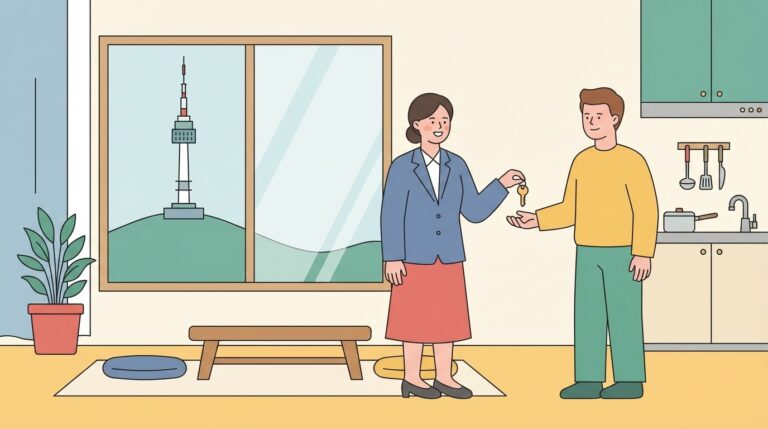
Picture this: You are watching your favorite K-Drama. The main character has just moved into a romantic Oktapbang (rooftop room) with a breathtaking view of the sparkling Seoul skyline. They are drinking beer on the rooftop under the stars. It looks like a dream, right?
But before you can live out your K-Drama fantasy, you have to face the ultimate boss level of living in Korea: House Hunting (부동산 – Budongsan).
Walking into a Korean real estate agency can be intimidating. The agent is speaking incredibly fast, calculators are flashing numbers with too many zeros, and suddenly you hear the word Bojeunggeum (deposit). If you do not know the basic vocabulary, finding your dream home can quickly turn into a stressful nightmare.
Do not worry! This guide is based on real questions from our beginner students who successfully found their cozy One-rooms (studio apartments) in Seoul. Let’s learn how to navigate a Korean real estate office like a true local!
Phase 2: Core Expressions Deep Dive
1. 월세 얼마예요? (How much is the monthly rent?)
- Pronunciation: wol-se eol-ma-ye-yo? [wol-seh ul-mah-yeh-yoh?]
- Sound guide: ‘wol’ sounds like ‘wall’ but shorter, ‘se’ sounds like the ‘se’ in ‘sell’.
- Meaning: How much is the monthly rent?
- K-Culture Moment: In K-Dramas, when a character loses their job or goes broke, you will often see them sighing while looking at their bank account, muttering, “Ah… the wolse is due tomorrow…”
- Editor’s Insight: Wolse refers specifically to monthly rent. In Korea, you must always ask this alongside the deposit (Bojeunggeum), as they are a package deal!
- Situation Spectrum:
[🚫 Never] ———— [⚠️ Caution] ———— [✅ Freely]- Close Friends (Casual): ✅ (월세 얼마야? – wol-se eol-ma-ya?)
- Real Estate Agent (Semi-formal): ✅ (월세 얼마예요?)
- Company Boss (Formal): ⚠️ (Not usually a topic for the boss!)
- 🤔 Think About It: Why is asking about rent not considered a taboo or overly private question among close friends in Korea? How does your culture view talking about housing costs?
2. 보증금은 얼마예요? (How much is the deposit?)
- Pronunciation: bo-jeung-geum-eun eol-ma-ye-yo? [boh-jung-gum-eun ul-mah-yeh-yoh?]
- Meaning: How much is the security deposit?
- K-Culture Moment: This is the moment of truth. In dramas, parents often give their children an envelope of cash to help with the Bojeunggeum when they move out.
- Editor’s Insight: Prepare yourself! Korean deposits are huge compared to Western countries. A standard studio deposit can range from 5 million to 10 million KRW ($3,500 to $7,500 USD) just for a basic room!
- Situation Spectrum:
[🚫 Never] ———— [⚠️ Caution] ———— [✅ Freely]- Real Estate Agent: ✅ (You MUST ask this!)
- 🤔 Think About It: The high deposit system is rooted in Korea’s unique Jeonse system (where you pay a massive deposit and no monthly rent). How does paying a huge lump sum change the dynamic between a landlord and a tenant?
3. 집 좀 볼 수 있을까요? (Can I see the house?)
- Pronunciation: jip jom bol su is-seul-kka-yo? [jeep johm bohl soo iss-eul-kkah-yoh?]
- Meaning: Can I take a look at the house?
- K-Culture Moment: The scene where the real estate agent unlocks the door, and the character steps into a dark, dusty room—only to open the curtains and let the sunshine in.
- Editor’s Insight: The word ‘좀’ (jom) literally means ‘a little’, but here it acts as a polite softener. It makes you sound much friendlier and less demanding.
- Situation Spectrum:
[🚫 Never] ———— [⚠️ Caution] ———— [✅ Freely]- Real Estate Agent: ✅
Phase 3: Textbook vs. Real Korean
| Situation | 📖 Textbook Korean | 🗣️ Real Korean | 💡 Why is it different? |
|---|---|---|---|
| Asking for rent | 매월 내는 집세는 얼마입니까? (How much is the rent paid every month?) | 월세 얼마예요? (How much is Wolse?) | Real life prefers short, specific noun-verb combos. |
| Negotiating | 가격을 낮춰 주실 수 있습니까? (Could you lower the price?) | 보증금 조절 되나요? (Can the deposit be adjusted?) | In Korea, you negotiate the ratio of deposit vs. rent, not just the rent itself! |
| Asking to view | 집을 구경하고 싶습니다. (I want to sightsee the house.) | 방 볼 수 있어요? (Can I see the room?) | “방” (bang/room) is more commonly used for studios than “집” (jip/house). |
Bottom Note: As an A1 learner, stick to “[Noun] + 얼마예요?” (How much is [Noun]?). It is the ultimate survival tool!
Phase 4: Cultural Context — K-Culture Deep Dive
4-1. Non-verbal Element: The Rule of Shoes!
When the real estate agent takes you to view a house, YOU MUST TAKE OFF YOUR SHOES at the entrance (현관 – hyeongwan). Walking into a Korean home with your shoes on is the ultimate cultural faux pas. Even if the house is empty and dusty, take them off! You will often notice the agent carrying a pair of indoor slippers just for this.
4-2. K-Drama Connection: The Reality of the Rooftop Room
K-Dramas love the Oktapbang (rooftop room) or the Banjiha (semi-basement, famously seen in the movie Parasite).
* The Fantasy: A cozy, romantic space where you fall in love with your handsome neighbor.
* The Reality: Rooftop rooms are notoriously freezing in the winter and boiling hot in the summer because they lack proper insulation. Semi-basements can be humid and lack sunlight. When house hunting, an agent might ask, “Are you okay with a Banjiha?” Knowing these terms will save you from an unexpected living situation!
Phase 5: Real-Life Roleplay Scenario
Setting: A bustling real estate office (부동산) near Sinchon Station, Seoul. There is a huge map of the neighborhood on the wall. The friendly Ahjussi (middle-aged man) offers you a paper cup of sweet instant coffee.
Characters:
* YOU: An international student looking for your first studio apartment.
* Ahjussi (Realtor): 55 years old, experienced, speaks a bit fast but means well.
Dialogue:
Ahjussi: 어서 오세요! 방 찾으세요? ☕
(eoseo oseyo! bang chajeuseyo?)
[Welcome! Are you looking for a room?]
(🎭 Stage Direction: He hands you the instant coffee with a warm smile)
YOU: 네, 안녕하세요. 원룸 찾고 있어요.
(ne, annyeonghaseyo. won-rum chatgo isseoyo.)
[Yes, hello. I am looking for a studio (one-room).]
Ahjussi: 학생이에요? 예산이 어떻게 돼요?
(haksaeng-ieyo? yesan-i eotteoke dwaeyo?)
[Are you a student? What is your budget?]
YOU: 네, 학생이에요. 이 근처 월세 얼마예요?
(ne, haksaeng-ieyo. i geuncheo wolse eolmayeyo?)
[Yes, I’m a student. How much is the monthly rent around here?]
Ahjussi: 보통 50만 원에서 60만 원 정도 해요.
(botong osip-man won-eseo yuksip-man won jeongdo haeyo.)
[Usually, it is around 500,000 to 600,000 won.]
YOU: 아, 그렇군요. 그럼 보증금은 얼마예요?
(a, geureokunyo. geureom bojeunggeum-eun eolmayeyo?)
[Ah, I see. Then how much is the deposit?]
Ahjussi: 보증금은 기본 1천만 원이에요.
(bojeunggeum-eun gibon il-cheon-man won-ieyo.)
[The deposit is basically 10 million won.]
🔀 YOUR TURN! How do you react to this massive deposit?
* A) “너무 비싸요! 안녕히 계세요.” (Too expensive! Goodbye.)
* B) “헉… 천만 원이요? 혹시 보증금 조절 되나요?” (Gasp… 10 million won? By any chance, can the deposit be adjusted?)
* C) “대박!” (Jackpot/Awesome!)✅ Best Choice: B — In Korea, you can often negotiate to increase your monthly rent slightly in exchange for lowering the massive deposit.
⚠️ Choice C Analysis: ‘대박’ (Daebak) is a slang term meant for excitement or shock among friends. Saying it to an older real estate agent might make you sound like a K-Pop fan, not a serious tenant!
YOU: (Choosing B) 혹시 보증금 조절 되나요?
(hoksi bojeunggeum jojeol doenayo?)
[By any chance, can the deposit be adjusted?]
Ahjussi: 음… 500만 원까지 되는 방이 하나 있어요. 지금 볼래요?
(eum… obaek-man won-kkaji doeneun bang-i hana isseoyo. jigeum bollaeyo?)
[Hmm… I have one room where the deposit can go down to 5 million won. Want to see it now?]
YOU: 네! 집 좀 볼 수 있을까요?
(ne! jip jom bol su isseulkkayo?)
[Yes! Can I see the house?]
Phase 6: 10-Second Shadowing Drill
Read this out loud and practice the natural rhythm of a native speaker!
😊 사장님, / 이 방 / 월세 / 얼마예요?
(sa-jang-nim, / i bang / wol-se / eol-ma-ye-yo?)
[Boss (Agent), how much is the monthly rent for this room?]
Pro-Tip: The tone should go up at the end, and you should sound polite but curious. “사장님” (Sajangnim) is a respectful way to address the real estate agent!
Phase 7: K-Culture Mini Dictionary
| Korean | Romanization | English | Context |
|---|---|---|---|
| 부동산 | budongsan | Real estate agency | Look for the sign with these characters on almost every street corner in Korea. |
| 원룸 | won-rum | Studio apartment | Literally “One-room.” The most common housing for singles and students. |
| 보증금 | bojeunggeum | Security deposit | A large lump sum you pay upfront. You get it back when you move out! |
| 월세 | wolse | Monthly rent | What you pay every month to the landlord. |
| 관리비 | gwallibi | Maintenance fee | Extra monthly fee for building cleaning, internet, or water. Always ask about this! |
Phase 8: Traveler’s Survival Kit
Even if you are just traveling and not signing a year-long lease, these phrases will save you at AirBnbs, Guesthouses, or Gosiwons (cheap mini-rooms)!
🆘 Survival Phrases for Short-term Stays
* 🇰🇷 “하루에 얼마예요?” (haru-e eolmayeyo?) – How much is it per day?
* 🇰🇷 “한 달에 얼마예요?” (han dal-e eolmayeyo?) – How much is it for one month?
* 🇰🇷 “여기에 와이파이 있어요?” (yeogi-e waipai isseoyo?) – Is there Wi-Fi here?📌 Editor’s Travel Note
* Useful Apps: Zigbang (직방) and Dabang (다방) are the best apps to check average room prices in a neighborhood, even if you are just curious!
* Gosiwon (고시원): If you are staying for just 1-3 months and have no deposit money, look for a Gosiwon. They are tiny, but require zero deposit!
Phase 9: Critical Thinking Corner — “One Step Deeper”
🧠 Think Deeper: Media vs. Reality
K-Dramas often portray the “poor” main character living in a beautiful, spacious rooftop room adorned with fairy lights and a large outdoor patio. In reality, Korean housing in Seoul is extremely dense and expensive. True rooftop rooms are often cramped, illegally expanded structures made of cheap panels. The media romantizes these spaces to show the character’s “struggle” in an aesthetic way, but real-life young Koreans face a very tough housing market with soaring Bojeunggeum (deposits).
💬 Your Turn: Have you ever noticed a difference between how houses in your country are shown in movies versus real life? Share it in the comments!
Phase 10: FAQ & Avoiding Misunderstandings
Q: Can I negotiate the rent in Korea?
Yes and no. You cannot usually haggle the rent down like at a flea market. However, you can negotiate the balance between the deposit and the rent. (e.g., “If I give you a higher deposit, can you lower the monthly rent by 50,000 won?”).
Q: Do I need to give the real estate agent a tip?
No! There is no tipping culture in Korea. Instead, you pay a legally set “brokerage fee” (복비 – bokbi) when you successfully sign the contract. Giving a tip will just confuse them!
❌ Common Mistake #1: Assuming utilities are included in the Wolse.
✅ Do this instead: Always ask, “관리비는 얼마예요?” (How much is the maintenance fee?). Sometimes a room looks cheap, but the maintenance fee is incredibly high!
Phase 11: Summary & Action Items
One-Liner Summary: To survive Korean house hunting, remember the golden trio: Wolse (rent), Bojeunggeum (deposit), and taking off your shoes!
Action Mission:
* 🥉 Bronze (Solo): Stand in front of a mirror and say “월세 얼마예요?” three times with confidence.
* 🥈 Silver (Online): Go to a Korean property app like Zigbang, look at a room, and write down its Wolse and Bojeunggeum on a piece of paper.
* 🥇 Gold (Real Life): Next time you pass by a Budongsan window in Korea, read the numbers listed on the window flyers!
🎬 K-Culture Mission:
Watch an episode of the K-Drama Because This Is My First Life (which is all about Korean housing struggles!). Look out for the scene where they discuss the deposit!
Did you know about the huge Korean deposit system before reading this? Let me know your thoughts in the comments below! 👇
Phase 12: Quiz — Interactive Challenge
1. Situational Judgment: You are looking at a nice studio. You want to know the monthly rent. What should you say?
* A) 전세 얼마예요? (Jeonse eolmayeyo?)
* B) 월세 얼마예요? (Wolse eolmayeyo?)
* C) 이 집 비싸요. (I jip bissayo.)
2. True or False – K-Culture Edition: When the real estate agent opens the door to show you an empty, dusty room, it is okay to keep your sneakers on.
* True or False?
3. Fill in the Blank:
Ahjussi: 방이 마음에 들어요? (Do you like the room?)
YOU: 네! 그런데 _________ 은/는 얼마예요? (Yes! By the way, how much is the deposit?)
Click here for Answers!
- B (Wolse means monthly rent. ‘Jeonse’ is the lump-sum deposit system with no monthly rent).
- False! Never wear shoes inside a Korean house, even if it is empty.
- 보증금 (Bojeunggeum – deposit).
Frequently Asked Questions (FAQ)
Q: What does "월세 얼마예요? (How much is the monthly rent?)" mean in Korean and how do you pronounce it?
A: In Korean, "월세 얼마예요? (How much is the monthly rent?)" is pronounced [wol-se eol-ma-ye-yo? [wol-seh ul-mah-yeh-yoh?] and means: a key conversational Korean expression covered in this lesson.
Q: What does "보증금은 얼마예요? (How much is the deposit?)" mean in Korean and how do you pronounce it?
A: In Korean, "보증금은 얼마예요? (How much is the deposit?)" is pronounced [bo-jeung-geum-eun eol-ma-ye-yo? [boh-jung-gum-eun ul-mah-yeh-yoh?] and means: How much is the security deposit?
Q: What does "집 좀 볼 수 있을까요? (Can I see the house?)" mean in Korean and how do you pronounce it?
A: In Korean, "집 좀 볼 수 있을까요? (Can I see the house?)" is pronounced [jip jom bol su is-seul-kka-yo? [jeep johm bohl soo iss-eul-kkah-yoh?] and means: Can I take a look at the house?







