

Phase 1: Empathy (The K-Drama Moment)
Hello! I’m your Daily Hangul Editor, your veteran tutor and local cultural navigator in Seoul.
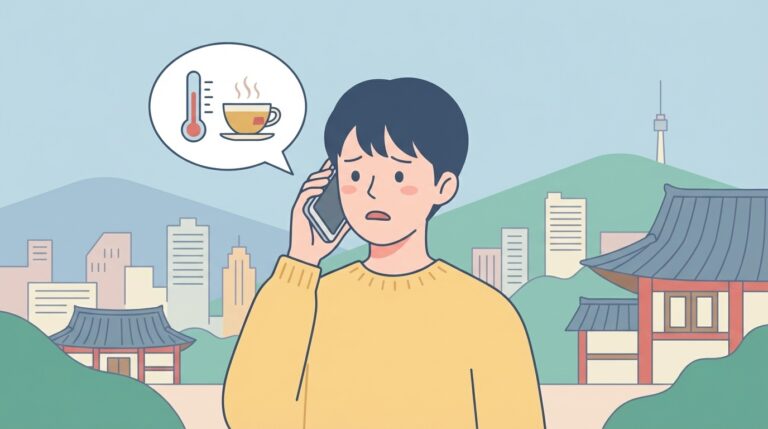
Picture this: You are watching a K-Drama. The male lead calls the heroine. She says a simple “Hello,” but her voice is slightly raspy. His eyes widen. He hangs up, grabs his car keys, and the next scene? He is running to her house with a bag full of medicine and hot porridge.
How did he know? In Korean culture, catching subtle changes in someone’s voice or behavior is a massive part of daily communication. It’s called 눈치 (Nunchi).
When you hear a friend coughing over the phone or sounding exhausted, you can’t just say, “You are sick.” You have to guess politely and show concern. Today, we are going to learn how to express guesses and assumptions in Korean—specifically when you hear someone’s voice and think, “Oh, they sound like they caught a cold!”
If you master this, you won’t just sound fluent; you will sound like a truly caring Korean friend. Let’s dive in!
Phase 2: Core Expressions Deep Dive
Let’s break down the three most essential ways to make a guess based on what you hear or see.
1. 목소리를 들으니 감기 걸린 것 같아요.
- Pronunciation: [mok-so-ri-reul deu-reu-ni gam-gi geol-rin geot ga-ta-yo]
- Meaning: (Literal) Listening to your voice, it seems like you caught a cold. / (Real Nuance) You sound like you have a cold.
- K-Culture Moment: This is your standard, polite “go-to” phrase. If your coworker calls in and sounds nasal, saying this shows you are attentive. It’s the equivalent of offering a warm cup of Yuja tea (유자차) through words.
- Editor’s Insight: The grammar
-(으)ㄴ/는 것 같다is the most common way to guess in Korean. It literally means “it is like ~” or “it seems ~—” It softens your statement so you don’t sound too aggressive or entirely sure of yourself.- Situation Spectrum:
[🚫 절대 금지] ———— [⚠️ 주의] ———— [✅ 자유롭게]
- 친구 사이 (Casual – remove ‘요’): ✅
- 직장 동료 (Semi-formal): ✅
- 직장 상사·어른 (Formal): ✅ (Very safe and polite)
- 🤔 Think About It: Why do Koreans love saying “I think” (것 같다) even when they are 99% sure? Does your native language value directness or indirectness more when commenting on someone’s health?
2. 목소리가 안 좋네요. 감기 걸렸나 봐요.
- Pronunciation: [mok-so-ri-ga an jon-ne-yo. gam-gi geol-lyeon-na bwa-yo]
- Meaning: (Literal) Your voice is not good. I guess you caught a cold. / (Real Nuance) Your voice sounds bad. You must have caught a cold.
- K-Culture Moment: You are on a video call with your Korean language exchange partner. They are sniffling. You use this expression because you have physical evidence (the sniffing and the voice).
- Editor’s Insight: The grammar
-나 보다is a Level-Up from-것 같다. You use it when you are guessing based on a clue you just saw or heard. It sounds very observant and native-like!- Situation Spectrum:
[🚫 절대 금지] ———— [⚠️ 주의] ———— [✅ 자유롭게]
- 친구 사이 (Casual – remove ‘요’): ✅
- 직장 동료 (Semi-formal): ✅
- 직장 상사·어른 (Formal): ⚠️ (Better to use 것 같아요 for superiors to sound a bit more humble)
- 🤔 Think About It: Notice the word “봐요” (to see) inside
-나 보다? It shows that Korean relies heavily on sensory observation to form deductions!3. 감기 기운이 있는 듯해요.
- Pronunciation: [gam-gi gi-u-ni in-neun deu-tae-yo]
- Meaning: (Literal) It appears there is a cold energy. / (Real Nuance) It seems like you’re coming down with something.
- K-Culture Moment: You will often hear this from a pharmacist or a doctor when you describe your symptoms. “Hmm, it appears you have the beginnings of a cold.”
- Editor’s Insight:
-듯하다is slightly more formal and written compared to-것 같다. Also,감기 기운(cold energy/symptoms) is a very Korean way to describe that heavy, tired feeling right before a full-blown cold hits you.- Situation Spectrum:
[🚫 절대 금지] ———— [⚠️ 주의] ———— [✅ 자유롭게]
- 친구 사이 (Casual): ⚠️ (A bit too formal for texting your bestie)
- 직장 동료 (Semi-formal): ✅
- 직장 상사·어른 (Formal): ✅
- 🤔 Think About It: Traditional Korean medicine (한의학) focuses a lot on “Gi” (기/Energy). Using words like “기운” (energy/vibe) reflects this ancient cultural perspective on health.
Phase 3: Textbook vs. Real Korean
| Situation | 📖 Textbook Korean | 🗣️ Real Korean | 💡 Why is it different? |
|---|---|---|---|
| Realizing a friend sounds sick on the phone | 감기에 걸린 것으로 추측됩니다. (I assume you caught a cold.) | 헐, 목소리 왜 그래? 코맹맹이 소리 나. (Whoa, what’s wrong with your voice? You sound nasal.) | Friends use dramatic reactions (“헐”) and descriptive words (“코맹맹이” – nasal sound) rather than clinical grammar. |
| Guessing they are tired | 많이 피곤한 것 같습니다. (It seems you are very tired.) | 목소리가 완전 잠겼네. 피곤한가 봐. (Your voice is totally hoarse. You must be tired.) | “목소리가 잠기다” (voice is locked/hoarse) is a highly common idiom used natively. |
| Telling them to rest | 푹 쉬시길 바랍니다. (I hope you rest well.) | 약 먹고 푹 쉬어! (Take medicine and get a good rest!) | Koreans almost always pair “resting” with “taking medicine” or “eating well” to show affection. |
Bottom Note for B1 Learners: You don’t need to use slang to sound natural. Simply switching from textbook robots to showing slight emotional reactions (Oh no! Have you eaten?) instantly makes you sound fluent.
Phase 4: Cultural Context — K-Culture Deep Dive
4-1. Non-verbal Nunchi (눈치)
When you realize someone is sick over the phone, Korean Nunchi dictates that you shouldn’t drag out the conversation. If you say “You sound sick,” the unspoken rule is to follow up immediately with, “I’ll let you go so you can rest.” Keeping a sick person on the phone is considered a bit thoughtless!
4-2. The KakaoTalk ‘선물하기’ (Gifting) Culture
In K-Dramas, the wealthy CEO might bring soup to the heroine’s house. In real modern Korea? We use KakaoTalk.
If you tell a Korean friend, “You sound sick, 감기 걸렸나 봐요,” the ultimate native move is to send a 기프티콘 (Gifticon) through the KakaoTalk ‘Gift’ menu.
What do we send?
1. 본죽 (Bonjuk – A famous porridge franchise): A coupon for Abalone Porridge (전복죽) or Beef Mushroom Porridge (쇠고기버섯죽).
2. 비타민 (Vitamins): A small box of Vitamin C.
3. 따뜻한 차 (Warm Tea): A Starbucks coupon for a warm Honey Grapefruit Black Tea.
Saying the words + sending a $10 porridge coupon? Congratulations, you have mastered Korean social skills.
Phase 5: Interactive Roleplay Scenario
Setting: Friday evening, 7:00 PM. You are standing outside Gangnam Station, waiting for your Korean language exchange partner, Min-su. It’s freezing. Min-su calls you, and as soon as you pick up, you hear him sniffling heavily.
Characters:
– YOU (The Reader): An eager Korean learner, currently freezing but very observant.
– Min-su (28): Friendly, a bit of a workaholic, sounds like he hasn’t slept in days.
Dialogue:
Min-su: 여보세요… 너무 미안해요. 저 지금 퇴근했어요. 🤧
(yeoboseyo… neomu mianhaeyo. jeo jigeum toegeunhaesseoyo.)
[Hello… I’m so sorry. I just got off work.]
YOU: 괜찮아요! 그런데… 목소리가 안 좋네요.
(gwaenchanayo! geureonde… moksoriga an jonneyo.)
[It’s okay! But… your voice doesn’t sound good.]
Min-su: 네, 회사에서 에어컨을 너무 세게 틀어서 그런지…
(ne, hoesa-eseo eeokeoneul neomu sege teureoseo geureonji…)
[Yeah, maybe because the AC at the office was too strong…]
(🎭 Stage Direction: Min-su coughs weakly into the phone)
🔀 Your Turn! How should you respond?
– A) “감기 걸린 것 같아요. 빨리 오세요!” (I think you caught a cold. Hurry up and come!)
– B) “감기 걸렸나 봐요. 오늘은 집에서 푹 쉬는 게 좋을 것 같아요.”
– C) “대박! 저도 감기 걸렸는데!”✅ Best Choice: B — “감기 걸렸나 봐요. 오늘은 집에서 푹 쉬는 게 좋을 것 같아요.” (You must have caught a cold. I think it’s better if you rest at home today.)
Reason: You correctly deduced he is sick using-나 봐요, and offered a considerate solution. In Korea, suggesting the other person rests is the pinnacle of politeness.
⚠️ Choice A Analysis: Telling a sick person to hurry up is a huge Nunchi failure!
⚠️ Choice C Analysis: Funny, but maybe not what a sick person wants to hear right now!
Min-su: 아, 정말 미안해서 어쩌죠? 다음 주에 제가 밥 살게요!
(a, jeongmal mianhaeseo eojjeojyo? daeum jue jaega bap salgeyo!)
[Ah, I feel so bad, what should I do? I’ll buy you food next week!]
YOU: 걱정 마시고 약 꼭 챙겨 드세요!
(geokjeong masigo yak kkok chaenggyeo deuseyo!)
[Don’t worry, and make sure to take your medicine!]
Phase 6: 10-Second Shadowing Drill
Practice saying this like a caring friend. Follow the slashes for pauses and match the emotion!
🥺 헐, / 목소리 들으니까 / 감기 걸린 것 같아요. / 약은 먹었어요?
(heol, / moksori deureunikka / gamgi geollin geot gatayo. / yageun meogeosseoyo?)
[Oh no, listening to your voice, it seems you caught a cold. Did you take medicine?]
Pronunciation Tips:
– 헐 (heol) sounds like you are softly exhaling in surprise.
– Connect 약은 smoothly into 야근 (ya-geun).
Phase 7: K-Culture Mini Dictionary
| Korean | Romanization | English | Contextual Meaning |
|---|---|---|---|
| 눈치 | nunchi | Social sense/Tact | The ability to read the room or a person’s condition without them saying it directly. |
| 기프티콘 | gi-peu-ti-kon | Gifticon | Mobile gift vouchers sent via messengers (KakaoTalk), crucial for maintaining relationships. |
| 코맹맹이 소리 | komaengmaeng-i sori | Nasal voice | The cute or stuffed-up voice you make when your nose is blocked by a cold. |
| 몸살 | mom-sal | Body ache/Fatigue | A severe cold accompanied by full-body aches, usually from overworking. |
| 챙겨 먹다 | chaeng-gyeo meok-da | To make sure to eat | A deeply caring phrase. “약 챙겨 드세요” means “Make sure you don’t skip your medicine.” |
Phase 8: Traveler Survival Kit
You guessed your friend is sick, but what if YOU get sick while traveling in Korea? Here are the essential phrases you need at a Korean pharmacy (약국 – Yakguk).
🆘 Survival Phrases at the Pharmacy
– 🇰🇷 “종합 감기약 주세요.” (jong-hap gam-gi-yak ju-se-yo)
– 🗣️ Meaning: Please give me multi-symptom cold medicine.
– 🇰🇷 “목이 너무 아파요.” (mo-gi neo-mu a-pa-yo)
– 🗣️ Meaning: My throat hurts so much.
– 🇰🇷 “열이 나고 콧물이 나요.” (yeo-ri na-go kon-mu-ri na-yo)
– 🗣️ Meaning: I have a fever and a runny nose.📌 Editor’s Travel Note
– Consult the Pharmacist: In Korea, you don’t usually pick cold medicine off the shelf yourself. You go to the counter, tell the pharmacist your symptoms, and they will recommend the best medicine.
– The Potion (마시는 약): Pharmacists often give you a small glass bottle of warm, herbal-tasting liquid (like 쌍화탕 – Ssanghwa-tang) along with pills. Drink it warm! It works wonders.
Phase 9: Critical Thinking — “One Step Deeper”
Food & Identity: The Healing Power of “Bap” (밥)
🧠 Think Deeper:
Why do Koreans instantly talk about food when someone is sick? “밥은 먹었어?” (Did you eat?), “죽 보내줄까?” (Shall I send you porridge?). In Korea, food is not just calories; it is the physical manifestation of 정 (Jeong – deep affection/bond). Sharing food, or ensuring someone is fed, is the ultimate way of showing you care. When someone is ill, the community’s instinct is to heal them through warm, easily digestible food. It shows that in a fast-paced society, pausing to make sure someone’s stomach is warm is the truest form of empathy.💬 Your Turn: In your culture, what is the “go-to” food or gesture when someone sounds sick on the phone? Let me know in the comments!
Phase 10: FAQ & Avoiding Mistakes
Q: Can I tell my boss “목소리가 안 좋네요”?
Yes, but with caution! Instead of just stating they sound bad, immediately show respect and care: “목소리가 안 좋으신데, 감기 조심하세요!” (Your voice doesn’t sound well, please be careful not to catch a cold!).
Q: Should I ask “Are you okay?” (괜찮아요?) like in English?
In English, “Are you okay?” is highly common. In Korean, it’s fine, but asking “약은 드셨어요?” (Did you take medicine?) or “병원에는 다녀오셨어요?” (Did you go to the clinic?) sounds much more natural and sincerely concerned.
❌ Common Mistake #1: Confusing tense in guesses.
– Wrong: 감기 걸릴 것 같아요. (I think you will catch a cold – used when someone is underdressed in winter).
– Right: 감기 걸린 것 같아요. (I think you caught a cold – used when you hear their sick voice).
Phase 11: Summary & Action Items
One-Liner Summary: Use -(으)ㄴ 것 같아요 or -나 봐요 to politely guess someone is sick from their voice, and always follow up with caring words about medicine or rest!
Your Action Mission for Today:
– 🥉 Bronze: Look in the mirror, cough fake-dramatically, and say to yourself: “아, 감기 걸렸나 봐요.”
– 🥈 Silver: Send a message to a Korean-learning friend: “요즘 날씨가 추워요. 감기 조심하는 것 잊지 마세요!” (The weather is cold lately. Don’t forget to be careful of colds!)
– 🥇 Gold: Next time you watch a K-Drama and a character sounds sick, shout at the screen: “헐! 감기 걸린 것 같아요!”
K-Culture Mission: Go to KakaoTalk (if you use it) and explore the ‘선물하기’ (Gift) tab. Search for ‘본죽’ (Bonjuk) and see what kind of porridge Koreans send to sick friends!
Phase 12: Quiz — Interactive Challenge
1. Situational Judgment: Your favorite K-Pop idol is doing a live stream, but they keep coughing and their voice is hoarse. What is the most natural comment to leave in the chat?
– A) 오빠, 감기 걸릴 것 같아요. (Oppa, I think you will catch a cold.)
– B) 오빠, 목소리 들으니까 감기 걸렸나 봐요. 약 꼭 챙겨 먹어요! (Oppa, listening to your voice, you must have caught a cold. Make sure to take medicine!)
– C) 오빠 병원 가. (Oppa, go to the hospital.)
2. True or False – K-Culture Edition:
In Korea, it is considered rude to ask someone if they have eaten when they are sick; you should only talk about medicine. (T/F)
(Scroll down for answers!)
Click to reveal answers
1. Answer: B. It uses the correct past tense guess (걸렸나 봐요) and shows sweet concern. A is incorrect tense, and C is too blunt/direct.
2. Answer: False. Asking if they have eaten (especially warm porridge) is the ultimate way to show you care in Korea!
Frequently Asked Questions (FAQ)
Q: What does "목소리를 들으니 감기 걸린 것 같아요." mean in Korean and how do you pronounce it?
A: In Korean, "목소리를 들으니 감기 걸린 것 같아요." is pronounced [mok-so-ri-reul deu-reu-ni gam-gi geol-rin geot ga-ta-yo] and means: (Literal) Listening to your voice, it seems like you caught a cold. / (Real Nuance) You sound like you have a cold.
Q: What does "목소리가 안 좋네요. 감기 걸렸나 봐요." mean in Korean and how do you pronounce it?
A: In Korean, "목소리가 안 좋네요. 감기 걸렸나 봐요." is pronounced [mok-so-ri-ga an jon-ne-yo. gam-gi geol-lyeon-na bwa-yo] and means: (Literal) Your voice is not good. I guess you caught a cold. / (Real Nuance) Your voice sounds bad. You must have caught a cold.
Q: What does "감기 기운이 있는 듯해요." mean in Korean and how do you pronounce it?
A: In Korean, "감기 기운이 있는 듯해요." is pronounced [gam-gi gi-u-ni in-neun deu-tae-yo] and means: (Literal) It appears there is a cold energy. / (Real Nuance) It seems like you're coming down with something.







