

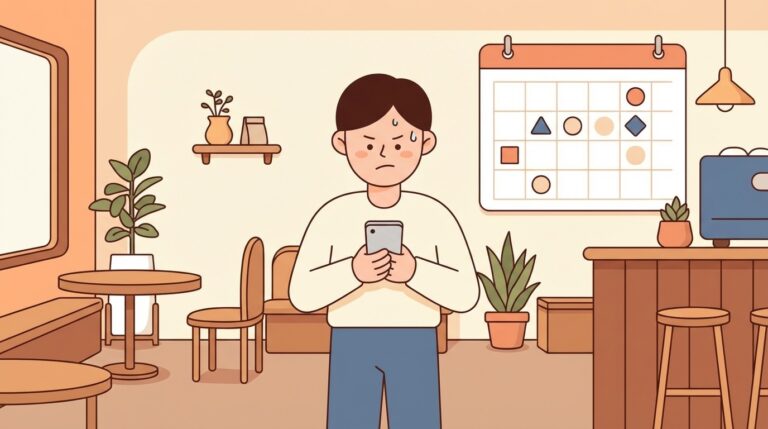
Phase 1: Empathy (The K-Drama Cancelation)
Hello! I’m your Daily Hangul Editor, your local Korean friend and veteran tutor.
Picture this: You’re watching your favorite K-Drama. The main character is staring at their phone, raindrops falling on the screen. They’re supposed to meet their crush, but an emergency happens. They quickly type a message, hit send, and the crush looks at their phone, sighing.
The subtitles usually just say, “I’m sorry. I can’t make it.”
But if you actually look at the Korean text they sent, it’s almost never a simple “I am sorry.” Canceling plans in Korea is an art form. It requires a delicate mix of genuine regret, a specific tone of voice, and a magical phrase that shows you are truly devastated about not going.
If you just translate “I want to cancel” from your textbook, you might accidentally sound like a cold robot terminating a contract! Today, we’re going to learn how to cancel an appointment and apologize profusely, exactly how locals do it. By the end of this guide, you’ll know how to navigate this tricky situation without losing any friends.
This guide is based on real moments my students faced—and panicked over! Let’s dive in.
Phase 2: Core Expressions Deep Dive
Here are the absolute must-know phrases for when you need to bail, A2 style!
1. 어떡하죠? (What should I do?)
- Pronunciation: [eotteokhajo?]
Sound-alike guide: ‘Uh-tteok-ha-jyo?’ (The ‘Uh’ sounds like you’re thinking, and ‘tteok’ sounds like the word ‘duck’ but with a hard T.)- Meaning: Literal: What do I do? / Real nuance: Oh no, I’m in a tricky situation (and I feel terrible about it).
- K-Culture Moment: Before a Korean person even says “sorry,” they often start with “어떡하죠?”. It sets the mood. It shows the other person that you are stressed about the situation. You’ll hear this in K-Dramas right before the bad news drops.
- Editor’s Insight: This isn’t really a question asking for a solution. It’s an emotional buffer! It softens the blow before you say you can’t make it.
- Situation Spectrum:
[🚫 Never] ———— [⚠️ Be Careful] ———— [✅ Freely]
- Casual with friends (어떡해? – dropping the ‘요’): ✅
- Semi-formal (coworkers): ✅
- Formal (strict boss/elders): ⚠️ (Better to apologize directly first)
- 🤔 Think About It: Why do Koreans ask “What should I do?” instead of just stating the fact? How does your culture soften bad news?
2. 정말 미안해요 / 진짜 죄송합니다 (I’m really sorry)
- Pronunciation: [jeongmal mianhaeyo / jinjja joesonghamnida]
Sound-alike guide: ‘Jung-mal me-an-hae-yo’ / ‘Jin-jja jway-song-ham-ni-da’- Meaning: I am really/truly sorry.
- K-Culture Moment: You accidentally bumped into someone at a crowded K-Pop concert, or you are running 30 minutes late to a dinner. “진짜 죄송합니다” is your ultimate shield.
- Editor’s Insight: ‘정말’ (jeongmal) and ‘진짜’ (jinjja) both mean ‘really’. Use ‘미안해요’ for friends and friendly colleagues. If you are canceling on someone older, someone you don’t know well, or a business contact, you MUST use ‘죄송합니다’.
- Situation Spectrum:
- Friends (정말 미안해): ✅
- Coworkers (정말 미안해요): ✅
- Boss/Elders (진짜 죄송합니다): ✅
- 🤔 Think About It: Korean has different levels of “sorry” depending on hierarchy. Does the weight of your apology change depending on who you are talking to in your native language?
3. 갑자기 일이 생겨서요 (Something suddenly came up)
- Pronunciation: [gapjagi iri saenggyeoseoyo]
Sound-alike guide: ‘Gap-ja-gee ee-ree sang-gyeo-suh-yo’- Meaning: Literal: Suddenly work/a thing happened. / Real nuance: An unexpected situation arose.
- K-Culture Moment: This is the universal, polite excuse in Korea. Whether your boss gave you extra work, or your pipes burst at home, this phrase covers it all without oversharing.
- Editor’s Insight: The beauty of this phrase is the ending ‘~서요’ (because). It leaves the sentence slightly unfinished, which sounds much softer and more polite than a harsh, full-stop sentence.
- Situation Spectrum:
- Casual: ✅ (갑자기 일이 생겨서)
- Semi-formal: ✅
- Formal: ✅
- 🤔 Think About It: In some cultures, people expect specific reasons when you cancel. Why do you think a vague “something came up” is perfectly acceptable and polite in Korea?
Phase 3: Textbook vs. Real Korean
Let’s see how the textbook compares to the lively streets of Seoul.
| Situation | 📖 Textbook Korean | 🗣️ Real Korean | 💡 Why the difference? |
|---|---|---|---|
| Canceling plans | 약속을 취소하겠습니다. (I will cancel the appointment.) | 어떡하죠? 오늘 못 갈 것 같아요. ㅠㅠ (What should I do? I don’t think I can go today. ㅠㅠ) | The textbook sounds like terminating a business contract. Real Koreans soften it with “I don’t think I can…” |
| Saying sorry | 대단히 죄송합니다. (I am exceptionally sorry.) | 진짜 너무 죄송해요. (I’m really so sorry.) | “대단히” is very formal (like airline announcements). “진짜 너무” adds real human emotion. |
| Making an excuse | 저는 오늘 바쁩니다. (I am busy today.) | 갑자기 일이 생겨서요. (Something suddenly came up.) | Saying “I am busy” directly can sound dismissive. Blaming “sudden circumstances” saves face for both parties. |
Bottom Note: As an A2 learner, using “~을 것 같아요” (I think that…) is a magic trick to sound 10x more natural and polite. It makes your statements sound less aggressive!
Phase 4: Cultural Context — K-Culture Deep Dive
4-1. Non-Verbal Nuances: The Telephone Bow
If you are calling to cancel, your tone of voice should sound a little hesitant and distressed. And here’s a funny secret: If you watch Koreans on the phone apologizing (like calling a restaurant to cancel a reservation), you will see them actually bowing to the air. The physical act of bowing changes your vocal tone to sound more humble and apologetic. Try it!
Also, if you are texting, using crying emojis like ㅠㅠ or ㅜㅜ is totally acceptable and actually encouraged among friends and friendly colleagues. It proves you are sad about canceling!
4-2. The “Rain Check” Culture (K-Drama Connection)
In K-Dramas, when someone cancels, they almost always follow up with: “다음에 꼭 밥 살게요!” (I’ll definitely buy you a meal next time!).
In Korean culture, food is love, and food is an apology. Promising to treat the person to a meal later is the ultimate way to say “I still value our relationship; this cancellation is just a temporary setback.” Even if you don’t immediately set a new date, offering to buy food later mends the hurt feelings.
Phase 5: Real-Life Roleplay Scenario
Setting: Friday, 5:30 PM. You are still at your desk in Seoul. You were supposed to meet your friendly Korean coworker, Minsu, for some juicy Samgyeopsal (pork belly) and Soju at 7 PM. But your manager just dropped a massive pile of documents on your desk. You have to text Minsu.
Characters:
– YOU: A hardworking expat trying to survive Friday overtime.
– Minsu (32): Your cheerful Korean coworker who has probably already skipped lunch in anticipation of the pork belly.
Dialogue:
YOU: 민수 씨, 어떡하죠? ㅠㅠ
(Minsu ssi, eotteokhajo? ㅠㅠ)
[Minsu, what should I do?]
(🎭 Stage Direction: You stare at the mountain of paperwork, sweating)
Minsu: 헉, 왜요? 무슨 일 있어요?
(Heok, waeyo? Museun il isseoyo?)
[Gasp, why? Is something wrong?]
YOU: 오늘 약속 정말 미안해요.
(Oneul yaksok jeongmal mianhaeyo.)
[I’m really sorry about our plans today.]
YOU: 제가 오늘 못 갈 것 같아요.
(Jega oneul mot gal geot gatayo.)
[I don’t think I can go today.]
Minsu: 아 진짜요? 야근해요?
(A jinjjayo? Yageunhaeyo?)
[Ah, really? Are you working late?]
YOU: 네, 갑자기 일이 생겨서요.
(Ne, gapjagi iri saenggyeoseoyo.)
[Yes, something suddenly came up.]
Minsu: 아이고… 금요일인데 너무 아쉽네요.
(Aigo… geumyoil-inde neomu aswimneyo.)
[Oh man… it’s Friday, that’s such a bummer.]
Minsu: 그래도 일 빨리 끝내세요! 고기는 다음에 먹죠 뭐.
(Geuraedo il ppalli kkeunnaeseyo! Gogineun da-eume meokjo mwo.)
[Still, finish your work quickly! We can just eat meat next time.]
🔀 Your Turn! How should you reply to save the relationship?
– A) 네, 안녕히 계세요. (Yes, goodbye.)
– B) 정말 미안해요. 다음에 제가 꼭 밥 살게요! (I’m really sorry. I’ll definitely treat you to a meal next time!)
– C) 수고하세요. (Keep up the hard work.)✅ Best Choice: B — Offering to buy food next time (밥 살게요) is the ultimate Korean social glue. It proves you aren’t just brushing him off.
⚠️ Choice A & C Analysis: Both sound incredibly robotic and cold to a friendly coworker, almost like you’re glad you canceled!
YOU (Choosing B): 정말 미안해요. 다음에 제가 꼭 밥 살게요!
(Jeongmal mianhaeyo. Da-eume jega kkok bap salgeyo!)
[I’m really sorry. I’ll definitely treat you to a meal next time!]
Minsu: 오, 약속했어요! ㅋㅋ 파이팅!
(O, yaksokaesseoyo! ㅋㅋ paiting!)
[Oh, you promised! Haha, fighting!]
Phase 6: 10-Second Shadowing Drill
Time to practice! Follow the slashes for pausing, and match the emotion tag.
🥺 Feeling terrible:
어떡하죠? / 오늘 / 못 갈 것 같아요.
(eotteokhajo? / oneul / mot gal geot gatayo.)
What should I do? I don’t think I can go today.
😢 Sincere Apology:
갑자기 / 일이 생겨서요. / 정말 / 미안해요.
(gapjagi / iri saenggyeoseoyo. / jeongmal / mianhaeyo.)
Something suddenly came up. I’m really sorry.
😊 Promising the future:
다음에 / 제가 / 꼭! / 살게요.
(da-eume / jega / kkok! / salgeyo.)
Next time, I will definitely pay (treat you).
Phase 7: K-Culture Mini Dictionary
| Korean | Romanization | English | Contextual Meaning |
|---|---|---|---|
| 눈치 | nunchi | Social sense | The ability to read the room. Having “good nunchi” means you know how to cancel gently without hurting feelings. |
| 핑계 | pinggye | Excuse | What you give when you cancel. In Korea, a polite “white lie” pinggye is often preferred over a harsh truth. |
| ㅠㅠ / ㅜㅜ | (none) | Crying eyes | Texting emoticons used to show sadness or guilt. Essential for canceling plans over text! |
| 약속 | yaksok | Appointment/Promise | Used for both doctor’s appointments and hanging out with friends. Canceling a yaksok is a big deal! |
| 밥 한번 먹자 | bap hambeon meokja | Let’s grab a meal | The standard greeting/goodbye. Often used to soften a cancellation. |
Phase 8: Traveler’s Survival Kit
If you are traveling in Korea, you might need to cancel a restaurant, tour, or hotel reservation. Doing this correctly shows great manners!
🆘 Survival Expression #1
– 🇰🇷 “예약을 취소하고 싶어요.” (yeyageul chwisohago sipeoyo.)
– 🗣️ Pronunciation: Yay-yahg-eul chwee-so-ha-go sheep-uh-yo.
– 📍 Where to use: Hotels, restaurants, tour guides.
– 💡 Pro Tip: Start with “죄송한데…” (I’m sorry, but…) to sound super polite!🆘 Survival Expression #2
– 🇰🇷 “조금 늦을 것 같아요.” (jogeum neujeul geot gatayo.)
– 🗣️ Pronunciation: Jo-geum neu-jeul guht gah-tah-yo.
– 📍 Where to use: When you aren’t canceling, but you are running late.
📌 Editor’s Travel Note
– No-Show Culture: In Korea, “No-shows” (reserving and not showing up without calling) are heavily frowned upon and harm small businesses. Even if your Korean isn’t perfect, calling to say “Cancel please” (취소해 주세요 – chwisohae juseyo) is highly respected.
– Apps: If you booked through an app like CatchTable or Naver, you can usually just press a cancel button without speaking to anyone. Phew!
Phase 9: Critical Thinking — “One Step Deeper”
🧠 Think Deeper: Nunchi and Relationship Maintenance
Have you noticed how indirect Korean cancellations are? Instead of saying “I am canceling,” Koreans say “I don’t think I can go” (못 갈 것 같아요). Instead of stating a bold excuse, they say “Something came up” (일이 생겨서요). This isn’t because Koreans are avoiding the truth; it’s a reflection of a community-first mindset. Being too direct can be seen as prioritizing your own schedule over the other person’s feelings. By using softening words, asking “What should I do?”, and promising food for next time, you are sending a clear message: “I value you, and I want to maintain our harmony despite this hiccup.”💬 Your Turn: In your culture, do people prefer direct honesty (e.g., “I’m too tired to go out”) or polite, softening excuses when canceling plans? Share in the comments!
Phase 10: FAQ & Avoiding Misunderstandings
Q: Can I just say “미안” (Mian) to cancel?
Absolutely not, unless it is your very close friend of the same age or younger! Saying just “미안” to an older person or a coworker sounds incredibly rude, like you don’t care at all. Always attach the “해요” (haeyo) to make it “미안해요”.
Q: I learned “취소하다” (to cancel). Can I use it with friends?
You can, but it sounds like a robot. “우리 약속 취소하자” (Let’s cancel our appointment) sounds very cold. Use “오늘 못 만날 것 같아” (I don’t think we can meet today) instead.
❌ Common Mistake #1: Translating “I have plans” directly as “저는 계획이 있어요” (jeoneun gyehoegi isseoyo).
✅ Do this instead: In Korean, “계획” means a big life plan or project. To say you have a schedule/plans, say “선약이 있어요” (I have a prior appointment) or just “일이 있어요” (I have something to do).
Phase 11: Summary & Action Items
One-Liner Summary: To cancel plans like a local, act a little distressed (“어떡하죠?”), give a soft excuse (“일이 생겨서요”), and promise to feed them later (“다음에 밥 살게요”).
Action Mission 3-Steps:
– 🥉 Bronze (Solo): Look in the mirror, put on your saddest face, and say “어떡하죠? 정말 미안해요” out loud 3 times.
– 🥈 Silver (Online): Go to your favorite language exchange app and text your partner, “갑자기 일이 생겨서요” as practice (tell them it’s practice afterward!).
– 🥇 Gold (Real World): Next time you are running even 5 minutes late to meet a Korean friend, use the phrase “조금 늦을 것 같아요! 진짜 미안해요!”
🎬 K-Culture Mission:
Watch one episode of a K-Drama today. I guarantee you will see at least one scene where a character cancels a meeting. Listen closely—did they say “어떡하죠?” or “미안해”?
Phase 12: Quiz — Interactive Challenge
Let’s test your new skills!
1. Situational Judgment: You need to cancel dinner with your strict 50-year-old boss because you feel sick. Which is the best text to send?
– A) 부장님, 어떡해? 나 오늘 못 가. (Boss, what do I do? I can’t go today.)
– B) 부장님, 정말 미안해요. 일이 생겨서요. (Boss, I’m really sorry. Something came up.)
– C) 부장님, 진짜 죄송합니다. 제가 오늘 몸이 좀 안 좋아서 못 갈 것 같습니다. (Boss, I am truly sorry. I don’t feel well today so I don’t think I can go.)
2. Fill in the Blank:
Friend: “Are you still coming to the cafe?”
You: “____? I don’t think I can go today.”
– A) 안녕 (Hello)
– B) 어떡하죠 (What should I do)
– C) 축하해요 (Congratulations)
3. True or False — K-Culture Edition:
When a Korean friend cancels on you and says, “I’ll buy you a meal next time,” they are legally bound to buy you food the very next day. (T/F)
🚨 Click here for Answers!
1. C is correct! A is super informal and will get you fired. B is okay for a friendly coworker, but ‘죄송합니다’ in C is necessary for a strict boss.
2. B. Adding ‘어떡하죠’ sets the perfect apologetic mood.
3. False. While they do mean they want to treat you eventually to show they care, it’s often a polite phrase to soften the blow. Don’t demand steak the next morning!
Loved this lesson? Have you ever had a funny misunderstanding when changing plans in Korea? Tell me your story in the comments below!
Frequently Asked Questions (FAQ)
Q: What does "어떡하죠? (What should I do?)" mean in Korean and how do you pronounce it?
A: In Korean, "어떡하죠? (What should I do?)" is pronounced [eotteokhajo?] and means: Literal: What do I do? / Real nuance: Oh no, I'm in a tricky situation (and I feel terrible about it).
Q: What does "정말 미안해요 / 진짜 죄송합니다 (I'm really sorry)" mean in Korean and how do you pronounce it?
A: In Korean, "정말 미안해요 / 진짜 죄송합니다 (I'm really sorry)" is pronounced [jeongmal mianhaeyo / jinjja joesonghamnida] and means: I am really/truly sorry.
Q: What does "갑자기 일이 생겨서요 (Something suddenly came up)" mean in Korean and how do you pronounce it?
A: In Korean, "갑자기 일이 생겨서요 (Something suddenly came up)" is pronounced [gapjagi iri saenggyeoseoyo] and means: Literal: Suddenly work/a thing happened. / Real nuance: An unexpected situation arose.







