

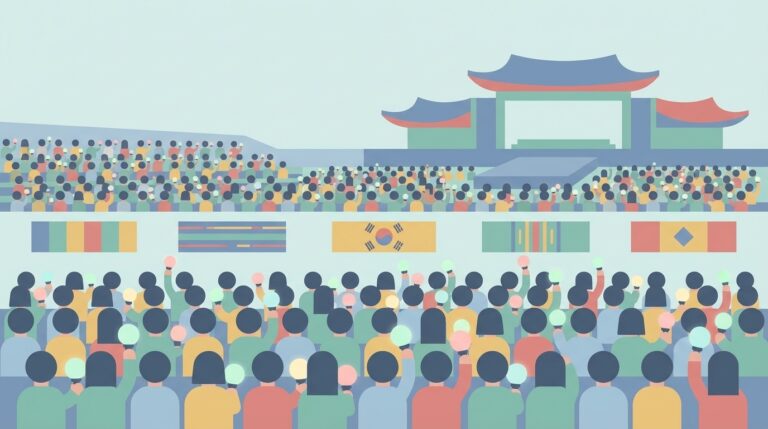
Phase 1: Welcome to the Ultimate Korean Concert Experience!
Hello, learners! It’s your Daily Hangul Editor here.
Picture this: The sliding doors at Incheon International Airport’s Terminal 2 slowly open. Hundreds of fans, holding meticulously crafted banners, hold their breath. Suddenly, the artist appears! The crowd erupts, not just in screams, but in a highly coordinated, respectful greeting. Or imagine being at the legendary KSPO Dome. The intro to a famous pop song plays, and instantly, 15,000 Korean fans start singing along—not just the lyrics, but the guitar riffs, too! The international artist on stage takes out their in-ear monitors, visibly moved to tears.
Have you ever seen these viral moments? When international artists visit Korea for a concert—a phenomenon we call 내한 (Naehan)—the welcome they receive is uniquely intense, passionate, and deeply organized.
If you’re attending a concert in Korea or just want to leave a supportive comment on your favorite artist’s Instagram when they announce a Seoul tour date, standard textbook phrases like “I like your song” won’t cut it. Today, we are going to dive deep into the real language of Korean concert-goers. Trust me, mastering these B2-level expressions will take you from a casual listener to a true local insider!
Phase 2: Core Expressions Deep Dive
Let’s break down the essential phrases you need to hype up a performance or welcome an artist.
1. 드디어 내한해 주셔서 감사합니다!
- Pronunciation: Deu-di-eo nae-han-hae ju-syeo-seo gam-sa-ham-ni-da! [Deu-dee-oh nay-han-hay joo-shuh-so gahm-sah-hahm-nee-dah!]
- Meaning: (Literal) Thank you for finally coming to Korea to perform! / (Real nuance) We’ve been waiting forever, thank you for coming all this way!
- K-Culture Moment: This is the ultimate banner phrase. When pop stars like Coldplay or Bruno Mars arrive at the airport, fans hold up signs with this exact wording. The word 내한 (Naehan) specifically means “a foreigner visiting Korea,” but it’s almost exclusively used in entertainment for international artists holding a concert here.
- Editor’s Insight: The word “드디어 (Finally)” carries so much emotional weight. It conveys years of waiting and yearning. It’s polite, respectful, and deeply appreciative.
- Situation Spectrum:
[🚫 절대 금지] ———— [⚠️ 주의] ———— [✅ 자유롭게]
- Close Friends (Casual): 🚫 (Too formal for friends)
- Public fan letter / Banner (Formal): ✅
- Leaving an Instagram comment: ✅
- 🤔 Think About It: Why is there a specific noun (내한) just for foreign artists visiting? How does this reflect Korea’s geographical location and its past position in the global music touring circuit?
2. 무대 완전 찢었다!
- Pronunciation: Mu-dae wan-jeon jji-jeot-da! [Moo-day wahn-jeon jee-jut-dah!]
- Meaning: (Literal) Completely tore the stage! / (Real nuance) You killed the performance! / That was absolutely epic!
- K-Culture Moment: You are at a Chimaek (Chicken and Beer) pub right after the concert, losing your voice. You turn to your Korean friend and shout this. You’ll also see this flooding Twitter/X after an amazing live show.
- Editor’s Insight: “찢다” means “to tear/rip.” In Korean slang, if someone “tore” something, it means they dominated it so completely that they broke the standard. It’s equivalent to “killed it” or “slayed.”
- Situation Spectrum:
[🚫 절대 금지] ———— [⚠️ 주의] ———— [✅ 자유롭게]
- Close Friends / Social Media (Casual): ✅
- Co-workers at a concert (Semi-formal): ⚠️ (Only if you’re close)
- To a boss / Formal review (Formal): 🚫
- 🤔 Think About It: Slang often uses destructive words (kill, tear, break) to express something incredibly positive. Do you have a similar expression in your native language?
3. 오늘 떼창 미쳤다!
- Pronunciation: O-neul tte-chang mi-cheot-da! [Oh-neul teh-chahng mee-chut-dah!]
- Meaning: (Literal) Today’s crowd singalong was crazy! / (Real nuance) The crowd’s energy and singalong tonight was unbelievable!
- K-Culture Moment: The artist stops singing, points the mic at the crowd, and 20,000 people sing the chorus in perfect harmony and pronunciation. The artist looks shocked. That collective singing is “떼창.”
- Editor’s Insight: “떼” means a group or flock, and “창” comes from the Chinese character for singing. Korean fans pride themselves on their 떼창. It’s considered the ultimate gift an audience can give to a visiting artist.
- Situation Spectrum:
[🚫 절대 금지] ———— [⚠️ 주의] ———— [✅ 자유롭게]
- Fellow fans / Friends (Casual): ✅
- Formal settings (Formal): 🚫 (Using ‘미쳤다/crazy’ is informal slang)
- 🤔 Think About It: Singing along happens everywhere, but why do Korean fans coordinate it so methodically? How does this tie into the Korean concept of “We” (우리)?
Phase 3: Textbook vs Real Korean
Let’s see how textbook Korean compares to the vibrant slang you’ll actually hear at the venue.
| Situation | 📖 Textbook Korean | 🗣️ Real Korean (Slang/Casual) | 💡 Why the Difference? |
|---|---|---|---|
| Praising vocals | 노래를 정말 잘 부르시네요. (You sing very well.) | 음원 삼켰다. (They swallowed the digital track.) | Fans want to emphasize that the live vocals sound exactly like the studio recording. |
| Waiting for a tour | 한국에 오기를 기다렸어요. (I waited for you to come to Korea.) | 내한 존버 성공! (Succeeded in holding out for Naehan!) | ‘존버’ is a popular internet slang meaning ‘holding on for dear life’ until what you want happens. |
| Getting concert tickets | 표를 구하기 힘들어요. (It is hard to get tickets.) | 완전 피켓팅이에요. (It’s a total blood-ticketing.) | “피” (Blood) + “Ticketing” highlights the fierce, cutthroat competition for concert seats in Korea. |
(Bottom Note: As a B2 learner, using words like ‘피켓팅’ or ‘음원 삼켰다’ will instantly make native speakers go “Whoa, where did you learn that?!” Just be sure to use them in casual settings!)
Phase 4: Cultural Context — K-Culture Deep Dive
4-1. The Unspoken Rules (Non-Verbal & Nunchi)
When welcoming an artist at the airport, you’ll witness a fascinating display of 눈치 (Nunchi – social awareness). Fans will self-organize into lines, ensuring they don’t block the pathways for ordinary travelers. When holding up a welcoming banner (플래카드), the unwritten rule is: Do not raise it higher than your head. Why? Because you’ll block the view of the fans behind you! Understanding this communal consideration is key to blending into Korean fandom culture.
4-2. The Magic of 떼창 (Singalong) & Fan Events
If you’ve ever watched K-Dramas like Reply 1997 or Lovely Runner, you’ve seen the intense dedication of Korean fans. But this isn’t just for K-Pop idols. When western artists like Charlie Puth or Anne-Marie perform in Korea, local fans prepare “Slogan Events.” They secretly pass around paper banners before the show. During a specific song, everyone holds them up simultaneously. It’s a breathtaking moment that often leaves the artist speechless. The concert isn’t a one-way performance in Korea; it’s an interactive dialogue between the stage and the audience.
Phase 5: Real-Life Roleplay Scenario
Setting: It’s 10:30 PM on a Saturday. You just walked out of the KSPO Dome after an earth-shattering concert by your favorite international band. The cool night air hits you. You and your Korean friend, Min-su, are walking toward the subway station, surrounded by thousands of buzzing fans.
Characters:
– YOU: An international resident in Seoul who finally scored tickets after failing three times.
– Min-su (28): A hardcore Korean concert-goer. He knows all the setlists and fan-chants.
Dialogue:
Min-su: 와, 오늘 진짜 대박 아니에요? 땀 난 것 좀 봐.
(Wa, oneul jinjja daebak anieyo? Ttam nan geot jom bwa.)
[Wow, wasn’t today completely awesome? Look at all this sweat.]
(🎭 Stage Direction: Min-su fans his face with the concert slogan banner, looking totally exhausted but thrilled)
YOU: 그러니까요! 저도 목이 다 쉬었어요.
(Geureonilkkayo! Jeodo mogi da swieosseoyo.)
[I know, right! My voice is completely gone too.]
Min-su: 특히 마지막 앵콜곡 부를 때, 사람들 떼창 들었어요?
(Teukhi majimak aengkol-gok bureul ttae, saramdeul tte-chang deureosseoyo?)
[Especially during the last encore song, did you hear people’s singalong?]
YOU: 네! 가수도 감동받아서 우는 것 같았어요. 드디어 내한해 줘서 너무 고마워요.
(Ne! Gasudo gamdong-badaseo uneun geot gatasseoyo. Deu-di-eo nae-han-hae jwoseo neomu gomawoyo.)
[Yes! It looked like the artist was so moved they were crying. I’m so thankful they finally came to perform here.]
Min-su: 내년에 또 오면 좋겠네요. 그나저나 오늘 밴드 라이브 어땠어요?
(Naenyeone tto omyeon joketneyo. Geunajeona oneul baendeu raibeu eottaesseoyo?)
[I hope they come again next year. By the way, how was the band’s live performance today?]
🔀 Your Turn! How should you respond?
– A) “수고하셨습니다!” (You worked hard!)
– B) “음악이 참 아름다웠어요.” (The music was very beautiful.)
– C) “완전 무대 찢었어요! 라이브 미쳤어요!” (They completely tore the stage! The live was crazy!)✅ Best Choice: C — Reason: You are hyped up with a friend right after a concert. This casual slang perfectly captures the adrenaline and excitement of the moment.
⚠️ Choice A Analysis: “수고하셨습니다” is used to thank someone for their hard work. You would say this to the staff or the artist, not to your friend who just watched the show with you!
⚠️ Choice B Analysis: It’s grammatically perfect but sounds a bit like an English textbook. It lacks the explosive energy of a post-concert vibe.
Phase 6: 10-Second Shadowing Drill
Let’s practice the rhythm and intonation. Follow the slash marks for pauses and match the emotional tags!
🤩 Excitedly: 와, / 오늘 무대 / 진짜 찢었다! (Wa, / oneul mudae / jinjja jjijeotda!)
🥺 Moved/Grateful: 한국에 / 와주셔서 / 정~말 감사합니다! (Hanguge / wajusyeoseo / jeong~mal gamsahamnida!)
😲 Amazed: 방금 / 떼창 들었어? / 완전 미쳤어! (Banggeum / ttechang deureosseo? / wanjeon micheosseo!)
Phase 7: K-Culture Mini Dictionary
| 한국어 | Romanization | English | Cultural Context |
|---|---|---|---|
| 내한 | naehan | Foreign artist performing in Korea | Literally “visiting Korea,” highly specific to international tours. |
| 떼창 | ttechang | Crowd singalong | A point of immense pride for Korean concert audiences. |
| 피켓팅 | piketting | Blood ticketing | The brutally competitive process of buying concert tickets online. |
| 앵콜 / 앙코르 | aeng-kol / angkoreu | Encore | When the crowd chants for one more song. “Encore” is often pronounced as 앵콜. |
| 굿즈 | gut-jeu | Merchandise | Derived from “goods,” referring to official concert merchandise. |
Phase 8: Traveler Survival Kit (Concert Edition)
Are you traveling to Korea to catch a concert? Navigating a massive venue like Jamsil Sports Complex or Gocheok Sky Dome can be overwhelming. Here are your lifesavers:
🆘 Survival Expression #1: Finding the Merch
– 🇰🇷 “굿즈 줄 어디에요?” (Gut-jeu jul eodieyo?)
– 🗣️ Pronunciation: [Goot-jeu jool uh-dee-eh-yo?]
– 📍 Where to use: Outside the stadium when you see a massive line.
– 💡 Pro Tip: Korean fans line up incredibly early for merch. If a concert is at 6 PM, the hottest merch might sell out by 1 PM!🆘 Survival Expression #2: Catching the Last Train
– 🇰🇷 “지하철 막차 몇 시예요?” (Ji-ha-cheol mak-cha myeot siyeyo?)
– 🗣️ Pronunciation: [Jee-hah-chul mahk-chah myut shee-yeh-yo?]
– 📍 Where to use: Asking venue staff or convenience store clerks after a delayed encore.📌 Editor’s Travel Note
– Navigating: Google Maps doesn’t work well for walking directions in Korea! Download Naver Map or KakaoMap to find your way from the subway to the stadium entrance.
– Cash vs Card: Buying water from street vendors outside the venue? Bring some physical cash (1,000 KRW bills). Inside the venue and for official merch, it’s 100% card only.
Phase 9: Critical Thinking — “One Step Deeper”
Language & Community: Why Do Koreans Love “떼창” (Ttechang)?
🧠 Think Deeper:
Have you ever wondered why Korean fans prepare so intensely to sing along, even memorizing lyrics in languages they don’t speak fluently? This stems from the deep-rooted Korean cultural concept of 정 (Jeong – emotional connection) and 우리 (Uri – “We” or collective identity). In western concert cultures, the focus is often on individual enjoyment—dancing, holding a drink, taking in the performance. In Korea, a concert is viewed as a collaborative event between the artist and the audience. By singing together in perfect unison, fans believe they are completing the performance, offering their collective voice as a gift of hospitality to the foreign guest.💬 Your Turn: How do crowds behave at concerts in your home country? Is it more about individual dancing, or collective singing? Share your experience in the comments!
Phase 10: FAQ & Avoiding Common Mistakes
Q: If an international artist I love comes to Korea, can I yell “오빠 (Oppa)” or “언니 (Unni)” even if they aren’t Korean?
Yes! In fact, it’s a hilarious and beloved crossover culture. Korean fans lovingly called Tom Cruise “친절한 톰 아저씨 (Friendly Uncle Tom)” and frequently yell “언니!” to female pop stars like Dua Lipa. It’s a sign of immense affection.
Q: I want to leave a comment on the artist’s post. Should I use formal or informal language?
For a general message of appreciation, use the polite form: “한국에 와주셔서 감사합니다.” If you are expressing pure excitement to the void (or other fans), use the casual exclamatory form: “무대 찢었다!”
❌ Common Mistake #1: Saying “너의 노래를 좋아해” (I like your song).
✅ Do this instead: While grammatically correct, “너” (You) is too direct and can sound rude if you don’t know the person. Instead, say: “노래 정말 잘 듣고 있어요” (I am really enjoying listening to your songs).
Phase 11: Summary & Action Items
One-Liner Summary: To welcome an artist like a true Korean fan, appreciate their visit with “내한해 주셔서 감사합니다” and hype their performance with “무대 찢었다!”
Your Action Missions:
– 🥉 Bronze (Solo): Stand in front of your mirror and pretend you just left the best concert of your life. Yell: “오늘 떼창 미쳤다!”
– 🥈 Silver (Online): Find a YouTube video of a foreign artist’s concert in Korea (search: 내한공연 떼창) and leave a comment using one of today’s expressions.
– 🥇 Gold (Real World): If an artist you love announces a tour in Seoul, go to their social media and write: “드디어 내한! 무대 찢을 준비 되셨나요?” (Finally visiting Korea! Are you ready to tear the stage?)
Phase 12: Interactive Challenge Quiz
Test your concert readiness!
1. Fill in the blank:
You are blown away by the live vocals. It sounded exactly like the Spotify track.
“와, 라이브 진짜 미쳤어. 완전 음원 OOOO!”
(A) 찢었다
(B) 삼켰다
(C) 불렀다
2. True or False – K-Culture Edition:
When an international artist arrives at Incheon Airport, it is considered good manners for fans to run up to them and grab their arm to say hello. (T/F)
3. Situational Judgment:
You finally managed to buy a ticket to a sold-out stadium tour after clicking refresh for 2 hours. What is the best Korean slang to describe this exhausting process?
(A) 내한 (Naehan)
(B) 떼창 (Ttechang)
(C) 피켓팅 (Piketting)
🚨 Click here for the answers!
1. (B) 삼켰다 (Swallowed). “음원 삼켰다” means they swallowed the digital track—their live vocals are flawless.
2. False. Korean fans pride themselves on maintaining an organized “photo line” and giving the artist personal space. Grabbing an artist is a huge faux pas!
3. (C) 피켓팅 (Blood ticketing). It truly feels like a battle, doesn’t it?
Stay tuned for our next module! Until then, keep practicing, and maybe I’ll see you at the next concert in Seoul! 🎤✨
Frequently Asked Questions (FAQ)
Q: What does "드디어 내한해 주셔서 감사합니다!" mean in Korean and how do you pronounce it?
A: In Korean, "드디어 내한해 주셔서 감사합니다!" is pronounced [Deu-di-eo nae-han-hae ju-syeo-seo gam-sa-ham-ni-da! [Deu-dee-oh nay-han-hay joo-shuh-so gahm-sah-hahm-nee-dah!] and means: (Literal) Thank you for finally coming to Korea to perform! / (Real nuance) We've been waiting forever, thank you for coming all this way!
Q: What does "무대 완전 찢었다!" mean in Korean and how do you pronounce it?
A: In Korean, "무대 완전 찢었다!" is pronounced [Mu-dae wan-jeon jji-jeot-da! [Moo-day wahn-jeon jee-jut-dah!] and means: (Literal) Completely tore the stage! / (Real nuance) You killed the performance! / That was absolutely epic!
Q: What does "오늘 떼창 미쳤다!" mean in Korean and how do you pronounce it?
A: In Korean, "오늘 떼창 미쳤다!" is pronounced [O-neul tte-chang mi-cheot-da! [Oh-neul teh-chahng mee-chut-dah!] and means: (Literal) Today's crowd singalong was crazy! / (Real nuance) The crowd's energy and singalong tonight was unbelievable!







