

Phase 1: Empathy & Immersion
Hello! I’m the Lead Editor of Daily Hangul.
Have you ever watched a K-Drama where the main character, exhausted after a long day at work, stops by a pyeonuijeom (convenience store)? They grab a green bottle of soju, some spicy ramen, and head to the counter. The cashier mumbles something lightning fast, the character simply nods, grabs a plastic bag, and walks out into the Seoul night.
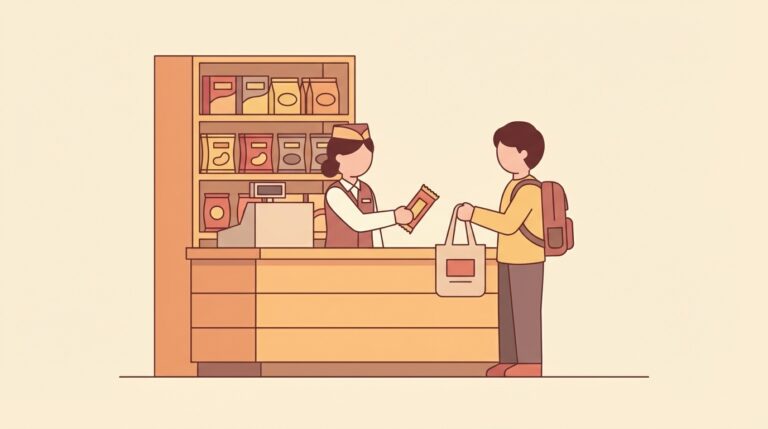
But let’s talk about your reality. You step into a brightly lit convenience store in Hongdae to buy some Banana Milk and chips. You place them on the counter. The cashier scans them, looks at you, and asks a quick question.
Suddenly, the pali-pali (hurry up) culture kicks in. The line behind you feels like it’s silently judging you. You freeze. What did they just say? Did you pay wrong?
Don’t panic! 99% of the time, they are just asking: “Do you need a bag?”
Not knowing how to answer this simple question is a major pain point for many Korean learners. Today, we are going to master this micro-interaction so you can breeze through the register like a true local!
Phase 2: Core Expressions Deep Dive
Let’s break down the exact phrases you will hear and how to respond.
1. 봉투 필요하세요?
- Pronunciation: bongtu pil-yohaseyo? (bong-too peel-yo-ha-se-yo?)
- Meaning: Do you need a bag?
- K-Culture Moment: This is the universal phrase you will hear in every GS25, CU, and 7-Eleven across Korea. In Korea, plastic bags are no longer free due to environmental laws (usually costing 20 to 100 won). That’s why cashiers must ask you this question before completing your transaction.
- Editor’s Insight: Listen closely to the rhythm. Cashiers say this hundreds of times a day, so it often sounds like one big word: “Bongtupilyohaseyo?”
- Situation Spectrum:
[🚫 Never] ———— [⚠️ Be Careful] ———— [✅ Freely]
- Cashier to Customer: ✅
- You to Cashier (asking for a bag): ⚠️ (You should use phrase #2 instead)
- 🤔 Think About It: Why does the cashier ask this instead of just giving you a bag? In your country, are bags automatically provided, or do you have to ask/pay for them?
2. 네, (봉투) 하나 주세요.
- Pronunciation: ne, (bongtu) hana juseyo. (neh, ha-na joo-se-yo.)
- Meaning: Yes, please give me one (bag).
- K-Culture Moment: You are carrying an umbrella, your phone, and a heavy jacket. There’s no way you can juggle 5 snacks. This is your go-to lifesaver phrase.
- Editor’s Insight: You can drop the word ‘봉투’ (bag) entirely because the context is already clear. Just saying “네, 하나 주세요” (Yes, one please) sounds very natural and fluent.
- Situation Spectrum:
[🚫 Never] ———— [⚠️ Be Careful] ———— [✅ Freely]
- To Cashier (Formal/Polite): ✅
- To Close Friends: 🚫 (You’d just say “응, 줘” – eung, jwo)
- 🤔 Think About It: Notice the word “주세요” (please give me). Korean is a highly transaction-based language when asking for favors or items. How do you politely request an item in your native language?
3. 아니요, 괜찮아요.
- Pronunciation: aniyo, gwaenchanayo. (a-ni-yo, gwen-chan-ah-yo.)
- Meaning: No, I’m okay. / No, thanks.
- K-Culture Moment: You only bought a pack of gum and a drink. You have a backpack. You say this, grab your items, and smoothly exit like a K-Drama protagonist.
- Editor’s Insight: This is the most polite and natural way to refuse something in Korea. Directly saying “I don’t need it” can sound a bit harsh. “괜찮아요” literally means “It is fine,” acting as a soft, polite cushion.
- Situation Spectrum:
[🚫 Never] ———— [⚠️ Be Careful] ———— [✅ Freely]
- Declining a bag from a cashier: ✅
- Declining a drink from a senior coworker: ✅
- 🤔 Think About It: “괜찮아요” is a magical word in Korean. It can mean “I’m okay,” “No thanks,” or “Don’t worry about it.” Why do you think Koreans prefer this soft refusal over a direct “No”?
4. 담아주세요. (Advanced)
- Pronunciation: damajuseyo. (da-ma-joo-se-yo.)
- Meaning: Please put it in (a bag).
- Editor’s Insight: If you want to sound like you’ve lived in Seoul for 5 years, use this. When asked “봉투 필요하세요?”, responding with “네, 담아주세요” means “Yes, please pack it for me.” It shows an advanced command of Korean verbs!
Phase 3: Textbook vs. Real Korean
Let’s see how the textbooks differ from the fast-paced reality of a Korean convenience store.
| Situation | 📖 Textbook Korean | 🗣️ Real Korean | 💡 Why is it different? |
|---|---|---|---|
| Cashier asking | “비닐봉투에 넣어 드릴까요?” (Shall I put it in a plastic bag?) | “봉투 필요하세요?” (Need a bag?) / “봉투 드릴까요?” (Shall I give you a bag?) | Textbooks use full descriptive sentences, but cashiers need efficiency. |
| Saying “No” | “아니요, 필요하지 않습니다.” (No, it is not necessary.) | “괜찮아요.” (I’m good.) / “그냥 가져갈게요.” (I’ll just take it.) | “필요하지 않습니다” sounds like a robot. Indirect refusal is more natural. |
| Saying “Yes” | “네, 봉투를 주시겠습니까?” (Yes, would you please give me a bag?) | “네, 담아주세요.” (Yes, pack it please) / Or just nodding and saying “네.” | Pali-pali culture! Short, clear answers are appreciated. |
Phase 4: Cultural Context — K-Culture Deep Dive
4-1. Non-verbal Communication: The “Hand Wave”
Language isn’t just spoken; it’s physical! When saying “아니요, 괜찮아요” (No, I’m okay), many Koreans will do a slight hand gesture. They will hold up one or two hands in front of their chest and wave them side-to-side, almost like wiping a window. It emphasizes, “Oh, no thank you, really!” Try using this gesture—the cashier will instantly recognize your fluent Nunchi (social sense)!
4-2. K-Culture Connection: The Death of the Black Plastic Bag
If you watch older K-Dramas, characters always carry a distinct, crinkly black plastic bag when returning home from a convenience store. It was iconic! However, Korea has recently implemented strict environmental laws. Those black plastic bags are mostly gone, replaced by biodegradable bags, paper bags, or reusable eco-bags. So when they ask “봉투 필요하세요?”, remember that saying “Yes” usually means adding a 50~100 won charge to your bill. It’s not a scam; it’s the law!
Phase 5: Real-Life Roleplay Scenario
Setting: It’s 11:30 PM on a Friday in Hongdae. The convenience store is packed with people buying hangover drinks before heading to karaoke. You’re holding a bottle of water, a triangular kimbap (삼각김밥), and a heavy jacket.
Characters:
– YOU: A traveler trying to buy late-night snacks.
– Cashier (Min-ji, 22): A tired college student working the night shift. She talks fast and just wants to clear the line.
Dialogue:
Min-ji: (Scanning your items rapidly) 바코드 찍어드릴게요. 삑, 삑.
(bakodeu jjigeodeurilgeyo. ppik, ppik.)
[I’ll scan the barcodes. Beep, beep.]
(🎭 Stage Direction: She looks at your hands full of items.)
Min-ji: 봉투 필요하세요?
(bongtu pil-yohaseyo?)
[Do you need a bag?]
🔀 YOUR TURN! How do you respond?
– A) “아니요, 안 필요해요.” (aniyo, an pil-yohaeyo.)
– B) “네, 하나 담아주세요.” (ne, hana damajuseyo.)
– C) “얼마예요?” (eolmayeyo?)✅ Best Choice: B. You have a heavy jacket and multiple items. Asking her to pack them (“담아주세요”) is natural and helpful.
⚠️ Choice A Analysis: While grammatically correct, “안 필요해요” (I don’t need it) sounds a bit blunt and unnatural in Korean. Always opt for “괜찮아요” (I’m okay) when refusing politely!
Min-ji: 네, 100원 추가됩니다. 카드를 꽂아주세요.
(ne, baeg-won chugadoemnida. kadeureul kkoj-ajuseyo.)
[Yes, 100 won will be added. Please insert your card.]
YOU: 네, 여기요. 감사합니다.
(ne, yeogiyo. gamsahamnida.)
[Yes, here. Thank you.]
Phase 6: 10-Second Shadowing Drill
Practice these sentences out loud to get the rhythm right. Pay attention to the pauses (/) and the emotion tags!
- 😐 Cashier: 손님 / 봉투 / 필요하세요?
(sonnim / bongtu / pil-yohaseyo?) - ☺️ You (Saying Yes): 네 / 하나 / 담아주세요.
(ne / hana / damajuseyo.) - ✋ You (Saying No): 아니요 / 괜찮아요. / 그냥 / 가져갈게요.
(aniyo / gwaenchanayo. / geunyang / gajyeogalgeyo.)
Phase 7: K-Culture Mini Dictionary
| Korean | Romanization | English | Contextual Meaning |
|---|---|---|---|
| 알바생 | al-ba-saeng | Part-time worker | The cashiers you meet at convenience stores. Usually university students. |
| 비닐봉투 | bi-nil-bong-tu | Plastic bag | The literal word for plastic bag. ‘비닐’ comes from ‘vinyl’. |
| 환경부담금 | hwan-gyeong-bu-dam-geum | Environmental fee | The 50~100 won you pay for the bag to protect the environment. |
| 눈치 | nun-chi | Social awareness | Reading the room. e.g., Not taking 5 minutes to find your card when a huge line is behind you! |
Phase 8: Traveler’s Survival Kit
Since you are at the convenience store, here are the Top 3 Survival Phrases you absolutely need!
🆘 Survival Phrase #1: Throwing away the receipt
– 🇰🇷 “영수증은 버려주세요.” (yeongsujeung-eun beoryeojuseyo.)
– 🗣️ Pronunciation: young-soo-jeung-eun buh-ryuh-joo-se-yo.
– 💡 Pro Tip: Koreans rarely take physical receipts anymore. Say this right after paying to sound like a local!🆘 Survival Phrase #2: Heating up food
– 🇰🇷 “이거 데워주세요.” (igeo dewojuseyo.)
– 🗣️ Pronunciation: ee-guh deh-woh-joo-se-yo.
– 💡 Pro Tip: Buying a lunch box (도시락)? If you can’t find the microwave, ask the cashier to heat it up for you.🆘 Survival Phrase #3: Finding items
– 🇰🇷 “___ 어디 있어요?” (___ eodi isseoyo?)
– 🗣️ Pronunciation: ___ uh-dee iss-uh-yo?
– 💡 Pro Tip: Fill in the blank! “바나나 우유 어디 있어요?” (Where is the banana milk?)📌 Editor’s Travel Note
– Payment: Korea is a cashless society! Cashiers actually prefer cards over cash. T-Money cards (transportation cards) can also be used to buy snacks!
– Tipping: Do NOT tip the cashier. There is no tipping culture in Korea, and handing them extra money will just cause confusion.
Phase 9: Critical Thinking — “One Step Deeper”
Language & Culture: The Art of Indirectness
In many Western cultures, being direct is a virtue. “No, I don’t need a bag” is a perfectly polite and efficient answer. However, in Korean culture, language is heavily focused on maintaining harmony and softening boundaries. That is why “괜찮아요” (I’m okay / It is fine) is preferred over “필요 없어요” (I don’t need it). By saying “I’m okay,” you are focusing on your own state of comfort rather than directly rejecting the cashier’s offer. This indirectness isn’t about being shy; it’s a sophisticated linguistic tool to show consideration for the other person’s feelings.
💬 Your Turn: Does your culture value directness or indirectness when refusing an offer? How do you say “No” politely in your country? Let us know in the comments!
Phase 10: FAQ & Avoiding Mistakes
Q: Do I have to pay for the bag?
Yes! Usually 20 won to 100 won depending on the bag’s size and material. Don’t be surprised if your total is slightly higher than expected.
Q: Can I use “괜찮아요” to my boss?
Yes, “괜찮습니다” (formal version) or “괜찮아요” are safe and polite to use with superiors when politely refusing something.
❌ Common Mistake #1: Saying “안 필요해요” (I don’t need it).
✅ Do this instead: Say “아니요, 괜찮아요” (No, I’m okay). It is much softer and socially acceptable.❌ Common Mistake #2: Nodding without saying anything when asked about the bag.
✅ Do this instead: The cashier might not see your nod because they are looking at the register. A simple “네” (Yes) out loud will speed up the process.
Phase 11: Summary & Action Items
One-Liner Summary: When asked “봉투 필요하세요?”, confidently reply with “네, 담아주세요” (Yes) or “아니요, 괜찮아요” (No) to navigate the convenience store like a pro!
Action Mission 3 Steps:
– 🥉 Bronze: Stand in front of a mirror and practice saying “아니요, 괜찮아요” with the Korean “hand wave” gesture.
– 🥈 Silver: Leave a comment below using “네, 하나 담아주세요” in a creative sentence.
– 🥇 Gold (Real Life): Next time you visit a Korean convenience store or an Asian supermarket, wait for the cashier to ask about the bag, and answer in Korean!
K-Culture Mission:
Go to YouTube and search for a Korean convenience store vlog. Listen closely to the interaction at the register. Can you hear the cashier ask “봉투 필요하세요?”
Phase 12: Interactive Quiz
Let’s test your Nunchi and Korean skills!
1. You bought a small pack of gum and don’t need a bag. The cashier asks: “봉투 필요하세요?” What is the most NATURAL response?
A) 아니요, 안 필요해요.
B) 아니요, 괜찮아요.
C) 네, 하나 주세요.
2. True or False: Plastic bags in Korean convenience stores are always free, so you should always ask for one.
3. Fill in the blank: You have many items and want the cashier to pack them for you. You say: “네, _____ 주세요.”
(Answers: 1: B – A sounds too blunt! / 2: False – Environmental laws require a fee! / 3: 담아 (dama))
Frequently Asked Questions (FAQ)
Q: What does "봉투 필요하세요?" mean in Korean and how do you pronounce it?
A: In Korean, "봉투 필요하세요?" is pronounced [bongtu pil-yohaseyo? (bong-too peel-yo-ha-se-yo?] and means: Do you need a bag?
Q: What does "네, (봉투) 하나 주세요." mean in Korean and how do you pronounce it?
A: In Korean, "네, (봉투) 하나 주세요." is pronounced [ne, (bongtu] and means: Yes, please give me one (bag).
Q: What does "아니요, 괜찮아요." mean in Korean and how do you pronounce it?
A: In Korean, "아니요, 괜찮아요." is pronounced [aniyo, gwaenchanayo. (a-ni-yo, gwen-chan-ah-yo.] and means: No, I'm okay. / No, thanks.
Q: What does "담아주세요. (Advanced)" mean in Korean and how do you pronounce it?
A: In Korean, "담아주세요. (Advanced)" is pronounced [damajuseyo. (da-ma-joo-se-yo.] and means: Please put it in (a bag).







