

Phase 1: Empathy & K-Culture Cold Open
Hello! I am the Lead Editor at Daily Hangul.
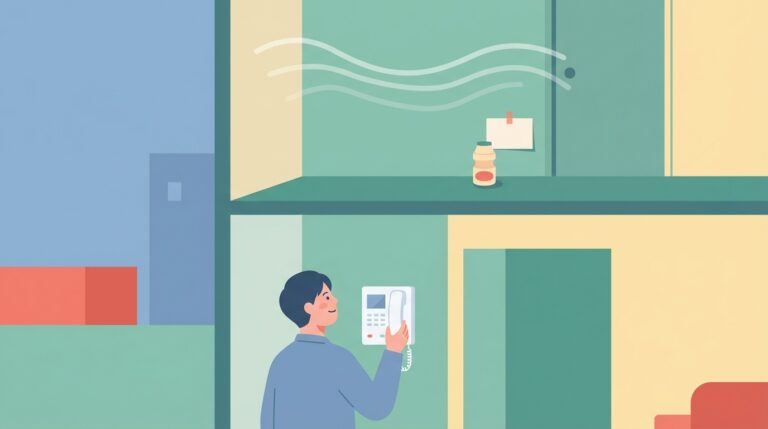
Imagine this: You are living your best life in a sleek, high-rise apartment in Seoul. It’s 11 PM, you’ve just finished a long day, and you’re winding down with your favorite K-Drama. Suddenly, the ceiling above you sounds like a herd of baby elephants practicing tap dance. Welcome to the infamous world of 층간소음 (cheung-gan so-eum, inter-floor noise).
In K-Dramas, you might see neighbors storming upstairs, dramatically pounding on the door, and demanding silence. But let me tell you—if you do that in real life, you might end up going viral on the internet or even facing legal trouble. In Korea’s hyper-dense urban living environment, dealing with noisy neighbors is an art form. It requires immense nunchi (social tact) and a deep understanding of indirect communication.
Whether you choose the cold, disembodied voice of the 인터폰 (intercom) or the passive-aggressive diplomacy of a 쪽지 (sticky note), the words you use can mean the difference between a peaceful resolution and a years-long neighborly feud. Today, we are diving deep into the C2-level nuances of complaining politely but effectively.
Phase 2: Core Expressions Deep Dive
At an advanced (C2) level, we do not simply say “You are loud.” We use language that removes direct blame while making the boundary crystal clear. Let’s look at the survival phrases for apartment politics.
1. 혹시 지금 무슨 작업 하시나요?
- Pronunciation: Hoksi jigeum museun jageop hasinayo? [Hok-shee jee-geum moo-seun jah-gup ha-shee-nah-yo?]
- Meaning: (Literal) Are you perhaps doing some work right now? / (Real nuance) “Whatever you are doing up there is incredibly loud, please stop.”
- K-Culture Moment: You call the upstairs neighbor via the wall-mounted intercom. Instead of accusing them, you pretend to be curiously inquiring if there’s construction going on. It’s the ultimate Korean face-saving technique.
- Editor’s Insight: The genius of this phrase lies in
혹시(by any chance) and작업(work/construction). You are offering them a graceful way out. You’re implying, “Surely you aren’t just stomping around; you must be doing something important.”- Situation Spectrum:
[🚫 Do Not Use] ———— [⚠️ Caution] ———— [✅ Freely Use]
- Casual (Friends): 🚫 (Too formal and passive-aggressive for friends)
- Semi-formal (Neighbors): ✅
- Formal (Management Office): ✅
- 🤔 Think About It: Why does Korean culture favor this indirect “inquiring” format over a direct “please be quiet”? How does this reflect the value of kibun (mood/face) in high-density living?
2. 발망치 소리가 조금 크게 들려서요.
- Pronunciation: Bal-mangchi soriga jogeum keuge deullyeoseoyo. [Bahl-mang-chee so-ree-gah jo-geum keu-geh deul-lyuh-suh-yo.]
- Meaning: (Literal) The foot-hammer sound is being heard a little loudly. / (Real nuance) “Your heavy footsteps are driving me crazy.”
- K-Culture Moment: Perfect for a carefully crafted sticky note left on their door (ideally attached to a small peace offering like a yogurt drink).
- Editor’s Insight:
발망치(Bal-mangchi) is a brilliant colloquial compound word: 발 (foot) + 망치 (hammer). It describes the thumping sound of heavy heel-walking. Note the grammar들려서요(is being heard). By using the passive voice, you aren’t saying “You are making noise,” but rather “The noise is reaching me.” It removes direct accusation.- Situation Spectrum:
[🚫 Do Not Use] ———— [⚠️ Caution] ———— [✅ Freely Use]
- Casual (Friends): 🚫
- Semi-formal (Neighbors via note): ✅
- Formal (Direct face-to-face): ⚠️ (Can sound a bit too direct if spoken face-to-face; better written.)
- 🤔 Think About It: Notice the use of
조금(a little). Even when the noise is deafening, Koreans use ‘a little’ as a linguistic shock absorber. Do you have mitigating words like this in your native language?3. 늦은 시간에는 조금만 주의 부탁드리겠습니다.
- Pronunciation: Neujeun siganeneun jogeumman ju-ui butakdeurigetseumnida. [Neu-jeun shee-gan-eh-neun jo-geum-mahn joo-wee boo-tak-deu-ree-get-seum-nee-da.]
- Meaning: (Literal) I would ask for a little bit of your attention during late hours. / (Real nuance) “Keep it down at night, I’m begging you politely.”
- K-Culture Moment: The closing sentence of a sticky note, or the final remark before hanging up the intercom.
- Editor’s Insight: Highly formal (
-겠습니다). It elevates the listener while firmly setting a boundary (late hours). It sounds incredibly educated and reasonable, making it very hard for the neighbor to get angry at you.- Situation Spectrum:
[🚫 Do Not Use] ———— [⚠️ Caution] ———— [✅ Freely Use]
- Casual (Friends): 🚫
- Semi-formal/Formal (Neighbors): ✅
Phase 3: Textbook vs. Real Korean
Let’s look at how textbooks handle complaints versus how actual Seoulites manage their apartment diplomacy.
| Situation | 📖 Textbook Korean | 🗣️ Real Korean | 💡 Why the difference? |
|---|---|---|---|
| Complaining about noise | 너무 시끄러워요. (It is too loud.) | 쿵쿵거리는 소리가 계속 들려서요. (Because thumping sounds keep being heard.) | Real Korean uses the passive voice and sound symbolism (onomatopoeia like 쿵쿵) to soften the blow. |
| Asking them to stop | 조용히 해 주세요. (Please be quiet.) | 바닥에 매트 하나만 깔아주실 수 있을까요? (Could you perhaps lay down a mat on the floor?) | Offering a specific, actionable solution is seen as more constructive than a blunt command. |
| Leaving a note | 조심하세요. (Be careful.) | 과일 조금 올려두고 갑니다. 평안한 밤 되세요. (I leave some fruit for you. Have a peaceful night.) | Softening a complaint note with a small gift (bribing with kindness) is a classic Korean conflict resolution tactic. |
Bottom Note for C2 Learners: At your level, avoid the textbook “조용히 하세요” (Be quiet). It is interpreted as a scolding from a superior to an inferior. Unless you want to start a war, use the indirect forms!
Phase 4: Cultural Context — K-Culture Deep Dive
4-1. Non-verbal Cues & The Law of the Land
When dealing with cheung-gan so-eum, there is an unwritten (and actually written) rule in Korea: Do not go upstairs and knock on the door. Legally, directly confronting a neighbor at their door can be considered trespassing or harassment in Korea. You must always use a mediator. This is why the intercom system (calling the security guard, or calling the apartment directly via the wall pad) and sticky notes are the standard mediums of conflict resolution.
4-2. The K-Drama Trope vs. Reality
You’ve definitely seen this K-Drama trope: The protagonist is stressed, hears a noise, grabs a broomstick, and aggressively bangs on the ceiling, or marches upstairs to have a screaming match that inevitably leads to romance.
Critical View: In reality, banging on the ceiling is considered a massive escalation (often called ‘revenge noise’ or 보복소음). Real Koreans rely heavily on nunchi. They might endure the noise for weeks, finally write a highly polite sticky note, stick it on a box of expensive strawberries, and leave it at the upstairs neighbor’s door. The message is clear: “I am a reasonable, nice person. Now please, stop stomping.”
Phase 5: Real-life Roleplay Scenario
Setting: A Tuesday night, 11:30 PM. You live in a nice officetel in Gangnam. For the past hour, it sounds like someone is dragging heavy furniture across the floor above you. You finally decide to use the wall intercom to call the 관리사무소 (Gwalli-samuso, Management Office) to handle it for you.
Characters:
– YOU: A foreign professional living in Seoul. You want to sleep.
– Security Guard (경비원 아저씨): 60s, tired, but helpful.
Dialogue:
YOU: 아저씨, 늦은 시간에 죄송합니다. 802호인데요.
(Ajeossi, neujeun sigane joesonghamnida. pal-baek-i ho-inde-yo.)
[Sir, sorry to bother you at this late hour. This is unit 802.]
Security: 네, 802호. 무슨 일이시죠?
(Ne, pal-baek-i ho. museun ir-i-si-jyo?)
[Yes, 802. What’s the matter?]
YOU: 윗집에서 한 시간째 가구 끄는 소리가 나서요.
(Wit-jib-eseo han sigan-jjae gagu kkeu-neun sori-ga naseoyo.)
[For the past hour, there’s been a sound of furniture being dragged from the unit above.]
Security: 아, 902호요? 제가 지금 바로 인터폰 해보겠습니다.
(Ah, gu-baek-i ho-yo? jega jigeum baro inteopon haebogetseumnida.)
[Ah, unit 902? I’ll call them on the intercom right now.]
🔀 Your Turn! How do you wrap up the request smoothly?
– A) “빨리 좀 해결해 주세요. 짜증나 죽겠어요.” (Please fix it fast. I’m annoyed to death.)
– B) “네, 조용히 하라고 전해 주세요.” (Yes, tell them to be quiet.)
– C) “네, 너무 감정 상하지 않게, 그냥 조금만 주의해 달라고 잘 부탁드릴게요.”✅ Best Choice: C — “Yes, please ask them nicely to just be a bit careful, so feelings don’t get hurt.” This is the pinnacle of C2-level Korean social grace. You are showing empathy not just to the neighbor, but also to the security guard who has to do the dirty work.
⚠️ Choice B Analysis: While grammatically perfect, commanding the guard with “tell them to be quiet” lacks the sophisticated nunchi expected of adult apartment dwellers.
Phase 6: 10-Second Shadowing Drill
Let’s practice the perfect polite-but-firm sticky note sentence. Pay attention to the pauses (/) and the prolonged softening of the vowels (~~~).
🥺 아랫집인데요 / 늦은 시간에는 / 발망치 소리를 / 조~~~금만 / 주의 부탁드릴게요.
(a-raet-jib-in-de-yo / neu-jeun si-gan-e-neun / bal-mang-chi so-ri-reul / jo~~~geum-man / ju-ui bu-tak-deu-ril-ge-yo.)
[I am the downstairs neighbor / During late hours / the foot-hammer noise / just a l~~~ittle bit / I ask for your care.]
Phase 7: K-Culture Mini Dictionary
| Korean | Romanization | English | Context |
|---|---|---|---|
| 층간소음 | cheung-gan so-eum | Inter-floor noise | A major social issue in Korea due to high apartment living rates. |
| 발망치 | bal-mangchi | Foot-hammer | Slang for walking with heavy, thumping heels. |
| 관리사무소 | gwalli-samuso | Management Office | The central hub of any apartment complex. Your first line of defense. |
| 인터폰 | inteopon | Intercom | The wall-mounted device used to call guards, neighbors, or open the lobby door. |
| 눈치 | nunchi | Social tact / Context reading | The vital skill of knowing when to complain and when to hold back. |
Phase 8: Traveler’s Survival Kit
Are you staying in an Airbnb or a Guesthouse in Korea? You might face the exact same noise issues. Here are your survival phrases:
🆘 Survival Expression #1
– 🇰🇷 “호스트님, 윗집이 너무 시끄러운데 혹시 연락 가능하실까요?”
– 🗣️ (Host-nim, wit-jib-i neomu sikkeureounde hoksi yeollak ganeung-hasilkkayo?)
– 📍 Where to use: Airbnb messaging app.
– 💡 Pro Tip: Never go confront the neighbor yourself. Let the host handle the “inter-floor politics.” They know the building’s dynamics.📌 Editor’s Travel Note
– Soundproofing reality: Many older Korean villas and officetels have famously thin walls. If you are a light sleeper, always pack earplugs for your Korea trip!
– Trash etiquette: Along with noise, sorting recycling improperly is the #1 way foreigners accidentally upset their Korean neighbors. Always ask the host for the specific rules!
Phase 9: Critical Thinking — “One Step Deeper”
Language & Power: The Architecture of Indirectness
In Korean, the way we construct sentences about conflict tells us everything about how Korean society views interpersonal harmony. By saying “소리가 들려서요” (The sound is heard) rather than “당신이 시끄러워요” (You are loud), the language acts as a buffer. In a country where over 60% of the population lives in multi-family housing (apartments/villas), direct confrontation is seen as a breakdown of the social contract. The Korean language has naturally evolved complex passive structures, hesitations (혹시, 조금만), and honorifics specifically to manage conflict in high-density environments without causing a loss of face (kibun).
💬 Your Turn:
In your culture, when a neighbor is too loud, do you confront them directly, call the police, or leave an anonymous note? How does your native language reflect that approach? Share in the comments!
Phase 10: FAQ & Avoiding Misunderstandings
Q: Can I just call the police (112) for inter-floor noise?
A: Technically yes, if it’s extreme (like a party at 3 AM). However, for daily living noises (walking, kids running, washing machines), the police cannot do much. Always go through the Management Office (관리사무소) first.
Q: If I leave a sticky note, should I sign my name?
A: It’s best to write “아랫집 올림” (From the downstairs neighbor). It’s anonymous enough to feel safe, but clear enough for them to know who is affected.
❌ Common Mistake #1: Going directly up to the neighbor’s door and ringing the bell repeatedly.
✅ Do this instead: Call the management office and say: “윗집에 층간소음 연락 좀 부탁드립니다” (Please contact the upstairs unit regarding the noise.)
Phase 11: Summary & Action Items
One-Liner Summary: In Korean apartment culture, resolve noise conflicts indirectly using passive grammar and the management office, never through direct confrontation!
Your Action Missions:
– 🥉 Bronze: Stand in front of a mirror and practice the phrase: “발망치 소리가 조금 크게 들려서요” with a polite, empathetic facial expression.
– 🥈 Silver: Go to a Korean learning forum and write a short mock “sticky note” to an imaginary noisy neighbor using today’s grammar.
– 🥇 Gold: The next time you stay at a Korean accommodation and experience an issue, use the indirect “~은/는 소리가 나서요” structure to inform the host.
K-Culture Mission:
Next time you watch a modern K-Drama (like Hospital Playlist or Reply 1988), pay attention to the scenes where characters interact with their neighbors. Notice the food sharing—it’s the ultimate pre-emptive strike against future complaints!
Phase 12: Quiz — Interactive Challenge
1. Situational Judgment:
It’s 1 AM. The neighbor above you is using a vacuum cleaner. You call the security guard. Which phrasing is the most appropriate for a C2 speaker?
– A) 윗집 조용히 하라고 하세요! (Tell them to be quiet!)
– B) 윗집에서 청소기 돌리는 소리가 나서요. 확인 한 번 부탁드립니다. (I hear a vacuum from upstairs. Please check on it.)
– C) 경찰 불러주세요. (Call the police.)
2. True or False — K-Culture Edition:
“If you are extremely angry about the noise, it is socially acceptable and legally safe in Korea to go upstairs, knock on their door, and yell at them.”
(Answers)
1. B – It uses the observational voice (소리가 나서요) and politely delegates the task to the guard.
2. False – Direct confrontation at the door is highly discouraged, socially taboo, and can even lead to trespassing or stalking charges in severe cases. Always use the intercom, notes, or security!
Frequently Asked Questions (FAQ)
Q: What does "혹시 지금 무슨 작업 하시나요?" mean in Korean and how do you pronounce it?
A: In Korean, "혹시 지금 무슨 작업 하시나요?" is pronounced [Hoksi jigeum museun jageop hasinayo? [Hok-shee jee-geum moo-seun jah-gup ha-shee-nah-yo?] and means: (Literal) Are you perhaps doing some work right now? / (Real nuance) "Whatever you are doing up there is incredibly loud, please stop."
Q: What does "발망치 소리가 조금 크게 들려서요." mean in Korean and how do you pronounce it?
A: In Korean, "발망치 소리가 조금 크게 들려서요." is pronounced [Bal-mangchi soriga jogeum keuge deullyeoseoyo. [Bahl-mang-chee so-ree-gah jo-geum keu-geh deul-lyuh-suh-yo.] and means: (Literal) The foot-hammer sound is being heard a little loudly. / (Real nuance) "Your heavy footsteps are driving me crazy."
Q: What does "늦은 시간에는 조금만 주의 부탁드리겠습니다." mean in Korean and how do you pronounce it?
A: In Korean, "늦은 시간에는 조금만 주의 부탁드리겠습니다." is pronounced [Neujeun siganeneun jogeumman ju-ui butakdeurigetseumnida. [Neu-jeun shee-gan-eh-neun jo-geum-mahn joo-wee boo-tak-deu-ree-get-seum-nee-da.] and means: (Literal) I would ask for a little bit of your attention during late hours. / (Real nuance) "Keep it down at night, I'm begging you politely."






