

Phase 1: Empathy (Immersive Opening)
Hello! I’m your Daily Hangul Editor.
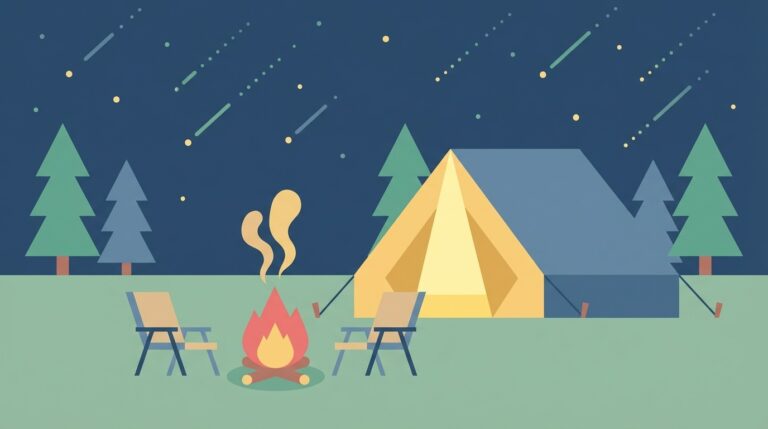
Picture this: It’s a crisp autumn evening in Gapyeong, surrounded by majestic pine trees. You’re sitting in front of a luxurious canvas tent, wrapped in a thick blanket. In front of you, a campfire is crackling, and above you, the night sky is absolutely brilliant. It feels exactly like that iconic healing scene from a K-Drama where the main characters escape the chaotic city of Seoul to find themselves.
Your Korean friend looks up and sighs softly, murmuring something about the stars “pouring down” and wanting to “hit a blank stare.” Wait, what? Hit a blank stare?
If you only learned Korean from textbooks, you might just look up and say, “하늘에 별이 많습니다” (There are many stars in the sky). While perfectly correct, it completely shatters the romantic, poetic vibe of a Korean glamping trip!
As a C1 learner, you’re not just aiming to communicate facts; you want to capture emotions. Knowing how to express the serene, aesthetic beauty of a Korean camping night will immediately elevate you from a “foreigner speaking good Korean” to an “insider who truly feels the culture.”
Everything in this lesson is based on real questions from advanced learners who wanted to sound as poetic and culturally attuned as a K-Drama lead. Let’s dive in!
Phase 2: Deep Dive into Core Expressions
Here are the top 3 expressions you need for a luxury stargazing and glamping trip in Korea.
1. 별이 쏟아질 것 같아요 (The stars look like they’re pouring down)
- Pronunciation: byeori ssodajil geot gatayo [The ‘쏟’ (ssot) sounds like a sharp hiss, similar to the ‘ss’ in ‘hiss’, followed by a quick stop.]
- Meaning: (Literal) It seems like the stars will pour down. / (Real Nuance) The sky is so densely packed with stars that it feels overwhelmingly beautiful, as if they could fall on us.
- K-Culture Moment: This is the classic line used in K-Dramas when the couple takes a romantic stroll away from the campsite. It’s poetic, emotional, and sets a vulnerable mood.
- Editor’s Insight: You don’t just say this expression; you have to breathe it. Say it softly, looking up at the sky, with a slight pause. It shows you are deeply moved by nature.
- Situation Spectrum:
[🚫 Absolutely Not] ———— [⚠️ Use with Caution] ———— [✅ Go For It]
- Close Friends/Partner (Casual – 별이 쏟아질 것 같아): ✅
- Colleagues (Semi-formal): ✅ (Great for team-building retreats)
- Boss/Elders (Formal): ✅ (Safe, as it’s an observation of nature)
- 🤔 Think About It: Why use the verb “쏟아지다” (to pour) for stars? Korean often uses highly dynamic, physical verbs to describe static visual beauty, making the description feel alive and active. Does your language have a similar dynamic metaphor for stars?
2. 불멍 때리면서 힐링할까요? (Shall we zone out by the fire and heal?)
- Pronunciation: bulmeong ttaerimyeonseo hilling-halkkayo? [‘멍’ (meong) rhymes with ‘lung’. ‘때’ (ttae) sounds like the sharp, tense ‘t’ in ‘stop’.]
- Meaning: (Literal) Shall we hit a fire-blank and heal? / (Real Nuance) Shall we space out while staring at the campfire and relax our minds?
- K-Culture Moment: If you watch Korean variety shows like I Live Alone (나 혼자 산다), you’ll constantly see celebrities going camping just to do “불멍” (bulmeong). It is the absolute core activity of modern Korean camping.
- Editor’s Insight: “멍 때리다” means to space out. Add “불” (fire), and you get “spacing out looking at the fire.” It’s an incredibly trendy and essential compound word.
- Situation Spectrum:
[🚫 Absolutely Not] ———— [⚠️ Use with Caution] ———— [✅ Go For It]
- Close Friends (Casual): ✅
- Colleagues (Semi-formal): ✅ (Very common to say at a company glamping trip)
- Boss/Elders (Formal): ⚠️ (The word ‘때리다’ is slightly slangy; safer to say “불을 보면서 쉴까요?” to a strict boss)
- 🤔 Think About It: “Healing” (힐링) is used as a verb in Korea (힐링하다). Why did Koreans adopt this English word instead of native words for resting? It implies a psychological detox rather than just physical sleep.
3. 와, 공기가 달아요 (Wow, the air is sweet)
- Pronunciation: wa, gong-giga darayo [‘달’ (dal) sounds like ‘dahl’.]
- Meaning: (Literal) Wow, the air is sweet. / (Real Nuance) The air is incredibly fresh, crisp, and pollution-free.
- K-Culture Moment: Koreans are very sensitive to air quality due to the fine dust (미세먼지) in cities like Seoul. When stepping out of the car in a pristine mountain glamping site, taking a deep breath and declaring the air “sweet” is the ultimate expression of relief.
- Editor’s Insight: It sounds highly advanced and native-like. While beginners say “공기가 맑아요” (the air is clear), C1 learners say the air is sweet.
- Situation Spectrum:
[🚫 Absolutely Not] ———— [⚠️ Use with Caution] ———— [✅ Go For It]
- Close Friends (Casual): ✅
- Colleagues (Semi-formal): ✅
- Boss/Elders (Formal): ✅
- 🤔 Think About It: Describing air with a taste adjective (sweet) is a beautiful synesthesia (mixing of senses). In your native language, how do you vividly describe fresh air?
Phase 3: Textbook vs. Real Korean
| Situation | 📖 Textbook Korean | 🗣️ Real Korean | 💡 Why different? |
|---|---|---|---|
| Commenting on the starry sky | 하늘에 별이 참 많습니다. (There are many stars in the sky.) | 와, 별 쏟아지는 거 봐. 대박. (Wow, look at the stars pouring down. Epic.) | Real Korean uses dynamic verbs (pouring) and casual exclamations to express immediate emotion. |
| Suggesting to relax by the fire | 모닥불을 보면서 휴식합시다. (Let’s rest while looking at the campfire.) | 장작 좀 더 넣고 불멍이나 때리자. (Let’s put in more firewood and just zone out by the fire.) | “불멍” captures the specific modern cultural trend of finding mental peace through fire-gazing. |
| Saying it’s getting cold outside | 밖의 날씨가 춥습니다. (The weather outside is cold.) | 쌀쌀한데 겉옷 좀 걸칠까요? (It’s a bit chilly, should we throw on some outerwear?) | Koreans prefer softening the statement (쌀쌀하다 over 춥다) and immediately suggesting a caring solution. |
Bottom Note for C1 Learners: You already know the textbook phrases. Now, focus on the “vibe.” Swap your standard verbs for sensory, trendy ones like ‘불멍 때리다’ to instantly sound like a local!
Phase 4: Cultural Context — K-Culture Deep Dive
4-1. Non-verbal Cues: The Nunchi of the Campfire
Glamping in Korea is deeply tied to Nunchi (눈치), the art of reading the room. When staring at the fire (불멍), silence is golden. Unlike Western camping cultures where singing and loud storytelling are common, Korean stargazing and fire-gazing are often treated like a shared meditation. Don’t feel the need to fill the silence with chatter. Enjoying the quiet together is a sign of a deep bond.
4-2. K-Food Connection: The Holy Trinity of Glamping
Korean glamping is 50% about the aesthetic and 50% about eating endlessly. You cannot talk about Korean camping without the BBQ culture.
– The Sequence: First, thick slices of pork belly (삼겹살) grilled over charcoal. Second, a bubbling pot of spicy Ramyeon (라면) cooked in a tin pot outdoors (it objectively tastes 100x better outside). Finally, as the fire dies down, wrapping sweet potatoes in foil and tossing them into the embers to make Gun-goguma (군고구마 – roasted sweet potatoes).
– Critical View: Notice how every stage of glamping food involves sharing from a central grill or pot? The physical act of sharing food (정 – Jeong) is what makes the cold night feel warm.
Phase 5: Real-Life Roleplay Scenario
Setting: Friday night, 9 PM. A luxury glamping site in Hongcheon, Gangwon-do. The air is crisp. A campfire is crackling softly, emitting a warm orange glow. You are sitting in a comfortable camping chair with your Korean friend.
Characters:
– YOU (The Reader): An expat working in Korea, enjoying your first luxury glamping experience.
– Min-su (32): Your close Korean friend and coworker. He organized the trip and takes his ‘healing’ very seriously.
Dialogue:
Min-su: (Taking a deep breath) 와, 여기 공기 진짜 달다. 서울 미세먼지 마시다가 여기 오니까 살 것 같네.
(Wa, yeogi gong-gi jinjja dalda. Seoul misemeonji masidaga yeogi onikka sal geot ganne.)
[Translation: Wow, the air here is seriously sweet. Coming here after breathing Seoul’s fine dust, I feel like I can live again.]
YOU: 내 말이. 스트레스가 다 날아가는 기분이야.
(Nae mari. Seuteureseuga da naraganeun gibuniya.)
[Translation: Tell me about it. It feels like all my stress is flying away.]
Min-su: (Pointing up) 야, 저기 봐봐. 별 쏟아질 것 같지 않아?
(Ya, jeogi bwabwa. Byeol ssodajil geot gatji ana?)
[Translation: Hey, look over there. Don’t the stars look like they’re pouring down?]
YOU: 진짜 대박이다… 사진으로 안 담기네.
(Jinjja daebagida… Sajineuro an damgine.)
[Translation: Seriously epic… It can’t be captured in a photo.]
Min-su: 원래 눈으로 담는 거야. 장작 좀 더 넣을까? 불멍이나 제대로 때리자.
(Wollae nuneuro damneun geoya. Jangjak jom deo neoeulkka? Bulmeong-ina jedaero ttaerija.)
[Translation: You’re supposed to capture it with your eyes anyway. Should I put in more firewood? Let’s hit a proper blank-stare at the fire.]
(🎭 Stage Direction: Min-su adds an oak log to the fire. A cool breeze blows by.)
Min-su: 어우, 밤 되니까 좀 쌀쌀하네. 감기 걸리겠다.
(Eou, bam doenikka jom ss쌀쌀hane. Gamgi geolligetda.)
[Translation: Ooh, it’s getting a bit chilly as it turns into night. We might catch a cold.]
🔀 Your Turn! How do you respond to Min-su?
– A) “저는 괜찮아요. 안 추워요.” (I’m fine. I’m not cold.)
– B) “우리 텐트 안에 들어가서 보일러 틀까요?” (Should we go inside the tent and turn on the boiler?)
– C) “제가 따뜻한 커피라도 타올까요?” (Should I go brew us some warm coffee?)✅ Best Choice for a C1 Learner: C — Reason: In Korean Nunchi culture, when someone mentions it’s cold, it’s a subtle prompt for mutual care. Offering to make coffee shows great empathy and “Jeong” (정).
⚠️ Choice B Analysis: Going inside ruins the “Bulmeong” mood! Glamping tents have underfloor heating (Ondol), but the point is to brave the cold for the aesthetic. Just grab a blanket!
Bonus K-Culture Scenario: The “Magic Powder”
(Min-su suddenly pulls out a small colorful packet.)
Min-su: 자, 하이라이트 갑니다. 오로라 가루 뿌린다?
(Ja, hairateu gamnida. Orola garu ppurinda?)
[Translation: Alright, here comes the highlight. I’m sprinkling the aurora powder, okay?]
YOU: 우와! 불꽃 색깔 변하는 거 봐. 인스타 각인데?
(Uwa! Bulkkot saekkkal byeonhaneun geo bwa. Inseuta gaginde?)
[Translation: Wow! Look at the flame colors changing. This is totally Instagram-worthy, right?]
Phase 6: 10-Second Shadowing Drill
Read this aloud, following the pauses (/) and the emotional tags! Match the rhythm to sound like a native.
🥺 감탄하면서 (With awe)
와… / 하늘에 / 별 쏟아질 것 같은 거 / 보이세요?
(wa… / haneure / byeol ssodajil geot gateun geo / bo-i-se-yo?)😊 편안하게 (Relaxed and cozy)
우리 / 장작 좀 더 넣고 / 불멍 때릴까요?
(u-ri / jang-jak jom deo neoko / bul-meong ttae-ril-kka-yo?)
Phase 7: K-Culture Mini Dictionary
| Korean | Romanization | English | Contextual Meaning |
|---|---|---|---|
| 불멍 | bulmeong | Fire-gazing | Spacing out while looking at a fire. A trendy way to de-stress. |
| 오로라 가루 | orora garu | Aurora powder | Chemical packets thrown into campfires to make the flames turn vibrant colors. Essential for Korean glamping photos. |
| 인스타 각 | inseuta gak | Insta-worthy | Slang meaning “This is the perfect angle/moment to post on Instagram.” |
| 장작 | jangjak | Firewood | You’ll often need to buy extra at the campsite shop (매점) to keep the ‘bulmeong’ going. |
| 겉옷 | geot-ot | Outerwear | A cardigan or light jacket. Koreans are very proactive about offering a ‘geot-ot’ when it gets chilly. |
Phase 8: Traveler Survival Kit
Are you booking a glamping trip in Korea? Here are the absolute must-know phrases for interacting with the camp host!
🆘 Survival Phrase #1: Asking for floor heating
– 🇰🇷 “텐트 바닥 난방(보일러)은 어떻게 켜요?”
– 🗣️ (Tenteu badak nanbang(boilleo)-eun eotteoke kyeyo?)
– 💡 Pro Tip: Korean luxury glamping tents often feature Ondol (underfloor heating) or electric mats. It might be freezing outside, but your bed will be boiling hot!🆘 Survival Phrase #2: Buying firewood
– 🇰🇷 “장작 한 망만 더 주세요. 얼마예요?”
– 🗣️ (Jangjak han mang-man deo juseyo. Eolmayeyo?)
– 💡 Pro Tip: Firewood is usually sold in nets (망). You will likely burn through more wood than you expect while doing ‘bulmeong’.🆘 Survival Phrase #3: Charcoal prep for BBQ
– 🇰🇷 “사장님, 7시에 바비큐 숯불 좀 피워주실 수 있나요?”
– 🗣️ (Sajangnim, ilgopsie babikyu sutbul jom piwojusil su innayo?)
– 💡 Pro Tip: In Korean glamping, the host usually prepares the charcoal grill for you at a requested time for a small extra fee.
Phase 9: Critical Thinking Corner — “A Step Deeper”
🧠 Think Deeper: The Paradox of “Healing” in a Hyper-Competitive Society
Why does the Korean language have so many specific words for spacing out—like Bul-meong (fire), Mul-meong (water), and even San-meong (mountains)? It directly reflects the intensity of Korean society. In a culture driven by Ppalli-Ppalli (hurry, hurry) and relentless productivity, simply “doing nothing” can feel guilt-inducing. Therefore, “staring at a fire” is packaged and legitimized as an active form of recovery called “Healing” (힐링). You aren’t wasting time; you are performing an essential detox for your brain.
💬 Your Turn:
Does your culture have a specific word or ritual for “doing absolutely nothing” to recover from stress? Let us know in the comments!
Phase 10: FAQ & Avoiding Misunderstandings
Q: Can I say “불멍 때리세요” to my boss if they look stressed?
No! 🚫 While “불멍” itself is fine, the verb “때리다” (to hit/strike) used in this slang is too casual. If you want to suggest relaxing by the fire to an elder or a boss, soften it: “불 보면서 좀 쉴까요?” (Shall we rest a bit while looking at the fire?)
Q: Are glamping sites actually warm in the Korean winter?
Yes! Koreans do not compromise on sleep temperature. Due to the traditional Ondol culture, even a canvas tent will likely have heavy-duty electric blankets and heated floors.
❌ Common Mistake:
Using “심심하다” (simsimhada) when stargazing.
Many learners translate “I have nothing to do” as 심심하다. But 심심하다 means you are bored and mildly annoyed by it. If you are peacefully doing nothing looking at the stars, never say you are 심심하다. Say “여유롭다” (yeoyouropda – I feel relaxed/have time to spare) instead!
Phase 11: Summary & Action Items
One-Liner Summary:
To sound like a true Korean at a glamping site, look at the sky and say the stars are “pouring down” (별이 쏟아질 것 같다), and look at the fire to “hit a blank stare” (불멍 때리다)!
Action Mission:
– 🥉 Bronze (Solo): Stand outside tonight, look up, and whisper “와… 별이 쏟아질 것 같아” 3 times with deep emotion.
– 🥈 Silver (Online): Find an ASMR campfire video on YouTube and leave a Korean comment: “불멍 때리니까 힐링 되네요.”
– 🥇 Gold (Real Life): On your next trip out of the city with a Korean friend, take a deep breath and tell them, “여기 공기 진짜 달아요!” (The air here is so sweet!).
🏕️ K-Culture Mission:
Search “오로라 가루 불멍” (Aurora powder bulmeong) on Instagram or TikTok and see the magical rainbow campfires that Koreans are obsessed with right now!
Phase 12: Quiz — Interactive Challenge
1. Fill in the Blank (Situational):
You step out of your car at a glamping site in the deep mountains. You take a deep breath. What is the most C1-level natural Korean thing to say?
“와… 서울이랑 다르게 여기 ( ________ ) 달아요.”
2. True or False — K-Culture Edition:
It is considered rude and anti-social in Korea to stare at the campfire without talking to your friends for 20 minutes.
3. Situational Judgment:
Your friend looks up at the sky at night and says “별이 쏟아질 것 같아.” Which response shows the best Nunchi and cultural understanding?
– A) “아니, 중력 때문에 별은 안 쏟아져.” (No, stars won’t pour down due to gravity.)
– B) “그러게. 쌀쌀한데 따뜻한 코코아 타줄까?” (I know right. It’s chilly, should I make you some hot cocoa?)
– C) “난 심심해. 빨리 자자.” (I’m bored. Let’s sleep quickly.)
(Scroll down for answers!)
(Answers: 1. 공기가 / 2. False! Enjoying the silence together is part of “Bulmeong” healing. / 3. B – Acknowledges the mood and offers warmth!)
Frequently Asked Questions (FAQ)
Q: What does "별이 쏟아질 것 같아요 (The stars look like they're pouring down)" mean in Korean and how do you pronounce it?
A: In Korean, "별이 쏟아질 것 같아요 (The stars look like they're pouring down)" is pronounced [byeori ssodajil geot gatayo [The '쏟' (ssot] and means: (Literal) It seems like the stars will pour down. / (Real Nuance) The sky is so densely packed with stars that it feels overwhelmingly beautiful, as if they could fall on us.
Q: What does "불멍 때리면서 힐링할까요? (Shall we zone out by the fire and heal?)" mean in Korean and how do you pronounce it?
A: In Korean, "불멍 때리면서 힐링할까요? (Shall we zone out by the fire and heal?)" is pronounced [bulmeong ttaerimyeonseo hilling-halkkayo? ['멍' (meong] and means: (Literal) Shall we hit a fire-blank and heal? / (Real Nuance) Shall we space out while staring at the campfire and relax our minds?
Q: What does "와, 공기가 달아요 (Wow, the air is sweet)" mean in Korean and how do you pronounce it?
A: In Korean, "와, 공기가 달아요 (Wow, the air is sweet)" is pronounced [wa, gong-giga darayo ['달' (dal] and means: (Literal) Wow, the air is sweet. / (Real Nuance) The air is incredibly fresh, crisp, and pollution-free.







