

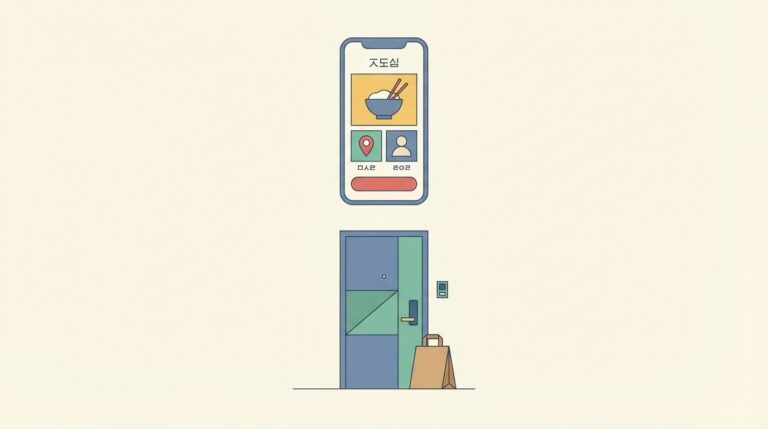
Phase 1: Empathy (Welcome to the Real Korea!)
Hello! I’m your Daily Hangul Editor.
Imagine you are watching your favorite K-Drama. The main character just had an awful day at work, and to cheer themselves up, they order a huge portion of spicy Tteokbokki. But when the delivery arrives, they don’t run to open the door. Instead, they wait silently… listening for the elevator doors to close. Once the hallway is completely empty, they slowly open the door like a stealthy ninja, grab the food bag, and lock the door again!
Have you ever wondered why they do this? Or have you ever been in a hotel in Seoul, craving midnight Chimaek (Chicken and Beer), but felt too shy to meet the delivery driver because you’re already in your pajamas with zero makeup on?
If you don’t know the magic phrases for ‘Delivery Culture’ (배달 문화), you might find yourself awkwardly bowing to the driver while wearing your favorite animal onesie. But if you master today’s lesson, you’ll be able to order food in Korea with 100% comfort and zero social anxiety, just like a local!
(Transparency: This guide is crafted from the real-life panic moments and questions of my actual beginner students who survived their first Korean delivery experiences!)
Phase 2: Core Expression Deep Dive
Here are the absolute lifesaver phrases you need for Non-face-to-face receiving (비대면 수령하기).
1. 문 앞에 두고 가주세요
- Pronunciation: [mun ape dugo gajuseyo] / moon ah-peh doo-go gah-joo-seh-yo
- Meaning: (Literal) Please put it in front of the door and go. / (Real Nuance) Please leave it at the door.
- K-Culture Moment: This is the ultimate default memo on Korean delivery apps like Baemin (배달의민족). It is the shield for introverts! If you select this, you can safely enjoy your K-Food without any human interaction.
- Editor’s Insight: Think of this as a polite but firm boundary. It doesn’t sound rude at all; in fact, delivery drivers prefer this because it saves them precious time!
- Situation Spectrum:
[🚫 Never] ———— [⚠️ Be Careful] ———— [✅ Freely]
- Delivery App Memo (Written): ✅
- Texting the Driver: ✅
- Saying it to an elderly neighbor: 🚫 (Too direct)
- 🤔 Think About It: Why is it so safe to leave packages and food out in the open hallway in Korea without them getting stolen? Does your home country have a similar ‘leave at door’ culture?
2. 벨 누르지 마세요
- Pronunciation: [bel nureuji maseyo] / bell noo-reu-jee mah-seh-yo (‘eu’ sounds like the disgusted sound you make when stepping in gum!)
- Meaning: (Literal/Real) Please don’t ring the bell.
- K-Culture Moment: Many K-Pop idols living alone with their pet dogs use this phrase. If the bell rings, the dogs bark, and chaos ensues! Also heavily used by parents of sleeping babies.
- Editor’s Insight: Korean drivers embody the Pali-pali (Hurry up) culture. They want to ensure you get your food piping hot, so they will ring the bell unless you specifically tell them not to.
- Situation Spectrum:
[🚫 Never] ———— [⚠️ Be Careful] ———— [✅ Freely]
- Delivery App Memo: ✅
- Talking to a coworker: 🚫
- 🤔 Think About It: The fact that we have to ask them not to ring the bell shows how much Koreans care about confirming the delivery instantly. How do delivery drivers in your country notify you?
3. 도착하면 문자 남겨주세요
- Pronunciation: [dochakhamyeon munja namgyeojuseyo] / doh-chak-ha-myun moon-ja nam-gyeo-joo-seh-yo
- Meaning: (Literal) If you arrive, please leave a text. / (Real Nuance) Text me when you drop it off.
- K-Culture Moment: Used together with phrase #2. You don’t want the bell ringing, but you still want to know exactly when your crispy chicken has arrived so it doesn’t get soggy!
- Editor’s Insight: ‘문자(munja)’ means text message. Even though the app sends an automated notification, adding this adds a polite, human touch.
- Situation Spectrum:
[🚫 Never] ———— [⚠️ Be Careful] ———— [✅ Freely]
- Delivery App Memo: ✅
- Formal business email: ⚠️ (Use more formal vocabulary instead)
Phase 3: Textbook vs. Real Korean
| Situation | 📖 Textbook Korean | 🗣️ Real Korean | 💡 Why is it different? |
|---|---|---|---|
| Writing a memo on the app | 배달해 주셔서 감사합니다. 문 앞에 놓아주세요. (Thank you for delivering. Please place it at the door.) | 문 앞이요 (Just ‘Door front’) / 문앞 보관 (Keep at door) | Delivery memos have character limits, and Koreans love extreme efficiency. |
| Asking not to ring the bell | 벨을 누르지 말아 주시기를 바랍니다. (I hope you refrain from ringing the bell.) | 벨X / 노크 부탁드려요 (Bell X / Knock please) | Using ‘X’ is a very common internet slang/abbreviation in Korea to mean ‘No’ or ‘Without’. |
| Giving directions | 공동현관 비밀번호는 1234번입니다. (The shared entrance password is 1234.) | 현관 비번: 1234 (Entrance pass: 1234) | ‘비번(bibeon)’ is the widely used abbreviation for 비밀번호(password). |
Phase 4: Cultural Context — K-Culture Deep Dive
4-1. The Non-verbal ‘Nunchi’ of Delivery
Korean culture relies heavily on 눈치 (Nunchi)—the subtle art of reading the room. When you request a non-face-to-face delivery, the nunchi rule dictates that you wait about 10 seconds after hearing the driver’s footsteps fade away before opening your door. Opening the door exactly as they are setting the food down creates a hilariously awkward moment where both of you didn’t expect to see each other!
4-2. K-Food Connection: The ‘Pali-Pali’ Reality
Why are Korean food deliveries so fast? It’s deeply rooted in the 빨리빨리 (Pali-pali – hurry hurry) culture. Korean dishes like noodles (Jajangmyeon) can easily become soggy, and fried foods lose their crispiness. Therefore, the delivery ecosystem is optimized for speed. This is why non-face-to-face delivery is so popular: it saves the driver from waiting 2 minutes for you to walk to the door, allowing them to rush to their next delivery!
Phase 5: Real-Life Roleplay Scenario
Setting: It’s Friday night, 11:00 PM. You are staying at a fancy hotel in Gangnam, Seoul. You and your Korean friend, Min-su, are watching a K-Drama in your pajamas. Suddenly, you both crave some late-night fried chicken.
Characters:
– YOU: A foreign traveler on day 3 of your Seoul trip. Very hungry, but very tired.
– Min-su: (32) Your Korean friend. Helpful and a master of delivery apps.
(🎭 Stage Direction: Min-su holds up his phone with the Baemin app open)
Min-su: 배고프다. 우리 치맥 시킬까? 🍗🍺
(baegopeuda. uri chimaek sikilkka?)
[I’m hungry. Should we order Chimaek?]
YOU: 좋아요! 근데 저 잠옷 차림이에요. 화장도 지웠고요.
(joayo! geunde jeo jamot charimieyo. hwajangdo jiwotgoyo.)
[Sounds great! But I’m in my pajamas. And I took off my makeup.]
Min-su: 걱정 마! ‘비대면’으로 받으면 돼.
(geokjeong ma! ‘bidaemyeon’euro badeumyeon dwae.)
[Don’t worry! We can receive it ‘non-face-to-face’.]
YOU: 오, 그거 어떻게 하는 건데요?
(o, geugeo eotteoke haneun geondeyo?)
[Oh, how do you do that?]
Min-su: 앱에 메모를 남기면 기사님이 그냥 두고 가셔.
(aebe memoreul namgimyeon gisanim-i geunyang dugo gasyeo.)
[If you leave a memo on the app, the driver just leaves it and goes.]
🔀 Your Turn! What should you tell Min-su to type in the memo?
– A) “기사님, 빨리 오세요!” (Driver, come quickly!)
– B) “문 앞에 두고 가주세요.”
– C) “똑똑, 문 열어주세요.”✅ Best Choice: B — Perfect! It politely asks them to leave it at the door.
⚠️ Choice A Analysis: Telling a Korean delivery driver to ‘hurry’ is considered rude. They are already driving as fast as safely possible!
YOU: 아하! 그럼 ‘문 앞에 두고 가주세요’라고 써주세요.
(aha! geureom ‘mun ape dugo gajuseyo’rago sseojuseyo.)
[Aha! Then please write ‘Please leave it at the door’.]
Min-su: 오~ 한국어 잘하는데? 호텔이니까 1층 로비라고 쓸게.
(o~ hangugeo jalhande? hoterinikka il-cheung robirago sseulge.)
[Oh~ Your Korean is good! Since it’s a hotel, I’ll write 1st floor lobby.]
YOU: 네! 벨 누르지 마세요! 저 깜짝 놀라요.
(ne! bel nureuji maseyo! jeo kkamjjak nollayo.)
[Yes! Please don’t ring the bell! It startles me.]
Min-su: ㅋㅋㅋ 알겠어. 결제 완료!
(kkk algesseo. gyeolje wallyo!)
[Hahaha okay. Payment complete!]
(🎭 Stage Direction: 30 minutes later, Min-su’s phone buzzes with a text message: ‘Your delivery has arrived at the lobby’.)
Phase 6: 10-Second Shadowing Drill
Practice this sentence so you can write it or say it naturally!
(Follow the pauses ‘/’ and match the emotion!)
🙏 기사님, / 문 앞에 / 두고 / 가주세요!
(gisanim, / mun ape / dugo / gajuseyo!)
Emotion: Polite and thankful, slightly begging for privacy.
Phase 7: K-Culture Mini Dictionary
| Korean | Romanization | English | Contextual Meaning |
|---|---|---|---|
| 눈치 | nunchi | Nunchi | The subtle social sense of reading the atmosphere. Waiting for the driver to leave before opening the door is ‘nunchi’. |
| 비대면 | bidaemyeon | Non-face-to-face | A massive trend in Korea post-COVID. Applies to delivery, banking, and shopping. |
| 라이더 | raideo | Rider | The delivery driver. We usually call them ‘기사님 (gisanim)’ respectfully. |
| 배달 팁 | baedal tip | Delivery Fee | Not a tip for service! It is just the mandatory delivery charge. Korea does NOT have a tipping culture. |
| 리뷰 이벤트 | ribyu ibenteu | Review Event | If you promise to write a 5-star review, restaurants often give you free cheese balls or extra soda! |
Phase 8: Traveler Survival Kit 🆘
If you are traveling in Korea, ordering delivery to your hotel or Airbnb is a must-do experience. But there is a catch!
🆘 Survival Phrase #1
– 🇰🇷 “1층 로비에 맡겨주세요.” (il-cheung robie matgyeojuseyo.)
– 🗣️ Pronunciation: eel-cheung lo-bee-eh mat-gyeo-joo-seh-yo.
– 📍 Where to use: Hotels, Hostels, Large office buildings.
– 💡 Pro Tip: For security reasons, 90% of Korean hotels do not allow delivery drivers to go up to guest floors. You MUST use this phrase and go down to the lobby to pick up your food!📌 Editor’s Travel Note
– Useful Apps: Baedal Minjok (Baemin), Yogiyo, Coupang Eats. (Tip: Shuttle Delivery app has English support!).
– Payment: If you choose ‘Non-face-to-face’, you CANNOT pay with cash at the door. You must pre-pay with a card in the app.
Phase 9: Critical Thinking — “One Step Deeper”
Media vs. Reality: The Evolution of the Iron Bowl
If you watch older K-Dramas or movies, you’ll see characters eating Jajangmyeon out of heavy plastic or iron bowls, leaving the empty, dirty bowls outside their door for the driver to pick up later.
However, in today’s modern ‘Non-face-to-face’ era, this is disappearing. To minimize contact and maximize efficiency, most restaurants now use disposable plastic containers. While the traditional image of returning the bowls represents a deep sense of community and trust between the neighborhood restaurant and the customer, the modern reality reflects a global shift towards individualism and convenience.
💬 Your Turn: Have you noticed this difference between older K-Dramas and modern ones? How does delivery packaging work in your culture? Share in the comments!
Phase 10: FAQ & Avoiding Mistakes
❌ Common Mistake #1: Leaving your hotel room door open waiting for the driver.
✅ Do this instead: Keep your door closed! It makes the driver uncomfortable if you are standing there staring at them when you selected “leave at door.”
K-Culture FAQ:
Q: “Can I write ‘문 앞에 두고 가주세요’ to my boss if I drop off documents?”
A: Absolutely NOT! 🚫 This is for service requests (like delivery). If dropping off documents for a boss, say “책상 위에 올려두었습니다 (I have placed it on your desk).”
Q: “If I select ‘Review Event’ for free cheese balls but forget to leave a review, what happens?”
A: The police won’t arrest you, but it’s very bad manners (nunchi failure!). Korean restaurant owners rely heavily on good reviews to survive.
Phase 11: Summary & Action Items
🌟 One-Liner Summary: Use “문 앞에 두고 가주세요” to safely and peacefully receive your Korean delivery without any awkward face-to-face encounters!
Your Action Missions:
– 🥉 Bronze: Say “문 앞에 두고 가주세요” out loud 3 times pretending you are leaving a voice memo.
– 🥈 Silver: Leave a comment below using the phrase to tell us what K-Food you would order right now!
– 🥇 Gold: Download a Korean delivery app, browse the menus, and find the memo section where you would type this!
🎬 Special K-Culture Mission:
Next time you watch a K-Drama, count how many times the characters actually meet the delivery driver vs. just picking up the bag from the floor!
Phase 12: Interactive Challenge Quiz
Q1. (Situational) Your baby just fell asleep. You ordered some spicy chicken. What is the BEST memo to leave?
A) 빨리 오세요 (Come quickly)
B) 벨 누르지 마세요 (Don’t ring the bell)
C) 문 열어주세요 (Open the door)
Q2. (Fill in the blank) You want the food left at your apartment door.
“___ 앞에 두고 가주세요.”
Q3. (True/False – Culture Edition) If you order delivery to a large hotel in Seoul, the driver will bring it straight to your room bed.
(Scroll down for answers!)
Answers: Q1: B (Don’t wake the baby!), Q2: 문 (Door), Q3: False (You usually have to go down to the 1st-floor lobby!)
Frequently Asked Questions (FAQ)
Q: What does "문 앞에 두고 가주세요" mean in Korean and how do you pronounce it?
A: In Korean, "문 앞에 두고 가주세요" is pronounced [mun ape dugo gajuseyo] and means: (Literal) Please put it in front of the door and go. / (Real Nuance) Please leave it at the door.
Q: What does "벨 누르지 마세요" mean in Korean and how do you pronounce it?
A: In Korean, "벨 누르지 마세요" is pronounced [bel nureuji maseyo] and means: (Literal/Real) Please don't ring the bell.
Q: What does "도착하면 문자 남겨주세요" mean in Korean and how do you pronounce it?
A: In Korean, "도착하면 문자 남겨주세요" is pronounced [dochakhamyeon munja namgyeojuseyo] and means: (Literal) If you arrive, please leave a text. / (Real Nuance) Text me when you drop it off.







