

Phase 1: Welcome to the Invisible Matrix of Korea 🕶️
Hello! I’m your Daily Hangul Editor, your local friend and cultural navigator here in Seoul.
Picture this: You’re watching a K-Drama. The main character walks into a Pojangmacha (street tent bar) or an office team dinner. Suddenly, the background music stops. Nobody says a word, but their eyes are frantically darting back and forth. Someone subtly hides a soju glass; another person quickly changes their seat. The subtitles simply say, “He felt awkward.”
But was it just awkwardness? No! You just witnessed the ultimate superpower of Korean society: 눈치 (Nunchi), the art of reading the room.
If vocabulary and grammar are the bricks of the Korean language, Nunchi is the invisible cement holding everything together. Without it, you might accidentally order the most expensive steak when the boss wanted cheap noodles, or you might speak too loudly in a tense meeting.
This guide isn’t just a vocabulary lesson; it’s your survival manual for grasping the atmosphere like a true local. Based on countless “Oops!” moments from my foreign students, let’s dive into the secret superpower of Korea!
Phase 2: Core Expressions — Mastering the Vibe
1. 눈치가 빠르다 / 없다 (nunchiga ppareuda / eopda)
- Pronunciation: [noon-chee-ga ppa-reu-da] Tip: For ‘eu’ (으), make the sound you make when you step in wet gum! ‘pp’ is a sharp, tense ‘p’.
- Meaning: (Literal) Nunchi is fast / Nunchi doesn’t exist. (Real Nuance) To be quick-witted and read the room well / To be totally clueless.
- K-Culture Moment: At a K-Pop fan sign event, an idol looks tired and needs water, but the staff doesn’t notice. A fan quickly slides a water bottle over. The idol whispers, “와, 눈치 빠르시네요!” (Wow, you’re so quick to catch on!).
- Editor’s Insight: This isn’t just about being smart; it’s about being socially observant. 눈치가 없다 (no nunchi) is one of the most common insults among friends when someone kills the mood!
- Situation Spectrum:
[🚫 Formal] ———— [⚠️ Caution] ———— [✅ Casual]- Friends (Casual): ✅ (Playful teasing: “아휴, 넌 진짜 눈치가 없냐?” – Ugh, are you seriously that clueless?)
- Coworkers (Semi-formal): ⚠️ (Only use as a compliment: “대리님 눈치 빠르시네요!”)
- Boss/Elders (Formal): 🚫 (Never say your boss has “no nunchi”!)
- 🤔 Think About It: Why does Korean have a specific word for “measuring the atmosphere”? How does this reflect the importance of community harmony over individual expression?
2. 분위기 파악하다 (bunwigi paak-hada)
- Pronunciation: [boon-wee-gi pa-ak-ha-da]
- Meaning: (Literal) To grasp the atmosphere. (Real Nuance) To read the room, understand the current situation.
- K-Culture Moment: In a K-Drama office scene, two coworkers are secretly fighting. A new employee walks in humming happily and tries to joke around. The senior whispers, “조용히 해, 분위기 파악 좀 해.” (Be quiet, read the room).
- Editor’s Insight: This is more direct and objective than nunchi. It’s usually used as a command when someone is acting inappropriately for the current mood.
- Situation Spectrum:
[🚫 Formal] ———— [⚠️ Caution] ———— [✅ Casual]- Friends (Casual): ✅
- Coworkers (Semi-formal): ⚠️ (Only to juniors)
- Boss/Elders (Formal): 🚫
- 🤔 Think About It: Is there a phrase in your native language that commands someone to “read the room”? Is it considered rude or helpful?
3. 눈치(를) 보다 (nunchi-reul boda)
- Pronunciation: [noon-chee-reul bo-da]
- Meaning: (Literal) To look at Nunchi. (Real Nuance) To walk on eggshells, to be self-conscious of others’ reactions.
- K-Culture Moment: You’re at a Korean café, and you want to leave at 5:50 PM, but your boss is still typing furiously on their laptop. You don’t pack your bag yet. You are 눈치를 보는 중 (studying the boss’s vibe).
- Editor’s Insight: This has a slightly negative or anxious undertone. It means you aren’t acting freely because you’re worried about what someone else with higher authority thinks.
- Situation Spectrum:
[🚫 Formal] ———— [⚠️ Caution] ———— [✅ Casual]- Friends (Casual): ✅ (“야, 내 눈치 보지 말고 먹어!” – Hey, don’t walk on eggshells around me, just eat!)
- Coworkers/Boss (Formal): ✅ (Used to describe the situation, e.g., “요즘 부장님 눈치가 보여요” – I feel like I’m walking on eggshells around the boss lately.)
Phase 3: Textbook vs. Real Korean
| Situation | 📖 Textbook Korean | 🗣️ Real Korean | 💡 Why the difference? |
|---|---|---|---|
| Telling a friend to read the room | 지금 상황을 이해하세요. (Understand the current situation.) | 야, 눈치 좀 챙겨! (Hey, pack your Nunchi!) | ‘챙기다’ means ‘to pack/take care of’. Using it with Nunchi is a trendy slang to say “Bring your brain!” |
| When the mood gets awkward | 분위기가 어색해졌어요. (The atmosphere became awkward.) | 갑분싸… (Gap-bun-ssa) | An abbreviation for ‘갑자기 분위기 싸해짐’ (Suddenly the mood turned icy). Koreans love shortening phrases for efficiency! |
| Telling someone not to worry about you | 제 걱정은 하지 마세요. (Please don’t worry about me.) | 내 눈치 보지 마~ (Don’t study my Nunchi~) | Focuses on alleviating the other person’s social anxiety rather than just “worry.” |
Phase 4: Cultural Context — Deep Dive into K-Culture
4-1. The Unspoken Rules (Non-verbal Nunchi)
In Korea, Nunchi is 80% non-verbal. If you are drinking with older Koreans, you turn your head to the side to drink. If the oldest person puts their spoon down, you shouldn’t keep eating for another 20 minutes. Nunchi is about matching the rhythm of the group.
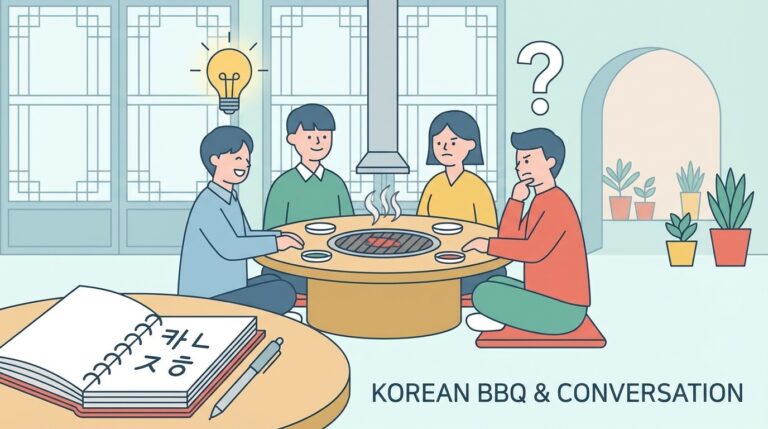
4-2. K-Food Connection: The K-BBQ Hierarchy
Let’s talk about the ultimate arena of Nunchi: The K-BBQ restaurant during a 회식 (Hoesik – Company Dinner).
If you are the 막내 (Maknae – youngest/junior), you don’t just sit there waiting for the meat to cook. Nunchi dictates that you should naturally grab the tongs, ensure the boss’s water glass is full, and laugh at their jokes. It might sound exhausting, but having “fast Nunchi” in these moments makes you the beloved star of the office! Conversely, if a senior says, “Don’t worry, I’ll grill,” having good Nunchi means letting them do it while expressing immense gratitude, rather than fighting them for the tongs.
Phase 5: Roleplay Scenario — “The K-BBQ Test”
Setting: Friday night, 7 PM. A noisy, smoke-filled Samgyeopsal (pork belly) restaurant near Gangnam Station. You are on a business trip in Korea, attending your first team dinner.
Characters:
– YOU: The foreign guest, eager to make a good impression.
– Minsu (32): Your friendly Korean coworker.
– Mr. Kim (50): The Team Leader (Boss).
Mr. Kim: 자, 오늘 회식은 내가 쏩니다! 먹고 싶은 거 다 시켜요! 🥩
(Ja, oneul hoesigeun naega ssomnida! Meokgo sipeun geo da sikyeoyo!)
[Alright, tonight’s dinner is on me! Order whatever you want!]
(🎭 Stage Direction: Mr. Kim opens the menu and smiles generously at you.)
Minsu: (Whispering to you) 오, 부장님 기분 좋으신가 봐요.
(O, bujangnim gibun joeusinga bwayo.)
[Oh, the boss must be in a good mood.]
YOU: (Whispering back) 진짜 아무거나 시켜도 돼요?
(Jinjja amugeona sikyeodo dwaeyo?)
[Can I really order anything?]
🔀 Your Turn! Use your Nunchi. How do you respond to the boss?
– A) “그럼 제일 비싼 소고기(Hanu/Beef) 3인분 주세요!” (Then 3 portions of the most expensive beef, please!)
– B) “부장님은 뭐 드시고 싶으세요? 부장님 드시는 걸로 할게요!” (What do you want to eat, boss? I’ll have whatever you’re having!)
– C) “저는 삼겹살이 좋습니다!” (I like pork belly!)✅ Best Choice: B or C.
– Why? In Korean Nunchi culture, when a senior says “order anything,” they usually mean “order anything within a reasonable boundary of what we usually eat.” Choice B is the ultimate Nunchi move—respecting the senior’s choice. Choice C is also great because pork belly is the standard, affordable, and beloved Hoesik food.
⚠️ Choice A Analysis: Total Nunchi failure! 🚫 Unless the boss specifically brought you to a luxury beef restaurant, ordering the most expensive item will create a sudden 갑분싸 (icy mood). Minsu will definitely kick you under the table!
(If you chose B…)
Mr. Kim: 하하, 역시 사회생활 잘하네. 여기 삼겹살 4인분 먼저 주세요!
(Haha, yeoksi sahoesaenghwal jalhane. Yeogi samgyeopsal sainbun meonjeo juseyo!)
[Haha, you’re good at navigating social life. We’ll take 4 portions of pork belly first!]
Phase 6: 10-Second Shadowing Drill
Let’s practice complaining to a friend about someone who has no Nunchi. Pay attention to the pauses (/) and the emotion!
😤 아 진짜, / 걔는 왜 이렇게 / 눈치가 없을까?
(Ah jinjja, / gyaeneun wae ireoke / nunchiga eopseulkka?)
[Ugh seriously, / why is he/she / so clueless?]
Tip: Stretch out the ‘아~’ (Ah~) and emphasize ‘없을까’ (eopseulkka) with an exasperated sigh.
Phase 7: K-Culture Mini Dictionary
| Korean | Romanization | English | Contextual Meaning |
|---|---|---|---|
| 눈치 | nunchi | Social tact / Wit | The core Korean social skill of reading the atmosphere without being told. |
| 회식 | hoesik | Company dinner | An extension of work in Korea, crucial for team bonding and Nunchi testing. |
| 막내 | maknae | The youngest | The youngest person in a group, often expected to have the fastest Nunchi. |
| 갑분싸 | gap-bun-ssa | Mood killer | Slang for “the atmosphere suddenly turning cold” due to someone’s lack of Nunchi. |
| 사회생활 | sahoe-saenghwal | Social/Work life | Literally “social life,” but used to describe how well one navigates office politics and hierarchy. |
Phase 8: Traveler Survival Kit 🎒
Even as a traveler, Nunchi is your best friend. Here are essential expressions to navigate public spaces without killing the vibe.
🆘 Survival Phrases for the Observant Traveler
– 🇰🇷 “여기 앉아도 되나요?” (yeogi anjado doenayo?)
– 🗣️ English: Can I sit here?
– 📍 Where to use: Crowded cafes, food courts. (Korean cafes are safe, but it’s polite to ask if a seat is clearly shared).
- 🇰🇷 “제가 눈치가 없었네요, 죄송합니다.” (jega nunchiga eopseonneyo, joesonghamnida.)
- 🗣️ English: I was clueless/didn’t read the room, I’m sorry.
- 📍 Where to use: A magical apology if you accidentally block a path, sit in a reserved seat, or break a cultural rule. It instantly softens Korean locals!
📌 Editor’s Travel Note
– Subway Nunchi: See empty seats at the ends of the subway cars? Those are strictly for the elderly, disabled, or pregnant. Even if the train is packed, people with Nunchi leave them empty!
– Cafe Nunchi: You’ll see laptops and bags left unattended on tables. Koreans have high Nunchi regarding personal property—nobody will steal it. But don’t move someone else’s bag to take their seat!
Phase 9: Critical Thinking — “One Step Deeper” 🧠
Language & Power: The Hierarchy Behind Nunchi
Why does Nunchi even exist? In Western cultures, speaking your mind directly is often praised as honesty. In Korea, heavily influenced by Confucianism, harmony within the group (the family, the company, the nation) is valued above individual desire. Therefore, explicitly stating what you want can sometimes be seen as selfish.
Instead, society developed a sophisticated radar system—Nunchi. Lower-status individuals (juniors, students) are expected to ‘read’ the needs of higher-status individuals (seniors, teachers) without them having to ask. It’s a beautiful system of silent care, but it can also be a tool of power.
💬 Your Turn: Does your culture value “speaking up” or “reading the room” more? Have you ever felt exhausted by having to guess what others want? Share your thoughts in the comments!
Phase 10: FAQ & Avoiding Common Mistakes
Q: Can I say “눈치 챙겨! (Get a clue!)” to my boss if they are being unreasonable?
A: ABSOLUTELY NOT! 🚫 That is a one-way ticket to getting fired. “눈치 챙겨” is slang used strictly among close friends or by someone much older to someone younger.
Q: Is “눈치” the same as being “considerate” (배려하다)?
A: Not quite. 배려하다 (Baeryeo-hada) is pure kindness and consideration (e.g., holding the door). 눈치 보다 is acting out of awareness or slight fear of social judgment (e.g., not eating because the boss isn’t eating).
❌ Common Mistake #1: Translating “You are so observant!” directly as “너는 나를 잘 본다” (You look at me well).
✅ Do This Instead: Say “진짜 눈치 빠르다!” (You have really fast Nunchi!). It’s the ultimate compliment for someone who anticipates your needs.
Phase 11: Summary & Action Items
One-Liner Summary: In Korea, what isn’t said is just as important as what is said—mastering Nunchi (눈치) is your key to cultural fluency!
Action Missions:
– 🥉 Bronze (Solo): Look in the mirror, sigh deeply, and practice saying “아, 분위기 파악 좀 해!” (Ah, read the room!) with pure K-Drama frustration.
– 🥈 Silver (Online): Go to YouTube, search for “갑분싸” (Gap-bun-ssa), and watch a Korean comedy sketch. Try to figure out why the mood dropped!
– 🥇 Gold (Real Life): Next time you are with Korean friends, anticipate a need (like passing a napkin before they ask). When they thank you, humbly say, “제가 또 눈치가 좀 빠르잖아요~” (You know my Nunchi is pretty quick~).
🎬 K-Culture Mission: Watch one episode of any office K-Drama (like Misaeng or Extraordinary Attorney Woo). Spot at least one scene where a character is 눈치를 보는 중 (walking on eggshells around a boss).
Did you use your Nunchi today? Let me know in the comments below! 👇
Phase 12: Interactive Quiz 🏆
1. You are at a team dinner. The boss drops their chopsticks on the floor. What is the “Fast Nunchi” (눈치가 빠른) move?
A) Point at the chopsticks and say “You dropped them.”
B) Silently wait for the waiter to notice.
C) Immediately press the call bell and hand the boss your clean spare chopsticks.
2. True or False?
Saying “대리님, 눈치가 없으시네요!” (Deputy Manager, you have no Nunchi!) is a cute and funny way to joke with your senior at work.
3. Fill in the blank:
When your friend makes a bad joke and everyone goes silent, you can whisper to them: “야, 너 때문에 ___ 됐잖아!”
(Hint: Slang for ‘suddenly icy mood’)
(Toggle for Answers)
Answers:
1. C) Taking action before the boss even asks is peak Nunchi.
2. False. Never say someone older/higher has “no nunchi” unless you want to pack your bags!
3. 갑분싸 (Gap-bun-ssa)
Frequently Asked Questions (FAQ)
Q: What does "눈치가 빠르다 / 없다 (nunchiga ppareuda / eopda)" mean in Korean and how do you pronounce it?
A: In Korean, "눈치가 빠르다 / 없다 (nunchiga ppareuda / eopda)" is pronounced [noon-chee-ga ppa-reu-da] and means: (Literal) Nunchi is fast / Nunchi doesn't exist. (Real Nuance) To be quick-witted and read the room well / To be totally clueless.
Q: What does "분위기 파악하다 (bunwigi paak-hada)" mean in Korean and how do you pronounce it?
A: In Korean, "분위기 파악하다 (bunwigi paak-hada)" is pronounced [boon-wee-gi pa-ak-ha-da] and means: (Literal) To grasp the atmosphere. (Real Nuance) To read the room, understand the current situation.
Q: What does "눈치(를) 보다 (nunchi-reul boda)" mean in Korean and how do you pronounce it?
A: In Korean, "눈치(를) 보다 (nunchi-reul boda)" is pronounced [noon-chee-reul bo-da] and means: (Literal) To look at Nunchi. (Real Nuance) To walk on eggshells, to be self-conscious of others' reactions.







