

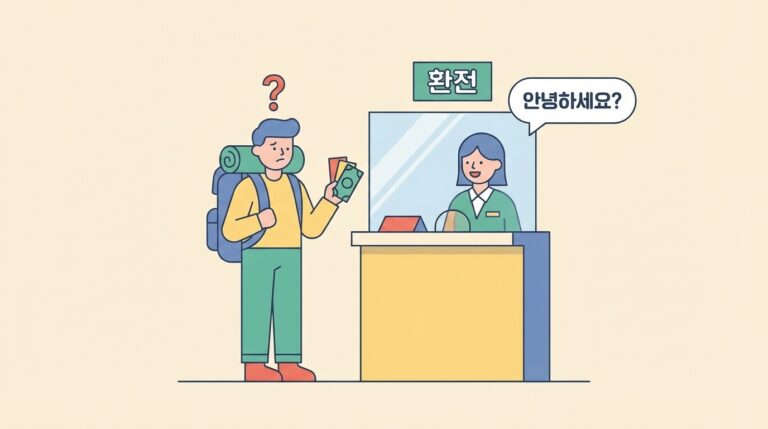
Phase 1: The ‘Cash Only’ Panic at Myeongdong
Hello! I’m your Daily Hangul Editor.
Picture this: You are standing in the middle of a bustling Korean night market. The sweet, spicy aroma of Tteokbokki (simmered rice cakes) is calling your name. Or maybe you’ve just spotted the rarest K-Pop photocards in an underground shopping mall. You pull out your shiny credit card, but the vendor crosses their arms to make an ‘X’ shape. “Cash only,” they say.
Panic! You check your wallet, but you only have your home currency. You need Korean Won (KRW), and you need it fast.
In K-Dramas, the handsome CEO just taps a sleek black card and everything is solved. But in reality? To survive the amazing world of Korean street food, local markets, and reloading your T-money transit card, you absolutely need physical cash.
Don’t worry! Exchanging money in Korea is incredibly safe and easy, provided you know exactly what to say. Today, we are going to learn the essential survival phrases to confidently exchange money like a seasoned traveler. This guide is built from the real, panicked questions of beginners who stood right where you are. Let’s dive in!
Phase 2: Core Expressions – Deep Dive
1. 환전해 주세요 (Please exchange money.)
- Pronunciation: hwan-jeon-hae ju-se-yo + [hwan rhymes with ‘swan’, jun sounds like ‘run’, heh sounds like ‘hey’ but shorter, joo-seh-yo]
- Meaning: Literal: Please do the money exchange. / Real nuance: I’d like to exchange money, please.
- K-Culture Moment: You walk into a brightly lit Myeongdong exchange booth or a traditional Korean bank. The teller smiles. You don’t need a long, complicated sentence. Just slide your money across the counter and confidently drop this phrase. It’s the ultimate magic password!
- Editor’s Insight: The word 주세요 (ju-se-yo) means “please give me” or “please do for me.” It is your best friend in Korea! You can attach it to almost anything at an A1 level to sound polite and get what you need.
- Situation Spectrum:
[🚫 절대 금지] ———— [⚠️ 주의] ———— [✅ 자유롭게]- Close friend (Casual): 🚫 (Friends don’t usually exchange currency for you!)
- Bank Teller/Clerk (Formal): ✅
- 🤔 Think About It: In English, we might say “Can I get this exchanged?” as a question. In Korean, we use a polite command (“Please exchange”). Why do you think polite commands are so common in Korean service interactions?
2. 한국 돈으로 바꿔 주세요 (Please change it to Korean money.)
- Pronunciation: han-guk do-neu-ro ba-kkwo ju-se-yo + [han-gook means Korea, dohn sounds like ‘bone’, ba-kkwo sounds like ‘bah-kwoh’]
- Meaning: Literal: To Korean money, please change. / Real nuance: Please convert this into Korean Won.
- K-Culture Moment: Imagine handing over a crisp $100 bill to the bank teller. They might ask you what you want to do with it (deposit it? send it?). This phrase clears up any confusion immediately.
- Editor’s Insight: 한국 돈 (Han-guk don) simply means “Korean money.” While the official term is 원화 (Won-hwa), saying “Korean money” is completely natural and much easier for beginners to pronounce!
- Situation Spectrum:
[🚫 절대 금지] ———— [⚠️ 주의] ———— [✅ 자유롭게]- Store Clerk: ⚠️ (Only at exchange booths or banks!)
- Bank Teller: ✅
- 🤔 Think About It: Notice the particle 으로 (eu-ro), which indicates direction or transformation (into). How does your native language express transforming one thing into another?
3. 여권 여기 있어요 (Here is my passport.)
- Pronunciation: yeo-gwon yeo-gi i-sseo-yo + [yuh-gwon (like ‘yuh’ + ‘gwon’), yuh-gee, ee-so-yo]
- Meaning: Literal: Passport here exists. / Real nuance: Here is my passport.
- K-Culture Moment: In Korea, you absolutely must have your passport to exchange money at a bank. If you use Nunchi (Korean social sense) and hand over your passport before they even ask, the teller will look at you with deep respect. You’ll instantly become a K-Bank VIP!
- Editor’s Insight: 여기 있어요 (yeo-gi i-sseo-yo) literally means “It is here.” You will use this phrase everywhere in Korea—handing your credit card to a barista, showing your ticket at a K-Pop concert, or giving your ID to a bank teller.
- Situation Spectrum:
[🚫 절대 금지] ———— [⚠️ 주의] ———— [✅ 자유롭게]- Friends: ⚠️ (A bit formal)
- Bank Teller/Officials: ✅
- 🤔 Think About It: Giving items with two hands is a sign of respect in Korea. If you say “여권 여기 있어요” while handing it over with two hands, you’re communicating respect both verbally and non-verbally!
Phase 3: Textbook vs Real Korean
| Situation | 📖 Textbook Korean | 🗣️ Real Korean | 💡 Why is it different? |
|---|---|---|---|
| Telling the clerk you want to exchange money | 환전 업무를 부탁드립니다. (I request currency exchange services.) | 환전해 주세요. (Exchange please.) | Koreans value Palli-palli (speed). Short, polite phrases are preferred in busy places! |
| Handing over your passport | 제 여권을 드리겠습니다. (I will give you my passport.) | 여권 여기요. (Passport here.) | “여기요” (Here you go) is the ultimate everyday shortcut for giving something to someone. |
| Asking the commission fee | 수수료가 얼마입니까? (How much is the commission?) | 수수료 얼마예요? (Commission how much?) | Dropping the subject particle (가) makes it sound much more natural and conversational. |
Bottom Note: As a beginner (A1), you don’t need to memorize long, robotic textbook sentences. Stick to “[Noun] + 주세요 (ju-se-yo)” and you will survive 99% of your trip!
Phase 4: Cultural Context — K-Culture Deep Dive
🙌 Non-verbal Magic: The Two-Handed Rule
Let’s talk about the unspoken language of Korea. When you are at the bank and the teller hands you a stack of crisp Korean Won, pay attention to their hands. They will likely hand it to you with both hands, or with one hand while the other lightly supports their elbow.
This is the Two-Handed Rule. In Korea, whenever you give or receive something from someone older or in a service position, using two hands is a sign of respect. When you hand over your passport, try offering it with both hands. The teller will instantly recognize your cultural appreciation!
🏦 Banks vs. Myeongdong Booths (K-Travel Survival)
Did you know Korean banks close at 4:00 PM? Yes, you read that right! If you’re out late shopping for K-Beauty products in Hongdae or eating street food, the banks will be locked tight.
That’s where the famous Myeongdong exchange booths come in. They look like tiny ticket windows, stay open late, and often have the best exchange rates in the city. There’s less small talk there—just slide your cash under the glass and say, “환전해 주세요” (Hwan-jeon-hae ju-se-yo)!
Phase 5: Real-Life Roleplay Scenario
Setting: A brightly lit bank near Gangnam Station. It’s 3:45 PM, and you just barely made it before closing! You are exhausted from your flight and desperately need cash for a taxi to your hotel.
Characters:
* YOU: A thirsty traveler who just wants to get to their accommodation.
* Ji-eun (NPC): A polite, fast-working 28-year-old bank teller wearing a neat uniform.
Dialogue:
Ji-eun: 어서 오세요. 어떻게 오셨어요?
(eo-seo o-se-yo. eo-tteo-ke o-syeo-sseo-yo?)
(English) Welcome. How can I help you?
YOU: 안녕하세요! 환전해 주세요.
(an-nyeong-ha-se-yo! hwan-jeon-hae ju-se-yo.)
(English) Hello! Please exchange money.
Ji-eun: 네, 어떤 돈으로 바꿔 드릴까요?
(ne, eo-tteon do-neu-ro ba-kkwo deu-ril-kka-yo?)
(English) Yes, what currency would you like to change it to?
YOU: 한국 돈으로 바꿔 주세요.
(han-guk do-neu-ro ba-kkwo ju-se-yo.)
(English) Please change it to Korean money.
Ji-eun: 네, 알겠습니다. 신분증이나 여권 주시겠어요?
(ne, al-ge-sseum-ni-da. sin-bun-jeung-i-na yeo-gwon ju-si-ge-sseo-yo?)
(English) Yes, understood. May I have your ID or passport?
🔀 YOUR TURN! How do you respond?
* A) (Slide the passport across the table with one hand without speaking.)
* B) “네, 여권 여기 있어요!” (Hand it over with two hands politely.)
* C) “여권 없어요.” (I don’t have a passport.)✅ Best Choice: B — You use the perfect A1 phrase and show cultural respect with two hands!
⚠️ Choice A Analysis: While they will accept it, sliding items with one hand in silence can be seen as slightly rude or dismissive in Korea.
🚫 Choice C Analysis: If you don’t have your passport, the bank cannot exchange your money. Game over!
(Continuing with Choice B)
YOU: 네, 여권 여기 있어요.
(ne, yeo-gwon yeo-gi i-sseo-yo.)
(English) Yes, here is my passport.
Ji-eun: 감사합니다. 여기에 서명해 주세요.
(gam-sa-ham-ni-da. yeo-gi-e seo-myeong-hae ju-se-yo.)
(English) Thank you. Please sign here.
YOU: 네, 다 했어요.
(ne, da hae-sseo-yo.)
(English) Yes, all done.
Ji-eun: 여기 현금과 영수증입니다. 즐거운 여행 되세요!
(yeo-gi hyeon-geum-gwa yeong-su-jeung-im-ni-da. jeul-geo-un yeo-haeng doe-se-yo!)
(English) Here is your cash and receipt. Have a nice trip!
YOU: 감사합니다! 안녕히 계세요.
(gam-sa-ham-ni-da! an-nyeong-hi gye-se-yo.)
(English) Thank you! Goodbye.
Phase 6: 10-Second Shadowing Drill
Let’s practice the flow of the sentences. Follow the slashes (/) to know where to pause!
- 😊 (Brightly, handing your money over)
저기요, / 환전해 / 주세요!
(jeo-gi-yo, / hwan-jeon-hae / ju-se-yo!) -
🙂 (Politely, confirming the currency)
이거 / 한국 돈으로 / 바꿔 주세요.
(i-geo / han-guk do-neu-ro / ba-kkwo ju-se-yo.)
Phase 7: K-Culture Mini Dictionary
| 한국어 (Korean) | Romanization | English | Cultural Context |
|---|---|---|---|
| 환전 | hwanjeon | Currency Exchange | You will see this written on signs outside banks and small booths in tourist areas. |
| 여권 | yeogwon | Passport | Absolutely mandatory for banking in Korea. Never leave your hotel without it if you need cash! |
| 현금 | hyeongeum | Cash | While Korea is a “card republic,” hyeongeum is king for street food, traditional markets, and T-money. |
| 영수증 | yeongsujeung | Receipt | Cashiers will always ask “영수증 드릴까요?” (Would you like a receipt?). You can say “아니요” (No) if you don’t need it. |
Phase 8: Traveler’s Survival Kit
If you’re out exploring and suddenly realize you need cash, use these vital survival phrases!
🆘 Survival Phrases
* 🇰🇷 “근처에 은행 있어요?” (geun-cheo-e eu-naeng i-sseo-yo?)
English: Is there a bank nearby?
* 🇰🇷 “카드 돼요?” (ka-deu dwae-yo?)
English: Do you accept credit cards?
* 💡 Pro Tip: Ask “카드 돼요?” at smaller shops before ordering food so you don’t get stuck doing the dishes!📌 Editor’s Travel Note
* Useful Apps: Download Naver Map or KakaoMap. Google Maps doesn’t work well for walking directions in Korea. Search “은행” (Bank) or “환전소” (Exchange booth).
* Cash vs Card: Korea is practically a cashless society for locals. You can buy a $1 coffee with a credit card without any dirty looks. However, charging your T-Money transit card usually requires cash at convenience stores or subway stations!
Phase 9: Critical Thinking — “One Step Deeper”
🧠 Think Deeper: Language & Power (The Two-Handed Culture)
When you hand your passport to the bank teller, we mentioned using two hands. Why is this so important? In Korean society, physical gestures are a direct reflection of the language’s politeness levels. Just as you use the polite “-yo” (요) at the end of your sentences to show respect, using two hands is the physical version of adding “-yo” to your actions. It shows humility and acknowledges the other person’s effort to help you. It’s a beautiful alignment of body language and spoken language!
💬 Your Turn: Does your culture have specific physical gestures that show respect to service workers or elders? Share it with us in the comments!
Phase 10: FAQ & Avoiding Common Mistakes
Q: Can I just show a photo of my passport on my phone to the bank teller?
No! Korean banks are very strict about financial security. You must have your physical, original passport. A copy or photo will be rejected.
Q: Is it okay to say “환전 (Hwanjeon)” without “주세요 (juseyo)”?
If you just bark “Hwanjeon!” at the teller, it sounds like “EXCHANGE!” It’s quite rude. Always add “주세요” to sound like a polite, educated traveler.
❌ Common Mistake #1: Going to the bank at 4:30 PM.
✅ Do This Instead: Korean banks operate from 9:00 AM to 4:00 PM. Plan your day so you visit the bank before a late lunch!
Phase 11: Summary & Action Items
📌 One-Liner Summary: Remember to smile, hand over your passport with two hands, and say “환전해 주세요” (Please exchange money)!
🚀 Action Mission:
* 🥉 Bronze (Solo): Stand in front of a mirror, pretend to hold out your passport with two hands, and say “여권 여기 있어요” out loud 3 times.
* 🥈 Silver (Online): Open Google Maps/Naver Map, find the area around your future Korean hotel, and search for the closest “은행” (Bank).
* 🥇 Gold (Real Life): On your next trip to Korea, confidently walk into a bank, use the two-handed rule, and successfully exchange your money using only Korean!
🇰🇷 K-Culture Mission: Watch a K-Drama set in a modern office or bank (like Business Proposal or The Interest of Love). Notice how the characters hand documents or coffee to each other. Are they using one hand or two?
Phase 12: Interactive Quiz!
1. You are at a Myeongdong exchange booth. You want to change your US Dollars to Korean Won. What is the most natural A1 phrase to say?
* A) 한국 돈으로 바꿔 주세요. (han-guk do-neu-ro ba-kkwo ju-se-yo)
* B) 영수증 주세요. (yeong-su-jeung ju-se-yo)
* C) 은행 어디 있어요? (eu-naeng eo-di i-sseo-yo)
2. True or False: In Korea, it is perfectly fine to visit a traditional bank at 5:00 PM to exchange money.
* True / False
3. Fill in the blank: When handing over your passport to the bank teller, it is best to use ______ to show respect.
* A) Only your left hand
* B) Two hands
* C) No hands, just slide it
(Answers: 1: A, 2: False – Banks close at 4 PM!, 3: B)
Frequently Asked Questions (FAQ)
Q: What does "환전해 주세요 (Please exchange money.)" mean in Korean and how do you pronounce it?
A: In Korean, "환전해 주세요 (Please exchange money.)" is pronounced [hwan-jeon-hae ju-se-yo + [hwan rhymes with 'swan', jun sounds like 'run', heh sounds like 'hey' but shorter, joo-seh-yo] and means: Literal: Please do the money exchange. / Real nuance: I'd like to exchange money, please.
Q: What does "한국 돈으로 바꿔 주세요 (Please change it to Korean money.)" mean in Korean and how do you pronounce it?
A: In Korean, "한국 돈으로 바꿔 주세요 (Please change it to Korean money.)" is pronounced [han-guk do-neu-ro ba-kkwo ju-se-yo + [han-gook means Korea, dohn sounds like 'bone', ba-kkwo sounds like 'bah-kwoh'] and means: Literal: To Korean money, please change. / Real nuance: Please convert this into Korean Won.
Q: What does "여권 여기 있어요 (Here is my passport.)" mean in Korean and how do you pronounce it?
A: In Korean, "여권 여기 있어요 (Here is my passport.)" is pronounced [yeo-gwon yeo-gi i-sseo-yo + [yuh-gwon (like 'yuh' + 'gwon'] and means: Literal: Passport here exists. / Real nuance: Here is my passport.







