

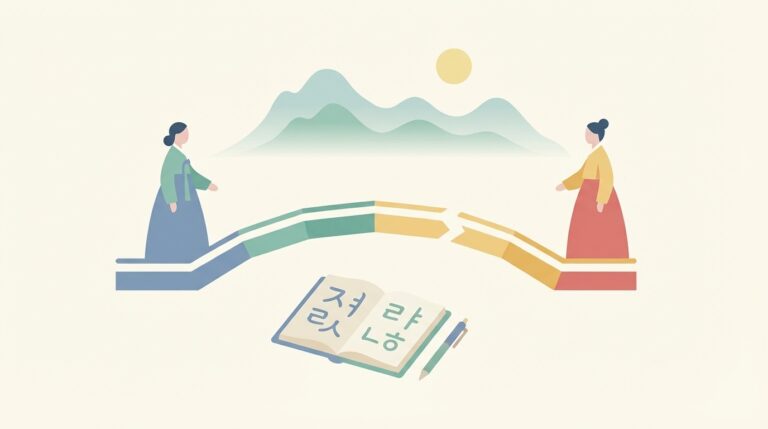
Phase 1: Empathy
Hello! Daily Hangul Editor here.
Picture this: You are watching a hit K-Drama. The female lead accidentally paraglides across the border, and a handsome soldier finds her. It’s romantic, thrilling, and… complicated. Or maybe you’re sitting in a Korean BBQ restaurant in Seoul, enjoying your pork belly, and suddenly the TV news flashes a breaking report about a missile launch from the North. You freeze, expecting panic, but your Korean friends just keep grilling the meat, completely unfazed.
Wait, what? Are they not worried?
If you’ve ever felt confused by how Koreans navigate the reality of a divided nation, you’re not alone. To truly understand Korea, you need to look beyond the neon lights of Gangnam and the romanticized K-Drama tropes. Today, we are diving deep into the B2-level vocabulary and cultural context surrounding Inter-Korean relations and unification. Knowing these nuances won’t just improve your Korean—it will show locals that you genuinely respect and understand their history.
Note: This post is crafted from real questions my B2-level students have asked after watching Korean movies or visiting the DMZ!
Phase 2: Core Expressions Deep Dive
Let’s look at the three most crucial terms you need to know to understand the conversation around the divided peninsula.
1. 통일 (Unification)
- Pronunciation: [tong-il] / Sounds like saying “tongue ill” but very quickly and softly.
- Meaning: Unification (Literal: Becoming one)
- K-Culture Moment: You will hear this word in historical K-Dramas, news broadcasts, or even in songs. In the past, children learned a song called “Our Wish is Unification” (우리의 소원은 통일).
- Editor’s Insight: This isn’t just a political term; it’s an emotional one. For older generations, it brings tears to their eyes. For younger Koreans, it often brings up economic concerns. The feeling attached to this word changes drastically depending on the speaker’s age.
- Situation Spectrum:
[🚫 Never] ———— [⚠️ Be Careful] ———— [✅ Freely]
- Close Friends (Casual): ✅ (Good for deep talks)
- Coworkers (Semi-formal): ⚠️ (Can get too political)
- Boss/Elders (Formal): ⚠️ (Listen more than you speak)
- 🤔 Think About It: Why do you think the younger generation in Korea might be less enthusiastic about “통일” than their grandparents? Does your country have a historical event that different generations view completely differently?
2. 이산가족 (Separated Families)
- Pronunciation: [isan-gajok] / “ee-sahn gah-joke”
- Meaning: Families separated by the Korean War.
- K-Culture Moment: Remember the heartbreaking movie Ode to My Father (국제시장)? The scenes of the 1983 live broadcast searching for separated families made the entire nation cry.
- Editor’s Insight: This word carries immense grief (한 – Han). It refers strictly to families torn apart by the 1950-1953 war, many of whom have never seen each other since.
- Situation Spectrum:
[🚫 Never] ———— [⚠️ Be Careful] ———— [✅ Freely]
- Close Friends (Casual): ✅
- Coworkers (Semi-formal): ✅
- Boss/Elders (Formal): ✅ (Always use with a tone of respect and empathy)
- 🤔 Think About It: Time is running out for the remaining “이산가족”. How does the concept of “family” (가족) in Korean culture amplify the tragedy of this separation?
3. 탈북민 (North Korean Defectors)
- Pronunciation: [tal-bung-min] / “tahl-boong-meen”
- Meaning: North Korean defector / refugee.
- K-Culture Moment: Shows like Now On My Way to Meet You (이제 만나러 갑니다) feature defectors sharing their life stories and talents.
- Editor’s Insight: The terminology has evolved. We used to say 탈북자 (tal-buk-ja), but “자” can sound a bit derogatory (meaning ‘person’). So, the government and media shifted to 탈북민 (“민” meaning ‘citizen’) or 새터민 (sae-teo-min, “people of a new land”) to be more welcoming.
- Situation Spectrum:
[🚫 Never] ———— [⚠️ Be Careful] ———— [✅ Freely]
- Close Friends (Casual): ✅
- Coworkers (Semi-formal): ✅
- Boss/Elders (Formal): ✅
- 🤔 Think About It: Language shapes reality. By changing “자” to “민”, what message is South Korean society trying to send to those arriving from the North?
Phase 3: Textbook vs. Real Korean
How do people actually talk about this in daily life?
| Situation | 📖 Textbook Korean | 🗣️ Real Korean | 💡 Why is it different? |
|---|---|---|---|
| Hearing news about a missile | 북한이 미사일을 발사했습니다. (North Korea launched a missile.) | 또 쐈어? (They shot another one?) | Locals are so desensitized to these threats that it’s treated like annoying weather. |
| Talking about unification | 남북통일이 꼭 이루어져야 합니다. (North-South unification must be achieved.) | 통일… 굳이 해야 돼? (Unification… do we really have to?) | Younger people worry more about taxes and economic burden than ethnic unity. |
| Describing the border | 우리는 분단국가입니다. (We are a divided country.) | 우린 아직 휴전 중이잖아. (We are still on a ceasefire, you know.) | Koreans are highly aware that the war never officially ended; it’s just paused. |
Phase 4: Cultural Context — K-Culture Deep Dive
4-1. Non-Verbal Cues: The Art of Nunchi (눈치)
When discussing North Korea with locals, your Nunchi needs to be sharp. If you ask an older Korean man about the war, maintain respectful eye contact and nod slowly. Don’t treat it like a fun action movie plot. However, if you are with university students, don’t be surprised if they brush the topic off with a joke. Read the room!
4-2. The K-Drama Connection: Dialects and Romanticization
If you’ve watched Crash Landing on You, you’ve heard the North Korean dialect (북한 사투리).
– The Trope: K-Dramas often portray North Korean soldiers as naive, pure-hearted, or intensely loyal. The dialect is used to sound rugged yet charming.
– The Reality: In reality, defectors often face discrimination in South Korea because their dialect gives them away. Many spend months in facilities like Hanawon learning South Korean standard speech and English loanwords (like “Ice Americano” or “Smartphone”) just to blend in and survive.
– Critical View: While dramas build empathy, they also heavily romanticize a very harsh reality. Never mimic a North Korean dialect as a joke in front of someone who might actually be from there.
Phase 5: Practical Roleplay Scenario
Setting: Friday evening, 7 PM. A smoky Samgyeopsal (pork belly) restaurant near Gangnam Station. You are having dinner with your Korean coworkers. The TV in the corner suddenly flashes breaking news: “North Korea fires unidentified projectile.”
Characters:
– YOU: A foreign expat who has been working in Seoul for 6 months. You are a bit nervous about the news.
– Minsu (32, Male): Your friendly Korean coworker who is more focused on the meat than the news.
Dialogue:
YOU: 어? 민수 씨, 저 뉴스 봤어요? (eo? minsu ssi, jeo nyuseu bwasseoyo?)
[English: Uh? Minsu, did you see that news?]
Minsu: 아, 네. 또 미사일 쐈나 보네요. 고기 다 익었어요, 드세요! (a, ne. tto misail ssuatna boneyo. gogi da igeosseoyo, deuseyo!)
[English: Ah, yeah. Looks like they fired another missile. The meat is fully cooked, eat up!]
(🎭 Stage Direction: Minsu casually flips a piece of pork and puts it on your plate.)
YOU: 안 무서워요? 전쟁 나는 거 아니에요? (an museowoyo? jeonjaeng naneun geo anieyo?)
[English: Aren’t you scared? Isn’t a war going to break out?]
Minsu: 에이, 늘 있는 일이에요. 신경 쓰지 마세요. (ei, neul itneun irieyo. singyeong sseuji maseyo.)
[English: Hey, it happens all the time. Don’t worry about it.]
🔀 Your Turn! How should you respond?
– A) “그래도 대피소(shelter)가 어디 있는지 알아야겠어요!” (But I need to know where the shelter is!)
– B) “진짜요? 신기하네요. 한국 사람들은 정말 무덤덤해요.” (Really? That’s fascinating. Koreans are really unfazed.)
– C) “아, 그럼 다행이네요. 잘 먹겠습니다!” (Ah, that’s a relief then. I will eat well!)✅ Best Choice: C — Why? In this social setting, Minsu is trying to reassure you and keep the mood light. Accepting his reassurance and enjoying the food shows you trust him.
⚠️ Choice B Analysis: “무덤덤하다” (unfazed/indifferent) is a great B2 word! But over-analyzing their reaction during a fun dinner might kill the vibe. Save the deep sociological analysis for a coffee chat later.
Bonus Scenario: At the DMZ Tour
Tour Guide: 저기 보이는 마을이 북한입니다. (jeogi boineun maeuri bukhanimnida. / The village you see over there is North Korea.)
YOU: 우와… 여기서 사진 찍어도 돼요? (uwa… yeogiseo sajin jjigeodo dwaeyo? / Wow… can I take a picture here?)
Tour Guide: 네, 하지만 군인들은 찍으시면 안 됩니다. (ne, hajiman gunindeureun jjigeusimyeon an demnida. / Yes, but you must not take pictures of the soldiers.)
Phase 6: 10-Second Shadowing Drill
Let’s practice a phrase you might hear in a documentary or a heartfelt drama about separated families.
😢 언젠가는 / 꼭 / 다시 만나고 싶어요.
(eonjenganeun / kkok / dasi mannago sipeoyo.)
Meaning: Someday, I definitely want to meet them again.
Pro-Tip: Emphasize the “꼭” (kkok – meaning ‘surely/definitely’) to express strong, desperate hope. Pause slightly before and after it.
Phase 7: K-Culture Mini Dictionary
| Korean | Romanization | English | Context |
|---|---|---|---|
| 군대 | gundae | Military | Because of the division, all able-bodied South Korean men must serve in the military (conscription). This heavily shapes Korean male culture and career timelines. |
| 휴전선 | hyujeonseon | Armistice Line | The actual border line dividing the two Koreas. Often used interchangeably with DMZ in daily conversation. |
| 새터민 | saeteomin | People of new land | A gentler, alternative term for North Korean defectors coined by the South Korean government. |
| 평화 | pyeonghwa | Peace | The ultimate goal often emphasized by politicians, regardless of whether actual unification happens. |
Phase 8: Traveler’s Survival Kit (DMZ Edition)
Many foreigners visiting Korea take a tour to the DMZ (Demilitarized Zone). Here is what you MUST know to survive and be respectful.
🆘 Survival Expression #1: Asking about photos
– 🇰🇷 “여기 사진 찍어도 돼요?” (yeogi sajin jjigeodo dwaeyo?)
– 🗣️ Sound-alike: “yogi sa-jin jji-go-do dway-yo?”
– 📍 Where to use: DMZ observatories, checkpoints.
– 💡 Pro Tip: Security is strict. If a soldier says “No,” put your phone away immediately.📌 Editor’s Travel Note
– Dress Code: DMZ tours often have a dress code! No ripped jeans, camouflage clothing, or sandals. Why? North Korean propaganda sometimes photographs tourists in torn clothes to claim that the rest of the world is poor.
– Booking: You cannot visit the JSA (Joint Security Area) alone. You MUST book an approved guided tour weeks in advance, and bring your physical passport.
Phase 9: Critical Thinking — “One Step Deeper”
🧠 Think Deeper: Media vs Reality (The generational gap)
In K-Dramas, unification or cross-border romances are often painted with a brush of destiny and shared bloodlines. However, if you live in Korea, you’ll notice a stark contrast in reality. For older generations who survived the war, unification is a tearful necessity—a return to a “whole” nation. But for millennials and Gen Z, North Korea feels like a completely foreign, sometimes hostile, country. They worry that sudden unification would crash the South Korean economy and raise taxes astronomically. This shift reflects how long the division has lasted; shared blood is no longer enough to bind two societies that have evolved in entirely different universes for 70 years.
💬 Your Turn: Does your country have a political or historical issue that causes a massive divide between the older and younger generations? How do you usually talk about it? Share your thoughts in the comments!
Phase 10: FAQ & Avoiding Misunderstandings
Q: Can I ask my Korean friends what they think about Kim Jong-un?
Yes, but keep it casual. Most Koreans don’t take him seriously in daily life and might just make a joke. However, avoid loudly praising or making insensitive jokes about North Korean leadership in public spaces.
Q: Is it safe to travel to Seoul? The news says tensions are high!
Absolutely safe. International media often sensationalizes North Korean missile tests. For Seoulites, it’s just another Tuesday. The crime rate in Seoul is incredibly low, and daily life is completely unaffected.
❌ Common Mistake #1: Treating North Korean defectors like aliens or overly interrogating them about their past trauma if you happen to meet one.
✅ Do This Instead: Treat them exactly like any other South Korean. Wait for them to open up about their background naturally.
Phase 11: Summary & Action Items
One-Liner Summary: Understanding terms like “통일” (Unification) and “이산가족” (Separated Families) reveals the hidden emotional depth and generational differences beneath Korea’s modern, fast-paced society.
Your Action Missions:
– 🥉 Bronze (Solo): Read the word “이산가족” out loud 3 times, remembering the heavy emotion it carries.
– 🥈 Silver (Online): Find a trailer for the movie JSA (Joint Security Area) or Ode to My Father on YouTube and read the Korean comments to see real reactions.
– 🥇 Gold (Action): If you are in Korea, book a DMZ tour! Use the phrase “사진 찍어도 돼요?” with your tour guide.
🎬 K-Culture Mission: Watch an episode of Crash Landing on You or a clip from the variety show Now On My Way to Meet You. Can you spot any differences in the accents?
Phase 12: Interactive Quiz
1. Situational Judgment: You are watching the news with your Korean host family, and a report about North Korea comes on. The grandfather sighs heavily. What is the most culturally appropriate reaction?
– A) Change the channel to a K-Pop music show.
– B) Sit quietly, nod, and show a respectful, serious expression.
– C) Loudly ask, “Why doesn’t South Korea just attack them?”
2. Fill in the Blank:
Many older Koreans cry when they think about the families torn apart by the war. These families are called __________.
– A) 탈북민 (tal-bung-min)
– B) 이산가족 (isan-gajok)
– C) 군대 (gundae)
3. True or False — K-Culture Edition:
Young Koreans in their 20s are generally just as desperate and eager for immediate unification as their grandparents. (T/F)
(Answers: 1. B, 2. B, 3. False – Many young Koreans are concerned about the economic burden.)
Frequently Asked Questions (FAQ)
Q: What does "통일 (Unification)" mean in Korean and how do you pronounce it?
A: In Korean, "통일 (Unification)" is pronounced [tong-il] and means: Unification (Literal: Becoming one)
Q: What does "이산가족 (Separated Families)" mean in Korean and how do you pronounce it?
A: In Korean, "이산가족 (Separated Families)" is pronounced [isan-gajok] and means: Families separated by the Korean War.
Q: What does "탈북민 (North Korean Defectors)" mean in Korean and how do you pronounce it?
A: In Korean, "탈북민 (North Korean Defectors)" is pronounced [tal-bung-min] and means: North Korean defector / refugee.







