

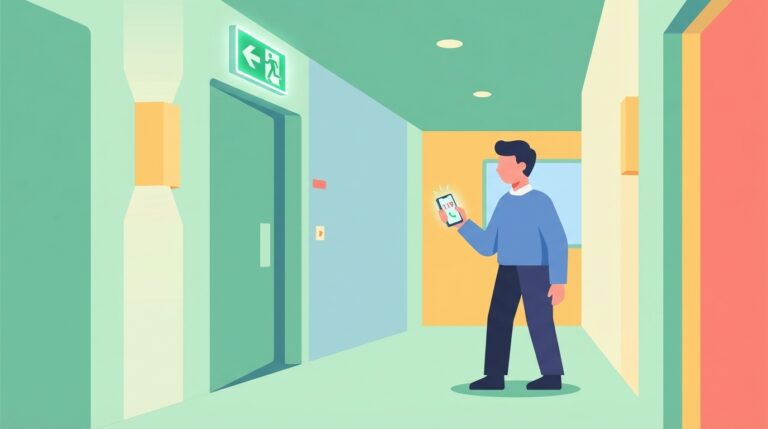
Phase 1: Empathy (The “Wait, What’s Happening?” Moment)
Hello! I’m your editor at Daily Hangul.
Picture this: You are relaxing in your cozy Seoul Airbnb after a long day of exploring Myeongdong. You’ve just ordered some delicious fried chicken and cracked open a cold beer, ready to binge-watch the latest K-Drama. Suddenly—WEE-WOO-WEE-WOO! A deafening siren echoes through the hallways.
Your heart drops. In a K-Drama, this is the moment the male lead dramatically grabs the heroine’s wrist and runs through the smoke. But in reality? You’re frozen. Do you call the police? Do you scream for help? And wait… what number do you even dial in Korea? Is it 911?
Emergencies are scary enough in your home country, but experiencing one in a foreign language can be terrifying. Today, we are going to learn exactly what to say and do when the fire alarm goes off in Korea. This isn’t just about vocabulary; it’s about survival, safety, and understanding how Korean culture reacts in a crisis. Let’s dive in!
Phase 2: Core Expressions Deep Dive
1. 불이야! (Fire!)
- Pronunciation: [bul-i-ya!] Sounds like “bull-ee-yah!” (Imagine saying “bull” then a quick “ee-yah” like a karate chop.)
- Meaning: Literal: “It’s a fire!” / Real nuance: “FIRE! EVERYONE RUN!”
- K-Culture Moment: You’ll hear this in historical K-Dramas (사극) when a spy sets the royal palace on fire, or in modern thrillers. It’s the universal scream for a fire emergency.
- Editor’s Insight: Notice that it ends in ‘야(ya)’, which is informal (반말). In a life-or-death emergency, nobody has time for polite honorifics. You just yell this at the top of your lungs to warn everyone.
- Situation Spectrum:
[🚫 Never] ———— [⚠️ Caution] ———— [✅ Freely]
- Close Friends (Casual): ✅
- Co-workers (Semi-formal): ✅ (In an actual fire, yes!)
- Boss/Elders (Formal): ✅ (Safety first!)
- 🤔 Think About It: Why does Korean drop its strict politeness levels during emergencies? Does your native language have specific “emergency-only” grammar structures?
2. 화재 경보기가 울려요. (The fire alarm is ringing.)
- Pronunciation: [hwajae gyeongbogiga ullyeoyo] “hwa-jay” (like ‘jay’ with an h) + “gyung-bo-gi-ga” + “ool-lyuh-yo”.
- Meaning: Literal & Nuance: “The fire alarm is going off.”
- K-Culture Moment: This is what you say to the hotel receptionist on the phone, or to a passing neighbor when you peek out of your door, confused.
- Editor’s Insight: ‘화재’ (hwajae) means a destructive fire (a disaster), whereas ‘불’ (bul) can just mean a flame or even a stove fire. Use this when reporting the situation objectively.
- Situation Spectrum:
[🚫 Never] ———— [⚠️ Caution] ———— [✅ Freely]
- Close Friends (Casual): ⚠️ (To friends, you’d just say “야, 사이렌 울려!” – Hey, the siren is ringing!)
- Co-workers (Semi-formal): ✅
- Boss/Elders (Formal): ✅
- 🤔 Think About It: Koreans often use passive/descriptive verbs like “is ringing” rather than “I hear an alarm.” How does this reflect the Korean tendency to focus on the situation rather than the “I” (subject)?
3. 대피해야 돼요? (Do we need to evacuate?)
- Pronunciation: [daepihaeya dwaeyo?] “dae-pee-hae-ya” + “dway-yo?”
- Meaning: Literal: “Do we have to evacuate?” / Real nuance: “Should we get out of here now?”
- K-Culture Moment: In crowded Korean apartments, false alarms happen occasionally. Instead of blindly running, Koreans often ask the building security guard (경비 아저씨) this exact question.
- Editor’s Insight: ‘대피하다’ (daepihada) means to evacuate or take shelter. Adding ‘해야 돼요?’ (do I/we have to?) makes it a practical question asking for instructions.
- Situation Spectrum:
[🚫 Never] ———— [⚠️ Caution] ———— [✅ Freely]
- Close Friends (Casual): ✅ (Drop the ‘요’: 대피해야 돼?)
- Co-workers (Semi-formal): ✅
- Boss/Elders (Formal): ✅
- 🤔 Think About It: Why do you think people wait for instructions instead of immediately running out?
Phase 3: Textbook vs. Real Korean
| Situation | 📖 Textbook Korean | 🗣️ Real Korean | 💡 Why the difference? |
|---|---|---|---|
| Announcing a fire | 화재가 발생했습니다. (A fire has occurred.) | 불이야! (Fire!) | In an emergency, brevity and volume save lives. Formalities are dropped. |
| Telling someone to run | 신속히 대피하십시오. (Please evacuate swiftly.) | 빨리 나가요! (Get out quickly!) | Official announcements use formal “-sipsio”, but real people use standard polite or casual forms. |
| Asking if it’s real | 이것은 실제 상황입니까? (Is this a real situation?) | 이거 진짜 불난 거예요? (Is this a real fire?) | Spoken Korean prefers conversational phrasing (‘불난 거예요’) over formal vocabulary (‘실제 상황’). |
Phase 4: Cultural Context — K-Culture Deep Dive
4-1. The “Nunchi” (눈치) of Emergencies
When a fire alarm goes off in a Korean apartment or mall, you might notice something strange: people don’t immediately sprint for the exits. They open their doors, peek into the hallway, and look at each other. This is Nunchi (reading the room) in action. Because false alarms (오작동) caused by cooking smoke or system glitches are somewhat common, Koreans often wait a few seconds to see if others are running or if they can smell smoke before evacuating.
4-2. K-Travel: The Green Running Man
If you are traveling in Korea, look up when you enter any building. You will see a green sign with a little man running through a door. This is the 비상구 (bisanggu – emergency exit). Unlike some Western countries where “EXIT” is written in red, Korea uses the universal green color for safety. Also, never take the elevator (엘리베이터) during a fire alarm in a Korean high-rise; always find the stairs marked by this green sign!
Phase 5: Real-Life Roleplay Scenario
Setting: A 15th-floor Airbnb in Gangnam. It’s 11 PM. You are packing your bags because your flight is tomorrow. Suddenly, the fire alarm blares loudly.
Characters:
– YOU: A foreigner visiting Korea, slightly panicked.
– Minji (28): Your Korean friend who is helping you pack.
Dialogue:
YOU: 헉! 민지 씨, 화재 경보기가 울려요! 🚨
(heok! minji ssi, hwajae gyeongbogiga ullyeoyo!)
[Gasp! Minji, the fire alarm is ringing!]
Minji: 헐! 진짜 불났어요? 타는 냄새 나요?
(heol! jinjja bullasseoyo? taneun naemsae nayo?)
[OMG! Is it a real fire? Do you smell burning?]
(🎭 Stage Direction: Minji runs to the door and sniffs the air.)
YOU: 아니요, 냄새는 안 나는데 소리가 너무 커요.
(aniyo, naemsaeneun an naneunde soriga neomu keoyo.)
[No, I don’t smell anything, but the sound is so loud.]
Minji: 안 되겠다. 일단 대피해요! 지갑이랑 여권만 챙겨요!
(an doegetda. ildan daepihaeyo! jigabirang yeogwonman chaenggyeoyo!)
[This won’t do. Let’s evacuate for now! Just grab your wallet and passport!]
YOU: 네! 우리 엘리베이터 타도 돼요?
(ne! uri ellibeiteo tado dwaeyo?)
[Okay! Can we take the elevator?]
Minji: 절대 안 돼요! 비상구 계단으로 가야 돼요.
(jeoldae an dwaeyo! bisanggu gyedaneuro gaya dwaeyo.)
[Absolutely not! We have to take the emergency exit stairs.]
YOU: 알겠어요! 제가 앞장설게요. 따라와요!
(algesseoyo! jega apjangseolgeyo. ttarawayo!)
[Got it! I’ll take the lead. Follow me!]
Minji: 연기 보이면 자세를 낮추고 입을 막아요.
(yeongi boimyeon jaseleul natchugo ibeul magayo.)
[If you see smoke, lower your posture and cover your mouth.]
(🎭 Stage Direction: You both reach the 1st floor lobby. It’s quiet.)
YOU: 1층 도착했어요. 다행히 연기는 없네요.
(ilcheung dochakaesseoyo. dahaenghi yeongineun eomneyo.)
[We reached the 1st floor. Thankfully there’s no smoke.]
Minji: 하아… 오작동이었나 봐요. 진짜 깜짝 놀랐네.
(haa… ojakdongieonna bwayo. jinjja kkamjjak nollanne.)
[Sigh… It must have been a false alarm. I was really startled.]
🔀 Your Turn! Decision Point
When Minji tells you to just grab your wallet and passport, what should you do?
– A) “잠깐만요! 내 캐리어 다 챙길게요!” (Wait! I’ll pack all my luggage!)
– B) “네, 빨리 나가요!” (Yes, let’s get out quickly!)
– C) “그냥 여기 있을게요.” (I’ll just stay here.)✅ Best Choice: B — In an emergency, leave heavy items behind.
⚠️ Choice A Analysis: Dragging a suitcase down 15 flights of stairs during an evacuation is extremely dangerous and blocks others.
Phase 6: 10-Second Shadowing Drill
Speak out loud! Follow the slashes (/) for natural pausing and intonation.
- 😱 다급하게 (Urgently): 불이야! / 빨리 / 나가요! (bul-i-ya! / ppal-li / na-ga-yo!)
- 😟 걱정스럽게 (Worried): 화재 경보기가 / 울려요. / 대피해야 돼요? (hwa-jae gyung-bo-gi-ga / ul-lyuh-yo. / dae-pi-hae-ya dway-yo?)
- 😤 단호하게 (Firmly): 엘리베이터 / 타면 / 안 돼요! (el-li-bay-ee-tuh / ta-myun / an dway-yo!)
Phase 7: K-Culture Mini Dictionary
| 한국어 | Romanization | English | Context |
|---|---|---|---|
| 비상구 | bisanggu | Emergency Exit | Literally “emergency opening.” Look for the green sign. |
| 소화기 | sohwagi | Fire Extinguisher | Red canisters found in every Korean hallway. |
| 119 | il-il-gu | Fire/Medical Emergency | The Korean equivalent of 911 for fires and ambulances. |
| 112 | il-il-ee | Police | The number to call for crimes or police assistance. |
| 오작동 | ojakdong | False Alarm / Malfunction | Very common word heard when an alarm rings by mistake. |
Phase 8: Traveler Survival Kit
🆘 Survival Phrases: Reporting an Emergency
– 🇰🇷 “여기에 불이 났어요!” (yeogie buri nasseoyo!) – There is a fire here!
– 🇰🇷 “소방차 불러주세요!” (sobangcha bulleojuseyo!) – Please call a fire engine!
– 🇰🇷 “도와주세요!” (dowajuseyo!) – Please help me!
– 📍 Where to use: Hotels, restaurants, on the street.
– 💡 Pro Tip: If you call 119 and can’t speak Korean, simply say “Help” and your location, or use a translation app. The operators have access to interpretation services for English.📌 Editor’s Travel Note
– Emergency Apps: Download the “Emergency Ready App” (안전디딤돌) by the Korean government. It provides disaster alerts (like earthquakes or fires) in English.
– Alerts on your phone: When you are in Korea, your phone will occasionally blare with a loud siren. Don’t panic! It’s often a public safety alert (재난문자) for heavy rain, missing persons, or heatwaves.
Phase 9: Critical Thinking — “One Step Deeper”
Language & Power (언어와 권력)
Korean is famous for its complex system of honorifics (존댓말) and strict social hierarchy. If you are a junior employee, you must use polite language to your boss. However, in an absolute emergency, this rule shatters. If a fire breaks out, a 20-year-old intern can scream “불이야! 빨리 나와!” (Fire! Get out quickly!) at the 60-year-old CEO without any social repercussions.
This reveals a beautiful underlying truth about Korean culture: while politeness and respect are pillars of society, human life and communal safety instantly override all social ranks. Efficiency and survival take priority over politeness.
💬 Your Turn: Does your native language have formal and informal speech? If so, do you drop formalities during an emergency? Let us know in the comments!
Phase 10: FAQ & Avoiding Misunderstandings
Q: “Can I just yell ‘Help’ in English?”
Yes! Most Koreans understand “Help!” or “Fire!” However, yelling “불이야!” will trigger a much faster, instinctual reaction from the locals around you.
Q: “If I need the police, do I call 119?”
No. This is a crucial difference! In the US, 911 handles everything. In Korea:
– 119 (일일구): Fire (소방) and Ambulance (구급).
– 112 (일일이): Police (경찰).
❌ Common Mistake #1: Calling 911.
✅ Do this instead: Memorize 119 (Fire/Medical) and 112 (Police).❌ Common Mistake #2: Taking the elevator because you are on a high floor.
✅ Do this instead: Always follow the green ‘비상구’ (Emergency Exit) signs to the stairs.
Phase 11: Summary & Action Items
- One-Liner Summary: When the fire alarm rings, don’t panic—yell “불이야!”, find the green ‘비상구’, and remember to call 119!
Action Mission 3 Steps:
– 🥉 Bronze (Solo): Stand in front of a mirror and urgently say “불이야! 대피해야 돼요?” 3 times.
– 🥈 Silver (Online): Share this post with a friend you’re planning to visit Korea with and test them: “What’s the Korean 911?”
– 🥇 Gold (Real Life): Next time you are in a Korean restaurant or hotel, locate the fire extinguisher (소화기) and the green emergency exit sign (비상구).
K-Culture Mission:
Watch any K-Drama action or thriller episode. When an emergency happens, listen closely—can you hear the characters drop their polite language and yell in banmal (casual speech)?
Phase 12: Quiz — Interactive Challenge
1. Situational Judgment: You are at a cafe and you see smoke coming from the kitchen. What is the BEST thing to yell?
– A) 저기요, 아이스 아메리카노 하나요! (Excuse me, one iced Americano!)
– B) 화재가 발생했습니다! (A fire has occurred!)
– C) 불이야! (Fire!)
Answer: C. It’s the most natural, urgent way to alert everyone. (B is too formal, like a robot).
2. True or False — K-Culture Edition:
“If you need the police because your wallet was stolen, you should call 119.”
Answer: False! 119 is for fire and medical emergencies. For the police, call 112.
3. Fill in the Blank:
(You hear the alarm, but no one is moving. You ask your coworker)
“우리 ________ 돼요?” (Should we evacuate?)
Answer: 대피해야 (daepihaeya)
Stay safe out there, and remember that confidence in your Korean will help you even in the scariest situations! What emergency phrase do you want to learn next? Let me know below!
Frequently Asked Questions (FAQ)
Q: What does "불이야! (Fire!)" mean in Korean and how do you pronounce it?
A: In Korean, "불이야! (Fire!)" is pronounced [bul-i-ya!] and means: Literal: "It's a fire!" / Real nuance: "FIRE! EVERYONE RUN!"
Q: What does "화재 경보기가 울려요. (The fire alarm is ringing.)" mean in Korean and how do you pronounce it?
A: In Korean, "화재 경보기가 울려요. (The fire alarm is ringing.)" is pronounced [hwajae gyeongbogiga ullyeoyo] and means: Literal & Nuance: "The fire alarm is going off."
Q: What does "대피해야 돼요? (Do we need to evacuate?)" mean in Korean and how do you pronounce it?
A: In Korean, "대피해야 돼요? (Do we need to evacuate?)" is pronounced [daepihaeya dwaeyo?] and means: Literal: "Do we have to evacuate?" / Real nuance: "Should we get out of here now?"







