

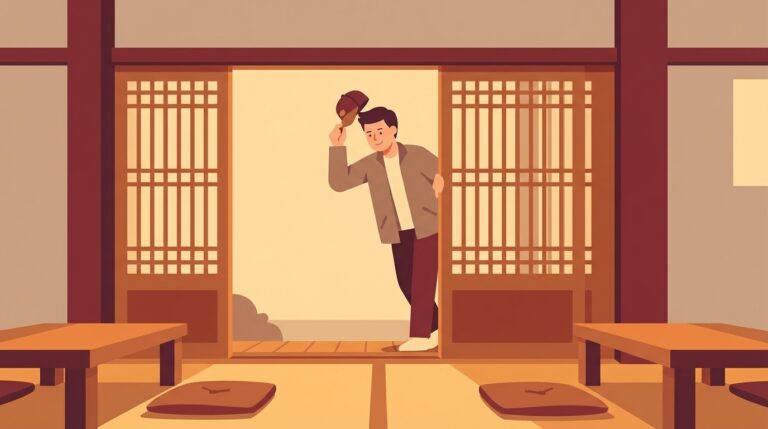
Don’t Be ‘That’ Tourist: The Unspoken Rule of Taking Off Your Hat in Korea
Phase 1: Empathy (Immersive Open)
Hello! I’m your Daily Hangul Editor.
Picture this: You are watching a K-Drama. The rebellious teenage son sits down at the breakfast table wearing his favorite baseball cap. Suddenly—Smack!—his mom hits him on the back. “Take that hat off at the table!” she scolds. The subtitles might just say “Take it off,” but the cultural weight behind that slap is huge.
As a foreigner in Korea, no one is going to smack your back for wearing a beanie indoors. But if you walk into a traditional restaurant, a friend’s home, or a formal meeting with your hat on, you might get some uncomfortable stares.
Why? Because in Korea, showing your full face—especially to your elders—is a basic sign of respect. Today, we are going to learn how to ask about indoor hat etiquette, how to politely respond if someone asks you to remove yours, and the deep cultural why behind it. All of this is based on real embarrassing moments my students have shared with me, so you don’t have to make the same mistakes!
Phase 2: Core Expressions Deep Dive
Let’s learn the 3 most important phrases you’ll need around this topic.
1. 모자 벗어야 해요?
- Pronunciation: moja beoseoya haeyo? [MO-ja BUH-suh-ya HAE-yo?]
- Tip: ‘어(eo)’ sounds like the ‘uh’ in “uh-oh.”
- Meaning: Do I have to take off my hat? (Literal: Hat must take off do?)
- K-Culture Moment: You just entered a nice Korean BBQ restaurant or a temple. You want to be polite, so you ask the staff or your Korean friend this question before sitting down.
- Editor’s Insight: This is a very innocent, polite way to ask. It shows you care about Korean culture!
- Situation Spectrum:
[🚫 Never] ———— [⚠️ Be Careful] ———— [✅ Freely]
- Close Friends (Casual): ✅ (Say: 모자 벗어야 돼? – moja beoseoya dwae?)
- Coworkers/Staff (Semi-formal): ✅
- Boss/Elders (Formal): ⚠️ (Better to just take it off without asking!)
- 🤔 Think About It: Why is asking before acting so appreciated in Korea? Does your culture value anticipating rules before being told?
2. 모자 좀 벗어주시겠어요?
- Pronunciation: moja jom beoseojusigesseoyo? [MO-ja JOM BUH-suh-joo-she-GESS-uh-yo?]
- Meaning: Could you please take off your hat? (Literal: Hat a little take off give will you?)
- K-Culture Moment: You are getting your passport checked at Incheon Airport, or you are at a formal museum. An official says this to you.
- Editor’s Insight: The magic word here is 좀 (jom), meaning “a little.” Koreans use it to soften a request so it doesn’t sound like a strict order. If you hear this, don’t panic! They are being very polite.
- Situation Spectrum:
[🚫 Never] ———— [⚠️ Be Careful] ———— [✅ Freely]
- Friends to you: 🚫 (Too formal! They’d just say “모자 벗어”)
- Staff to you (Formal): ✅
- 🤔 Think About It: Koreans love using “a little” (jom) to make commands sound softer. How do you soften a command in English?
3. 여기서는 모자 벗는 게 예의예요.
- Pronunciation: yeogiseoneun moja beonneun ge yeuiyeyo. [YUH-gi-suh-neun MO-ja BUN-neun geh YEH-ee-yeh-yo.]
- Meaning: It’s polite to take off your hat here.
- K-Culture Moment: You are visiting your Korean friend’s grandmother’s house. Your friend leans in and whispers this to you at the doorway.
- Editor’s Insight: ‘예의 (ye-ui)’ means manners or etiquette. This is a very direct but helpful explanation.
- Situation Spectrum:
[🚫 Never] ———— [⚠️ Be Careful] ———— [✅ Freely]
- Informing a friend (Semi-formal): ✅
- 🤔 Think About It: Why are there specific “zones” for politeness in Korea (like entering a house)?
Phase 3: Textbook vs. Real Korean
| Situation | 📖 Textbook Korean | 🗣️ Real Korean | 💡 Why the difference? |
|---|---|---|---|
| Telling someone to remove their hat | 모자를 벗으십시오. (mojareul beoseusipsio.) | 모자 잠깐만 벗어주세요~ (moja jamkkanman beoseojuseyo~) | “잠깐만(just a moment)” makes the request feel less aggressive and more friendly. |
| Asking if you should take it off | 제가 모자를 벗어야 합니까? (jega mojareul beoseoya hamnikka?) | 모자 벗을까요? (moja beoseulkkayo?) | The real Korean phrase implies “Shall I?” which is softer and shows Nunchi (reading the room). |
Phase 4: Cultural Context — K-Culture Deep Dive
4-1. Non-Verbal Cues: The Art of Nunchi
When dealing with etiquette like taking off hats, 눈치 (Nunchi)—the subtle art of reading the room—is your best friend. Look around. Are older people eating? Are you indoors at a house? Take the hat off. When you take it off, do it gently, and give a slight bow if you are greeting someone. Don’t toss it on the dining table; place it on the spare chair or in your bag.
4-2. The K-Drama Connection: The Dinner Table
Have you noticed in K-Dramas that the dining table is sacred? Families fight, make up, and bond over food. Eating together is a sign of ultimate respect and intimacy. Wearing a hat at the table creates a physical barrier between you and the other person. In a drama, a character keeping their cap pulled down low while eating is a classic trope showing they are hiding a secret, feeling ashamed, or rebelling against their parents. If you want to show you are open and respectful, let them see your eyes!
Phase 5: Real-Life Roleplay Scenario
Setting: Friday evening, 6 PM. You are invited to your Korean friend Minsu’s family home for the first time. You are wearing a stylish beanie because it’s cold outside. You step into the entryway (현관 – hyeongwan).
Characters:
– YOU: A foreigner eager to make a good impression.
– Minsu (30): Your friendly Korean friend.
– Minsu’s Mother (60): Warm, welcoming, but traditional.
Dialogue:
Minsu: 어서 와! 우리 엄마야. 😊
(eoseo wa! uri eommaya.)
[Welcome! This is my mom.]
(🎭 Stage Direction: Minsu points to his smiling mother)
YOU: 안녕하세요! 초대해 주셔서 감사합니다.
(annyeonghaseyo! chodaehae jusyeoseo gamsahamnida.)
[Hello! Thank you for inviting me.]
Minsu’s Mother: 아이고, 반가워요! 추운데 얼른 들어와요.
(aigo, bangawoyo! chuunde eolleun deureowayo.)
[Oh my, nice to meet you! It’s cold, come on in quickly.]
Minsu: (Whispering to you) 야, 근데…
(ya, geunde…)
[Hey, by the way…]
Minsu: 실내에서는 모자 벗는 게 좋아. 어른들 앞이잖아.
(sillaeseoneun moja beonneun ge joa. eoreundeul apijana.)
[It’s better to take off your hat indoors. You’re in front of elders.]
🔀 YOUR TURN! How do you respond?
– A) “아, 몰랐어요. 모자 벗어야 해요?” (Oh, I didn’t know. Do I have to take it off?)
– B) “아, 네! 바로 벗을게요. 죄송합니다.” (Ah, yes! I’ll take it off right away. I’m sorry.)
– C) “제 스타일이에요. 안 벗을래요.” (It’s my style. I won’t take it off.)✅ Best Choice: B — You showed Nunchi! Acknowledging the mistake politely and acting quickly is the best way to charm Korean parents.
⚠️ Choice A Analysis: While grammatically correct, asking “Do I have to?” after being told it’s better to do so can sound a bit defensive. Just take it off!
(Bonus K-Culture Scenario)
At a K-Pop Fan Sign Event:
You are wearing a giant frog hat to make your favorite idol laugh. You step up to the table.
Staff: 팬분, 얼굴 확인을 위해 모자 잠깐만 벗어주시겠어요?
(paenbun, eolgul hwagineul wihae moja jamkkanman beoseojusigesseoyo?)
[Fan, could you take off your hat for a moment to verify your face?]
YOU: 아, 네! (Takes off hat quickly) 다시 써도 돼요?
(a, ne! dasi sseodo dwaeyo?)
[Ah, yes! Can I put it back on?]
Staff: 네, 확인됐습니다. ^^ (Yes, verified.)
Phase 6: 10-Second Shadowing Drill
Practice these lines out loud. Pay attention to the pauses (/) and the emotions!
- 🥺 (Politely asking): 저기요, / 제가 / 모자를 / 벗어야 해요?
(jeogiyo, / jega / mojareul / beoseoya haeyo?) - 😲 (Realizing a mistake): 아! / 몰랐어요. / 당장 / 벗을게요!
(a! / mollasseoyo. / dangjang / beoseulgeyo!) - 😊 (Friendly staff): 실례지만, / 모자 좀 / 벗어주시겠어요?
(sillyejiman, / moja jom / beoseojusigesseoyo?)
Phase 7: K-Culture Mini Dictionary
| Korean | Romanization | English | Context |
|---|---|---|---|
| 눈치 | nunchi | Social sense | The ability to read the room and know how to act without being told. |
| 예의 | yeui | Manners / Etiquette | The rules of polite behavior, heavily based on age and hierarchy. |
| 실내 | sillae | Indoors | Spaces inside buildings. In Korea, rules change drastically when you move from outdoors to indoors (taking off shoes, hats). |
| 어른 | eoreun | Elder / Adult | Anyone older than you, especially older generations. They are treated with high respect. |
Phase 8: Traveler Survival Kit
Since indoor etiquette often involves taking things off at the door, here are the top survival phrases for entering places in Korea!
🆘 Survival Phrases: Entering a Korean Space
– 🇰🇷 “신발 벗고 들어가요?” (sinbal beotgo deureogayo?)
– 🗣️ Pronunciation: [SHIN-bal BUT-go DEU-ruh-ga-yo?]
– 📍 Where to use: Traditional restaurants, guesthouses, clinics.
– 💡 Meaning: Do I take off my shoes and go in?
- 🇰🇷 “여기 모자 둬도 돼요?” (yeogi moja dwodo dwaeyo?)
- 🗣️ Pronunciation: [YUH-gi MO-ja DWUH-do DWAE-yo?]
- 📍 Where to use: Cafes, restaurants.
- 💡 Meaning: Can I leave my hat here?
📌 Editor’s Travel Note:
– If you are wearing a hat because of a “Bad Hair Day,” don’t worry! In modern cafes, shopping malls, and casual restaurants, young Koreans wear baseball caps all the time. The “take off your hat” rule really only applies when dining with older people, visiting homes, or entering formal institutions.
Phase 9: Critical Thinking — “One Step Deeper”
🧠 Think Deeper: Age, Hierarchy, and Respect
Why does taking off a hat matter so much? In traditional Korean culture (influenced by Confucianism), showing respect to elders (어른) is the foundation of society. Taking off your hat is a symbol of lowering your guard, removing barriers, and presenting your true, humble self to someone of higher status. It’s similar to how Koreans bow instead of just waving. The physical action represents a mental attitude of respect.
💬 Your Turn:
In your culture, what is a physical action you must do to show respect to older people or in formal situations? Share it in the comments below!
Phase 10: FAQ & Mistake Prevention
- Q: Can I wear a cap in a trendy Seoul cafe?
- A: Yes, absolutely! Young people wear caps, beanies, and bucket hats indoors all the time for fashion. Just remember to take it off if you go to a fancy restaurant or visit someone’s parents.
- Q: What if I have a really bad hair day and my Korean boss invites me to dinner?
- A: Take it off anyway! Bad hair is easily forgiven; bad manners are not.
❌ Common Mistake #1: Leaving your hat on while bowing to say “Hello” to an older person.
✅ Do This Instead: Take the hat off before you bow, hold it in your hands, and then say “안녕하세요!” (Hello!). It makes you look 100x more respectful.
Phase 11: Summary & Action Items
One-Liner Summary: In Korea, taking off your hat indoors (especially around elders) is a silent but powerful way to show respect and great Nunchi!
Action Mission:
– 🥉 Bronze (Solo): Stand in front of a mirror, take off an imaginary hat, and say “모자 벗어야 해요?” out loud.
– 🥈 Silver (Online): Comment below telling us if people wear hats indoors in your country!
– 🥇 Gold (Real Life): The next time you enter a traditional Korean restaurant, take off your hat at the door. Watch how warmly the owners treat you!
🎬 K-Culture Mission:
Watch one episode of a family K-Drama this week. Look closely at the dining table scenes. Does anyone wear a hat? (Spoiler: Probably not!)
Phase 12: Interactive Quiz
1. Situational Judgment: You are walking into a modern hip-hop cafe in Hongdae with friends. Should you take off your stylish bucket hat?
– A) Yes, always take off hats indoors.
– B) No, it’s a casual setting with friends, so fashion rules apply here.
2. Fill in the Blank: To politely ask someone to take off their hat, you can say: “모자 ( ____ ) 벗어주시겠어요?”
– A) 많이 (a lot)
– B) 좀 (a little)
3. True or False – K-Culture Edition: You must take off your hat when riding the Seoul subway.
– True / False
(Answers: 1. B – Casual places are fine! / 2. B – ‘jom’ softens the request. / 3. False – Public transit is perfectly fine for hats!)
Frequently Asked Questions (FAQ)
Q: What does "모자 벗어야 해요?" mean in Korean and how do you pronounce it?
A: In Korean, "모자 벗어야 해요?" is pronounced [moja beoseoya haeyo? [MO-ja BUH-suh-ya HAE-yo?] and means: a key conversational Korean expression covered in this lesson.
Q: What does "모자 좀 벗어주시겠어요?" mean in Korean and how do you pronounce it?
A: In Korean, "모자 좀 벗어주시겠어요?" is pronounced [moja jom beoseojusigesseoyo? [MO-ja JOM BUH-suh-joo-she-GESS-uh-yo?] and means: Could you please take off your hat? (Literal: Hat a little take off give will you?)
Q: What does "여기서는 모자 벗는 게 예의예요." mean in Korean and how do you pronounce it?
A: In Korean, "여기서는 모자 벗는 게 예의예요." is pronounced [yeogiseoneun moja beonneun ge yeuiyeyo. [YUH-gi-suh-neun MO-ja BUN-neun geh YEH-ee-yeh-yo.] and means: It's polite to take off your hat here.







