

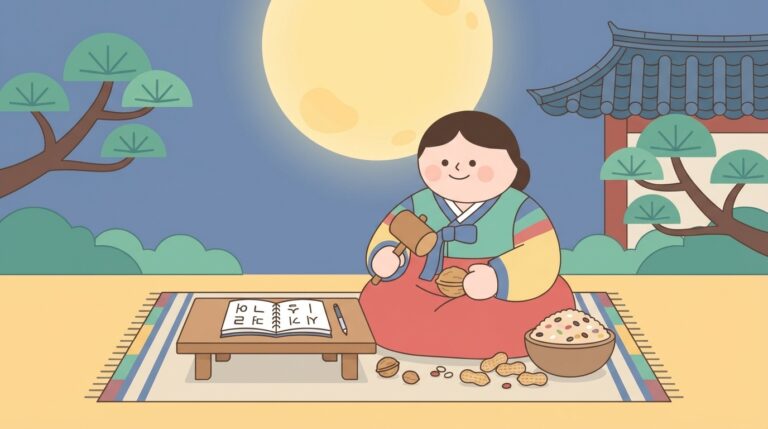
Hello there! I’m your Lead Editor at Daily Hangul.
Imagine this: You’re watching a Korean variety show featuring your favorite K-Pop idols. Suddenly, one member shouts “Buy my heat!” at another and runs away laughing. Meanwhile, the others are aggressively biting into raw walnut shells, making loud CRACK sounds. What on earth is happening? Is this some weird punishment game?
Not at all! Welcome to Jeongwol Daeboreum (정월 대보름), the first full moon of the Lunar New Year.
While Seollal (Lunar New Year) gets all the global spotlight, Daeboreum (which falls on the 15th day of the lunar calendar) is actually the day packed with the most interactive, food-centric, and slightly bizarre Korean customs. If you want to move beyond textbook Korean and truly impress your local friends—or understand what your bias is talking about on their February Weverse live—you need to know how to navigate this day.
As a veteran tutor who has seen countless C1 students master complex grammar but freeze when a Korean friend hands them a whole peanut and says “Crack it!”, I’m here to guide you. This post is built on real questions from advanced learners just like you. Let’s dive into the authentic language of Korea’s most playful seasonal custom!
Phase 2: Core Expressions Deep Dive
1. 부럼 깨자! (Let’s crack nuts!)
- Pronunciation: bureom kkaeja! [boo-rum ggae-jah] (The ‘ㄲ/kk’ sounds like the sharp, tense ‘g’ in ‘sky’, not an airy ‘k’).
- Meaning: (Literal) Let’s crack bureom! / (Real Nuance) Let’s do the traditional nut-cracking ritual to ward off bad luck and wish for health.
- K-Culture Moment: It’s February. You walk into the office, and a senior colleague has left a small bag of unpeeled peanuts and walnuts on everyone’s desk. They walk by and cheerfully say, “오늘 대보름이니까 부럼 깨자!” (It’s Daeboreum today, let’s crack nuts!).
- Editor’s Insight: Bureom (부럼) specifically refers to hard-shelled nuts (walnuts, peanuts, chestnuts, pine nuts) eaten on this day. The tradition says cracking them with your teeth makes a loud noise that scares away evil spirits and prevents boils (부스럼 – buseureom) for the year. It’s a fun, communal activity.
- Situation Spectrum:
[🚫 Absolutely Not] ———— [⚠️ Be Careful] ———— [✅ Freely Use]- Friends (Casual): ✅ (부럼 깨자!)
- Colleagues (Semi-formal): ✅ (부럼 깨요!)
- Boss/Elders (Formal): ⚠️ (부럼 깨시죠! – A bit too direct; usually elders initiate this).
- 🤔 Think About It: “Bureom” (nuts) sounds almost exactly like “Buseureom” (skin boils). Koreans have historically used wordplay and homophones in their superstitions. Does your native language have traditions based on rhyming or similar-sounding words?
2. 내 더위 사가라! (Buy my heat!)
- Pronunciation: nae deowi sagara! [neh duh-wee sah-gah-rah]
- Meaning: (Literal) Buy my heat! / (Real Nuance) Take my summer heat so I won’t suffer this summer!
- K-Culture Moment: This is the ultimate Daeboreum prank. On the morning of Daeboreum, you must call someone’s name. If they answer “Yes?”, you immediately shout “내 더위 사가라!” Congratulations, you’ve just sold them your portion of the grueling Korean summer heat. You’ll see K-Drama characters or idols trying to trick each other with this all morning.
- Editor’s Insight: It’s a playful linguistic trap. The only way to defend yourself if someone calls your name is to strike first by saying “내 더위 사가라!” before they do, or by completely ignoring them (which requires extreme nunchi).
- Situation Spectrum:
[🚫 Absolutely Not] ———— [⚠️ Be Careful] ———— [✅ Freely Use]- Friends (Casual): ✅ (Go wild!)
- Colleagues (Semi-formal): ⚠️ (Only if you are very close).
- Boss/Elders (Formal): 🚫 (Do NOT try to sell your summer heat to your CEO).
- 🤔 Think About It: This implies that ‘heat’ or ‘hardship’ is something that can be traded or passed on like a commodity. What does this tell us about the traditional Korean view of nature and human agency?
3. 올 한 해 무사태평하게 해주세요. (Please let this year be peaceful.)
- Pronunciation: ol han hae musataepyeonghage haejuseyo. [ohl hahn heh moo-sah-teh-pyeong-hah-geh heh-joo-seh-yo]
- Meaning: (Literal) Please make this one year safe and peaceful. / (Real Nuance) I wish for a year free of trouble and full of peace.
- K-Culture Moment: When you are actually cracking the nut, or when you go outside at night to look at the full moon (달맞이 – dalmaji), you clasp your hands together and say this. It’s the solemn, wishing part of the holiday.
- Editor’s Insight: “무사태평 (無事泰平)” is a four-character idiom (Saja-seongeo) meaning “no trouble, great peace.” Using this instead of just “건강하게 해주세요” (Make me healthy) immediately elevates your Korean to a sophisticated C1 level.
- Situation Spectrum:
[🚫 Absolutely Not] ———— [⚠️ Be Careful] ———— [✅ Freely Use]- This is a wish directed at the moon/heavens, so you can say it anywhere, to anyone! ✅
Phase 3: Textbook vs. Real Korean
| Situation | 📖 Textbook Korean | 🗣️ Real Korean | 💡 Why the difference? |
|---|---|---|---|
| Explaining the custom | 정월 대보름에는 견과류를 먹습니다. (We eat nuts on Daeboreum.) | 오늘 부럼 깨는 날이잖아! (Today is the day we crack bureom!) | Real life focuses on the culturally specific action (cracking bureom) rather than a clinical description of eating nuts. |
| Wishing someone well | 올해 건강하시길 바랍니다. (I hope you are healthy this year.) | 올해도 무사태평합시다! (Let’s have a peaceful year again!) | Using traditional idioms (Saja-seongeo) fits the festive mood much better. |
| Morning greeting on Daeboreum | 좋은 아침입니다. (Good morning.) | 야, 내 더위 사가라! (Hey, buy my heat!) | It’s a culturally sanctioned day for this specific morning prank among friends. |
Phase 4: Cultural Context — K-Culture Deep Dive
4-1. Non-verbal Nuances: The Louder, The Better
When you crack bureom, do not be polite about it. In everyday Korean dining culture, making loud noises while eating is generally frowned upon. However, Jeongwol Daeboreum is the exception! The superstition relies on the sound of the crack to scare away evil spirits (귀신 – gwisin). So, channel your inner K-Drama villain and bite down with dramatic flair.
Safety Note: In modern times, dentists highly advise against actually using your teeth for hard walnuts. Biting a peanut is fine, but for walnuts, Koreans now use nutcrackers. You can just crack it with your hands/tool while making the wish!
4-2. The K-Food Connection: Ogokbap & Namul
If you go to a Korean restaurant around this time, you might be surprised to see your standard white rice replaced by a purplish, multi-textured bowl of rice. This is Ogokbap (오곡밥)—five-grain rice. You will also be served various dried and seasoned vegetables called 묵은 나물 (Mugeun Namul).
Why? In the past, late winter was a time of nutritional scarcity in Korea. Eating nutrient-dense grains and vegetables dried from the previous spring was a brilliant survival strategy masked as a holiday tradition. Today, eating Ogokbap with neighbors is a symbol of community. In fact, tradition dictates you must eat Ogokbap from at least three different households to receive good luck!
Phase 5: Interactive Roleplay Scenario
Setting: Friday evening, late February. You are at a bustling local pub (호프집) in Hongdae with your Korean university friends. The table is cluttered with empty beer glasses and half-eaten fried chicken.
Characters:
– YOU: An international student in Seoul, pretty confident in your Korean, but still learning the cultural quirks.
– Min-su (24): The playful mood-maker of the group. Always looking for a laugh.
– Ji-eun (23): The caring “mom” of the friend group.
Dialogue:
Min-su: (Pulling a brown paper bag out of his backpack) 자, 다들 주목! 내가 오늘 누나 몰래 집에서 훔쳐온 게 있지. 🥜
(ja, dadeul jumok! naega oneul nuna mollae jibeseo humcheoon ge itji.)
[Alright, everyone pay attention! I brought something I secretly stole from my sister’s house today.]
(🎭 Stage Direction: Min-su dumps a pile of whole walnuts and peanuts onto the table.)
Ji-eun: 아, 맞다! 오늘 대보름이지? 나 완전 까먹고 있었네.
(a, matda! oneul daeboreumiji? na wanjeon kkameokgo isseonne.)
[Oh, right! Today is Daeboreum, isn’t it? I completely forgot.]
Min-su: 한국 생활 3년 차인 우리 외국인 친구님! 이게 뭔지 아십니까?
(hanguk saenghwal samnyeon chain uri oegugin chingunim! ige mwonji asimnikka?)
[Our international friend in your 3rd year in Korea! Do you know what this is?]
YOU: 당연하지! 부럼이잖아. 부럼 깨자!
(dangyeonhaji! bureomijana. bureom kkaeja!)
[Of course! It’s bureom. Let’s crack bureom!]
Min-su: 오~ 역시. 좋아, 다들 하나씩 들어.
(o~ yeoksi. joa, dadeul hanassik deureo.)
[Oh~ as expected. Alright, everyone grab one.]
Ji-eun: 야, 호두는 이빨로 깨지 마. 임플란트 비용 네가 낼 거 아니잖아.
(ya, hoduneun ippallo kkaeji ma. impeullanteu biyong nega nael geo anijana.)
[Hey, don’t crack the walnuts with your teeth. It’s not like you’re going to pay for our dental implants.]
Min-su: (Laughing mischievously and suddenly staring right at you) 어, 잠깐만. [Your Name]아!
(eo, jamkkanman. [Your Name]-a!)
[Uh, wait a second. [Your Name]!]
🔀 Your Turn! How do you respond to Min-su calling your name so suddenly?
- A) “어? 왜?” (Huh? Why?)
- B) “내 더위 사가라!!!” (Buy my heat!!!)
- C) (Stare at him silently without answering)
✅ Best Choice: B or C.
Analysis: If you chose A, Min-su will immediately shout “내 더위 사가라!” and you will be cursed with his summer heat. It’s a trap! If you choose B, you brilliantly counter-attack him. If you choose C, you show ultimate nunchi by not falling for it, leaving him awkward.
(Assuming you chose B…)
YOU: 내 더위 사가라!!! 🥵
(nae deowi sagara!!!)
[Buy my heat!!!]
Min-su: (Looking shocked and defeated) 와… 졌다. 넌 진짜 이제 반은 한국인이다.
(wa… jyeotda. neon jinjja ije baneun hanguginida.)
[Wow… I lost. You are seriously half-Korean now.]
Ji-eun: ㅋㅋㅋ 자, 헛소리 그만하고. 다들 올해도 무사태평하게 해주세요~ 하고 깨는 거야. 하나, 둘, 셋!
(ㅋㅋㅋ ja, heotsori geumanhago. dadeul olhaedo musataepyeonghage haejuseyo~ hago kkaeneun geoya. hana, dul, set!)
[Hahaha. Alright, stop talking nonsense. Everyone say ‘Please let us be peaceful this year too~’ and crack them. One, two, three!]
(🎭 Stage Direction: Everyone cracks their peanuts together, making a loud crunching sound over the pub music.)
Phase 6: 10-Second Shadowing Drill
Practice making this sound as natural as a native speaker! Pay attention to the pauses (/) and emotions.
😤 Playfully aggressive:
야! / 내 더위 / 사가라!
(ya! / nae deowi / sagara!)🙏 Sincere and warm:
올해는 / 부럼 깨고 / 무사태평하자~
(olhaeneun / bureom kkaego / musataepyeonghaja~)
Phase 7: K-Culture Mini Dictionary
| Korean | Romanization | English | Cultural Context |
|---|---|---|---|
| 눈치 | nunchi | Social sense/wit | The core Korean ability to read the room. Crucial for dodging the “buy my heat” prank! |
| 무사태평 | musataepyeong | Absolute peace | A traditional idiom often used during New Year and Daeboreum wishes. |
| 오곡밥 | ogokbap | Five-grain rice | A healthy mix of glutinous rice, sorghum, millet, red beans, and black beans eaten on Daeboreum. |
| 귀밝이술 | gwibalgisul | Ear-quickening wine | Cheongju (clear rice wine) drank cold on Daeboreum morning. Legend says it makes your ears sharp to hear only good news all year. |
Phase 8: Traveler’s Survival Kit
If you are traveling in Korea around February (roughly two weeks after Lunar New Year), local markets like Gwangjang Market or Namdaemun Market will be overflowing with nuts and dried vegetables. Here is how you navigate it!
🆘 Survival Phrases for the Market
🇰🇷 1. “부럼 세트 있어요?” (bureom sete isseoyo?)
– 🗣️ Meaning: Do you have a bureom set?
– 📍 Where to use: Supermarkets, traditional markets. They often sell pre-packaged mixed nuts specifically for this day!🇰🇷 2. “오곡밥 파나요?” (ogokbap panayo?)
– 🗣️ Meaning: Do you sell five-grain rice?
– 📍 Where to use: Banchan (side dish) shops in markets. They sell it ready-made!🇰🇷 3. “호두까기 있어요?” (hodukkagi isseoyo?)
– 🗣️ Meaning: Do you have a nutcracker?
– 📍 Where to use: Daiso or local household goods stores. (Save your teeth!)📌 Editor’s Travel Note
If you visit traditional folk villages (like Korean Folk Village in Yongin or Namsangol Hanok Village in Seoul) on Daeboreum, you can witness Daljip Taeugi (Burning the Moon House)—a massive bonfire event where people burn a large pile of pine branches to ward off misfortune. It’s a spectacular photo op!
Phase 9: Critical Thinking — “One Step Deeper”
🧠 Think Deeper: Food & Identity (음식과 정체성)
Why does Korean culture tie almost every holiday so intimately to specific foods? In the case of Jeongwol Daeboreum, eating Ogokbap and sharing it with neighbors wasn’t just a superstition; it was a communal safety net. In the agrarian society of the past, the end of winter was when food stores ran dangerously low. By creating a “superstition” that mandated sharing highly nutritious grains and dried vegetables with at least three neighbors, the society ensured that the poorest members wouldn’t starve before spring arrived.
Behind the playful act of cracking nuts lies a profound cultural DNA of Jeong (정 – communal affection and responsibility). Language and tradition here are tools for collective survival.
💬 Your Turn: Does your culture have a specific holiday food that was originally created for practical survival or health reasons? Share it in the comments below!
Phase 10: FAQ & Avoiding Mistakes
Q: Can I use almonds or pistachios for Bureom?
Yes! While walnuts, peanuts, and chestnuts are traditional, modern Koreans often use almonds or whatever hard-shelled nuts are easily available. The act of cracking is more important than the specific nut.
Q: Should I write “내 더위 사가라” to my favorite idol on Weverse?
Absolutely! Idols love it when international fans know these niche cultural jokes. It’s a great way to get noticed. Just make sure it’s actually Daeboreum in Korea!
❌ Common Mistake:
Trying to pull the “Buy my heat” prank in the afternoon.
✅ Do this instead:
Tradition dictates that you must sell your heat early in the morning before breakfast. If you do it after lunch, Koreans might jokingly tell you that the market for heat is already closed!
Phase 11: Summary & Action Items
One-Liner Summary: Jeongwol Daeboreum is Korea’s interactive late-winter festival where cracking nuts (부럼) and trading summer heat (내 더위 사가라) build community and wish for a peaceful year (무사태평).
Your Action Missions:
– 🥉 Bronze (Solo): Grab any nut in your kitchen, crack it, and declare aloud: “올해도 무사태평하게 해주세요!”
– 🥈 Silver (Online): Go to your language exchange app (HelloTalk, Tandem) and ask a Korean partner: “올해 부럼 깼어요?” (Did you crack bureom this year?)
– 🥇 Gold (Real World): Visit a local Korean grocery store and successfully ask, “부럼 세트 있어요?”
K-Culture Mission: Search for “BTS Daeboreum” or “Seventeen Daeboreum” on YouTube. You will almost certainly find clips of them playing the “Sell my heat” game or aggressively cracking walnuts. See if you can catch the exact phrases we learned today!
Phase 12: Interactive Quiz
1. Situational Judgment: You arrive at work on the morning of Daeboreum. Your Korean boss, Mr. Kim, walks in and says, “[Your Name]씨!” How should you respond?
– A) “네, 부장님!” (Yes, Boss!)
– B) “내 더위 사가라!” (Buy my heat!)
– C) “부럼 깨자!” (Let’s crack bureom!)
2. True or False — K-Culture Edition:
“According to tradition, it is best to crack walnuts with your teeth to ensure good dental health for the rest of the year.”
3. Fill in the Blank:
When looking at the full moon, you should say: “올 한 해 _________하게 해주세요.” (Please let this year be peaceful.)
(Click here or scroll down for answers!)
👀 View Answers
1. A! Do not try to sell your heat to your boss. The prank is strictly for friends and close colleagues. Respect the hierarchy!
2. False! Historically, yes. But practically and modernly, PLEASE use a nutcracker. Your dentist will thank you.
3. 무사태평 (musataepyeong)
Ready to master more authentic Korean? Bookmark Daily Hangul and keep your Nunchi sharp! Let me know in the comments who you plan to sell your summer heat to this year! 😊
Frequently Asked Questions (FAQ)
Q: What does "부럼 깨자! (Let's crack nuts!)" mean in Korean and how do you pronounce it?
A: In Korean, "부럼 깨자! (Let's crack nuts!)" is pronounced [bureom kkaeja! [boo-rum ggae-jah] and means: (Literal) Let's crack bureom! / (Real Nuance) Let's do the traditional nut-cracking ritual to ward off bad luck and wish for health.
Q: What does "내 더위 사가라! (Buy my heat!)" mean in Korean and how do you pronounce it?
A: In Korean, "내 더위 사가라! (Buy my heat!)" is pronounced [nae deowi sagara! [neh duh-wee sah-gah-rah] and means: (Literal) Buy my heat! / (Real Nuance) Take my summer heat so I won't suffer this summer!
Q: What does "올 한 해 무사태평하게 해주세요. (Please let this year be peaceful.)" mean in Korean and how do you pronounce it?
A: In Korean, "올 한 해 무사태평하게 해주세요. (Please let this year be peaceful.)" is pronounced [ol han hae musataepyeonghage haejuseyo. [ohl hahn heh moo-sah-teh-pyeong-hah-geh heh-joo-seh-yo] and means: (Literal) Please make this one year safe and peaceful. / (Real Nuance) I wish for a year free of trouble and full of peace.







