

Phase 1: Empathy (K-Culture Cold Open)
Hello, everyone! I’m your Daily Hangul Editor, your veteran tutor and local cultural navigator.
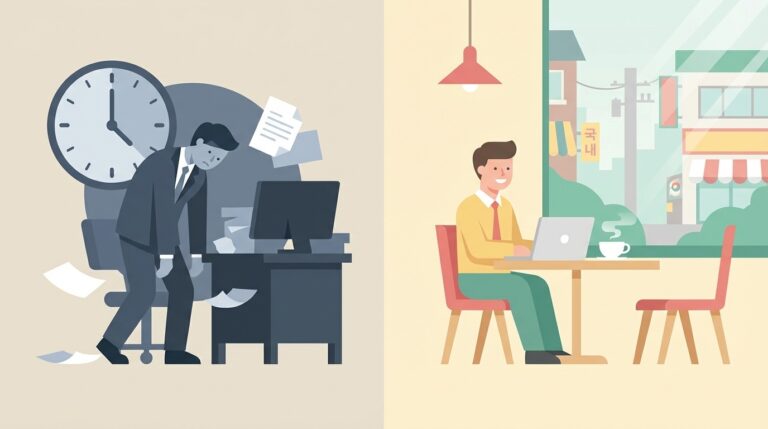
Picture this K-Drama scene: It’s 10:30 PM. The protagonist is sitting in a dim office in Yeouido, staring blankly at a glowing monitor. The only sound is the mechanical clicking of a keyboard. Suddenly, a news anchor’s voice echoes from a TV in the breakroom: ‘The debate over the 4-day workweek is heating up…’ The protagonist scoffs, takes a sip of a lukewarm Americano, and mutters, ‘Yeah, right. In this company?’
If you’ve watched K-Dramas like Misaeng or My Mister, you know that Korean corporate culture—famous for its ‘Ppalli-Ppalli’ (hurry up) mindset, Hoesik (company dinners), and Yageun (night shifts)—is intense. But right now, Korea is undergoing a massive paradigm shift. The MZ generation is fiercely demanding ‘주 4일제’ (the 4-day workweek), sparking heavy debates about productivity versus quality of life.
At a C2 (Advanced) level, you aren’t just learning how to say ‘I work.’ You need to know how to eloquently debate socio-economic policies, express complex corporate nuances, and survive the subtle psychological warfare of the Korean office. Let’s dive into the real Korean expressions used when debating the 4-day workweek—because sounding like an insider in a Pangyo tech-hub meeting is a flex you definitely want.
Phase 2: Core Expressions Deep Dive
1. 숨통이 트이다 (To finally be able to breathe)
- Pronunciation: sum-tong-i teu-i-da [Sound-alike: ‘soom-tong-ee / teu-ee-dah’. Remember, ‘eu’ sounds like the disgusted sound you make when stepping in gum.]
- Meaning: Literal: ‘One’s windpipe opens up.’ Real nuance: ‘To finally get a breather / to feel relieved from immense pressure.’
- K-Culture Moment: Imagine a Friday evening. Your boss just announced that the company is piloting a ‘work from home on Fridays’ policy. Your colleague leans over and whispers, ‘와, 진짜 숨통이 트이네요.’ (Wow, I can finally breathe.)
- Editor’s Insight: This is a high-level idiomatic expression. It physically describes the sensation of suffocating under heavy workload and finally getting oxygen. It’s much more emotional and native-like than simply saying ‘기분이 좋아요’ (I feel good).
- Situation Spectrum:
[🚫 절대 금지] ———— [⚠️ 주의] ———— [✅ 자유롭게]
- Friends (Casual): ✅
- Coworkers (Semi-formal): ✅ (Perfect for bonding over shared misery)
- Boss/Seniors (Formal): ⚠️ (Use cautiously; you don’t want to imply the boss was suffocating you!)
- 🤔 Think About It: Why does Korean have so many idioms related to physical bodily sensations (like the windpipe, stomach, or chest) to describe emotional stress? Does your language somaticize stress in the same way?
2. 압축 노동 때문에 번아웃이 오다 (To experience burnout due to compressed labor)
- Pronunciation: ap-chuk no-dong ttae-mun-e beon-a-ut-i o-da
- Meaning: Literal/Real: To get burnout from compressed work.
- K-Culture Moment: This is a hot topic in Korean news. Critics of the 4-day workweek argue that if you have to do 5 days of work in 4 days, the intensity will skyrocket.
- Editor’s Insight: ‘압축’ (compressed) is a C2-level vocabulary word often used in socio-economic contexts (e.g., Korea’s ‘compressed economic growth’). ‘번아웃이 오다’ (burnout comes) treats burnout as an external force hitting you, which is a very Korean grammatical framing (like a cold catching you).
- Situation Spectrum:
[🚫 절대 금지] ———— [⚠️ 주의] ———— [✅ 자유롭게]
- Friends (Casual): ✅
- Coworkers/Debates (Semi-formal): ✅
- Boss/Seniors (Formal): ⚠️ (Complaining about burnout to a traditional boss might get you a lecture on ‘mental fortitude’.)
- 🤔 Think About It: Notice how Koreans use the English word ‘burnout’ rather than a pure Korean translation. Why do you think modern corporate terminology in Korea heavily relies on English loanwords?
3. 눈치가 보일 수밖에 없죠 (You can’t help but feel self-conscious/pressured)
- Pronunciation: nun-chi-ga bo-il su-bak-kke eop-jjo
- Meaning: Literal: ‘There is no choice but for the nunchi to be seen.’ Real nuance: ‘It’s inevitable that we’ll feel pressured by others’ judgments.’
- K-Culture Moment: The company technically allows a 4-day week, but the CEO still comes in on Fridays. Your colleague sighs and says this expression. Even if the system changes, the culture of Nunchi (reading the room) remains.
- Editor’s Insight: ‘-을 수밖에 없다’ (have no choice but to / it is inevitable) is a crucial advanced grammar point. It shows objective inevitability, making your argument sound logical and persuasive rather than just emotional.
- Situation Spectrum:
[🚫 절대 금지] ———— [⚠️ 주의] ———— [✅ 자유롭게]
- Friends (Casual): ✅
- Coworkers (Semi-formal): ✅
- Boss/Seniors (Formal): 🚫 (Do not tell your boss you feel pressured by them!)
- 🤔 Think About It: Nunchi is often translated as ‘emotional intelligence,’ but in the workplace, it’s tied to hierarchy. How does the concept of invisible social pressure affect productivity in your home country compared to Korea?
Phase 3: Textbook vs. Real Korean
| Situation | 📖 Textbook Korean | 🗣️ Real Korean | 💡 Why is it different? |
|---|---|---|---|
| Discussing workload | 업무량이 너무 많습니다. (The workload is too much.) | 일이 밀려서 오늘 칼퇴는 글렀어요. (Work is backed up, leaving on time is ruined today.) | ‘칼퇴’ (blade-like exit = leaving exactly on time) reflects the deep desire of modern workers. |
| Feeling exhausted | 저는 매우 지쳤습니다. (I am very exhausted.) | 요즘 야근 연속이라 영혼까지 털렸어요. (Continuous night shifts lately, even my soul has been robbed.) | Koreans love dramatic, hyperbolic metaphors (‘soul robbed’) to express extreme fatigue. |
| Praising efficiency | 효율성이 높습니다. (Efficiency is high.) | 일처리 진짜 깔끔하시네요. (Your work process is really clean.) | ‘깔끔하다’ (clean/neat) is widely used in business to praise someone who works efficiently without causing trouble. |
Bottom Note for C2 Learners: At the advanced level, abandoning stiff textbook translations and adopting these slightly dramatic but highly standard workplace metaphors (‘영혼이 털리다’, ‘칼퇴’) is the key to sounding like a native professional.
Phase 4: Cultural Context — K-Culture Deep Dive
4-1. Non-Verbal Elements: The Art of the ‘Busy Sigh’
When discussing workload or productivity in Korea, language is only half the battle. If you’re staying late to finish compressed work, you must master the ‘K-Office Sigh’ (한숨). It’s a subtle, slightly audible exhale while staring at your monitor. It non-verbally communicates to your seniors: ‘I am working very hard, I am slightly stressed, but I am dedicated.’ Also, when leaving on time (칼퇴), do not make eye contact with the senior who is staying late. A quick, polite bow with a hushed ‘먼저 들어가 보겠습니다’ (I will be leaving first) is the survival code.
4-2. K-Drama Tie-in: The Romance vs. Reality of the Office
If you watch K-Dramas, you’ll see a trope where the entire team goes out for Hoesik (barbecue and soju) to ‘build teamwork’ after a stressful project. While dramas make this look like a fun, bonding experience where the leads might secretly hold hands under the table, the reality for MZ generation workers is different. A company dinner is often viewed as an extension of labor (연장 근로). The push for the 4-day workweek is fundamentally a push against this boundary-less work culture. When you debate this topic, recognizing the gap between the romanticized K-Drama office and the pragmatic MZ mindset will make your arguments highly sophisticated.
Phase 5: Interactive Roleplay Scenario
Scenario A: The Pangyo Tech-Hub Debate
- Setting: Friday evening, 7:00 PM. A trendy, dimly lit Izakaya in Pangyo (Korea’s Silicon Valley). You’re having highballs with your dev team.
- Characters:
- YOU (Reader): A senior expat developer who values work-life balance.
- Taeho (42): Your Team Lead. Hardworking, slightly traditional, a bit of a workaholic.
- Minji (28): Junior developer. Chronically exhausted, dreaming of the 4-day workweek.
Taeho: 요즘 뉴스 보니까 주 4일제 얘기가 많던데, 솔직히 우리 업계에서 그게 가능할까?
(Yojeum nyuseu bonikka ju sailje yaegiga manteonde, soljiki uri eopgye-eseo geuge ganeunghalkka?)
[Translation: I see a lot of news about the 4-day workweek lately, but honestly, is that even possible in our industry?]
(🎭 Stage Direction: Taeho takes a sip of his highball, looking skeptical.)
Minji: 팀장님, 도입만 되면 진짜 숨통이 트일 것 같아요. 저격은 아니고요, 요즘 너무 번아웃이 와서요.
(Timjangnim, do-imman doemyeon jinjja sumtong-i teu-il geot gatayo. Jeogyeogeun anigoyo, yojeum neomu beon-au-si waseoyo.)
[Translation: Team Lead, if it’s introduced, I feel like I could finally breathe. Not attacking you or anything, I’m just so burnt out lately.]
Taeho: (Sighs) 에휴, 나도 쉬고 싶지. 근데 근무 시간이 줄면 납기일은 어떻게 맞춰? 압축 노동 하다가 다 쓰러질걸?
(Ehyu, nado swigo sipji. Geunde geunmu sigani julmyeon napgi-ireun eotteoke matchwo? Apchung nodong hadaga da sseureojilgeol?)
[Translation: Sigh, I want to rest too. But if working hours decrease, how do we meet deadlines? Everyone will collapse from compressed labor.]
🔀 Your Turn! How do you respond?
– A) “팀장님 말이 맞습니다. 주 4일제는 안 됩니다!” (Agree blindly – safe, but kills the debate.)
– B) “시간이 주는 만큼 업무 효율성을 극대화하면 충분히 가능하다고 봅니다. 회의 시간만 줄여도요.”
– C) “꼰대 같은 생각이네요. 유럽은 다 그렇게 해요.”✅ Best Choice: B — Reason: It uses advanced business terminology (‘업무 효율성을 극대화하다’ – maximize work efficiency) while politely proposing a logical solution (reducing meetings). It shows C2-level diplomacy.
⚠️ Choice C Analysis: Calling your boss a ‘꼰대’ (Kkondae – boomer) will instantly ruin your relationship and possibly your career, no matter how progressive the tech hub is!
Scenario B: K-Travel Bonus Roleplay (The Digital Nomad)
- Setting: A bustling cafe in Jeju Island. You’re working remotely.
- You: 안녕하세요, 혹시 콘센트 있는 자리가 있을까요?
(Annyeonghaseyo, hoksi konsenteu inneun jariga isseulkkayo?)
[Translation: Hello, by any chance are there any seats with power outlets?] - Staff: 아, 창가 쪽 바(bar) 자리에 다 있습니다.
(Ah, chang-ga jjok ba jarie da itseumnida.)
[Translation: Ah, they are all available at the bar seats by the window.] - You: 감사합니다. 아, 그리고 와이파이 비밀번호는 영수증에 있나요?
(Gamsahamnida. Ah, geurigo wa-i-pa-i bimilbeonhoneun yeongsujeung-e innayo?)
[Translation: Thank you. Oh, and is the Wi-Fi password on the receipt?]
Phase 6: 10-Second Shadowing Drill
Let’s practice a complex, persuasive sentence you can use in a debate.
😤 단호하지만 논리적으로 (Firmly but logically)
시간만 / 줄이는 게 아니라, / 업무 효율성을 / 극대화하는 게 / 핵심이죠.
(si-gan-man / ju-ri-neun ge a-ni-ra, / eom-mu hyo-yul-seong-eul / geuk-dae-hwa-ha-neun ge / haek-si-mi-jo.)
“It’s not just about reducing time; maximizing work efficiency is the core.”
Phase 7: K-Culture Mini Dictionary
| 한국어 | Romanization | English | Context/Explanation |
|---|---|---|---|
| 워라밸 | wo-ra-bael | Work-Life Balance | Short for ‘Work-Life Balance’. The ultimate goal of the MZ generation. |
| 야근 | ya-geun | Night shift / Overtime | Historically seen as a sign of loyalty, now heavily criticized by younger workers. |
| 칼퇴 | kal-toe | Leaving exactly on time | ‘Kal’ means knife. Cutting off work exactly at 6:00 PM without looking back. |
| 눈치 | nun-chi | Reading the room | The cultural concept of assessing others’ moods and adjusting your behavior. |
| 꼰대 | kkon-dae | Condescending older person | A slang term for someone who forces outdated, traditional work ethics on others. |
Phase 8: Traveler & Digital Nomad Survival Kit
Even if you’re not debating labor laws, if you’re in Korea, you’ll likely visit cafes to experience your own ‘productivity’. Here are survival phrases for the digital nomad:
🆘 Survival Expression #1: Finding the Essentials
– 🇰🇷 “여기 와이파이 비밀번호가 어디 적혀 있나요?”
– 🗣️ Guide: [yeo-gi wa-i-pa-i bi-mil-beon-ho-ga eo-di jeo-kyeo in-na-yo?]
– 📍 Where to use: Cafes, hotel lobbies, restaurants.
– 💡 Pro Tip: In Korea, the Wi-Fi password is almost always printed at the very bottom of your receipt (영수증)! Don’t throw it away immediately.📌 Editor’s Travel Note
– Best Apps for Working: Naver Map (to find cafes with tags like ‘콘센트’ (outlets) or ‘노트북 하기 좋은’ (good for laptops)).
– Cafe Culture: In Korea, leaving your laptop on a table while you go to the restroom is incredibly common and safe. Koreans joke that they will steal your seat, but never your Macbook!
Phase 9: Critical Thinking Corner — “One Step Deeper”
🧠 Think Deeper: Language & Power in the Korean Workplace
The debate over the 4-day workweek in Korea is fascinating because it exposes the deep roots of Confucian hierarchy encoded in the Korean language. Notice how junior employees use polite ‘-요’ or formal ‘-습니다’ forms to carefully suggest ideas (like our character Minji saying ‘숨통이 트일 것 같아요’ – ‘I feel like I could breathe’), while superiors might use casual speech (반말) or rhetorical questions (‘납기일은 어떻게 맞춰?’ – ‘How do we meet deadlines?’). True systemic change like a 4-day workweek requires not just policy changes, but a flattening of this linguistic and psychological hierarchy. If you can’t freely say “No” to your boss without using ten layers of honorific padding, can true work-life balance exist?
💬 Your Turn: Does the language you speak at work reflect a strict hierarchy, or is everyone on a first-name basis? How does that affect debates about productivity in your culture? Share in the comments!
Phase 10: FAQ & Common Mistakes
Q: “Can I tell my boss ‘저 내일 워라밸을 위해 쉴게요’ (I will rest tomorrow for my work-life balance)?”
A: NO! 🚫 While ‘워라밸’ is a popular buzzword, it is too casual and slightly confrontational to use directly with a boss when requesting time off. Instead, use formal HR terminology: “개인 사정으로 연차를 쓰겠습니다” (I will use my annual leave for personal reasons).
Q: “If I disagree with a colleague’s point on productivity, can I just say ‘틀렸어요’ (You’re wrong)?”
A: NO! 🚫 In Korean corporate culture, direct confrontation is jarring. Use the ‘Yes, but’ softening technique: “그 말씀도 맞지만, 이런 측면도 고려해야 하지 않을까요?” (Your point is correct, but shouldn’t we also consider this aspect?)
❌ Common Mistake #1: Translating “I’m tired” as “저는 피곤합니다” in a professional setting.
✅ Do this instead: To sound like a native C2 speaker, use “요즘 업무가 몰려서 조금 지치네요” (Work has been piling up lately, so I’m a bit exhausted.) It sounds much more professional and contextual.
Phase 11: Summary & Action Items
- One-Liner Summary: Discussing the 4-day workweek in Korean requires mastering vocabulary around efficiency, burnout, and the subtle pressures of office hierarchy (nunchi).
-
Action Mission 3 Steps:
- 🥉 Bronze (Solo): Read the shadowing drill (Phase 6) out loud 3 times in front of a mirror, channeling your inner exhausted office worker.
- 🥈 Silver (Online): Write a comment on a Korean news YouTube video discussing ‘주 4일제’, using the phrase “업무 효율성 극대화”.
- 🥇 Gold (Real World): Next time you finish a big task with a Korean friend or colleague, jokingly sigh and say, “아, 진짜 하얗게 불태웠다… 번아웃 올 것 같아요” (Ah, I really burned it white [gave it my all]… I feel like burnout is coming).
- K-Culture Mission: Watch an episode of a Korean office drama (like Misaeng or Start-Up) and count how many times you see employees checking their boss’s nunchi before leaving the office!
Phase 12: Quiz — Interactive Challenge
1. Situational Judgment: Your team finished a massive project. Your boss says, “다들 고생했어. 오늘 회식 어때?” (Everyone worked hard. How about a company dinner tonight?) You are completely burnt out and want to go home. What is the most C2-appropriate, polite way to decline?
– A) 안 됩니다. 저 워라밸 지켜야 해요.
– B) 아유, 팀장님. 저희 오늘 너무 달려서 번아웃 올 것 같아요. 다음 주에 맛있는 거 사주세요!
– C) 저는 회식 싫어합니다. 칼퇴하겠습니다.
2. True or False – K-Culture Edition: In traditional Korean corporate culture, it is perfectly acceptable for a junior employee to leave exactly at 6:00 PM (칼퇴) without saying a word, as long as their work is done. (T/F)
3. Fill in the Blank:
“주 4일제가 도입되면 당연히 좋겠지만, 막상 쉬는 날에 상사에게 연락이 올까 봐 _____가 보일 것 같아요.”
(Hint: The invisible pressure from others’ gazes.)
🚨 Click here for the Answers!
1. B – It softens the rejection with humor, expresses the reality (burnout), and defers the event gracefully. A and C are too aggressive and will ruin the team dynamic.
2. False – While MZ generation workers are fighting for this right, traditionally, it is highly frowned upon to leave without checking if your team members or boss need help (눈치) and giving a polite farewell.
3. 눈치 (nunchi)
Frequently Asked Questions (FAQ)
Q: What does "숨통이 트이다 (To finally be able to breathe)" mean in Korean and how do you pronounce it?
A: In Korean, "숨통이 트이다 (To finally be able to breathe)" is pronounced [sum-tong-i teu-i-da [Sound-alike: 'soom-tong-ee / teu-ee-dah'. Remember, 'eu' sounds like the disgusted sound you make when stepping in gum.] and means: Literal: 'One's windpipe opens up.' Real nuance: 'To finally get a breather / to feel relieved from immense pressure.'
Q: What does "압축 노동 때문에 번아웃이 오다 (To experience burnout due to compressed labor)" mean in Korean and how do you pronounce it?
A: In Korean, "압축 노동 때문에 번아웃이 오다 (To experience burnout due to compressed labor)" is pronounced [ap-chuk no-dong ttae-mun-e beon-a-ut-i o-da] and means: Literal/Real: To get burnout from compressed work.
Q: What does "눈치가 보일 수밖에 없죠 (You can't help but feel self-conscious/pressured)" mean in Korean and how do you pronounce it?
A: In Korean, "눈치가 보일 수밖에 없죠 (You can't help but feel self-conscious/pressured)" is pronounced [nun-chi-ga bo-il su-bak-kke eop-jjo] and means: Literal: 'There is no choice but for the nunchi to be seen.' Real nuance: 'It's inevitable that we'll feel pressured by others' judgments.'







