

Phase 1: Empathy (Immersive Opening)
Hello! I am your Daily Hangul Editor, your local culture navigator and veteran tutor.
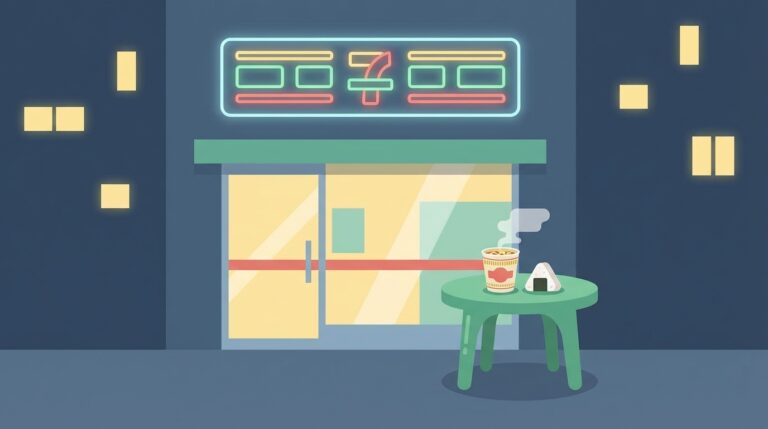
Imagine this K-Drama scene: The main characters just had a dramatic argument, or maybe they’ve been studying late into the night. Where do they always end up? The convenience store (편의점, pyeon-ui-jeom). They sit at those iconic plastic tables, tearing open a steaming bowl of cup noodles (컵라면, keop-ra-myeon), and suddenly, the world feels right again.
You want to experience this ultimate K-Vibe, right? But as an absolute beginner (A1), standing inside a Korean convenience store can feel like a mission impossible. You are staring at the hot water dispenser, wondering how to ask for chopsticks, and hoping the cashier doesn’t ask you a complex question. Don’t worry! I have guided hundreds of beginners through this exact scenario. By the end of this post, you will be slurping ramen like a true local.
Phase 2: Core Expressions Deep Dive
Let’s learn the survival phrases you need to conquer the convenience store.
1. 젓가락 주세요. (Please give me chopsticks.)
- Pronunciation: jeot-ga-rak ju-se-yo.
- Sound Analogy: jeot (like ‘jut’ but with a shorter ‘uh’) + ga + rak / ju (joo) + se (say) + yo.
- Meaning: Literal: Chopsticks, please give. / Real Nuance: I need a pair of chopsticks, please.
- K-Culture Moment: In K-Dramas, you always see the main character snapping a pair of disposable wooden chopsticks apart before taking that massive first bite of ramen. You need this phrase to get your chopsticks from the cashier!
- Situation Spectrum:
[🚫 Formal] ———— [⚠️ Semi-formal] ———— [✅ Casual & Polite]
- Close Friends (Casual): 🚫 (Too polite, drop the ‘yo’)
- Store Clerks/Cashiers (Polite): ✅ (Perfect!)
- 🤔 Think About It: Notice how there is no “I” or “You” in this sentence? Korean language relies heavily on context. If you are pointing at the ramen and asking the cashier, it’s obvious who wants the chopsticks. Does your language always require a subject?
2. 뜨거운 물 어디 있어요? (Where is the hot water?)
- Pronunciation: tteu-geo-un mul eo-di isseo-yo?
- Sound Analogy: tteu (make a tight ‘t’ sound while saying ‘eu’, the disgusted sound you make when stepping in gum) + geo-un / mul (mool) / eo-di (uh-dee) / isseo-yo (ee-ssuh-yo).
- Meaning: Literal: Hot water, where exists? / Real Nuance: Where can I find the hot water dispenser?
- K-Culture Moment: You bought the cup noodles, but now you need to cook it! Every Korean convenience store has a dedicated hot water and microwave station, usually near the window.
- Situation Spectrum:
[🚫 Formal] ———— [⚠️ Semi-formal] ———— [✅ Casual & Polite]
- Asking a stranger/clerk (Polite): ✅
- 🤔 Think About It: “있어요 (isseo-yo)” is a magical word in Korean. It can mean “I have,” “It exists,” or “It is located at.” Efficiency is key in everyday Korean!
3. 여기서 먹고 갈게요. (I will eat here.)
- Pronunciation: yeo-gi-seo meok-go gal-ge-yo.
- Sound Analogy: yeo-gi-seo (yuh-gee-suh) + meok-go (muck-go) + gal-ge-yo (gal-gay-yo).
- Meaning: Literal: Here at, eat and I will go. / Real Nuance: I’ll eat this right here before leaving.
- K-Culture Moment: If you buy instant food, the cashier might assume you are taking it home. Saying this lets them know you’re heading straight to the store’s dining area (or the plastic tables outside) to enjoy your ramen immediately.
- Situation Spectrum:
[🚫 Formal] ———— [⚠️ Semi-formal] ———— [✅ Casual & Polite]
- Telling the cashier (Polite): ✅
Phase 3: Textbook vs. Real Korean
| Situation | 📖 Textbook Korean | 🗣️ Real Korean | 💡 Why the difference? |
|---|---|---|---|
| Asking for chopsticks | 젓가락을 주시겠습니까? (Would you please give me chopsticks?) | 젓가락 주세요. (Chopsticks, please.) | Textbooks teach formal grammar, but in busy stores, short and polite phrases are preferred. |
| Asking where it is | 뜨거운 물은 어디에 있습니까? | 뜨거운 물 어디 있어요? | We drop particles (은/는/이/가/에) in spoken Korean to speak faster! |
| Saying “Thank you” after paying | 대단히 감사합니다. (Thank you very much.) | 감사합니다 or 수고하세요! (Keep up the good work!) | “수고하세요” acknowledges the worker’s hard effort. It’s the ultimate local vibe! |
Bottom Note: For A1 beginners, don’t worry about complex grammar particles. Just combine the Noun + 주세요 (ju-se-yo), and you will survive 90% of shopping situations!
Phase 4: Cultural Context — K-Culture Deep Dive
4-1. Non-Verbal Communication: The “Nunchi” at the Counter
When you buy your cup noodles, the cashier might hand you the receipt with two hands or a slight bow of the head. You don’t need to bow 90 degrees! A simple, polite head nod while taking your items and saying “감사합니다 (gam-sa-ham-ni-da)” shows you have great 눈치 (Nunchi – social awareness).
4-2. The K-Drama Tropes vs. Reality
Have you ever heard the famous K-Drama line, “라면 먹고 갈래?” (Do you want to eat ramen before you go?)
Warning! In K-Dramas and movies, inviting someone to your house to “eat ramen” late at night is the Korean equivalent of “Netflix and chill” (a romantic or flirty invitation).
However, eating ramen together at a convenience store is completely innocent! It’s a cheap, cozy way for friends, students, and coworkers to bond, complain about their day, and share a warm meal.
4-3. The Art of Slurping
In many Western cultures, making loud slurping noises while eating soup is considered bad manners. In Korea? Slurp away! Slurping your cup noodles shows you are truly enjoying the hot food. It actually cools the noodles down as they enter your mouth.
Phase 5: Real-Life Roleplay Scenario
Let’s put you in the spotlight.
Setting: It’s 11:30 PM in Hongdae. You just finished attending an amazing K-Pop concert. You are exhausted but starving. You walk into a brightly lit GS25 convenience store, grab a spicy cup noodle, and walk up to the counter.
Characters:
– YOU: An A1 Korean learner, tired but determined to buy your late-night snack.
– Jimin (22): The friendly part-time cashier, scanning items quickly.
Jimin: 어서 오세요! (Welcome!)
eo-seo o-se-yo!
(🎭 Stage Direction: Jimin scans your cup noodle with a beep.)
Jimin: 봉투 필요하세요? (Do you need a plastic bag?)
bong-tu pi-ryo-ha-se-yo?
🔀 Your Turn! How do you reply?
– A) 네, 주세요. (Yes, please give me one.)
– B) 아니요, 여기서 먹고 갈게요. 젓가락 주세요. (No, I’ll eat it here. Please give me chopsticks.)
– C) 대박! (Awesome!)✅ Best Choice: B — You brilliantly answered the bag question and asked for chopsticks in one breath! You are a true local now.
⚠️ Choice A Analysis: Safe and correct, but if you want to eat at the tables outside, you don’t need to pay extra for a plastic bag.
❌ Choice C Analysis: “대박” means “Awesome” or “Jackpot.” Shouting this at a cashier offering a plastic bag will just confuse them!
YOU: 아니요, 여기서 먹고 갈게요. 젓가락 주세요.
a-ni-yo, yeo-gi-seo meok-go gal-ge-yo. jeot-ga-rak ju-se-yo.
(🎭 Stage Direction: You smile politely.)
Jimin: 네, 여기 있습니다. 1,500원입니다. (Yes, here you go. That’s 1,500 won.)
ne, yeo-gi it-seum-ni-da. cheon-o-baek-won-im-ni-da.
YOU: 감사합니다! 뜨거운 물 어디 있어요? (Thank you! Where is the hot water?)
gam-sa-ham-ni-da! tteu-geo-un mul eo-di isseo-yo?
Jimin: (Pointing to the corner) 저기 창문 쪽에 있어요. (It’s over there by the window.)
jeo-gi chang-mun jjo-ge isseo-yo.
Phase 6: 10-Second Shadowing Drill
Let’s practice your pronunciation. Follow the slashes for pausing, and read it with the emotional tag!
😊 politely
저기요 / 젓가락 / 하나만 / 주세요!
(jeo-gi-yo / jeot-ga-rak / ha-na-man / ju-se-yo!)
“Excuse me / chopsticks / just one / please give!”
Phase 7: K-Culture Mini Dictionary
| Korean | Romanization | English | Context |
|---|---|---|---|
| 편의점 | pyeon-ui-jeom | Convenience store | The 24/7 hub of Korean daily life. |
| 컵라면 | keop-ra-myeon | Cup noodles | The ultimate late-night snack. |
| 삼각김밥 | sam-gak-gim-bap | Triangle riceball | Ramen’s best friend. People often dip it in the leftover ramen broth! |
| 야식 | ya-sik | Late-night snack | A huge part of Korean food culture. |
Phase 8: Traveler’s Survival Kit
🆘 Survival Expressions for the Convenience Store
– 🇰🇷 이거 얼마예요? (i-geo eol-ma-ye-yo?)
– 🗣️ Meaning: How much is this?
– 📍 Where to use: Convenience stores, street markets, underground shopping malls.
– 💡 Pro Tip: If you don’t understand the numbers they say, just look at the cash register screen. The total is always displayed there!📌 Editor’s Travel Note
– Payment: Korea is a cashless society! You can use your international credit card or a rechargeable “T-Money” transit card to buy snacks at the convenience store.
– Self-Cleanup: If you eat at the convenience store tables, you must clean up after yourself. Throw away the leftover broth in the specific liquid bin, and throw the cup in the recycling bin.
– Tipping: Do NOT tip the cashier. There is no tipping culture in Korea. They might chase you down thinking you forgot your change!
Phase 9: Critical Thinking Corner — “One Step Deeper”
Food & Identity: The Power of Sharing a Meal
🧠 Think Deeper:
Why do Koreans love eating ramen together at convenience stores, even when they could easily afford a proper restaurant? In Korean culture, eating isn’t just about fuel; it’s about 정 (Jeong – affection/bonding). Sharing a cheap, warm meal in a casual setting breaks down social barriers. It implies: “We are close enough to eat humble food in our sweatpants.” The act of pouring hot water, waiting 3 minutes together, and sharing side dishes like Kimchi creates an intimate, shared experience.💬 Your Turn: Does your culture have a specific “late-night comfort food” that people eat together after a long day? Share it in the comments below!
Phase 10: FAQ & Avoiding Misunderstandings
Q: Can I use “라면 먹고 갈래?” (Do you want to eat ramen?) to invite a Korean friend to a convenience store?
NO! As mentioned earlier, this specific phrase has a very flirty, romantic undertone (like “Netflix and chill”). If you just want to grab food, say, “편의점 가서 라면 먹을래요?” (Do you want to go to the convenience store and eat ramen?).
Q: Is it okay to ask the cashier to throw away my trash?
Maybe, but usually NO. Koreans are very strict about recycling. It is standard etiquette to clean your own table and sort your trash into the bins provided by the door.
❌ Common Mistake #1: Saying “You” (당신 – dang-sin) to the cashier.
✅ Do this instead: Never use “당신”. Simply say “저기요” (Excuse me) to get their attention, or just drop the subject entirely and say “~주세요” (~please give).
Phase 11: Summary & Action Items
- One-Liner Summary: To survive a Korean convenience store ramen run, master the magic word “주세요 (ju-se-yo)” and clean up your own table!
-
Action Mission 3 Steps:
- 🥉 Bronze (Solo): Stand in front of a mirror and ask for chopsticks out loud three times: “젓가락 주세요.”
- 🥈 Silver (Online): Comment below with your favorite brand of Korean instant noodles!
- 🥇 Gold (Real Life): Go to a local Asian market or Korean convenience store and try saying “감사합니다” to the cashier when you buy a snack.
- K-Culture Mission:
Watch one episode of your favorite K-Drama today. I guarantee you will spot a convenience store scene within the first 3 episodes. When you do, look closely: Are they eating cup noodles? Are they slurping?
Phase 12: Quiz — Interactive Challenge
1. Situational Judgment: You just poured hot water into your cup noodles at the convenience store. You realize you don’t have chopsticks. What is the most natural thing to say to the cashier?
– A) 당신은 젓가락이 있습니까? (Do you have chopsticks?)
– B) 젓가락 주세요. (Chopsticks, please.)
– C) 라면 먹고 갈래? (Want to eat ramen?)
2. True or False — K-Culture Edition:
– You should always leave a 10% tip for the convenience store cashier if they are nice to you. (T/F)
3. Fill in the Blank:
You want to eat your snack at the table outside the store. You say to the cashier: “여기서 먹고 _____.” (I will eat here and go).
– A) 올게요 (come)
– B) 갈게요 (go)
– C) 잘게요 (sleep)
(Answers: 1. B, 2. False – No tipping in Korea!, 3. B)
Frequently Asked Questions (FAQ)
Q: What does "젓가락 주세요. (Please give me chopsticks.)" mean in Korean and how do you pronounce it?
A: In Korean, "젓가락 주세요. (Please give me chopsticks.)" is pronounced [jeot-ga-rak ju-se-yo.] and means: Literal: Chopsticks, please give. / Real Nuance: I need a pair of chopsticks, please.
Q: What does "뜨거운 물 어디 있어요? (Where is the hot water?)" mean in Korean and how do you pronounce it?
A: In Korean, "뜨거운 물 어디 있어요? (Where is the hot water?)" is pronounced [tteu-geo-un mul eo-di isseo-yo?] and means: Literal: Hot water, where exists? / Real Nuance: Where can I find the hot water dispenser?
Q: What does "여기서 먹고 갈게요. (I will eat here.)" mean in Korean and how do you pronounce it?
A: In Korean, "여기서 먹고 갈게요. (I will eat here.)" is pronounced [yeo-gi-seo meok-go gal-ge-yo.] and means: Literal: Here at, eat and I will go. / Real Nuance: I'll eat this right here before leaving.







