

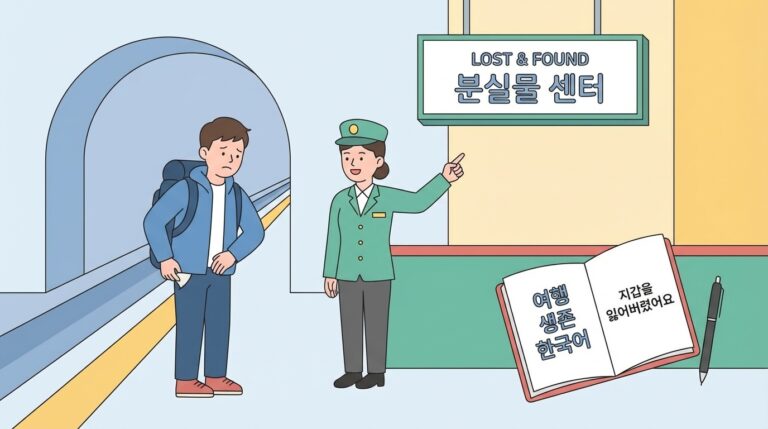
Phase 1: Empathy (The “My Wallet is Gone!” Panic)
Hello! I’m your Lead Editor at Daily Hangul.
Picture this: You’ve just finished shopping in bustling Myeongdong or enjoying a lively K-Pop concert. You head over to a street food stall, craving some spicy Tteokbokki. You reach into your pocket or bag to pay and… nothing. Your wallet is gone.
Your heart drops. The upbeat K-Drama OST playing in your head suddenly screeches to a halt. Panic sets in. How do you explain this in Korean?
Losing your belongings in a foreign country is terrifying. But here’s the good news: Korea has one of the highest recovery rates for lost items in the world! If you know just a few basic phrases to ask for help, your chances of getting your wallet back are incredibly high.
This guide is based on real SOS messages I’ve received from my students. Let’s learn exactly what to say so you can turn a travel nightmare into a “You won’t believe how kind people were!” story.
Phase 2: Deep Dive into Key Expressions
Let’s look at the top 3 survival phrases you need for a lost-and-found situation.
1. 지갑을 잃어버렸어요. (I lost my wallet.)
- Pronunciation: jigabeul ileobeoryeosseoyo. [jee-gah-beul ee-ruh-buh-ryuh-sso-yo]
- Meaning: Literal: I lost my wallet. / Real nuance: “Help, I lost my wallet!”
- K-Culture Moment: In K-Dramas, you often see the main character frantically searching their pockets at a bus stop, muttering “아, 잃어버렸나 봐!” (Ah, I think I lost it!). It’s the standard, go-to phrase for losing anything.
- Editor’s Insight: The verb 잃어버리다 (to lose) is a bit of a tongue twister! Practice saying “ee-ruh-buh-ryuh” slowly. You can replace ‘지갑’ (wallet) with ‘여권’ (passport) or ‘핸드폰’ (phone).
- Situation Spectrum:
[🚫 Never] ———— [⚠️ Caution] ———— [✅ Freely]
- Close Friends (Casual): ⚠️ (You would drop the ‘-yo’ and say “잃어버렸어”)
- Strangers/Staff (Formal): ✅ (Perfect to use with police or station staff)
- 🤔 Think About It: In Korean, we focus on the action of losing it rather than saying “My wallet is missing.” Why do you think Korean drops the word “my” (제) here? It’s because the context already makes it obvious whose wallet it is!
2. 혹시 지갑 못 보셨어요? (By any chance, haven’t you seen a wallet?)
- Pronunciation: hokshi jigap mot bosyeosseoyo? [hok-shee jee-gap moht bo-shuh-sso-yo?]
- Meaning: Did you happen to see a wallet around here?
- K-Culture Moment: Imagine dropping your wallet at a cafe where you just had an iced Americano. You run back inside and gently ask the barista this question.
- Editor’s Insight: ‘혹시’ (hokshi) is a magical word in Korean. It means “by any chance.” Starting a question with ‘혹시’ acts as a verbal cushion, making you sound extremely polite and careful not to bother the other person.
- Situation Spectrum:
[🚫 Never] ———— [⚠️ Caution] ———— [✅ Freely]
- Strangers/Staff: ✅ (Highly recommended!)
- 🤔 Think About It: Why is it more polite to ask “Haven’t you seen it?” (못 보셨어요?) rather than “Did you see it?” (보셨어요?)? Negative questions in Korean often give the listener an easy way out if they can’t help.
3. 분실물 센터가 어디예요? (Where is the lost and found?)
- Pronunciation: bunsilmul senteoga eodiyeyo? [boon-shil-mool sen-tuh-gah uh-dee-yeh-yo?]
- Meaning: Where is the Lost and Found center?
- K-Culture Moment: You’re navigating the massive maze of Seoul Station or COEX Mall. This is the phrase you use when asking a security guard for directions.
- Editor’s Insight: 분실물 (bunsilmul) sounds formal, but it’s the exact word written on the signs. 어디예요? (Where is it?) is an A2 survival chunk you can attach to any place!
- Situation Spectrum:
[🚫 Never] ———— [⚠️ Caution] ———— [✅ Freely]
- Anyone on the street/Staff: ✅
Phase 3: Textbook vs. Real Korean
| Situation | 📖 Textbook Korean | 🗣️ Real Korean | 💡 Why the difference? |
|---|---|---|---|
| Telling a friend | 저의 지갑을 분실했습니다. (I have lost my wallet.) | 나 지갑 잃어버렸어 ㅠㅠ (I lost my wallet [crying face]) | Friends don’t use formal vocabulary like ‘분실하다’ (to misplace) or ‘저의’ (my). |
| Asking staff | 분실물 보관소가 어디에 있습니까? (Where is the lost items storage located?) | 저기… 분실물 센터 어딘지 아세요? (Excuse me… do you know where the lost and found is?) | Real spoken Korean uses ‘센터’ (Center) more often than ‘보관소’, and ends in a softer question format. |
Phase 4: Cultural Context — K-Culture Deep Dive
4-1. Non-verbal Cues: The Art of Asking for Help
When approaching a stranger or a subway staff member, don’t just shout “Excuse me!” Walk up slightly hunched (to show urgency and politeness), make brief eye contact, and start with a soft “저기요…” (Excuse me…). A slight bow of the head goes a long way in Korea to activate the local’s desire to help you!
4-2. K-Travel & The “K-Conscience” (양심)
If you watch crime thrillers, you might think wallets get stolen instantly. But welcome to reality: Korea is famous for its “Cafe Trust Culture.” People leave laptops, phones, and designer bags on tables just to reserve a seat while going to the restroom.
If you drop your wallet, it is highly likely that a passerby either left it exactly where it fell, handed it to the nearest store owner, or turned it in to the police. This is known as 양심 (Yang-sim), meaning conscience. So, don’t assume it was stolen right away—assume it is waiting for you at the lost and found!
Phase 5: Real-World Roleplay Scenario
Setting: Friday afternoon. Inside a busy Seoul Subway Station. You realize you left your wallet on the train that just departed. You rush to the Customer Information Center (고객안내센터).
Characters:
– YOU: A traveler who just lost a black leather wallet.
– Station Staff (역무원): A polite and efficient worker in a uniform.
Dialogue:
YOU: 저기요… 혹시 분실물 센터가 어디예요?
(jeogiyo… hokshi bunsilmul senteoga eodiyeyo?)
[Excuse me… by any chance, where is the lost and found?]
Staff: 여기가 고객 센터입니다. 무슨 일 있으신가요?
(yeogiga gogaek senteo-imnida. museun il isseusingayo?)
[This is the customer center. Is something the matter?]
YOU: 지하철에 지갑을 두고 내렸어요.
(jihacheore jigabeul dugo naeryeosseoyo.)
[I left my wallet on the subway and got off.]
Staff: 아고, 그러셨군요. 지갑이 무슨 색이에요?
(ago, geureosyeotgunyo. jigabi museun saegiyeyo?)
[Oh no. What color is the wallet?]
🔀 Your Turn! How do you answer?
– A) “제 지갑은 검은색 가죽 지갑입니다.” (Textbook perfect, but very robotic)
– B) “검은색이에요!” (Black! – Natural and urgent)
– C) “블랙.” (Black – Just the English word)✅ Best Choice: B — “검은색이에요 (geomeun-saegiyeyo)” is polite, natural, and gets straight to the point.
⚠️ Choice C Analysis: While many Koreans understand English colors, adding ‘-이에요’ makes it a proper, polite Korean sentence.
Staff: 네, 확인해 보겠습니다. 연락처 남겨주세요.
(ne, hwaginhae bogetseumnida. yeollakcheo namgyeojuseyo.)
[Okay, I will check. Please leave your contact information.]
Phase 6: 10-Second Shadowing Drill
Let’s practice the tone! When you lose something, you shouldn’t sound too cheerful. Use a slightly worried, polite tone.
🥺 저기요... / 혹시 / 지갑 / 못 보셨어요?
(jeogiyo… / hokshi / jigap / mot bosyeosseoyo?)
😢 지하철에 / 지갑을 / 두고 내렸어요.
(jihacheore / jigabeul / dugo naeryeosseoyo)
(Emotion: Upset/Regretful)
Phase 7: K-Culture Mini Dictionary
| Korean | Romanization | English | Context |
|---|---|---|---|
| 분실물 | bunsilmul | Lost item | The official word used on all signs and websites. |
| 역무실 | yeongmusil | Station office | Where you go in a subway station if you lose something. |
| 파출소 | pachulso | Local police box | Small neighborhood police stations. Great places to report lost items. |
| 양심 | yangsim | Conscience | The social pressure/ethics that stop Koreans from taking your lost phone. |
| 두고 내리다 | dugo naerida | To leave behind and get off | Used specifically for leaving items on buses, taxis, or trains. |
Phase 8: Traveler Survival Kit
If you lose something in Korea, these are your lifelines!
🆘 Survival Phrase #1: 경찰서가 어디예요?
– 🇰🇷 (gyeongchalseoga eodiyeyo?)
– 🗣️ English: Where is the police station?
– 📍 Where to use: On the street if you can’t find a lost and found.
– 💡 Pro Tip: Don’t be afraid of Korean police stations! They are very helpful to tourists dealing with lost items.🆘 Survival Phrase #2: 누가 훔쳐갔어요.
– 🇰🇷 (nuga humchyeogasseoyo.)
– 🗣️ English: Someone stole it.
– 📍 Where to use: ONLY if you are 100% sure you were pickpocketed (which is very rare).📌 Editor’s Travel Note
– The Magic Portal: Bookmark the website LOST112 (police lost and found portal). Almost all found items in Korea are registered here, and they have language support!
– CCTV is everywhere: Korea has CCTVs on almost every corner. If you lost your wallet in a specific restaurant, go back. The owner likely checked the CCTV and kept it safe for you.
– Cards over Cash: If you lost a credit card, quickly freeze it on your bank app. Fortunately, carrying huge amounts of cash isn’t necessary in Korea!
Phase 9: Critical Thinking Corner — “Going Deeper”
🧠 Think Deeper: Media vs. Reality – The “Honest” Society
In many action K-Dramas, you see pickpockets in crowded markets or villains stealing bags. But in reality, Korea is famous globally as a “high-trust society” when it comes to personal belongings. People routinely leave expensive items unattended in cafes.Why? Some say it’s strict laws, others point to the massive network of CCTVs, but a lot of it comes down to a strong cultural taboo against taking what isn’t yours. In Korea, stealing someone’s wallet isn’t just a crime; it’s considered deeply shameful.
💬 Your Turn: Does your home country have a similar “cafe trust culture”? Or would a laptop left on a table disappear in 5 seconds? Let us know in the comments!
Phase 10: FAQ & Avoiding Common Mistakes
Q: Can I just speak English to the station staff or police?
Yes and no. In central Seoul, many staff know basic English. However, starting with a polite Korean phrase like “지갑을 잃어버렸어요” shows respect and makes them much more eager to assist you. Plus, they have translation apps like Papago ready to help with the details!
Q: Should I offer a reward if someone finds it?
In Korea, by law, a finder can claim 5~20% of the lost item’s value, but in reality, most ordinary citizens return wallets purely out of goodwill and will humbly refuse a cash reward. A simple “정말 감사합니다!” (Thank you so much!) and maybe a warm canned coffee from a convenience store is the perfect gesture.
❌ Common Mistake #1: Immediately saying “내 지갑 도둑맞았어요!” (My wallet was stolen!)
✅ Do this instead: Start with “잃어버렸어요” (I lost it). Assuming theft right away can create unnecessary tension, as true theft is quite rare. Assume you misplaced it first.
Phase 11: Summary & Action Items
One-Liner Summary: If your wallet goes missing, stay calm, find the staff, and say, “지갑을 잃어버렸어요!”
Action Mission:
– 🥉 Bronze (Solo): Look in the mirror with a worried face and say “지갑을 잃어버렸어요” 3 times aloud.
– 🥈 Silver (Online): Go to Google Maps, look up your favorite K-Pop idol’s agency building, and find the nearest ‘파출소’ (Police Box) nearby just in case!
– 🥇 Gold (Real World): Next time you can’t find something at home, practice saying “아, 핸드폰 잃어버렸어요!” instead of English.
K-Culture Mission: Search for “Korea cafe leaving laptop” on YouTube. Watch how locals reserve their seats with their valuables. It will blow your mind!
Phase 12: Interactive Quiz
1. You are at a subway station and need to find where lost items are kept. What do you ask?
A) 혹시 지갑 잃어버렸어요?
B) 분실물 센터가 어디예요?
C) 경찰서가 어디예요?
2. Fill in the blank: “_______ 지갑 못 보셨어요?” (By any chance, haven’t you seen a wallet?)
A) 혹시 (Hokshi)
B) 진짜 (Jinjja)
C) 빨리 (Ppalli)
3. True or False: If you leave your wallet at a restaurant in Korea, the staff will most likely throw it away.
(Answers: 1: B, 2: A, 3: False – They will keep it safely behind the counter for you!)
Frequently Asked Questions (FAQ)
Q: What does "지갑을 잃어버렸어요. (I lost my wallet.)" mean in Korean and how do you pronounce it?
A: In Korean, "지갑을 잃어버렸어요. (I lost my wallet.)" is pronounced [jigabeul ileobeoryeosseoyo. [jee-gah-beul ee-ruh-buh-ryuh-sso-yo] and means: Literal: I lost my wallet. / Real nuance: "Help, I lost my wallet!"
Q: What does "혹시 지갑 못 보셨어요? (By any chance, haven't you seen a wallet?)" mean in Korean and how do you pronounce it?
A: In Korean, "혹시 지갑 못 보셨어요? (By any chance, haven't you seen a wallet?)" is pronounced [hokshi jigap mot bosyeosseoyo? [hok-shee jee-gap moht bo-shuh-sso-yo?] and means: Did you happen to see a wallet around here?
Q: What does "분실물 센터가 어디예요? (Where is the lost and found?)" mean in Korean and how do you pronounce it?
A: In Korean, "분실물 센터가 어디예요? (Where is the lost and found?)" is pronounced [bunsilmul senteoga eodiyeyo? [boon-shil-mool sen-tuh-gah uh-dee-yeh-yo?] and means: Where is the Lost and Found center?






