

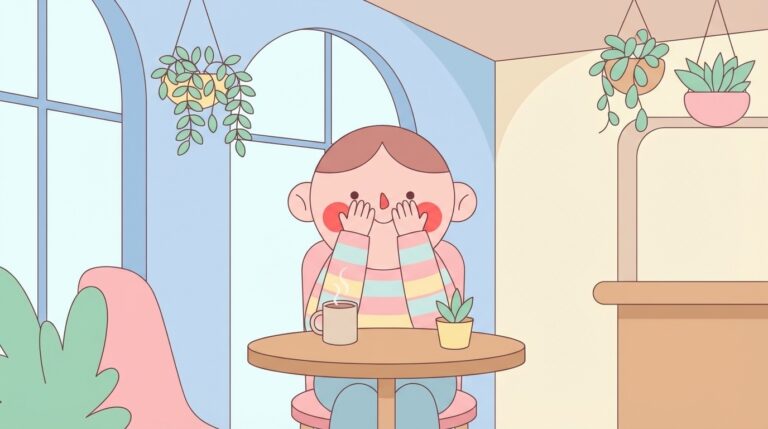
Phase 1: Empathy (Welcome to the Panic Zone)
Hello! I’m the lead editor of Daily Hangul—your veteran Korean tutor and local cultural navigator.
Picture this: You are in Seoul. You walk up to a very handsome barista in a trendy Hongdae cafe. You’ve practiced your coffee order in your head fifty times. You open your mouth to say, “Excuse me!” (저기요 – jeo-gi-yo), but your brain glitches. Instead, out comes: “Oppa!”
The cafe goes silent. The barista blinks. You want the ground to open up and swallow you whole. 🕳️
If you watch K-Dramas, you know this exact scene. The female lead trips over nothing, or accidentally texts her boss instead of her best friend. But what do they actually say in these moments to make it cute rather than completely disastrous?
Today, we are talking about Emotions – Negative (Feeling Embarrassed/Shy). Learning how to express your embarrassment in Korean doesn’t just save you from awkwardness—it’s actually a “cheat code” to making Korean people think you are incredibly charming and relatable.
This guide is built from the real, sweaty-palmed experiences of my A1 beginner students. Let’s turn your awkward moments into K-Drama magic!
Phase 2: Core Expressions – Deep Dive
Let’s look at the two absolute must-know phrases for when you want to hide under a table.
1. 부끄러워요 (I am shy / embarrassed)
- Pronunciation: bu-kkeu-reo-wo-yo [boo-kkuh-raw-wuh-yo]
Editor’s Sound Guide: For the ‘eu’ (으) sound in ‘kkeu’, make the disgusted sound you make when you step in chewing gum: “Eugh!”- Meaning: Literal = I am bashful/shy. Real Nuance = I feel shy, flustered, or mildly embarrassed (in a cute way).
- K-Culture Moment: Think of K-Pop idols. When fans chant their names loudly, or when an idol is asked to do Aegyo (cute acts) on a variety show, they do it—and then immediately cover their red face screaming, “Ah, bu-kkeu-reo-wo-yo!”
- Editor’s Insight: This is a soft, innocent type of embarrassment. You use this when someone compliments you too much, or when you are just naturally shy meeting someone new.
- Situation Spectrum:
[🚫 Never] ———— [⚠️ Be Careful] ———— [✅ Freely]
- Close Friends (Casual): ✅ (You can drop the ‘yo’ and just say 부끄러워 – bu-kkeu-reo)
- Co-workers (Semi-formal): ✅
- Boss / Elders (Formal): ⚠️ (It’s okay to express shyness, but use polite body language!)
- 🤔 Think About It: Why do K-Pop idols constantly express that they are bu-kkeu-reo-wo-yo? In Korean culture, showing a little bit of shyness and humility is often seen as much more attractive than total, unshakeable confidence.
2. 창피해요 (I am ashamed / embarrassed by a mistake)
- Pronunciation: chang-pi-hae-yo [chahng-pee-heh-yo]
- Meaning: Literal = I am ashamed. Real Nuance = “I did something silly/stupid and I’m so embarrassed!”
- K-Culture Moment: The classic K-Drama scene where the protagonist realizes they wore their sweater inside out to a job interview, or they pushed a “PULL” door with all their might in public.
- Editor’s Insight: While bu-kkeu-reo-wo-yo is for shyness, chang-pi-hae-yo is for clumsiness or minor public humiliation. If you trip on the subway stairs, this is the word you need!
- Situation Spectrum:
[🚫 Never] ———— [⚠️ Be Careful] ———— [✅ Freely]
- Close Friends (Casual): ✅ (Just say 창피해! – chang-pi-hae!)
- Co-workers (Semi-formal): ✅
- Boss / Elders (Formal): ⚠️ (You are admitting a mistake, so be mindful of the context.)
- 🤔 Think About It: Does your language have a clear line between “feeling shy” and “feeling embarrassed by a mistake”?
Phase 3: Textbook vs. Real Korean
How do real Koreans say it compared to your beginner textbooks?
| Situation | 📖 Textbook Korean | 🗣️ Real Korean | 💡 Why is it different? |
|---|---|---|---|
| Making a silly mistake | 저는 창피합니다. (I am embarrassed.) | 아, 창피해! (Ah, so embarrassing!) | Koreans love adding exclamation words like “Ah!” or “Hul!” (헐) to express raw, unfiltered emotion. We often drop the formal endings when talking to ourselves in shock. |
| Feeling shy | 저는 부끄럽습니다. (I am shy.) | 부끄러워요~ (I’m shy~) | Adding a little “~” (extending the end of the word) softens the tone and makes you sound much more natural and approachable. |
Bottom Note for Beginners (A1): You don’t need complicated slang yet! Just putting “Ah…” (아…) before the word makes you sound 50% more native.
Phase 4: K-Culture Deep Dive
4-1. The Non-Verbal “Embarrassed” Survival Guide
In Korea, body language speaks louder than words, especially when you are flustered!
– The Face Fan: If you make a mistake, wave your hand in front of your face like you are fanning yourself. It implies, “Oh my, I’m sweating from embarrassment!”
– The Mouth Cover (입 가리기): When Koreans laugh because they are shy or embarrassed, they almost always cover their mouths with their hands. Try it! It instantly gives you the “local” vibe.
4-2. The “Ibul-kik” (이불킥) Phenomenon
Have you ever done something so embarrassing during the day that when you go to sleep at night, you suddenly remember it and violently kick your blankets in frustration?
In Korea, we call this 이불킥 (i-bul-kik).
– 이불 (i-bul) = blanket
– 킥 (kik) = kick
K-Dramas feature this trope constantly! The heroine gets drunk, calls her ex, and the next morning she is doing an ibul-kik in bed. Even as an A1 learner, if you point to yourself and say “Ah, ibul-kik!” after a mistake, Korean friends will burst into laughter and completely forgive you.
Phase 5: Interactive Roleplay Scenario
Setting: A Friday afternoon. A cozy, aesthetic cafe in Yeonnam-dong. You are trying to order an iced Americano in Korean. You step up to the counter, but you completely forget the word for “Ice” and end up gesturing wildly like a penguin.
Characters:
– YOU: A brave beginner Korean learner.
– Min-jun (25): The friendly cafe worker who is trying not to laugh at your cute penguin gestures.
Dialogue:
YOU: 저기요… 아메리카노 하나 주세요. 🐧
(Jeo-gi-yo… a-me-ri-ka-no ha-na ju-se-yo.)
(Excuse me… one Americano, please.)
Min-jun: 네, 따뜻한 걸로 드릴까요?
(Ne, tta-tteu-tan geol-lo deu-ril-kka-yo?)
(Yes, would you like it hot?)
YOU: (Brain freezing) 아니요! 그… 펭귄… 너무 추워요…
(A-ni-yo! geu… peng-gwin… neo-mu chu-wo-yo…)
(No! Uh… penguin… very cold…)
(🎭 Stage Direction: Min-jun realizes you mean “iced” and gives a big, warm smile.)
Min-jun: 아~ 아이스요? 알겠습니다. (Chuckles)
(Ah~ A-i-seu-yo? Al-get-seum-ni-da.)
(Ah~ Iced? Understood.)
🔀 YOUR TURN! How do you respond to save yourself from this awkwardness?
– A) “감사합니다.” (Thank you.) – The safe, textbook choice.
– B) “아, 창피해요!” (Ah, I’m embarrassed!) – The relatable, human choice.
– C) “대박!” (Awesome!) – Wait, what’s awesome? The penguin?✅ Best Choice: B!
Why? Admitting your embarrassment with a smile (Ah, chang-pi-hae-yo!) breaks the ice. Min-jun will definitely think your effort to speak Korean was adorable. Choice A is fine but a bit robotic. Choice C doesn’t fit the context!
Bonus K-Culture Scenario: The Fan-sign Freeze 🎤
Imagine you finally meet your favorite K-Pop idol at a fan-sign event. You walk up, they look into your eyes and smile brightly.
Idol: 안녕하세요! 이름이 뭐예요? (Hello! What is your name?)
YOU: (Freezing completely) 어… 어…
YOU: 너무 부끄러워요… (Neo-mu bu-kkeu-reo-wo-yo…) (I’m so shy…)
Idol: 귀여워요! 천천히 말해요. (Gwi-yeo-wo-yo! Cheon-cheon-hi mal-hae-yo.) (You’re cute! Take your time.)
Phase 6: 10-Second Shadowing Drill
Let’s practice the rhythm! Pay attention to the pauses (/) and the emotion tags.
🥺 (Covering your face playfully)
아… / 저 너무 / 부끄러워요!
(A… / jeo neo-mu / bu-kkeu-reo-wo-yo!)
Ah… / I am so / shy!😤 (Laughing at your own silly mistake)
헐… / 진짜 / 창피해요!
(Heol… / jin-jja / chang-pi-hae-yo!)
Oh my… / really / embarrassing!
Phase 7: K-Culture Mini Dictionary
Here are some related words you will hear constantly in Korea.
| Korean | Romanization | English | Context / Meaning |
|---|---|---|---|
| 눈치 | nunchi | Social sense | The superpower of reading the room. If you do something embarrassing, you might check other people’s nunchi to see if they noticed. |
| 이불킥 | ibul-kik | Blanket kick | Remembering an embarrassing moment at night and kicking your bedsheets in regret. |
| 헐 | heol | OMG / Whoa | A very common exclamation used when you are shocked, surprised, or embarrassed. |
| 애교 | aegyo | Cute acts | Acting incredibly cute (usually with a baby voice). High risk of feeling bu-kkeu-reo-wo-yo afterward! |
Phase 8: Traveler’s Survival Kit
Embarrassing moments happen constantly when you travel. You walk into the wrong restroom, you drop your chopsticks loudly in a quiet restaurant… When panic strikes, use these!
🆘 Survival Phrases for the Awkward Tourist
– 🇰🇷 “죄송합니다.” (joe-song-ham-ni-da) = I am sorry. (Use this if your mistake inconvenienced someone else!)
– 🇰🇷 “아, 창피해요.” (a, chang-pi-hae-yo) = Ah, I’m embarrassed. (Use this to laugh at yourself.)
– 🇰🇷 “한국어 잘 못해요.” (han-gu-geo jal mo-tae-yo) = I can’t speak Korean well.📌 Editor’s Travel Note:
If you accidentally drop your metal chopsticks in a Korean restaurant (claaang!), don’t panic! You don’t need to apologize profusely. Just look at the staff, do a little embarrassed smile (you can whisper chang-pi-hae-yo to your friend), and the staff will casually bring you a new pair. No big deal!
Phase 9: Critical Thinking Corner — “A Step Deeper”
🧠 Think Deeper: Vulnerability as a Social Glue
In many Western cultures, projecting confidence is the key to success. Admitting you are embarrassed might be seen as a weakness. But in Korea, admitting you are bu-kkeu-reo-wo-yo (shy) or chang-pi-hae-yo (embarrassed) is actually a social strategy! It shows humility. It shows you are human. By lowering your own “status” momentarily, you make the other person feel comfortable and protective of you. Vulnerability here is a tool for building Jeong (정 – deep emotional connection).💬 Your Turn: How is showing embarrassment treated in your home country? Do people try to hide it, or do they laugh about it openly? Tell me in the comments!
Phase 10: FAQ & Avoiding Common Mistakes
Q: Can I tell my boss “창피해요” if I mess up a big presentation?
A: NO! 🚫 Chang-pi-hae-yo is for personal, minor embarrassment. If you make a professional mistake, you must use “죄송합니다” (I am sorry). Saying you feel “embarrassed” sounds like you care more about your own feelings than the company’s problem!
Q: Can I say “부끄러워요” to my K-Pop idol in a fan letter?
A: YES! ✅ They will think it’s adorable that their fan is shy to write to them.
❌ Common Mistake Alert!
Don’t confuse 부끄러워요 (I’m shy) with 두려워요 (I’m terrified/scared).
If a cute guy talks to you, you are 부끄러워요. If a tiger chases you, you are 두려워요. Don’t tell the cute guy he makes you feel like a tiger is chasing you!
Phase 11: Summary & Action Items
One-Liner Summary: Use 부끄러워요 (bu-kkeu-reo-wo-yo) when you feel shy, and 창피해요 (chang-pi-hae-yo) when you do something silly and want to hide!
Your Missions for Today:
– 🥉 Bronze (Solo): Stand in front of a mirror, cover your mouth, and practice saying “아, 창피해요!” with a smile.
– 🥈 Silver (Online): Go to your favorite idol’s YouTube video and comment: “오빠/언니 너무 멋있어서 부끄러워요!” (You are so cool, I’m shy!)
– 🥇 Gold (Real Life): The next time you make a tiny mistake in front of a Korean friend or at a Korean restaurant, use the phrase to break the ice!
🎬 K-Culture Mission: Watch one episode of a K-Drama today. I guarantee you will spot at least one character covering their face and doing an ibul-kik! When you see it, shout “Chang-pi-hae!” at your screen.
Phase 12: Interactive Quiz
Test your new “embarrassment” skills!
1. You are walking down the street in Seoul, and you trip over your own shoelaces. A group of students sees you. What is the most natural thing to whisper to yourself?
A) 저는 두려워요. (I am terrified.)
B) 아, 창피해! (Ah, so embarrassing!)
C) 감사합니다. (Thank you.)
2. Fill in the blank: You are meeting your Korean language partner for the first time. You want to say, “I’m a little shy.”
“저 조금 ___________.”
A) 부끄러워요
B) 이불킥
C) 눈치
3. True or False – K-Culture Edition:
In Korea, covering your mouth while laughing is considered extremely rude. (T/F)
(Scroll down for answers!)
…
…
…
Answers:
1. B (You made a silly mistake, so it’s chang-pi-hae! A means you are scared of the shoelaces.)
2. A (Meeting someone new makes you bu-kkeu-reo-wo-yo.)
3. False! It is actually very common and often shows a polite, shy kind of laughter!
Did you enjoy today’s lesson? Don’t be *bu-kkeu-reo-wo-yo, leave a comment below about your most embarrassing travel moment!* 😉
Frequently Asked Questions (FAQ)
Q: What does "부끄러워요 (I am shy / embarrassed)" mean in Korean and how do you pronounce it?
A: In Korean, "부끄러워요 (I am shy / embarrassed)" is pronounced [bu-kkeu-reo-wo-yo [boo-kkuh-raw-wuh-yo] and means: Literal = I am bashful/shy. Real Nuance = I feel shy, flustered, or mildly embarrassed (in a cute way).







