

Phase 1: Empathy (The K-Culture Cold Open)
Hello, C1 learners! Welcome back. I’m your Daily Hangul Chief Editor.
Picture this: You are watching a sleek modern K-Drama, perhaps something like Start-Up. The charismatic CEO gets into their luxury car, taps a button, takes their hands off the steering wheel, and turns entirely to the passenger seat to deliver a heart-melting line. The car is smoothly navigating the neon-lit streets of Gangnam on its own.
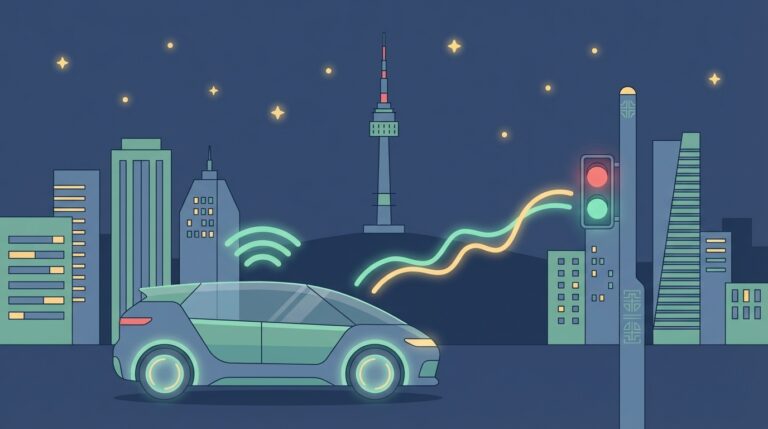
Or maybe you’ve visited Seoul recently and noticed the autonomous shuttles quietly gliding around Cheonggyecheon stream, or your Kakao Taxi driver getting real-time alerts about an ambulance approaching three blocks away. Welcome to the world of IoT (Internet of Things) and V2X (Vehicle-to-Everything) communication in South Korea—one of the most hyper-connected tech landscapes on the planet.
At the C1 level, you already know how to ask for directions or buy a subway ticket. But can you confidently discuss smart mobility with a Korean colleague? Can you complain about your smartphone not ‘syncing’ with your smart car using the exact vocabulary a Seoulite would use?
If you want to move beyond textbook survival Korean and sound like a true industry insider who understands the nunchi of Korean technology, buckle up. This guide is based on real interactions with expats working in Korea’s booming tech hubs.
Phase 2: Core Expressions Deep Dive
Let’s master the advanced expressions you need when navigating Korea’s smart infrastructure.
1. 연동되다 (To be synced/linked/integrated)
- Pronunciation: [yŏn-dong-dwe-da] Think of ‘yeon’ like the start of ‘yawn’ and ‘dong’ like a bell’s chime.
- Meaning: (Literal) To be interlocked/geared together. (Real Nuance) To be synced or digitally connected across platforms (e.g., IoT devices, V2X systems).
- K-Culture Moment: You’ll hear this constantly in Korean tech offices or when buying home appliances at LG or Samsung. “이 블랙박스는 스마트폰 앱이랑 연동돼요.” (This dashcam syncs with the smartphone app.)
- Editor’s Insight: This is a golden C1 word. Beginners say “연결되다” (connected). Advanced speakers use “연동되다” when talking about software, IoT, and V2X. It implies a seamless, two-way communication between systems.
- Situation Spectrum:
[🚫 절대 금지] ———— [⚠️ 주의] ———— [✅ 자유롭게]
- Friends (Casual): ✅ (e.g., “내 폰이랑 차가 연동이 안 돼!”)
- Colleagues (Semi-formal): ✅
- Boss/Seniors (Formal): ✅ (Perfect for professional presentations)
- 🤔 Think About It: Korea is a highly integrated society, both socially and digitally. Do you think the frequent use of words like “연동” reflects the Korean cultural emphasis on collective harmony and interconnectedness?
2. 경로를 재탐색합니다 (Recalculating the route)
- Pronunciation: [gyŏng-no-rŭl chae-tam-sae-kam-ni-da]
- Meaning: (Literal) Re-exploring the route. (Real Nuance) Recalculating route (Navi AI voice).
- K-Culture Moment: This is the iconic, slightly robotic voice of Korean navigation systems (like Kakao Navi or T-Map) when the driver misses a turn.
- Editor’s Insight: Beyond the literal tech context, Koreans use this metaphorically! If a project fails or you make a mistake in life, a friend might jokingly say, “경로를 재탐색합니다~” meaning “Time to come up with Plan B!”
- Situation Spectrum:
[🚫 절대 금지] ———— [⚠️ 주의] ———— [✅ 자유롭게]
- Friends (Casual): ✅ (Great for witty metaphorical use)
- Colleagues (Semi-formal): ⚠️ (Good for lighthearted moments, avoid in serious crisis)
- Boss/Seniors (Formal): 🚫 (Too informal/jokey for upper management)
- 🤔 Think About It: Why do Koreans love personifying AI? From navigation apps voiced by K-Pop idols to robotic servers in restaurants, AI is treated almost like a companion. How is AI voice integrated into your culture?
3. 전방에 주의 구간입니다 (Caution zone ahead)
- Pronunciation: [jŏn-bang-e chu-ŭi gu-ga-nim-ni-da]
- Meaning: (Literal) It is a caution section ahead. (Real Nuance) V2X/Navi alert for upcoming hazards, school zones, or speed cameras.
- K-Culture Moment: If you ride a taxi in Seoul, you will hear the navigation app beeping constantly, alerting the driver to speed bumps, cameras, and school zones. The V2X infrastructure feeds this data in real-time.
- Editor’s Insight: “전방” (ahead/front) is heavily used in driving and military contexts. In IoT driving tech, the car ‘reads’ the “전방” using sensors.
- Situation Spectrum:
[🚫 절대 금지] ———— [⚠️ 주의] ———— [✅ 자유롭게]
- Used by AI/Announcements: ✅
- General Conversation: ⚠️ (Usually, people just say “앞에 조심해” – be careful ahead. Use ‘전방’ to sound specifically like tech/news).
Phase 3: Textbook vs. Real Korean
How do we talk about smart cars in real life versus what the textbook says?
| Situation | 📖 Textbook Korean | 🗣️ Real Korean | 💡 Why is it different? |
|---|---|---|---|
| Explaining V2X | 자동차가 신호등과 정보를 교환합니다. | 차랑 신호등이 연동돼 있어요. | Koreans prefer the concise, professional term “연동” (sync/link) over “exchanging information.” |
| Turning on Auto-pilot | 자율 주행 모드를 시작합니다. | 자율주행 켤게. / 오토파일럿 켰어. | Everyday tech usage borrows English terms or uses the simple verb “켜다” (to turn on). |
| Navigation lost signal | 통신 연결이 끊어졌습니다. | 아, GPS 튀었어 / 통신 끊겼어. | “GPS가 튀다” (GPS bounced/glitched) is real driver slang when the V2X/Navi loses your exact location. |
Bottom Note: At the C1 level, dropping “GPS 튀었어” during a ride will instantly earn you the “Honorary Korean” badge.
Phase 4: Cultural Context — K-Culture Deep Dive
4-1. The ‘Nunchi’ of Korean Autonomous Driving
In Korean culture, 눈치 (Nunchi) is the art of reading the room and anticipating what others need before they say it. In a way, V2X (Vehicle-to-Everything) is the ultimate technological manifestation of Nunchi. A smart car in Seoul doesn’t just drive; it ‘reads the room’ of the city. It talks to the traffic lights, senses the pedestrian crossing the street looking at their smartphone, and anticipates the movements of the aggressive delivery motorcycles (배달 오토바이). When you explain V2X in Korean, comparing it to “자동차가 눈치를 보는 기술” (The technology of cars using Nunchi) is a brilliantly advanced way to express it.
4-2. The K-Drama Tech Trope vs. Reality
In K-Dramas, autonomous driving is often used as a romantic plot device. The protagonist pushes a button, the steering wheel retracts, and they lean over to gently wipe a crumb off the female lead’s face while the car smoothly drives down the Olympic Expressway.
Critical View: In reality, Korea’s driving culture is notoriously fast-paced (빨리빨리 – hurry, hurry!). While Seoul has cutting-edge V2X testbeds (like Sangam-dong), most Korean drivers will tell you that true autonomous driving still struggles to keep up with the unpredictability of Seoul traffic, especially those weaving delivery scooters.
Phase 5: Real-life Roleplay Scenario
Setting: It’s 10:00 PM on a rainy Tuesday in Gangnam. You and your Korean colleague, Min-su, just finished a late dinner. Min-su ordered a ‘RoboRide’ (an autonomous taxi currently being tested in specific Seoul zones). You are both sitting in the back seat as the steering wheel turns by itself.
Characters:
– YOU: An expat tech consultant working in Seoul.
– Min-su (34): Your Korean colleague, a bit of an early adopter, loves showing off new tech.
Dialogue:
Min-su: 우와, 진짜 알아서 가네요. 핸들 돌아가는 거 봐요! 😲
(Uwa, jinjja araseo ganeyo. Haendeul doraganeun geo bwayo!)
[Wow, it’s really driving itself. Look at the steering wheel turning!]
YOU: 그러게요. 생각보다 엄청 부드럽게 주행하는데요?
(Geureogeyo. Saenggakboda eomcheong budeureopge juhaenghaneundeyo?)
[I know, right? It’s driving much smoother than I expected.]
Min-su: 이게 V2X 기술이 적용돼서, 저기 앞 신호등이랑 통신하면서 가는 거래요.
(Ige V2X gisuri jeogyongdwaeseo, jeogi ap sinhodeung-irang tongsinhamyeonseo ganeun georaeyo.)
[They say V2X tech is applied here, so it drives while communicating with the traffic light up ahead.]
YOU: 아, 인프라랑 연동되어 있군요. 그래서 신호 바뀔 때 자연스럽게 멈췄구나.
(A, inpeurarang yeondongdoeeo itgunyo. Geuraeseo sinho bakkwil ttae jayeonseureopge meomchwotguna.)
[Ah, it’s synced with the infrastructure. That’s why it stopped so naturally when the light changed.]
(🎭 Stage Direction: Suddenly, a delivery motorcycle cuts in front of the car. The car stops abruptly but safely.)
Min-su: 휴, 깜짝이야! 저 오토바이 진짜…
(Hyu, kkamjjagiya! Jeo otobai jinjja…)
[Phew, that startled me! That motorcycle, seriously…]
🔀 Your Turn! How should you respond to this sudden AI braking?
– A) “기계가 사람보다 낫네요. 정말 훌륭한 기술입니다.” (Too textbook, sounds like a robot yourself).
– B) “차가 우리보다 눈치가 빠르네요. 방어운전 제대로 하는데요?” (Witty, culturally contextualized).
– C) “헐 대박! 오토바이 미쳤어!” (A bit too casual for a work colleague).✅ Best Choice: B — Why? Using “눈치가 빠르다” (quick to read the situation) to describe an AI car is pure C1-level genius. It shows you understand both the tech capability and the Korean cultural concept of situational awareness. Plus, “방어운전” (defensive driving) is the exact term Koreans use for this.
Phase 6: 10-Second Shadowing Drill
Let’s practice your tone. Imagine you are demonstrating the car’s features to a friend.
😲 우와! / 이 차는 / 신호등이랑 / 완벽하게 / 연~~~동되어 있어요!
(Uwa! / I cha-neun / sin-ho-deung-i-rang / wan-byŏk-ha-ge / yŏn~~~dong-dwe-ŏ i-ssŏ-yo!)
[Wow! / This car / is perfectly / syn~~~ced / with the traffic lights!]
Tip: Elongate the “연” slightly to emphasize how impressed you are by the seamless connection.
Phase 7: K-Culture Mini Dictionary (Tech & Transit)
| Korean | Romanization | English | Contextual Meaning |
|---|---|---|---|
| 연동 | yeondong | Syncing/Linking | The magic word for IoT. When your smartwatch talks to your phone, it’s ‘연동’. |
| 방어운전 | bang-eo-unjeon | Defensive driving | Crucial in Seoul. It’s what autonomous cars are programmed to do against aggressive drivers. |
| 과속 방지턱 | gwasok bangjiteok | Speed bump | Korea has many of these. V2X systems alert drivers in advance so they don’t bounce. |
| 내비 | naebi | Navi (Navigation) | Nobody says ‘내비게이션’. It’s always just ‘내비’. |
| 눈치 | nunchi | Social awareness | The cognitive V2X of human beings. Anticipating the flow of the environment. |
Phase 8: Traveler’s Survival Kit (Smart Mobility Edition)
Even if you aren’t testing V2X tech, you will use smart mobility when traveling in Korea. Here are your top survival phrases for dealing with taxis and navigation.
🆘 Survival Phrase #1: Following the AI
– 🇰🇷 “기사님, 내비게이션 경로대로 가주세요.”
– 🗣️ (Gisanim, naebigeisyeon gyeongnodaelo gajuseyo.)
– 📍 Where to use: In a taxi, if you want to ensure the driver follows the optimized app route rather than a ‘shortcut’ (which might cost more).
– 💡 Pro Tip: Say “내비대로” for short. It sounds very native.🆘 Survival Phrase #2: Dropping off
– 🇰🇷 “저기 편의점 앞에서 세워주세요.”
– 🗣️ (Jeogi pyeon-uijeom apeseo sewojuseyo.)
– 📍 Where to use: When you reach your destination but the GPS pin is slightly off.
📌 Editor’s Travel Note:
– Apps: Do not use Google Maps for driving/walking in Korea (due to security laws, it doesn’t have local vector data). You must download Kakao T (for taxis) and Naver Map / Kakao Map (for navigation).
– Payment: Kakao T allows you to link international credit cards nowadays, making the “IoT” experience of hopping out without pulling out your wallet seamless!
Phase 9: Critical Thinking Corner — “한 발 더 깊이”
🧠 Think Deeper: Global Era Korean & Tech Vocabulary
If you listen to Korean tech professionals discussing IoT and autonomous driving, you’ll notice an incredible amount of English. They will say “V2X 통신” (V2X communication), “IoT 디바이스” (IoT device), or “오토파일럿” (Autopilot).
However, they don’t just use English; they Koreanize it by attaching native grammar and verbs. For example, instead of saying “The devices are synced via IoT,” a Korean will say “IoT로 연동시켰어” (I made them sync via IoT).
This reflects a fascinating aspect of Global Era Korean: the language is highly adaptive. It absorbs foreign technical jargon rapidly to maintain the 빨리빨리 (fast-paced) innovation cycle, but it rigidly applies traditional Korean hierarchical grammar (like honorifics) and Sino-Korean action verbs (like 연동, 적용) to make those concepts culturally functional.
💬 Your Turn: In your native language, do you translate new tech words (like IoT or V2X) into your language’s vocabulary, or do you just use the English acronyms? Tell us in the comments!
Phase 10: FAQ & Common Mistakes
Q: Can I use informal language (반말) when talking to AI assistants in cars?
Yes! Most Koreans speak casually to AI (e.g., “아리아, 에어컨 켜줘” – Aria, turn on the AC). However, some newer V2X/AI interfaces in luxury cars are programmed to respond with extreme politeness, creating a funny dynamic where the car is highly respectful, and the human is very blunt.
Q: How do I tell a smart taxi to change the route?
Instead of arguing with the AI, tell the driver: “경로 좀 바꿔주실 수 있나요?” (Could you change the route?).
❌ Common Mistake #1: Using ‘운전하다’ for AI
Beginners often say “자동차가 스스로 운전해요” (The car drives itself). While grammatically perfect, it sounds like a children’s book.
✅ Do this instead: Use “자율주행” (Autonomous driving). -> “자율주행 모드네요!” (It’s in autonomous driving mode!)
Phase 11: Summary & Action Items
🚗 One-Liner Summary: To master Korean tech-talk, remember that devices don’t just connect; they perfectly ‘sync’ (연동되다), and even AI cars need high-tech nunchi (방어운전).
Action Mission 3-Steps:
– 🥉 Bronze: Say “기기들이 연동되어 있어요” (The devices are synced) out loud 3 times with confidence.
– 🥈 Silver: Change your smartphone’s navigation app (Google Maps/Apple Maps) to Korean voice guidance for one day. Listen for “경로를 재탐색합니다.”
– 🥇 Gold: Next time you are in a taxi in Korea (or an Uber with a Korean driver), casually observe the navigation app and say, “길이 막히네요, 내비대로 가주세요.” (Traffic is heavy, please follow the navi).
K-Culture Mission:
Watch an episode of the K-Drama Start-Up or any modern K-Drama featuring tech offices. Every time you hear the word “연동” (sync) or see a character let the car drive itself, take a mental note!
Phase 12: Quiz — Interactive Challenge
1. Fill in the Blank:
“내 스마트워치랑 자동차가 완벽하게 [ _______ ]되어 있어서 편해요.”
(My smartwatch and car are perfectly [ _______ ], so it’s convenient.)
2. Situational Judgment:
You are explaining why autonomous cars are safe in Korea to your boss. Which phrase is most appropriate?
– A) 차가 눈치가 빨라요!
– B) V2X 기술이 신호등과 연동되어 방어운전을 돕습니다.
– C) GPS 튀어도 알아서 가요.
3. True or False – K-Culture Edition:
When taking a taxi in Seoul, it is considered rude to ask the driver to follow the navigation app’s route exactly. (T/F)
🚨 Click here for Answers!
- 연동 (yeondong) – The magic word for syncing devices!
- B – A is too casual for a boss, and C uses slang (“GPS 튀어도”). B perfectly uses high-level tech vocabulary.
- False – It is perfectly normal and often preferred. You can just say “내비대로 가주세요” (Please follow the navi).
Frequently Asked Questions (FAQ)
Q: What does "연동되다 (To be synced/linked/integrated)" mean in Korean and how do you pronounce it?
A: In Korean, "연동되다 (To be synced/linked/integrated)" is pronounced [yŏn-dong-dwe-da] and means: (Literal) To be interlocked/geared together. (Real Nuance) To be synced or digitally connected across platforms (e.g., IoT devices, V2X systems).
Q: What does "경로를 재탐색합니다 (Recalculating the route)" mean in Korean and how do you pronounce it?
A: In Korean, "경로를 재탐색합니다 (Recalculating the route)" is pronounced [gyŏng-no-rŭl chae-tam-sae-kam-ni-da] and means: (Literal) Re-exploring the route. (Real Nuance) Recalculating route (Navi AI voice).
Q: What does "전방에 주의 구간입니다 (Caution zone ahead)" mean in Korean and how do you pronounce it?
A: In Korean, "전방에 주의 구간입니다 (Caution zone ahead)" is pronounced [jŏn-bang-e chu-ŭi gu-ga-nim-ni-da] and means: (Literal) It is a caution section ahead. (Real Nuance) V2X/Navi alert for upcoming hazards, school zones, or speed cameras.






