

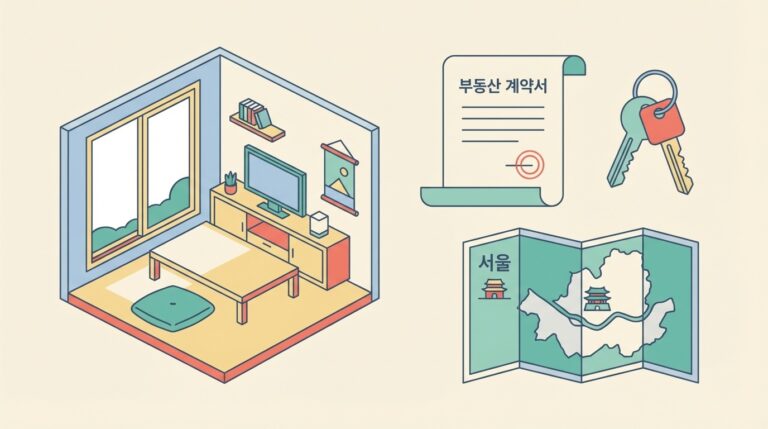
Phase 1: Empathy (Immersive Opening)
Hello there! I’m your Daily Hangul Editor. Have you ever watched a K-Drama where the main character, down on their luck, visits a local real estate agent and the agent casually throws out numbers like, “It’s 1000 over 50”? Or maybe you’ve seen the romanticized “rooftop room” (옥탑방) scenes where friends gather for BBQ under the Seoul skyline.
But what happens when YOU actually need to rent a place in Korea? Whether you’re planning a long-term stay, studying abroad, or just curious about Korean daily life, walking into a 부동산 (Budongsan – Real Estate Agency) can feel like stepping into a parallel universe with its own unique math. The Korean deposit system is famous worldwide for being… well, intensely expensive and confusing.
Today, we’re going to decode the secret language of Korean housing. We will focus on the essential phrases for asking about the deposit (보증금) and monthly rent (월세). Let’s turn that K-Drama confusion into real-life confidence! This guide is built from the exact pain points my B1-level students face when moving to Seoul.
Phase 2: Core Expressions Deep Dive
1. 보증금하고 월세가 어떻게 돼요?
- Pronunciation: bo-jeung-geum-ha-go / wol-se-ga / eo-tteo-ke dwoe-yo? (The ‘eo’ sounds like the ‘u’ in ‘uh-oh’, and ‘eu’ is like the disgusted sound you make when you step in gum.)
- Meaning: Literal: How do the deposit and monthly rent become? / Real nuance: How much are the deposit and monthly rent?
- K-Culture Moment: You’ll hear this exact phrase when someone walks into a Budongsan. The agent will usually reply with two numbers, like “1000에 50” (1000 over 50). The first number is the deposit (usually in units of 10,000 KRW, so 1000 means 10 million KRW, about $7,500 USD), and the second is the monthly rent (500,000 KRW). It’s a huge shock for many expats!
- Editor’s Insight: Using “어떻게 돼요?” instead of “얼마예요?” (How much is it?) makes you sound 10x more natural. It’s a softer, more polite way to ask about prices or personal details in Korea.
- Situation Spectrum:
[🚫 Never] ———— [⚠️ Caution] ———— [✅ Freely]
- Close Friends (Casual): 🚫 (You wouldn’t use standard polite form ‘-yo’ with close friends)
- Real Estate Agent (Semi-formal): ✅
- Formal/Business (Formal): ✅
- 🤔 Think About It: Why do Koreans prefer asking “How does it become?” instead of a direct “How much is it?” when dealing with large sums of money or important matters? What does this say about the culture of indirectness?
2. 관리비는 포함인가요?
- Pronunciation: gwal-li-bi-neun / po-ha-min-ga-yo? (Notice the sound change! ‘gwan-ri-bi’ becomes ‘gwal-li-bi’ for easier flow.)
- Meaning: Literal: Is the maintenance fee included? / Real nuance: Does the rent cover the maintenance fee, and what’s in it?
- K-Culture Moment: The dreaded ‘Gwanribi’ trap! In many Korean studios, the rent might look cheap (e.g., $300/month), but the agent will hit you with a $150/month maintenance fee. Knowing to ask this question separates the rookies from the veterans.
- Editor’s Insight: Always follow up by asking what is included (water, internet, cleaning). Electricity and gas are usually separate.
- Situation Spectrum:
[🚫 Never] ———— [⚠️ Caution] ———— [✅ Freely]
- Close Friends (Casual): 🚫
- Real Estate Agent (Semi-formal): ✅
- Formal/Business (Formal): ✅
- 🤔 Think About It: “포함” (Inclusion) is a Hanja (Sino-Korean) word. Notice how formal contexts in Korea heavily rely on these Hanja-based vocabulary words instead of pure Korean words?
3. 방 좀 볼 수 있을까요?
- Pronunciation: bang jom / bol su i-sseul-kka-yo?
- Meaning: Literal: Could I see the room a little? / Real nuance: Can I take a tour of the room?
- K-Culture Moment: After discussing the budget, it’s time for the tour. The agent will grab a massive ring of keys, and you’ll walk to the building.
- Editor’s Insight: The word “좀” (a little) is the magic softening word in Korean. You aren’t literally asking to see the room “for a little bit”—it just makes the request sound much more polite and less demanding.
- Situation Spectrum:
[🚫 Never] ———— [⚠️ Caution] ———— [✅ Freely]
- Close Friends (Casual): ⚠️ (Too formal for friends)
- Real Estate Agent (Semi-formal): ✅
- Formal/Business (Formal): ✅
Phase 3: Textbook vs. Real Korean
| Situation | 📖 Textbook Korean | 🗣️ Real Korean | 💡 Why the difference? |
|---|---|---|---|
| Asking the rent | 이 방의 월세는 얼마입니까? (How much is the rent for this room?) | 월세 얼마예요? / 1000에 50 맞아요? (How much is rent? / Is it 1000 over 50?) | Textbooks use the rigid ‘입니다’ form, but real life uses the softer ‘해요체’ (-yo) and omits subjects. |
| Asking to bargain | 보증금을 깎아주실 수 있습니까? (Can you give a discount on the deposit?) | 보증금 조율 되나요? (Can the deposit be adjusted?) | “깎다” (to cut/discount) sounds a bit aggressive for real estate. “조율하다” (to adjust/tune) sounds professional. |
| Asking if furnished | 가구가 다 있습니까? (Is all the furniture there?) | 풀옵션이에요? (Is it full-option?) | Konglish rules the real estate market! “Full-option” means it has a fridge, washer, and AC. |
Phase 4: Cultural Context — K-Culture Deep Dive
4-1. Non-Verbal Nuances
When you go to see a room, do not forget to take off your shoes! Even if the room is empty and dusty, Korean homes are strictly shoe-free zones. Usually, you’ll leave your shoes at the small entrance area called the 현관 (Hyeongwan). Also, you’ll often see Koreans turn on the sink or shower during a room tour. Why? They are checking the 수압 (water pressure), which is a huge deal when living in older Seoul buildings!
4-2. The “Oktapbang” & “Banjiha” Tropes in K-Media
If you’ve watched K-Dramas like Fight For My Way or the movie Parasite, you know about the 옥탑방 (Rooftop room) and 반지하 (Semi-basement).
In dramas, the rooftop room is a romantic spot where young, attractive people drink beer under fairy lights. The Reality: They are freezing in the winter and boiling hot in the summer because they lack proper insulation.
Meanwhile, the semi-basement offers cheaper rent but comes with high humidity and lack of sunlight. When asking an agent about rooms, they might suggest a Banjiha if your deposit is low. It’s a vivid reminder of Seoul’s intense housing density and the economic realities faced by young people.
Phase 5: Real-Life Roleplay Scenario
Setting: Saturday afternoon in Sinchon, near the university. The Budongsan smells like instant coffee. A large, colorful map of the neighborhood covers the wall. You are looking for a studio apartment for your study abroad year.
Characters:
– YOU: An expat who knows a bit of Korean but is nervous about getting scammed.
– Agent Ahn (50s): A friendly but fast-talking local real estate agent (Ajeossi).
Agent Ahn: 어서 오세요! 학생이에요? 방 찾으러 왔어요? ☕
(eoseo oseyo! haksaeng-ieyo? bang chajeureo wasseoyo?)
[Welcome! Are you a student? Did you come to look for a room?]
(🎭 Stage Direction: Agent Ahn hands you a paper cup of sweet instant coffee.)
YOU: 네, 원룸 찾고 있어요.
(ne, wonrum chatgo isseoyo.)
[Yes, I’m looking for a studio.]
Agent Ahn: 예산이 어떻게 돼요? 보증금 얼마 생각해요?
(yesani eotteoke dwoeyo? bojeunggeum eolma saenggakaeyo?)
[What’s your budget? How much deposit are you thinking?]
YOU: 보증금 천만 원에 월세 60만 원 정도요.
(bojeunggeum cheonman wone wolse yuksipman won jeongdoyo.)
[Around 10 million won deposit and 600,000 won monthly rent.]
Agent Ahn: 아, 딱 좋은 방이 하나 있어요. 1000에 60! 근데 관리비는 별도예요.
(a, ttak joeun bang-i hana isseoyo. cheone yuksip! geunde gwallibineun byeoldoyeyo.)
[Ah, I have a perfectly good room. 1000 over 60! But the maintenance fee is separate.]
🔀 YOUR TURN! How do you respond?
– A) “관리비가 뭐예요?” (What is a maintenance fee?)
– B) “관리비는 한 달에 얼마예요? 인터넷 포함인가요?” (How much is it per month? Is internet included?)
– C) “너무 비싸요. 깎아주세요!” (It’s too expensive. Give me a discount!)✅ Best Choice: B! You must always ask what the ‘Gwanribi’ includes (water, internet, cleaning).
⚠️ Choice C Analysis: Negotiating rent directly like buying a t-shirt at a market is frowned upon. You adjust the deposit, not aggressively demand a discount.
YOU: 관리비는 한 달에 얼마예요? 인터넷 포함인가요?
(gwallibineun han dare eolmayeyo? inteonet pohamin-gayo?)
[How much is the maintenance fee per month? Is internet included?]
Agent Ahn: 5만 원이고 인터넷, 수도 포함이에요. 가스만 따로 내면 돼요. 방 좀 볼래요?
(oman wonigo inteonet, sudo pohamieyo. gaseuman ttaro naemyeon dwaeyo. bang jom bollaeyo?)
[It’s 50,000 won and includes internet and water. You just pay gas separately. Do you want to see the room?]
YOU: 네, 방 좀 볼 수 있을까요?
(ne, bang jom bol su isseulkkayo?)
[Yes, could I see the room?]
Agent Ahn: 그럼요! 가시죠.
(geureomyo! gasijyo.)
[Of course! Let’s go.]
Phase 6: 10-Second Shadowing Drill
Practice these lines out loud! Pay attention to the pauses (/) and the emotion tags.
- 🧐 (Curiously) 보증금하고 / 월세가 / 어떻게 돼요? (bo-jeung-geum-ha-go / wol-se-ga / eo-tteo-ke dwoe-yo?)
- 🤔 (Carefully) 관리비는 / 포함인가요? (gwal-li-bi-neun / po-ha-min-ga-yo?)
- 😊 (Politely) 방 좀 / 볼 수 있을까요? (bang jom / bol su i-sseul-kka-yo?)
Phase 7: K-Culture Mini Dictionary
| Korean | Romanization | English | Cultural Context |
|---|---|---|---|
| 부동산 | budongsan | Real Estate Agency | Literally means “immovable property.” Every neighborhood has tons of them. |
| 원룸 | wonrum | Studio Apartment | Konglish for “One-room.” It does NOT mean a one-bedroom apartment; it’s a studio where bedroom and kitchen share the space. |
| 풀옵션 | pul-op-syeon | Fully Furnished | Essential for students/expats. Usually includes AC, washing machine, fridge, and sometimes a bed. |
| 전세 | jeonse | Key Money Deposit System | A unique Korean system where you pay a massive deposit (often 50-80% of house value) and pay NO monthly rent. |
| 월세 | wolse | Monthly Rent | You pay a smaller deposit (still large by Western standards, e.g., $5,000+) and a monthly fee. |
Phase 8: Traveler Survival Kit
Even if you aren’t signing a one-year lease, you might use Airbnb or look for short-term stays like Gosiwons. Here are survival phrases if you need help with your accommodation.
🆘 Survival Phrases for Accommodations
– 🇰🇷 “수압 좀 확인해도 될까요?” (suap jom hwaginhaedo doelkkayo?)
– 🗣️ English: Can I check the water pressure?
– 📍 Where to use: Viewing any room or Airbnb.
- 🇰🇷 “와이파이 비밀번호가 뭐예요?” (waipai bimilbeonhoga mwoyeyo?)
- 🗣️ English: What’s the Wi-Fi password?
- 📍 Where to use: Guesthouses, hotels, cafes.
🇰🇷 “에어컨이 안 돼요.” (eeokeoni an dwaeyo.)
- 🗣️ English: The AC isn’t working.
- 📍 Where to use: Texting your Airbnb host in the sweltering Korean summer.
📌 Editor’s Travel Note
– Useful Apps: Zigbang (직방) and Dabang (다방) are the go-to apps for checking average room prices in Seoul. Even if you don’t speak perfect Korean, you can look at the “1000/50” numbers to understand the market rate before you arrive!
Phase 9: Critical Thinking Corner — “A Step Deeper”
Media vs Reality: The K-Drama Illusion
🧠 Think Deeper:
Korean dramas often use housing to quickly establish a character’s social class. The chaebol (conglomerate heir) lives in a sleek, empty penthouse in Gangnam, while the hardworking female lead lives in a charming rooftop room (옥탑방). In reality, renting a decent studio in Seoul is highly competitive and expensive due to the massive deposits required. The unique “Jeonse” (huge deposit, no rent) system relies on high interest rates and a booming housing market, a system that doesn’t exist anywhere else in the world. It shows how deeply tied the Korean concept of “coming of age” is to gathering enough cash to finally afford your own deposit.💬 Your Turn: Does your country have a unique renting system? How much is a typical deposit for a young person moving out for the first time? Share in the comments!
Phase 10: FAQ & Avoiding Misunderstandings
Q: Can I negotiate the rent in Korea?
Yes and No. You rarely negotiate the monthly rent itself (e.g., asking to drop it from 60 to 50). However, you CAN “adjust” (조율하다) the ratio between the deposit and the rent. For example, if you offer a higher deposit, the landlord will usually lower the monthly rent!
Q: What if I don’t have a $10,000 deposit?
Many foreigners look for 단기 임대 (Short-term rentals) or 고시원 (Gosiwon – tiny dorm-like rooms) which require very low or zero deposits!
❌ Common Mistake #1: Thinking “One-room” means a 1-bedroom apartment with a separate living room.
✅ Do this instead: If you want a separate bedroom and living room, you must ask for a 투룸 (Two-room)!❌ Common Mistake #2: Ignoring the 관리비 (maintenance fee) until move-in day.
✅ Do this instead: Always ask “관리비 포함이에요?” to calculate your true monthly expenses.
Phase 11: Summary & Action Items
🎯 One-Liner Summary: To master Korean apartment hunting, ask “어떻게 돼요?” for the prices, verify the “관리비” (maintenance), and ensure it’s “풀옵션” (furnished)!
🚀 Action Mission:
– 🥉 Bronze (Solo): Stand in your current room and say “방 좀 볼 수 있을까요?” to your imaginary real estate agent.
– 🥈 Silver (Online): Download the ‘Zigbang (직방)’ app, click on a random neighborhood in Seoul, and see if you can spot the deposit/rent numbers!
– 🥇 Gold (Real Life): If you’re in Korea, walk past a Budongsan and read the printed papers on the window. Try to guess how much the deposits are!
🎬 K-Culture Mission:
The next time you watch a K-Drama and the main character moves into a new house or complains about money, listen closely for the words “보증금” (Bojeunggeum) or “월세” (Wolse). It happens more often than you think!
Drop a comment below: What’s the biggest culture shock you’ve had regarding housing in your travels?
Phase 12: Quiz — Interactive Challenge
1. Situational Judgment: You are looking at a paper on a Budongsan window. It says “풀옵션 원룸 500/40”. What does this mean?
– A) The rent is 500,000 won and maintenance is 40,000 won.
– B) The deposit is 5 million won and the rent is 400,000 won.
– C) The room is 500 square feet and costs $40.
(Answer: B! Remember, the first number is the deposit in ten-thousands. 500 = 5,000,000 KRW.)
2. Fill in the Blank:
You want to know if the internet and water are included in the extra monthly fee.
“__________ 포함인가요?”
(Answer: 관리비 – gwallibi / maintenance fee)
3. True or False — K-Culture Edition:
“In Korea, it’s polite to keep your shoes on when viewing an empty apartment for rent.” (T/F)
(Answer: False! You should almost always take your shoes off at the Hyeongwan, even if the house is empty.)
Frequently Asked Questions (FAQ)
Q: What does "보증금하고 월세가 어떻게 돼요?" mean in Korean and how do you pronounce it?
A: In Korean, "보증금하고 월세가 어떻게 돼요?" is pronounced [bo-jeung-geum-ha-go / wol-se-ga / eo-tteo-ke dwoe-yo? (The 'eo' sounds like the 'u' in 'uh-oh', and 'eu' is like the disgusted sound you make when you step in gum.] and means: Literal: How do the deposit and monthly rent become? / Real nuance: How much are the deposit and monthly rent?
Q: What does "관리비는 포함인가요?" mean in Korean and how do you pronounce it?
A: In Korean, "관리비는 포함인가요?" is pronounced [gwal-li-bi-neun / po-ha-min-ga-yo? (Notice the sound change! 'gwan-ri-bi' becomes 'gwal-li-bi' for easier flow.] and means: Literal: Is the maintenance fee included? / Real nuance: Does the rent cover the maintenance fee, and what's in it?
Q: What does "방 좀 볼 수 있을까요?" mean in Korean and how do you pronounce it?
A: In Korean, "방 좀 볼 수 있을까요?" is pronounced [bang jom / bol su i-sseul-kka-yo?] and means: Literal: Could I see the room a little? / Real nuance: Can I take a tour of the room?







