

Phase 1: Empathy
Hello! Daily Hangul Editor here.
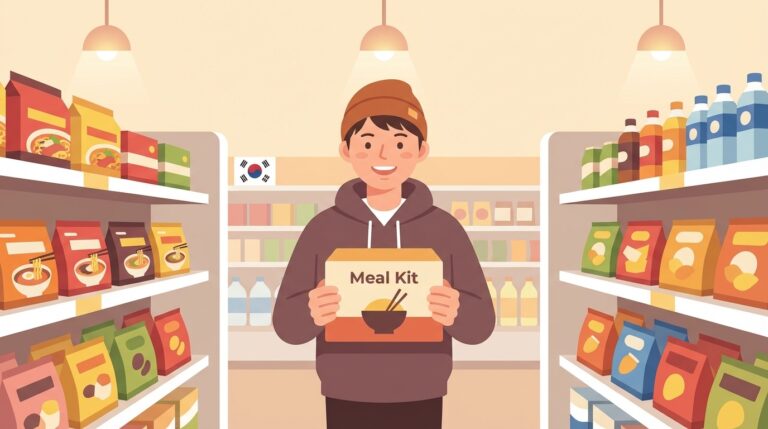
Picture a classic K-Drama scene: The protagonist, exhausted after a grueling late-night shift at the office, wanders into a brightly lit neighborhood convenience store. They skip the massive produce section and head straight for a sleek aisle filled with neatly packed, single-serving boxes. They grab a budae jjigae (sausage stew), take it home, and have a quiet, comforting meal alone.
Have you ever walked into a massive Korean E-mart or traditional market and felt completely overwhelmed? For solo expats, exchange students, or solo travelers in Korea, buying a giant bundle of green onions or a massive tub of gochujang is a nightmare.
Korea’s demographic has shifted dramatically towards 1인 가구 (Single Households). Because of this, the country has developed a brilliant, hyper-efficient ecosystem of 소포장 (Small-packaged groceries) and 밀키트 (Meal kits). Knowing how to navigate this isn’t just about grocery shopping—it’s about saving money, reducing waste, and living like a true Seoulite. Let’s dive into the essential expressions you need to survive the Korean mart!
Phase 2: Core Expressions Deep Dive
1. 이거 1인분이에요?
- Pronunciation: igeo irinbunieyo? [ee-guh ee-rin-boon-ee-eh-yo?]
- Meaning: Is this one serving? (Is this for one person?)
- K-Culture Moment: You are standing in front of the legendary meal kit section at a Korean supermarket. You see a delicious-looking Dakgalbi (spicy stir-fried chicken) kit, but you can’t tell if it’s meant to feed you, or you and three imaginary friends.
- Editor’s Insight: The word 인분 (inbun) means ‘portions based on the number of people.’ 1인분 (1 serving), 2인분 (2 servings). It’s a crucial unit of measurement in a food culture historically built around sharing.
- Situation Spectrum:
[🚫 Never] ———— [⚠️ Caution] ———— [✅ Freely]
- Close Friends (Casual): ✅ (Say: 이거 1인분이야?)
- Store Staff (Semi-formal): ✅
- Formal/Elders (Formal): ✅
- 🤔 Think About It: Why is food portioned so strictly by ‘number of people’ (인분) in Korea, rather than just by weight or size (small/medium/large)? How does this reflect Korea’s communal eating history?
2. 소포장된 거 혹시 있나요?
- Pronunciation: sopojangdoen geo hoksi innayo? [so-po-jang-dwen guh hok-shi een-na-yo?]
- Meaning: Do you happen to have this in smaller packaging?
- K-Culture Moment: You are trying to cook a simple pasta, but the mart only sells garlic in giant bundles of 50 bulbs. You gently ask the Ajeumoni (middle-aged lady staff) if they have a smaller pack hidden somewhere.
- Editor’s Insight: Adding 혹시 (hoksi – ‘by any chance’) makes your request sound much softer and more polite. You aren’t demanding; you are cautiously asking for a favor.
- Situation Spectrum:
[🚫 Never] ———— [⚠️ Caution] ———— [✅ Freely]
- Close Friends (Casual): 🚫 (Too formal for friends)
- Store Staff (Semi-formal): ✅
- Formal/Elders (Formal): ✅
- 🤔 Think About It: In the past, buying small amounts of groceries in Korea was considered “not cost-effective.” Now, supermarkets have dedicated “small-portion” zones. What does this tell us about modern urban living in Seoul?
3. 해 먹기 편한 밀키트 있어요?
- Pronunciation: hae meokgi pyeonhan milkiteu isseoyo? [hae muhk-gi pyun-han meel-kee-teu ees-uh-yo?]
- Meaning: Do you have meal kits that are easy to whip up (cook and eat)?
- K-Culture Moment: You have zero energy to chop vegetables, but you want a hot, home-cooked Korean meal instead of delivery. Meal kits (밀키트) are the holy grail for busy Korean workers.
- Editor’s Insight: The verb phrase ‘해 먹다’ (hae meokda) literally means ‘to do/make and eat.’ It implies the entire process of preparing a meal at home.
- Situation Spectrum:
[🚫 Never] ———— [⚠️ Caution] ———— [✅ Freely]
- Close Friends (Casual): ✅ (Say: 해 먹기 편한 거 있어?)
- Store Staff (Semi-formal): ✅
- Formal/Elders (Formal): ⚠️ (Slightly casual, but acceptable in stores)
Phase 3: Textbook vs. Real Korean
| Situation | 📖 Textbook Korean | 🗣️ Real Korean | 💡 Why is it different? |
|---|---|---|---|
| Asking portion size | 이 음식의 양이 많습니까? (Is the quantity of this food large?) | 이거 혼자 먹기 많나요? (Is this too much to eat alone?) | Focuses practically on the “solo dining” experience rather than objective quantity. |
| Looking for simple food | 간단한 음식을 찾고 있습니다. (I am looking for simple food.) | 자취생 꿀템 있어요? (Do you have any must-haves for people living alone?) | Jachwisaeng (students/singles living alone) + Kkultem (honey item/must-have) is trendy internet slang used commonly by young people. |
| Checking ingredients | 재료가 다 들어 있습니까? (Are all ingredients included?) | 이거 야채도 다 손질돼서 나오는 거죠? (The veggies come all prepped in this, right?) | Highlights the main benefit of a meal kit: zero prep work (손질). |
Phase 4: Cultural Context — K-Culture Deep Dive
4-1. Non-verbal Nuances & Nunchi
When asking for a smaller portion at a traditional market (where bulk buying is the norm), it’s good Nunchi to look slightly apologetic. An awkward smile and a slight tilt of the head while saying “혹시… 소포장은 없나요?” (By any chance… no small packs?) will often win over the vendor’s heart, and they might just split a larger pack for you!
4-2. The “Honbap” (혼밥) Revolution in K-Drama and Reality
If you watch older K-Dramas (early 2000s), eating alone was depicted as something pathetic or sad. Characters would hide in the bathroom to eat a sandwich! But cut to recent dramas, and you see characters proudly enjoying a solo feast of premium steak meal kits or convenience store gourmet sets with a can of beer. This reflects the massive cultural shift toward 혼밥 (Honbap – Solo dining). Now, 24-hour 무인 밀키트 가게 (Unmanned meal kit stores) are everywhere in Korean neighborhoods. You just walk in, grab a kit from the fridge, scan it at the kiosk, and leave. Introvert heaven!
Phase 5: Real-Life Roleplay Scenario
Setting: 8 PM on a Friday. A bustling E-mart in Mapo-gu. You are an expat living alone, craving something spicy, and standing bewildered in the vegetable aisle.
Characters:
– YOU: A B2-level Korean learner trying to cook without generating massive food waste.
– Ajeumoni (Store Staff): A friendly, fast-paced woman in her 50s wearing a mart apron.
Dialogue:
YOU: 저기요, 혹시 깐마늘 소포장된 거 있나요?
(jeogiyo, hoksi kkanmaneul sopojangdoen geo innayo?)
[Excuse me, do you happen to have small packs of peeled garlic?]
Ajeumoni: 아유, 학생! 지금 큰 봉지 세일하는데 이거 가져가요. 훨씬 싸!
(ayu, haksaeng! jigeum keun bongji seilhaneunde igeo gajeogayo. hwolssin ssa!)
[Oh, student! The big bags are on sale right now, take this one. It’s way cheaper!]
YOU: 아… 제가 1인 가구라서요. 다 못 먹을 것 같아요.
(a… jega irin gaguraseoyo. da mot meogeul geot gatayo.)
[Ah… Because I live in a single-person household. I don’t think I can eat it all.]
Ajeumoni: 냉동실에 얼려두면 되지!
(naengdongshire eollyeodumyeon doeji!)
[Just freeze it in the freezer!]
🔀 Your Turn! How do you reply?
– A) 싫어요! 작은 거 주세요. (I don’t want to! Give me the small one.)
– B) 아, 냉동실이 꽉 차서요 ㅠㅠ. 그냥 밀키트 코너로 갈게요!
– C) 이 마트는 왜 이렇게 큰 것만 팔아요?✅ Best Choice: B — “Ah, my freezer is completely full ㅠㅠ. I’ll just head over to the meal kit section!”
Why? It politely deflects her well-meaning but pushy suggestion with a white lie (full freezer) and gracefully exits the conversation. Option A is too aggressive, and C sounds like a complaint.
Ajeumoni: 아유, 그래? 밀키트는 저쪽 3번 코너에 있어요.
(ayu, geurae? milkiteuneun jeojjok sambeon koneoe isseoyo.)
[Oh, really? The meal kits are over there in aisle 3.]
Phase 6: 10-Second Shadowing Drill
Let’s practice the intonation! Follow the emotion tags.
- 😊 저기요, / 이거 / 혼자 먹기 / 많나요?
(jeogiyo, / igeo / honja meokgi / mannayo?) - 🥺 저… / 혹시 / 소포장된 거 / 있나요?
(jeo… / hoksi / sopojangdoen geo / innayo?) - 😤 저는 / 오늘 / 찌개 밀키트를 / 해 먹을 거예요!
(jeoneun / oneul / jjigae milkiteureul / hae meogeul geoeyo!)
Phase 7: K-Culture Mini Dictionary
| Korean | Romanization | English | Context |
|---|---|---|---|
| 혼밥 / 혼술 | honbap / honsul | Solo dining / Solo drinking | A huge lifestyle trend for modern Koreans. |
| 자취생 | jachwisaeng | Person living alone | Usually refers to university students or young professionals renting a studio (one-room). |
| 가성비 | gaseongbi | Cost-effectiveness | “Price-to-performance ratio.” A vital concept for Korean consumers. |
| 밀키트 무인점포 | milkiteu muinjeompo | Unmanned meal kit store | 24/7 self-service shops selling only pre-portioned meal kits. |
| 1+1 (원플러스원) | won peulleoseu won | Buy one get one free | The ultimate trap that ruins your “small packaging” plan at convenience stores! |
Phase 8: Traveler Survival Kit
Even if you are just visiting Korea for a week, you’ll likely visit a convenience store or mart for late-night snacks!
🆘 Survival Expressions Top 3
– 🇰🇷 “이거 전자레인지에 돌려도 돼요?” (igeo jeonjareinjie dollyeodo dwaeyo?)
– Meaning: Is it okay to microwave this?
– 🇰🇷 “유통기한 언제까지예요?” (yutonggihan eonjekkajiyeyo?)
– Meaning: What is the expiration date?
– 🇰🇷 “봉투 필요하세요?” ➔ “아니요, 괜찮아요.” (bongtu piryohaseyo? -> aniyo, gwaenchanayo.)
– Meaning: “Do you need a bag?” -> “No, I’m okay.”📌 Editor’s Travel Note
Korea has strict environmental laws. Large supermarkets (like E-mart, Homeplus) do not provide plastic bags at all. You must bring your own eco-bag, or you will have to buy a standard paper bag or a reusable plastic bag at the checkout. Also, remember to separate your food waste (음식물 쓰레기) from general trash!
Phase 9: Critical Thinking — “One Step Deeper”
Food & Identity: The Paradox of Korean Dining
Historically, Korean food culture is the ultimate symbol of community and affection, known as Jeong (정). Sharing bubbling stews from a single pot and passing side dishes around a large table was how Koreans bonded. So, how does a society that values “eating together” adapt to an era where 34% of the population lives alone?
The meal kit (밀키트) boom is the fascinating answer. Instead of giving up their complex, communal dishes (like Gamjatang or Dakgalbi), Koreans cleverly commercialized them into single servings. Meal kits allow people living alone to still enjoy the emotional comfort of traditional Korean “soul food” without the financial burden or loneliness of cooking a giant feast. It’s technology and commerce adapting to preserve cultural cravings.
💬 Your Turn: How does your culture view eating alone? Is there a stigma, or is it totally normal? Share your thoughts in the comments!
Phase 10: FAQ & Avoiding Misunderstandings
Q: Can I go to a Korean BBQ restaurant and just say “1인분 주세요” (One serving, please)?
A: Usually, No. While Korea is adapting to single diners, most traditional meat grilling restaurants (K-BBQ) still have a strict 2인분 이상 (Minimum 2 servings) policy for the first order due to the cost of setting up the charcoal and side dishes. If you are alone, you usually have to order 2 servings for yourself!
Q: Where can I find these unmanned meal kit stores?
A: They are everywhere in residential areas! Just search “밀키트” on Naver Map or Kakao Map. Brands like Damgguk (담꾹) or Meal-kit Story are very common.
❌ Common Mistake:
Confusing 1인분 (One serving) with 1개 (One item).
✅ How to fix it: If you want one box of a meal kit, say “한 개 주세요.” (One item). If you are asking how many people the box feeds, ask “이거 1인분이에요?” (Is this one serving?).
Phase 11: Summary & Action Items
One-Liner Summary: Surviving as a single household in Korea is all about mastering “1인분” (1 serving) and hunting for “소포장” (small packaging) meal kits!
Action Missions:
– 🥉 Bronze: Say “이거 혼자 먹기 많나요?” out loud 3 times in front of your mirror.
– 🥈 Silver: Search “밀키트” on YouTube and watch a Korean Vlogger review a convenience store meal kit.
– 🥇 Gold: Next time you are in Korea (or at your local Korean mart like H-Mart), actually buy a meal kit and ask the cashier, “이거 1인분이에요?”
K-Culture Special Mission:
Open Naver Map (or Google Street View) in a Seoul neighborhood like Yeonnam-dong or Sillim-dong (where many students live) and try to spot a 24-hour unmanned meal kit store (무인 밀키트) from the street view!
Phase 12: Quiz — Interactive Challenge
1. You are at an E-mart, and you only need two onions, but they are sold in a massive net of 20. What is the most natural thing to ask the staff?
A) 양파 한 개 주세요.
B) 혹시 소포장된 거 있나요?
C) 혼밥 할 거예요.
2. True or False: If you go to a traditional Korean BBQ place alone, you can easily order just 1 serving of pork belly (Samgyeopsal).
3. Fill in the blank:
“I have no energy to cook from scratch tonight. Let’s just buy a ___________ (meal kit) at the convenience store!”
Answers (Click to reveal)
1. B (Do you happen to have this in smaller packaging?). A is wrong because large marts don’t sell loose onions upon request like traditional markets. C just means “I’m eating alone” and isn’t a request.
2. False. Most BBQ restaurants require a minimum order of 2 servings (2인분 이상) for the first order.
3. 밀키트 (milkiteu)
Frequently Asked Questions (FAQ)
Q: What does "이거 1인분이에요?" mean in Korean and how do you pronounce it?
A: In Korean, "이거 1인분이에요?" is pronounced [igeo irinbunieyo? [ee-guh ee-rin-boon-ee-eh-yo?] and means: Is this one serving? (Is this for one person?)
Q: What does "소포장된 거 혹시 있나요?" mean in Korean and how do you pronounce it?
A: In Korean, "소포장된 거 혹시 있나요?" is pronounced [sopojangdoen geo hoksi innayo? [so-po-jang-dwen guh hok-shi een-na-yo?] and means: Do you happen to have this in smaller packaging?
Q: What does "해 먹기 편한 밀키트 있어요?" mean in Korean and how do you pronounce it?
A: In Korean, "해 먹기 편한 밀키트 있어요?" is pronounced [hae meokgi pyeonhan milkiteu isseoyo? [hae muhk-gi pyun-han meel-kee-teu ees-uh-yo?] and means: Do you have meal kits that are easy to whip up (cook and eat)?







