

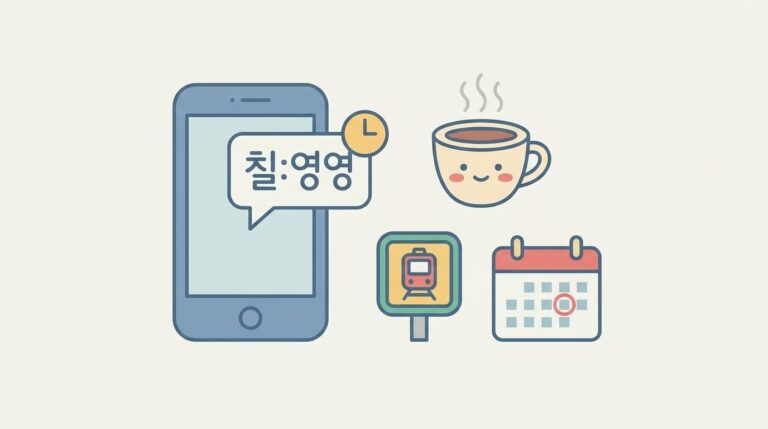
Greeting & The K-Drama Cold Open
Hello! I’m the lead editor at Daily Hangul.
Picture this: You are watching your favorite K-Drama. The main leads have been dancing around their feelings for 10 episodes. Finally, the male lead pulls out his phone and sends a text. The subtitles just say, “Let’s meet later!” Your heart flutters. But wait… what exactly did he type? How did they know when and where to meet?
Or maybe this is you right now: You made a new Korean friend, and you want to grab some delicious Korean BBQ tonight. You have your KakaoTalk app open, but you are staring at the blinking cursor, totally freezing up because you don’t know how to ask, “What time should we meet?”
Don’t worry! This post is built from the real tears and triumphs of my beginner (A1) students who used to mix up 7 AM and 7 PM and missed out on great meals. Today, we are going to learn how to set a time to meet like a true local, avoiding the robotic textbook phrases. Let’s dive in!
Core Expressions Deep Dive
Here are the top 3 expressions you need to lock down a time for that Chimaek (Chicken and Beer) date!
1. 몇 시에 만날까요? (What time shall we meet?)
- Pronunciation: [Myeot si-e mannal-kkayo?]
- Myeot sounds like “myut” (rhymes with ‘put’).
- si sounds like “shee”.
- Meaning: What time should we meet? (Literal: At what time shall we meet?)
- K-Culture Moment: This is the ultimate “green light” text message in Korea. If someone asks you this, it means they are genuinely excited to make plans with you. It’s not just polite empty talk!
- Editor’s Insight: Notice the “-kkayo?” ending. It sounds bouncy and soft. In Korean, we rarely say “Tell me a time!” We prefer to gently suggest, “What time shall we… do this together?” It feels much more considerate.
- Situation Spectrum:
[🚫 Do Not Use] ———— [⚠️ Caution] ———— [✅ Freely]
- Friends (Casual): ✅ (You can drop the ‘yo’ and just say “몇 시에 만날까?”)
- Co-workers (Semi-formal): ✅
- Boss/Elders (Formal): ⚠️ (Better to use a more formal structure like “언제가 편하신가요?”)
- 🤔 Think About It: Why does Korean rely so much on soft questions (shall we?) rather than direct statements? How do you ask someone out in your native language?
2. 7시에 만나요. (Let’s meet at 7 o’clock.)
- Pronunciation: [Ilgop si-e mannayo.]
- Ilgop sounds like “eel-gop”.
- Meaning: Let’s meet at 7.
- K-Culture Moment: The magic hour in Seoul! 7 PM is when most office workers finish their commute, leading to the golden hour of Hoesik (company dinners) or friendly hangouts.
- Editor’s Insight: Warning! A1 Trap! For hours (o’clock), Koreans use Native Korean numbers (Hana, Dul, Set…). So, 7 is Ilgop, not Chil. Think of native numbers as the “heartbeat” of daily life—used for counting things and hours!
- Situation Spectrum:
[🚫 Do Not Use] ———— [⚠️ Caution] ———— [✅ Freely]
- Friends (Casual): ✅
- Co-workers (Semi-formal): ✅
- Boss/Elders (Formal): ⚠️
- 🤔 Think About It: Korean has two number systems. It seems complicated, right? But think about English: we say “first” instead of “one-th”. Languages always have quirky historical layers!
3. 시간 괜찮아요? (Are you free? / Is the time okay?)
- Pronunciation: [Sigan gwaenchanayo?]
- Sigan = shee-gahn (time)
- gwaenchanayo = gwen-cha-na-yo (okay)
- Meaning: Are you free? / Is that time okay with you?
- K-Culture Moment: Before confirming the 7 PM plan, a Korean will almost always ask this. It’s a reflection of Nunchi (reading the room)—making sure you aren’t pressuring the other person.
- Editor’s Insight: Memorize the word gwaenchanayo. It’s a magical survival word. Are you okay? Is the food okay? Is the time okay? You can use it for everything!
- Situation Spectrum:
[🚫 Do Not Use] ———— [⚠️ Caution] ———— [✅ Freely]
- Friends (Casual): ✅
- Co-workers (Semi-formal): ✅
- Boss/Elders (Formal): ⚠️ (Use “시간 괜찮으세요?” instead).
Textbook vs. Real Korean
Let’s see how native speakers actually text on KakaoTalk compared to textbook examples.
| Situation | 📖 Textbook Korean | 🗣️ Real Korean (KakaoTalk style) | 💡 Why the difference? |
|---|---|---|---|
| Asking the time | 약속 시간이 언제입니까? (When is the appointment time?) | 언제 볼까요? (When shall we see each other?) | Textbooks sound like a police interrogation. Natives use “볼까요” (shall we see) for casual plans. |
| Suggesting 7 PM | 저는 7시가 좋습니다. (7 o’clock is good for me.) | 7시 어때요? (How about 7?) | “어때요?” (How about) is the most natural way to suggest something without being bossy. |
| Agreeing | 네, 알겠습니다. (Yes, I understand.) | 좋아요! 7시에 봐요~ (Good! See you at 7~) | Adding a tilde (~) shows warmth and excitement over text! |
Bottom Note for A1 Learners: You don’t need to learn heavy slang yet. Just swapping “언제입니까?” (formal) to “언제 볼까요?” (polite/casual) instantly makes you sound like you’ve lived in Seoul for months!
Cultural Context — K-Culture Deep Dive
4-1. The Art of “Korean Time”
When making plans, you might wonder if Koreans are punctual. The answer is YES! Especially for dates or 1-on-1 meetings, arriving 5 minutes early is standard.
Non-verbal tip: If you are running late, send a quick text before the meeting time. Do not just show up late and apologize. A quick “미안해요, 5분 늦어요” (Sorry, I’ll be 5 mins late) saves the day.
4-2. The “Exit 9” Phenomenon (K-Travel Connection)
If you watch K-Vlogs or travel to Seoul, you will quickly learn that Koreans don’t just set a time; they set highly specific meeting spots. The most famous one? Hongdae Station Exit 9 (홍대입구역 9번 출구).
If someone says “Let’s meet at 7,” the automatic next question is “Where?” Subway exits are the ultimate rendezvous points because they are easy to find.
Critical view: Why subway exits? Seoul is incredibly dense, and GPS can get confusing in narrow alleys. Subway exits are universally recognized landmarks. But be warned: Friday at 7 PM at Hongdae Exit 9 is a sea of people! You might have to text, “I’m wearing a red jacket!”
Real-Life Roleplay: Friday Night at Hongdae
Setting: It’s Friday afternoon. You are sitting in a cozy Seoul cafe, texting your Korean friend, Minji. She wants to introduce you to authentic Chimaek (Fried Chicken and Beer) tonight.
Characters:
– YOU: A beginner Korean learner, excited but slightly nervous about texting in Korean.
– Minji: Your cheerful Korean friend who loves good food.
The KakaoTalk Chat:
Minji: 오늘 치맥 어때요? 🍗🍻
(oneul chimaek eottaeyo?)
[How about chicken and beer today?]
YOU: 좋아요! 몇 시에 만날까요?
(joayo! myeot si-e mannal-kkayo?)
[Sounds good! What time shall we meet?]
Minji: 음… 7시 어때요?
(eum… ilgop si eottaeyo?)
[Hmm… how about 7?]
🔀 YOUR TURN! How do you reply?
– A) “7시에 만나요!” (Let’s meet at 7!)
– B) “시간이 언제입니까?” (What is the time?)
– C) “7시 안 괜찮아요.”✅ Best Choice: A — It’s the most natural and enthusiastic way to confirm!
⚠️ Choice B Analysis: This sounds like a robot asking for the current time. Minji already suggested 7!
(Continuing with Choice A)
YOU: 7시에 만나요! 어디서 볼까요?
(ilgop si-e mannayo! eodiseo bol-kkayo?)
[Let’s meet at 7! Where shall we see each other?]
Minji: 홍대입구역 9번 출구에서 봐요!
(hongdae-ipgu-yeok gubeon chulgu-eseo bwayo!)
[Let’s see each other at Hongdae Station Exit 9!]
YOU: 네! 이따 봐요~
(ne! itta bwayo~)
[Okay! See you later~]
10-Second Shadowing Drill
Time to practice out loud! Pay attention to the pauses / and the emotion.
😊 밝게 (Brightly):
일곱 시에 / 홍대입구역에서 / 만나요!
(ilgop si-e / hongdae-ipgu-yeogeseo / mannayo!)
“Let’s meet at 7 at Hongdae Station!”
K-Culture Mini Dictionary
| 한국어 (Korean) | Romanization | English | Cultural Context |
|---|---|---|---|
| 약속 | yaksok | Promise / Plans | Literal meaning is “promise,” but Koreans use it for any casual hangout plans. “I have a yaksok” = “I have plans.” |
| 이따 봐요 | itta bwayo | See you later | Used when you are going to see someone later on the same day. |
| 불금 | bulgeum | Fire Friday | A slang term combining “Fire” and “Friday.” Equivalent to TGIF! The ultimate day for 7 PM meetings. |
| 톡 | tok | KakaoTalk message | Instead of saying “I will text you,” Koreans say “I will Tok you.” |
Traveler Survival Kit 🧳
If you are traveling in Korea, setting times and locations is your daily mission. Here are the top 3 survival phrases you need when coordinating your schedule!
🆘 Survival Phrase #1: 지금 몇 시예요?
– 🇰🇷 jigeum myeot siyeyo?
– 🗣️ Sound-alike: jee-geum myut shee-ye-yo?
– 📍 Where to use: Asking a stranger or friend for the current time.🆘 Survival Phrase #2: 여기서 얼마나 걸려요?
– 🇰🇷 yeogiseo eolmana geollyeoyo?
– 🗣️ Sound-alike: yuh-gee-suh ul-ma-na gul-lyuh-yo?
– 📍 Where to use: Asking a taxi driver or hotel staff how long it takes to get to your meeting spot.🆘 Survival Phrase #3: 5분 늦어요!
– 🇰🇷 obun neujeoyo!
– 🗣️ Sound-alike: oh-boon neu-juh-yo!
– 📍 Where to use: Texting your friend when your subway is delayed.📌 Editor’s Travel Note
– Useful Apps: Google Maps doesn’t work well for walking/driving in Korea. Download Naver Map or KakaoMetro to calculate exact travel times so you are never late for your yaksok!
Critical Thinking Corner — “One Step Deeper”
🧠 Think Deeper: Language & Power — The Weight of ‘Yaksok’
In English, a “promise” is a heavy, serious word used for vows or secrets. But in Korea, getting coffee with a friend is called a Yaksok (약속, promise). Why? Historically, Korean society is deeply rooted in community and collective relationships. Time spent with others isn’t just a casual occurrence; it’s a commitment to maintaining social harmony. Breaking a yaksok without a good reason is considered very rude. It shows how the Korean language elevates everyday human connections into something meaningful.
💬 Your Turn: Does your culture treat casual hangouts as serious “promises,” or is it more relaxed? Let us know in the comments!
FAQ & Mistake Prevention
Q: “Can I just say ‘7 (칠, chil)’ instead of ‘일곱 (ilgop)’?”
No! This is the most common A1 mistake. If you say “칠 시” (Chil-si), Koreans will understand you, but it sounds very unnatural. Always use native numbers (하나, 둘, 셋… 일곱) for the hour!
Q: “Do I need to say AM or PM?”
Usually, context is enough. If you say “Let’s drink beer at 7,” no one thinks you mean 7 AM. But if you must specify, put the AM/PM before the time: 오전 (ojeon – AM) 7시, 오후 (ohu – PM) 7시.
❌ Common Mistake: Saying “만나요” (mannayo) to your boss or professor to schedule a meeting.
✅ Do This Instead: “만나요” is friendly. For a boss, politely ask “언제 시간이 괜찮으신가요?” (When is a good time for you?).
Summary & Action Items
One-Liner Summary: Use “몇 시에 만날까요?” (What time shall we meet?) and remember your Native Korean numbers for the hour!
Action Mission:
– 🥉 Bronze (Solo): Stand in front of a mirror and ask yourself, “몇 시에 만날까요?” 3 times with a friendly smile.
– 🥈 Silver (Online): Go to a Korean learning forum or discord and ask someone, “몇 시에 공부할까요?” (What time shall we study?).
– 🥇 Gold (Real-world): Text a Korean speaking friend to set up a coffee date using only Korean time expressions!
🇰🇷 K-Culture Mission:
The next time you watch a K-Drama and they show a close-up of a smartphone screen on KakaoTalk, hit pause! Try to spot the number next to “시” (hour) to see what time they are meeting.
Did you enjoy today’s lesson? Where is your dream “Exit 9” meeting spot in Korea? Tell me in the comments below! 👇
Quiz — Interactive Challenge
1. Situational Judgment:
You want to gently suggest meeting at 6 PM to a friend. Which is the best text to send?
A) 6시입니다. (It is 6 o’clock.)
B) 6시 어때요? (How about 6?)
C) 약속 시간이 언제입니까? (When is the appointment?)
2. Fill in the Blank:
“____ 시에 만날까요?” (What time shall we meet?)
A) 어디 (Where)
B) 몇 (How many/What)
C) 왜 (Why)
3. True or False – K-Culture Edition:
“Hongdae Exit 9 is a quiet, secret spot perfect for a peaceful meeting.”
👉 Click to see the answers!
- B – “어때요?” is the perfect, natural way to suggest a time.
- B – “몇 시” means “what time” (literally “how many hours”).
- False! – It is one of the busiest, most chaotic meeting spots in Seoul! Expect crowds, buskers, and lots of people waiting for their “yaksok.”
Frequently Asked Questions (FAQ)
Q: What does "몇 시에 만날까요? (What time shall we meet?)" mean in Korean and how do you pronounce it?
A: In Korean, "몇 시에 만날까요? (What time shall we meet?)" is pronounced [Myeot si-e mannal-kkayo?] and means: a key conversational Korean expression covered in this lesson.
Q: What does "7시에 만나요. (Let's meet at 7 o'clock.)" mean in Korean and how do you pronounce it?
A: In Korean, "7시에 만나요. (Let's meet at 7 o'clock.)" is pronounced [Ilgop si-e mannayo.] and means: a key conversational Korean expression covered in this lesson.
Q: What does "시간 괜찮아요? (Are you free? / Is the time okay?)" mean in Korean and how do you pronounce it?
A: In Korean, "시간 괜찮아요? (Are you free? / Is the time okay?)" is pronounced [Sigan gwaenchanayo?] and means: a key conversational Korean expression covered in this lesson.







